From Surf Wiki (app.surf) — the open knowledge base
Portsmouth Harbour
Natural harbour in Hampshire, England

Natural harbour in Hampshire, England
| Field | Value |
|---|---|
| image | Portsmouth harbour England - panoramio.jpg |
| name | Portsmouth Harbour |
| aos | Hampshire |
| interest | Biological |
| gridref | |
| area | 1264.2 ha |
| notifydate | 1992 |
| map | *Magic Map* |
Portsmouth Harbour is a 1264.2 ha/12.6 sqkm biological Site of Special Scientific Interest between Portsmouth and Gosport in Hampshire. It is a Ramsar site and a Special Protection Area.
_-_Portsmouth_Harbour_-_RCIN_404789_-_Royal_Collection.jpg)
It is a large natural harbour in Hampshire, England. Geographically it is a ria: formerly it was the valley of a stream flowing from Portsdown into the Solent. At its north end is Portchester Castle, of Roman origin and the first fortress built to protect the harbour.

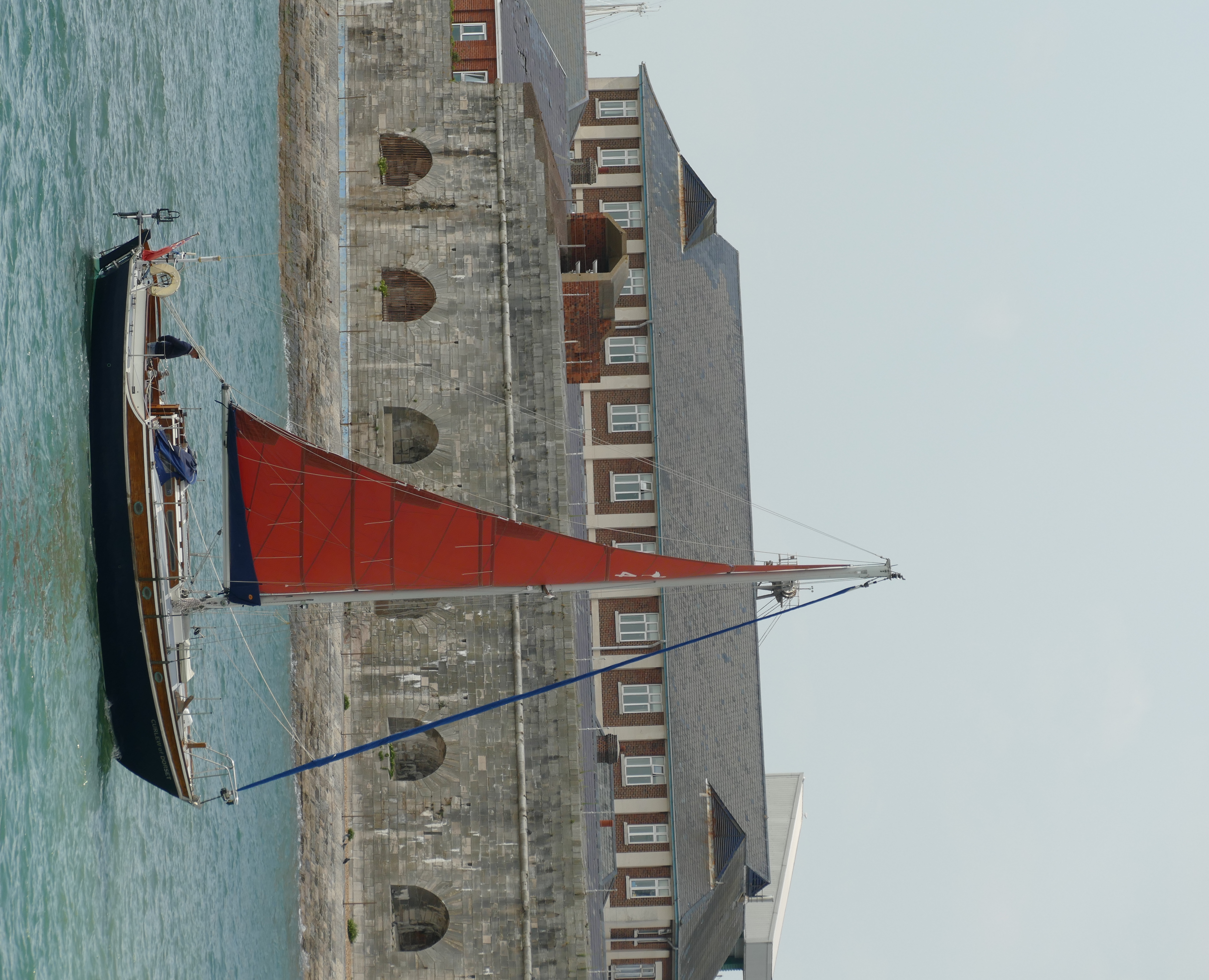
In modern times, the harbour has become a major commercial ferry port, with regular services to Bilbao, Santander, Caen, Cherbourg, St Malo, Le Havre, The Channel Islands and the Isle of Wight. There is also a passenger ferry to Gosport. The international ferry port also saw a cruise terminal expansion in 2012 and sees regular cruise ship operations. It is also a major area for leisure sailing. In 2001 the Gunwharf Quays development, was opened on the site of HMS Vernon (a former naval shore establishment).
Islands
Portsmouth Harbour contains a number of islands. Whale Island is the home of the training establishment . Horsea Island is now connected to the mainland due to land reclamation. It is also part of HMS Excellent. Pewit Island is a small island located in the north western section of Portsmouth Harbour. Closer to the harbour entrance on the Gosport side is Burrow Island, also known as Rat Island.
Camber Dock

Main article: Portsmouth Point
Launch
Portsmouth investigated three locations for a ferry port at the end of the 1960s and the current location was chosen. The choice was based on cost and the likely benefit of cross-channel ferries. The site was at the end of the newly constructed M275. Originally built with two berths the site opened in 1976 with the Earl William (Sealink) running to the Channel Islands, the Viking Victory (Townsend Thoresen) running to Cherbourg and the Brittany Ferries running to Saint-Malo.
Expansion
All three operators increased their usage of the port during the mid-eighties, which led to expansion. An additional two berths were built, both twin tier. Berth 2 was filled and a new Berth 2 built, which was mainly used by the Earl Granville (Sealink) running to both the Channel Islands and Cherbourg, Berth 1 become more tight to use and the newly roll-on, roll-off Commodore Shipping used it for their Channel Island freight services. Berth 3 was left incomplete while Berth 4 was finished. This was generally considered the Brittany Ferries berth. When Berth 3 was finished Townsend Thoresen moved their passenger operation entirely from Southampton to Portsmouth. Shortly afterwards, Townsend Thoresen bought P&O (Normandy Ferries) and relocated them to Portsmouth. The old Southampton Ferry port was then converted to a marina.
The continued use of Portsmouth saw the creation of Berth 5 and the final stage of development. Portsmouth had seen additional ferry companies Channel Island Ferries, Hoverspeed and Truckline and new routes to Caen, Santander and Bilbao. With the advent of the Channel Tunnel and the abolition of Duty Free most of the companies disappeared. Sealink merged their Channel Island operations with the newly created Channel Island Ferries to create British Channel Island Ferries. They then later relocated operations to Poole before merging into Condor Ferries. Sealink operated to Cherbourg with the Earl Granville for several further years until the Earl Granville violently ran aground off Cherbourg. Hoverspeed ran the HOVERSPEED GB from Portsmouth to Cherbourg intermittently one summer – often the "new ferry of the future" was out of action and the now repaired but ageing Earl Granville would step into the breach – much to passenger annoyance.
Decline
By 2000 Portsmouth only had ferries from Brittany Ferries, Condor and P&O. P&O replaced the ageing Super Vikings with a Ro-pax ship and a Sea-Cat on the Portsmouth-Cherbourg route, but by 2006 P&O had all but closed its operation from Portsmouth but retained the route to Bilbao and Portsmouth became a quiet port again.
After P&O Ferries withdrawal from the Le Havre route in September 2005 a new company stepped in to replace them with LD Lines running one sailing a day to Le Havre with the Norman Spirit.
The Spanish ferry company Acciona tried briefly in 2006 to compete on the northern Spain route to Bilbao using their ferry the Fortuny, but it lasted 3 months before closure.
Today
Today, Brittany Ferries operates a three times daily service to Caen, daily to St Malo, daily to Le Havre and offers a high-speed seasonal service to Cherbourg, which runs daily; on Friday, Saturday & Sunday it runs twice daily. Brittany Ferries also has up to six sailings a week to Spain with two departures to Bilbao and four to Santander.
Condor Ferries have two sailings a day to the Channel Islands with a morning sailing to the Islands with the passenger and freight ferry Commodore Clipper and an evening sailing to the islands with the freight-only ferry Commodore Goodwill.
The sole remaining P&O service to Bilbao ceased in September 2010 but has since been replaced by Brittany Ferries as of April 2011 with two sailings a week using their modern and fast ferry Cap Finistere which can make the trip from Portsmouth to Bilbao in 24 hours with a top cruising speed of 27 knots.
On 10 May 2011 the New Terminal building at the newly renamed Portsmouth International Port was opened by Vince Cable MP.
As well as the regular ferry sailings there were 45 cruise ships that called at the port during 2018 with several of them being turnaround calls. Regular calls are undertaken by CMV Cruises, Crystal Cruises, Hapag Lloyd, Phoenix Reisen, Saga Cruises, Viking Ocean Cruises, Windstar Cruises.
The harbour was dredged in 2016 in preparation for the arrival of and , the Navy's first supercarriers, with regular maintenance dredging taking place at various times of the year.

Site of Special Scientific Interest
Most of the harbour is composed of intertidal mudflats and cordgrass marshes, and they have abundant benthic fauna which provide food for birds. It is of national importance for dark-bellied Brent geese and for three species of waders, grey plover, black-tailed godwit and dunlin.
Proposed tunnel

A tunnel crossing the mouth of the harbour between Gosport and Portsmouth was proposed in 1941, which would have allowed pedestrian traffic while doubling as a subterranean air raid shelter for residents on both sides. This proposal came during the Blitz, which saw Portsmouth and Gosport bombed heavily. The proposal, termed the "Kearney Tube" after the Australian engineer conducting the initial study, evolved into a proposal for rail link tunnel in 1942, but the project was never constructed.
In 1999, a study was undertaken by the Light Rail Transit Association in regard to a proposed tunnel crossing to alleviate traffic congestion in the area, particularly Gosport. Of three construction methods examined, an immersed tube was deemed to be the most effective, as it would not necessitate closing the harbour for over a year, but rather a series of shorter closures of around 24 hours for the addition of each segment of the tunnel. The tunnel would be approximately 1 km in length, though only around 670m of this would be underwater. The tunnel would have been part of a light rail network connecting Fareham, Gosport and Portsmouth. The South Hampshire Rapid Transit Order 2001 provided authorisation for the project, with construction intended for 2002, but financial problems delayed this. The Department for Transport ultimately declined to fund the initiative in 2005.
References
References
- "Designated Sites View: Portsmouth Harbour". Natural England.
- "Map of Portsmouth Harbour". Natural England.
- "Designated Sites View: Portsmouth Harbour". Natural England.
- "Designated Sites View: Portsmouth Harbour". Natural England.
- Sumption, Jonathan. (1999). "The Hundred Years War: Trial by Battle". University of Pennsylvania Press.
- Webb, John. (1977). "The Siege of Portsmouth in the Civil War". Portsmouth City Council.
- Department of Geography at the University of Portsmouth & The Hampshire and Wight Trust for Maritime Archaeology. "Pewit Island". University of Portsmouth, Department of Geography.
- Department of Geography at the University of Portsmouth & The Hampshire and Wight Trust for Maritime Archaeology. "Burrow Island". University of Portsmouth, Department of Geography.
- Patterson, B.H.. (1985). "A Military Heritage A history of Portsmouth and Portsea Town Fortifications". Fort Cumberland & Portsmouth Militaria Society.
- (1997). "The Spirit of Portsmouth: A history". Phillimore & Co.
- "Camber Dock & Quay". Portsmouth International Port.
- (13 February 2012). "Drilling rig starts Portsmouth aircraft carriers work". BBC News.
- "Portsmouth Harbour citation". Natural England.
- "Kearney Tube".
- Meeuwissen, P.. (25 May 1999). "PORTSMOUTH HARBOUR TUNNEL". Tramways & Urban Transit.
- "South Hants LRT".
- "The South Hampshire Rapid Transit Order 2001".
- "Hampshire County Council with Portsmouth City Council – Railway Technology".
This article was imported from Wikipedia and is available under the Creative Commons Attribution-ShareAlike 4.0 License. Content has been adapted to SurfDoc format. Original contributors can be found on the article history page.
Ask Mako anything about Portsmouth Harbour — get instant answers, deeper analysis, and related topics.
Research with MakoFree with your Surf account
Create a free account to save articles, ask Mako questions, and organize your research.
Sign up freeThis content may have been generated or modified by AI. CloudSurf Software LLC is not responsible for the accuracy, completeness, or reliability of AI-generated content. Always verify important information from primary sources.
Report