From Surf Wiki (app.surf) — the open knowledge base
Portable computer
Lightweight, compact computer with built-in peripherals

Lightweight, compact computer with built-in peripherals


A portable computer is a computer designed to be easily moved from one place to another, as opposed to those designed to remain stationary at a single location such as desktops and workstations. These computers usually include a display and keyboard that are directly connected to the main case, all sharing a single power plug together, much like later desktop computers called all-in-ones (AIO) that integrate the system's internal components into the same case as the display. In modern usage, a portable computer usually refers to a very light and compact personal computer such as a laptop, subnotebook or handheld PC, while touchscreen-based handheld ("palmtop") devices such as tablets, phablets and smartphones are called mobile devices instead.
The first commercially sold portable computer might be the 20 lb MCM/70, released 1974. The next major portables were the 50 lb IBM 5100 (1975), Osborne's 24 lb CP/M-based Osborne 1 (1981) and Compaq's 28 lb, advertised as 100% IBM PC compatible Compaq Portable (1983). These luggable computers still required a continuous connection to an external power source;{{cite web
Portable computers, more narrowly defined, are distinct from desktop replacement computers in that they usually were constructed from full-specification desktop components, and often do not incorporate features associated with laptops or mobile devices. A portable computer in this usage, versus a laptop or other mobile computing device, have a standard motherboard or backplane providing plug-in slots for add-in cards. This allows mission specific cards such as test, A/D, or communication protocol (IEEE-488, 1553) to be installed. Portable computers also provide for more disk storage by using standard disk drives and provide for multiple drives.
Early history
SCAMP
In 1973, the IBM Los Gatos Scientific Center developed a portable computer prototype called SCAMP (Special Computer APL Machine Portable) based on the IBM PALM processor with a Philips compact cassette drive, small CRT and full function keyboard. SCAMP emulated an IBM 1130 minicomputer in order to run APL\1130. In 1973, APL was generally available only on mainframe computers, and most desktop sized microcomputers such as the Wang 2200 or HP 9800 offered only BASIC. Because SCAMP was the first to emulate APL\1130 performance on a portable, single user computer, PC Magazine in 1983 designated SCAMP a "revolutionary concept" and "the world's first personal computer". The engineering prototype is in the Smithsonian Institution.
Xerox NoteTaker
Xerox NoteTaker, developed in 1976 at Xerox PARC, was a precursor to later portable computers from Osborne Computer Corporation and Compaq, though it remained a prototype and did not enter production.
IBM 5100
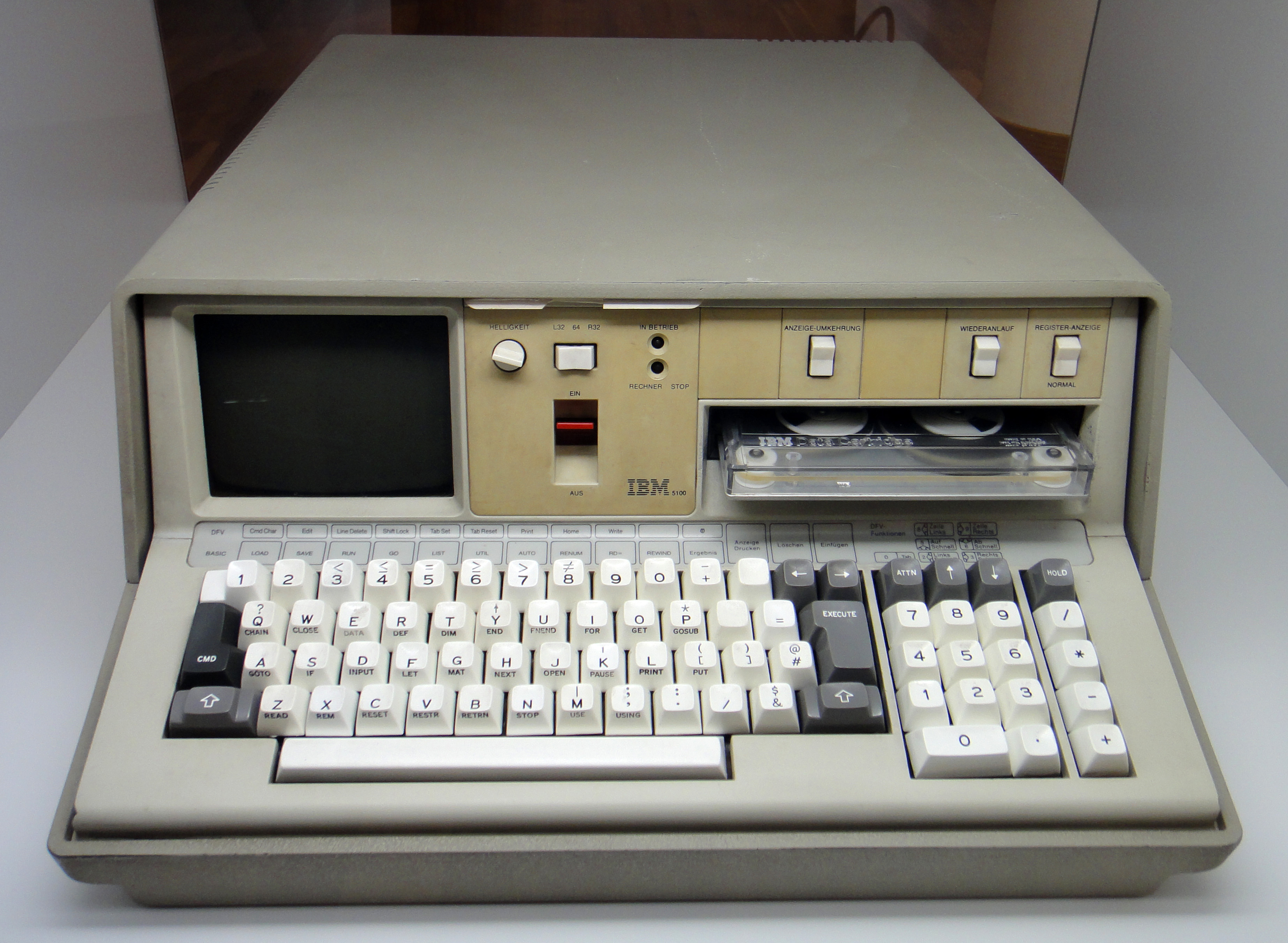
Successful demonstrations of the 1973 SCAMP prototype led to the first commercial IBM 5100 portable microcomputer launched in 1975. The product incorporated an IBM PALM processor, 5 in CRT, full function keyboard and the ability to be programmed in both APL and BASIC for engineers, analysts, statisticians and other business problem-solvers. (IBM provided different models of the 5100 supporting only BASIC, only APL, or both selectable by a physical switch on the front panel.) IBM referred to its PALM processor as a microprocessor, though they used that term to mean a processor that executes microcode to implement a higher-level instruction set, rather than its conventional definition of a complete processor on a single silicon integrated circuit; the PALM processor was a large circuit board populated with over a dozen chips. In the late 1960s, such a machine would have been nearly as large as two desks and would have weighed about half a ton (0.5 ST). In comparison, the IBM 5100 weighed about 53 pounds (24 kg and very portable for that time).
MIT Suitcase Computer
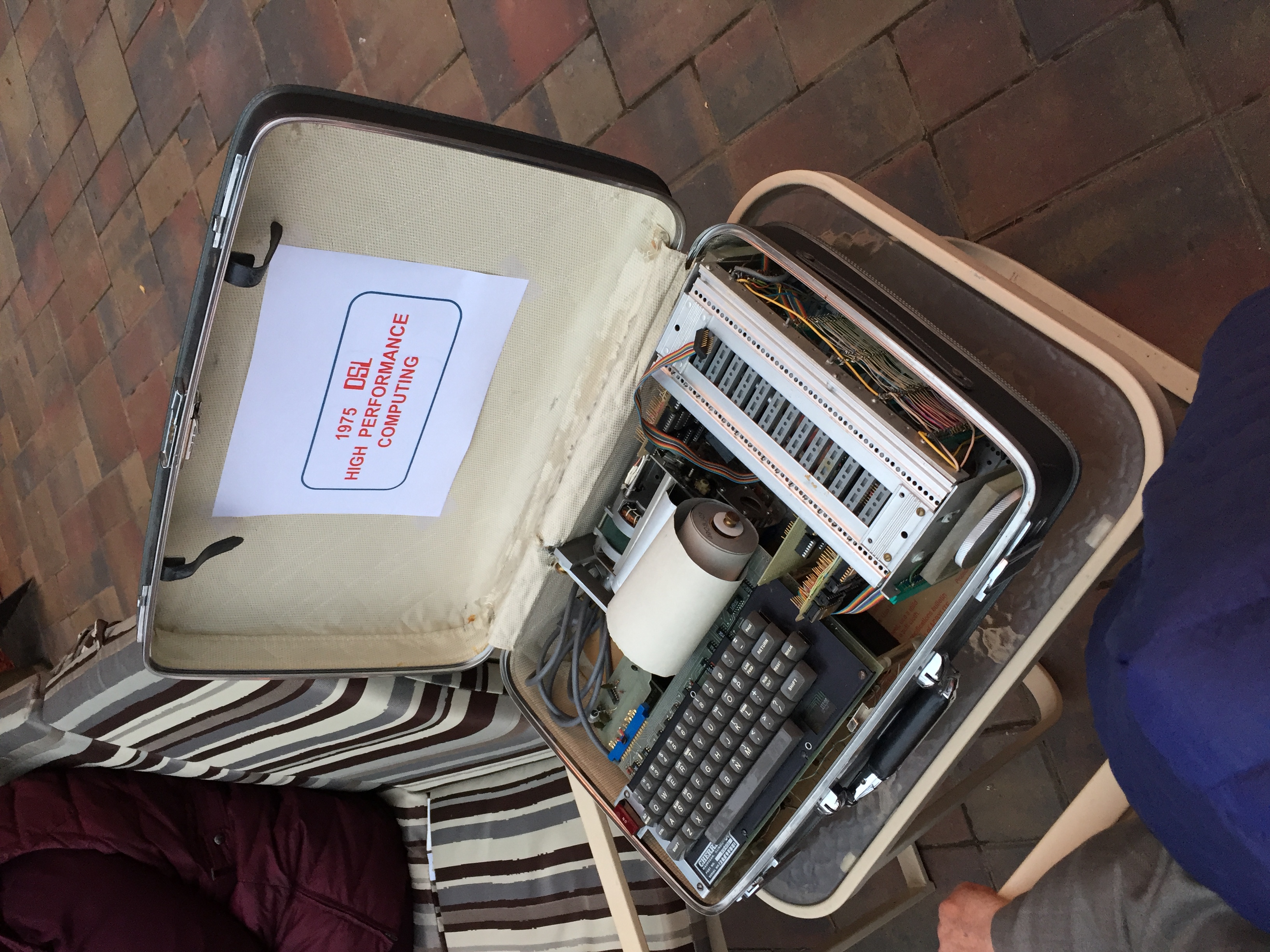
The MIT Suitcase Computer, constructed in 1975, was the first known microprocessor-based portable computer. It was based on the Motorola 6800. Constructed in a Samsonite suitcase approximately 20x30x8 in and weighing approximately 20 lb, it had 4K of SRAM, a serial port to accept downloaded software and connect to a modem, a keyboard and a 40-column thermal printer taken from a cash register. Built by student David Emberson in the MIT Digital Systems Laboratory as a thesis project, it never entered production. It is currently in the collection of Dr. Hoo-Min D. Toong.
Micro Star or Small One
An early portable computer was manufactured in 1979 by GM Research, a small company in Santa Monica, California. The machine which was designed and patented by James Murez. It was called the Micro Star and later the name was changed to The Small One. Although Xerox claims to have designed the first such system, the machine by Murez predated anything on the market or that had been documented in any publication at the time hence the patent was issued. As early as 1979, the U.S. Government was contracting to purchase these machines. Other major customers included Sandia Labs, General Dynamics, BBN (featured on the cover of their annual report in 1980 as the C.A.T. system) and several dozen private individuals and companies around the world. In 1979, Adam Osborne viewed the machine along with several hundred other visitors at the first computer show that was sponsored by the IEEE Westec in Los Angeles. Later that year the machine was also shown at the first COMDEX show.
Portal R2E CCMC

The portable micro computer; the "Portal" of the French company R2E Micral CCMC officially appeared in September 1980 at the Sicob show in Paris. The Portal was a portable microcomputer designed and marketed by the studies and developments department of the French firm R2E Micral in 1980 at the request of the company CCMC specializing in payroll and accounting. The Portal was based on an intel 8085 processor, 8-bit, clocked at 2 MHz. It was equipped with a central 64 KB RAM, a keyboard with 58 alpha numeric keys and 11 numeric keys (separate blocks), a 32-character screen, a floppy disk: capacity = 140 000 characters, of a thermal printer: speed = 28 characters / sec, an asynchronous channel, a synchronous channel, a 220 V power supply. Designed for an operating temperature of 15-35 C, it weighed 12 kg and its dimensions were 45 x. It provided total mobility. Its operating system was Prolog. A few hundred were sold between 1980 and 1983.
Osborne 1

The first mass-produced microprocessor-based portable computer released in 1981 was the Osborne 1, developed by Osborne, which owed much to the NoteTaker's design. The company had early success with the design and went public but later due to small screen sizes and other devices being released found trouble selling the Osborne. The Osborne 1 is about the size and weight of a sewing machine, and was advertised as the only computer that would fit underneath an airline seat.
Kaypro
Another early portable computer released in 1982 was named the Kaypro II, although it was the company's first commercially available product. Some of the press mocked its design—one magazine described Kaypro Corporation as "producing computers packaged in tin cans". Others raved about its value, as the company advertised the Kaypro II as "the computer that sells for ", some noting that the included software bundle had a retail value over by itself, and by mid-1983 the company was selling more than 10,000 units a month, briefly making it the fifth-largest computer maker in the world. It managed to correct most of the Osborne 1's deficiencies: the screen was larger and showed more characters at once, the floppy drives stored over twice as much data, the case was more attractive-looking, and it was also much better-built and more reliable.
Grid Compass

.jpg)
The Grid Compass ran its own operating system, GRiD-OS. Its specialized software and high price (US$8,000–10,000) meant that it was limited to specialized applications. The main buyer was the U.S. government. NASA used it on the Space Shuttle during the early 1980s, as it was powerful, lightweight, and compact. The military Special Forces also purchased the machine, as it could be used by paratroopers in combat.
Post-IBM PC portables
Compaq Portable and competitors
Although Columbia Data Products' MPC 1600, "Multi Personal Computer" came out in the summer of 1982, one of the first extensively IBM PC compatible computers was the Compaq Portable. Eagle Computer then came out with their offering. and Corona Data Systems's PPC-400., the "portable" Hyperion Computer System. Both Eagle Computer and Columbia were sued by IBM for copyright infringement of its BIOS. They settled and were forced to halt production. Neither the Columbia nor the Eagle were nearly as IBM PC DOS compatible as Compaq's offerings.
Commodore SX-64
The first full-color portable computer was the Commodore SX-64 in January 1984.
Atari STacy
Originally announced in 1987, the Atari STacy was released to the public in December 1989 and was one of the first laptop-like portables.
Apple Macintosh Portable
Apple Inc. introduced and released the Macintosh Portable in 1989, though this device came with a battery, which added to its substantial weight. The Portable has features similar to the Atari STacy, include integrated trackball and clamshell case.
IBM PS/2 Portable
After release of IBM PC Convertible in 1986, IBM still produced classic portable computers, include released in 1989 PS/2 P70 (with upgrade in 1990 to P75), and IBM produce portables for up to release of PS/2 Note and PS/55note notebook lines.
Modern portables
Freelance journalist David Kline wrote in 1983 that portable computers like his Osborne 1 had "radically transformed my work [and] begun to radically reshape the entire field of journalism", but predicted that such luggables ("Like Neanderthal man ... a species without a future") would be replaced by laptops. In today's world of laptops, smart phones, and tablets, portable computers have evolved and are now mostly used for industrial, commercial or military applications.
Timeline
| Year | Price | CPU | CPU clock rate (MHz) | Computer name | Comment | ||||||||
|---|---|---|---|---|---|---|---|---|---|---|---|---|---|
| 1954 | Vacuum tube: Diode gates, tube amplifiers and electrical delay lines | 1 | DYSEAC | For the military, movable by truck. | |||||||||
| 1955 | ~ | Custom vacuum tube CPU | 0.01 | Monrobot V | For the military, movable by truck. Used for surveying and mapmaking. | ||||||||
| 1957 | ~ RECOMP II | RECOMP I CP-266 | For the military, movable by two men. | ||||||||||
| 1959 | ~ MOBIDIC A | Custom transistor CPU (inverter logic) | 1 MOBIDIC B | MOBIDIC | Truck-based for the military, five were built and deployed. Sylvania later offered a commercial version as the S 9400. | ||||||||
| 1960 | ~ (development) | Modular circuit boards | 0.448 | FADAC | For the military, movable by two men. | ||||||||
| 1960 | ~ | Standard Modular System with complementary diode-transistor logic | 0.087 | IBM 1401 | Truck-based for military, also touring Datamobile for demos. | ||||||||
| last1=Beck | first1=Robert Mark | date=30 December 1960 | title=PB-250 - A High Speed Serial General Purpose Computer Using Magnetostrictive Delay Line Storage | journal=Managing Requirements Knowledge, International Workshop on (AFIPS) | language=en | pages=284–285, 287 | doi=10.1109/afips.1960.58 | quote=The first production computer was delivered in October 1960.}} | ~ | Plug-in circuit modules | 2 | PB 250 | Portable as the control computer for commercial mobile (by van) data systems. Can operate entirely from a battery. |
| 1961 | ~ | Custom transistor CPU | 1 | BASICPAC | For the military, movable by truck. | ||||||||
| 1962 | ~ | L-2010 | For the military. | ||||||||||
| 1967 | CDC 449 | For the military.Used in translocation backpack system (prototype) and as an onboard computer for Grumman planes | |||||||||||
| 1975 | IBM PALM processor | 1.9 | IBM 5100 Portable Computer | 17975}}. | |||||||||
| 1975 | Motorola 6800 | 1 | MIT Suitcase Computer | 4K SRAM, approx. 20 lbs. Built by David Emberson in the MIT Digital Systems Laboratory as a thesis project. Currently in the collection of Dr. Hoo-Min D. Toong. | |||||||||
| 1976 | Z80? | 1 | Xerox NoteTaker | ||||||||||
| 1977 | Z80 | title=old-computers.com : The Museum | url=https://www.old-computers.com/MUSEUM/computer.asp?c=345&st=1}} 090508 old-computers.com | ||||||||||
| 1978 | IBM PALM processor | 1.9 | title=IBM 5110 computer | url=http://oldcomputers.net/ibm5110.html}} 090508 oldcomputers.net | |||||||||
| 1979 | 6502, 1K | 1 | Rockwell AIM-65 | title=Weird World of Hardware | url=http://www.trygve.com/hardweird.html}} 090508 trygve.com | ||||||||
| 1979 | Custom HP 8-bit | 0.613 | Hewlett-Packard Model 85 | ||||||||||
| 1980 | PA512 | Made in Serbia. | |||||||||||
| 1980 | SC43177, SC43178 | TRS-80 Pocket Computer | |||||||||||
| 1980 | Intel 8085 | 2.0 | Portal R2E CCMC | ||||||||||
| 1981 | Z80 | 4.0 | Osborne 1 | ||||||||||
| 1981 | 2× Hitachi 6301 | 0.614 | title=Epson HX-20 computer | url=http://oldcomputers.net/hx-20.html}} 090508 oldcomputers.net | |||||||||
| 1981 | Z80 compatible | title=OLD-COMPUTERS.COM : The Museum | url=https://www.old-computers.com/museum/computer.asp?c=285}} 090508 old-computers.com | ||||||||||
| 1982 | 8088 | 4.77 | Columbia Data Products | ||||||||||
| 1982 | Z80A | 4 | Grundy NewBrain | ||||||||||
| 1982 | Z80 | 2.5 | Kaypro | ||||||||||
| 1982 | 8086 | Grid Compass 1100 | NASA laptop | ||||||||||
| 1982 | Z80 | 4.0 | Osborne Executive | ||||||||||
| 1983 | x86 | Hyperion (computer) | |||||||||||
| 1983 | x86 | Compaq Portable | |||||||||||
| 1983 | 80C85 | 2.4 | TRS-80 Model 100 | 40 × 8 LCD | |||||||||
| 1983 | Z80A, 8086, 128K | title=MicrocomputerChronology | url=http://is2.lse.ac.uk/History/MicrocomputerChronology.htm | url-status=dead | archive-url=https://archive.today/20121223100718/http://is2.lse.ac.uk/History/MicrocomputerChronology.htm | archive-date=2012-12-23}} 090508 is2.lse.ac.uk | |||||||
| 1983 | Z80A | 3.4 | Sord IS-11 | ||||||||||
| 1983 | Z80A | 4 | Zorba | ||||||||||
| 1984 | 8088 | 4.77 | title=IBM 5155 portable computer | url=http://oldcomputers.net/ibm5155.html}} 090508 oldcomputers.net | |||||||||
| 1984 | Z80 | Actrix (computer) | |||||||||||
| ~1984 | 8088 | 4.77 | Bondwell-8 | ||||||||||
| 1984 | Z80 | 2.45 | title=Epson PX-8 computer | url=http://oldcomputers.net/px-8.html}} 090508 oldcomputers.net | |||||||||
| 1984 | 6502 | 1.02 | Commodore SX-64 | First portable with color display | |||||||||
| 1984 | Harris 80C86 | 4 | Data General-One | First true IBM PC-compatible (mostly) laptop; CGA (640x200) monochrome LCD | |||||||||
| 1984 | Z80 | 4.0 | Osborne Vixen | ||||||||||
| 1984 | 80C88 | ZP-150 | |||||||||||
| 1984 | HP-71B | Calculator programmable in BASIC | |||||||||||
| 1984 | Harris 80C86 | 5.33 | HP 110 | 80 × 16 LCD, 300-baud modem | |||||||||
| 1984 | 8086 | 4.77 | Apricot Portable | First portable computer with 25-line LCD. Included speech recognition, wireless keyboard, and optional wireless mouse | |||||||||
| 1985 | Z80 | 4 | Bondwell-2 | ||||||||||
| 1985 | Harris 80C86 | 5.33 | HP 110 Plus | 80 × 25 LCD, 1200-baud modem | |||||||||
| 1985 | Toshiba T1100 80C88 | 4.77 | Toshiba T1100 | 80 × 25 LCD | |||||||||
| 1986 | 8088 | 4.77 | IBM 5140 | ||||||||||
| 1986 | Intel 80286 | 8 | Compaq Portable II | ||||||||||
| 1986 | LPA512 | ||||||||||||
| 1987 | Z80 | Cambridge Z88 | |||||||||||
| 1988 | Intel 8088 | NEC UltraLite | |||||||||||
| 1988 | 68HC000 | 8 | Atari STacy | ||||||||||
| 1989 | Intel 8088 | 4.9152 | Atari Portfolio | ||||||||||
| 1989 | Intel 80C88 | 7 | Poqet PC (Classic) | ||||||||||
| 1989 | 8086 | 9.55 | Compaq LTE | ||||||||||
| 1989 | Motorola 68000 | 16 | Macintosh Portable | ||||||||||
| 1989 | Motorola 68000 | 15 | Outbound Laptop | ||||||||||
| 1991 | Motorola 68000 | 8 | title=Planet Irata: Atari ST Book Notebook Computer | url=http://www.geocities.com/~irata/stbook.html | archive-url=https://web.archive.org/web/20091026155421/http://geocities.com/~irata/stbook.html | archive-date=2009-10-26}} 090508 geocities.com | |||||||
| 1991 | NEC V20 | 5.37 | HP 95LX | ||||||||||
| 1991 | Motorola 68000 | 16 | Apple PowerBook 100 | ||||||||||
| 1992 | IBM 486SLC | 25 | IBM ThinkPad 700 | The first ThinkPad | |||||||||
| 1992 | Z80, 64K | Amstrad NC100 | |||||||||||
| 1992 | CY601 + CY604 | 25 | SPARCbook1 | Unix with SunOS | |||||||||
| 1993 | Intel "Hornet" 80186 | 7.91 | HP 100LX | ||||||||||
| 1993 | AlphaSmart | ||||||||||||
| 1994 | Intel "Hornet" 80186 | 7.91 | HP 200LX | ||||||||||
| 1995 | Intel 80486DX4 | 75 | IBM ThinkPad Butterfly keyboard | IBM ThinkPad 701c and 701Cs, famous for their "Butterfly Keyboard" which slides into place when opening the lid | |||||||||
| 1996 | Intel Pentium | 133 | Panasonic Toughbook CF-25 | The first Toughbook, an example of a ruggedized laptop | |||||||||
| 1997 | Intel Pentium | 150 | IBM ThinkPad 380 | An average late-1990s notebook | |||||||||
| 2001 | SA-1110 | 206 | SIMpad | ||||||||||
| 2001 | Intel Mobile Pentium III-M | 1200 | Dell Precision M40 | One of the world's first mobile workstation notebooks | |||||||||
| 2002 | Intel Pentium 4 | 2400 | Alienware Area 51-M | An early example of a gaming laptop: high performance desktop components in a notebook | |||||||||
| 2003 | Intel Pentium M | 1700 | IBM ThinkPad R50p | Notable for its ultra high resolution 2048x1536 (QXGA) display option |
References
References
- As contrasted with [[DYSEAC]] and [[MOBIDIC]], 1950s era military systems which were truck-based/"movable by truck".
- (28 January 2015). "How to Buy an All-in-One PC".
- "and plug in instead of relying on battery power."
- Petre, Reza Rawassizadeh, Blaine A Price, Marian. (January 2015). "Wearables: Has the Age of Smartwatches Finally Arrived? {{!}} January 2015 {{!}} Communications of the ACM".
- Freeman, Shanna. (2012-09-19). "HowStuffWorks "What was the first portable computer?"". Computer.howstuffworks.com.
- ''PC Magazine'', Vol. 2, No. 6, November 1983, ‘’SCAMP: The Missing Like in the PC's Past?‘’
- (23 January 2003). "IBM Archives: IBM 5100 Portable Computer". 03.ibm.com.
- "IBM SCAMP, National Museum of American History". Smithsonian Institution.
- This author learned this from an original IBM document for operators of the 5100 but does not recall the title of the document.
- "Daves Old Computers- IBM 5100".
- "Industrial Portable Computers". Advantech.
- "Computer History Museum".
- "Osborne 1". OldComputers.net.
- Fallows, James. (July 1982). "Living With a Computer". Atlantic Magazine.
- Dickinson, John. (July 1986). "Kaypro 2000". PC.
- (January 1984). "The {{US$". BYTE.
- didyouknowwebsite. (2020-06-14). "The Space Age Best Inventions We use Today".
- [https://books.google.com/books?id=14Kfbrc6cbAC&pg=PA451 "Aboard the Columbia"], By Bill Machrone, Page 451, Jun 1983, ''PC Mag''
- "Columbia personal computer - CHM Revolution".
- "Eagle personal computer - CHM Revolution".
- Caruso, Denise. (1984-02-27). "IBM wins disputes over PC copyrights". InfoWorld.
- "Hyperion computer system - CHM Revolution".
- "Atari Stacy 2 - Computer - Computing History".
- ausretrogamer. (2016-04-06). "The Lovely Atari STacy {{!}} AUSRETROGAMER".
- Kline, David. (1983-08-15). "Portables revolutionize free-lance journalism".
- Liu, Zhiye. (2020-08-06). "Take This Portable Threadripper 3990X Workstation Wherever You Go".
- Faulkner, Cameron. (2021-02-08). "This laptop has seven times the average number of screens".
- Shilov, Anton. (2021-02-19). "Seven-Screen Aurora A7 Laptop Costs Up to $20,000".
- "Scs".
- United States.. (1969). "Field Artillery Digital Automatic Computer (FADAC) - TOTAL FADAC COSTS". Hearings Cong. 91 Sess. 1 Appropriations V. 9 1969..
- (7 March 2012). "IBM 1401: The Mainframe".
- "Columbia University Computing History: IBM 1401".
- (7 March 2012). "IBM 1401: Cultural Impacts".
- (30 December 1960). "PB-250 - A High Speed Serial General Purpose Computer Using Magnetostrictive Delay Line Storage". Managing Requirements Knowledge, International Workshop on (AFIPS).
- Weik, Martin H.. (Mar 1961). "PACKARD BELL 250".
- "The PB-250".
- "The RCA Micromodule".
- (Nov 1967). "Across the Editor's Desk: CONTROL DATA 449 COMPUTER". Computers and Automation.
- (Oct 1967). "Control Data 449 Computer Reference Manual".
- "IBM 5100 computer".
- "old-computers.com : The Museum".
- "IBM 5110 computer".
- "Weird World of Hardware".
- "Rockwell AIM-65 computer".
- "Old Computers – rare, vintage, and obsolete computers".
- "Radio Shack TRS-80 Pocket Computer".
- "Epson HX-20 computer".
- "OLD-COMPUTERS.COM : The Museum".
- "World's first laptop. Osborne 1 GRiD Compass 1101.".
- "MicrocomputerChronology".
- "IBM 5155 portable computer".
- "Epson PX-8 computer".
- "Atari STacy computer".
- "Planet Irata: Atari ST Book Notebook Computer".
- "Chips in ATARI-Computern mit TOS-Betriebssystem".
This article was imported from Wikipedia and is available under the Creative Commons Attribution-ShareAlike 4.0 License. Content has been adapted to SurfDoc format. Original contributors can be found on the article history page.
Ask Mako anything about Portable computer — get instant answers, deeper analysis, and related topics.
Research with MakoFree with your Surf account
Create a free account to save articles, ask Mako questions, and organize your research.
Sign up freeThis content may have been generated or modified by AI. CloudSurf Software LLC is not responsible for the accuracy, completeness, or reliability of AI-generated content. Always verify important information from primary sources.
Report