From Surf Wiki (app.surf) — the open knowledge base
Port of Tanjung Priok

| Field | Value | |
|---|---|---|
| name | Port of Tanjung Priok | |
| Pelabuhan Tanjung Priok | ||
| image | Tanjung priok2.jpg | |
| image_size | 200px | |
| image_caption | Aerial view | |
| country | Indonesia | |
| locode | ID TPP | |
| location | Tanjung Priok, North Jakarta | |
| coordinates | ||
| owner | PT Pelabuhan Indonesia | |
| type | Coastal breakwater | |
| sizewater | 604 ha (6.04 sq km) | |
| sizeland | 424 ha (4.24 sq km) | |
| size | 1,028 ha (10.28 sq km) | |
| berths | 76 | |
| <!-- | arrivals | 17,829 vessels (2007) |
| cargotonnage | 41,980,914 tonnes (2007) -- | |
| containervolume | 6.59 million TEU's (2013) | |
| passengertraffic | 438,090 people (2007)-- | |
| website |
Pelabuhan Tanjung Priok
The Port of Tanjung Priok () is the busiest and most advanced seaport in Indonesia, handling more than 50% of Indonesia's trans-shipment cargo traffic. The port is located at Tanjung Priok, North Jakarta, and is operated by Indonesian state-owned PT Pelindo. The port has 20 terminals for accommodating general cargo, liquid bulk, dry bulk, containers, etc. It has specialised facilities catering to oil tankers, chemical-laden ships, metal scrap, and passengers.
The port loaded and unloaded 6.2 million, 6.92 million, and 7.8 million TEUs of cargo during 2016, 2017, and 2018, respectively, out of a total capacity of about 8 million TEUs. Lloyd's One Hundred Ports 2019 ranked the container port as the 22nd busiest in the world.
History
The earliest record of Jakarta as a coastal settlement and port can be traced to the Indianized kingdom of Tarumanagara as early as the fourth century. In AD 39, King Purnawarman established Sunda Pura as the kingdom's new capital city, located on the northern coast of Java. Purnawarman left seven memorial stones with inscriptions bearing his name spread across the area, including the present-day Banten and West Java provinces. The Tugu Inscription is considered the oldest of all of them.
After Tarumanagara's power declined, all of its territories, including Sunda Pura, became part of the Kingdom of Sunda. The harbour area was renamed Sunda Kelapa, as written in a Hindu monk's lontar manuscripts, which are now located at the Bodleian Library of Oxford University in England, and travel records by Prince Bujangga Manik.
By the 14th century, Sunda Kelapa became a major trading port for the kingdom. The first European fleet, four Portuguese ships from Malacca, arrived in 1513 when the Portuguese sought a route for spices, especially black pepper.
A new harbour was needed for the Dutch East Indies to replace the Sunda Kelapa harbour to the west, which was too small for the increased traffic resulting from the opening of the Suez Canal. Construction on the Port of Tanjung Priok began in 1877, along with Tanjung Priuk railway station and other supporting facilities. The construction of the new harbour was started by Governor General Johan Wilhelm van Lansberge (1875-1881). The new harbour was named Tandjong Priok. Several facilities were built to support the function of the new harbour, such as the Tanjung Priuk Station (1914).
The port is part of the Maritime Silk Road, which runs from the Chinese coast via the Suez Canal to the Mediterranean and then to the Upper Adriatic region of Trieste, where there are further rail connections to Central and Eastern Europe.
JICT
A container terminal of the port is known as Jakarta International Container Terminal (JICT). It is operated by Hutchison Port Holdings and Pelindo and is the largest container terminal in Indonesia and the country's national hub port. In April 2011, JICT received an Asian Freight and Supply Chain Award (AFSCA) for the best service quality and technology innovation of terminals with less than 4 million twenty-foot equivalent units of handling capacity.
Port extension (New Priok Terminal)

The port was among the least efficient in all Southeast Asia, with turn-around times 6 times that of Singapore, and severely congested due to slow customs handling, as well as limited port capacity. Regarding the port capacity, the two-phase "New Priok" extension project is ongoing and is expected to be fully operational in 2023. When fully operational, this New Priok Port (also known as Kalibaru Port) will increase the annual capacity of Tanjung Priok more than triple. Annual capacity will increase from five million twenty-foot equivalent units (TEU) of containers to 18 million TEU. The port will also be able to facilitate triple-E class container ships (with an 18,000 TEU capacity) in a 300 m two-way sea lane.
The first phase of the project was completed in 2016, which has helped to improve the port's performance. The dwelling time in the port, which was once seven days, was reduced to almost three days. With eight cranes that can move 30 containers per hour and berths that can dock ships with a draft of as much as 16 m, the new terminal, NPT 1, can accommodate container ships with a capacity of up to 15,000 TEUs. The terminal has a land area of 32 ha, and the dock length is 450 m. A joint venture between state-run port operator Pelindo II and a Japan-Singapore consortium handled the project under PT New Priok Container Terminal 1 (NPCT1).
Description
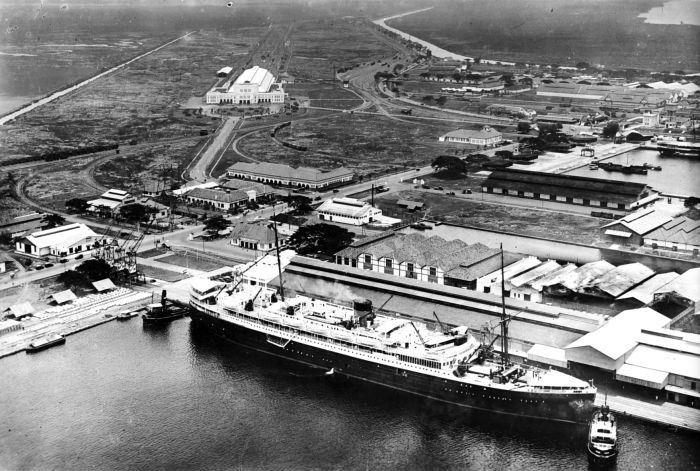
The Port of Tanjung Priok has 20 terminals: general cargo, multipurpose terminal, scraps terminal, passenger terminal, dry bulk terminal, liquid bulk terminal, oil terminal, chemicals terminal and three container terminals. It also has 76 berths, a quay length of 16,853 m, a total storage area of 661,822 m2, and a storage capacity of 401,468 tonnes.
Statistics
In 2007 the Port of Tanjung Priok handled 41,980,914 tonnes of cargo and 3,689,783 TEU's making it the busiest cargo port in Indonesia and the largest container port in the country.
| Year | 2004 | 2005 | 2006 | 2007 |
|---|---|---|---|---|
| Bag cargo* | 1,434,571 | 1,821,689 | 1,159,622 | 1,763,415 |
| Liquid bulk* | 11,034,843 | 9,147,300 | 8,614,492 | 6,333,766 |
| Dry bulk* | 10,177,616 | 9,969,790 | 10,740,499 | 8,200,586 |
| Nr of passengers | 619,995 | 577,021 | 485,644 | 438,090 |
| Containers (TEU's) | 3,248,149 | 3,277,868 | 3,419,541 | 3,689,783 |
| Containers* | 9,391,489 | 11,685,428 | 10,355,703 | 10,491,462 |
| General cargo* | 4,035,195 | 5,532,741 | 7,866,223 | 7,889,879 |
| Vessels (nr) | 16,154 | 17,374 | 16,214 | 17,829 |
| '''Total*'''' | 36,073,714 | 38,154,370 | 38,736,579 | 41,980,914 |
:****** figures in tonnes*
--
Marunda terminal
PT Karya Citra Nusantara (KCN) operates Marunda Port, which was built to reduce the burden of bulk handling at Tanjung Priok port terminals. Pier 1 of this port has been operating since 2018, and another two piers are under construction. Once completed, the port will be able to handle about 30 to 35 million tons of bulk per year from 50 ships. The port will have three piers/docks with a total length of 5,350 m and a supporting area spreading over 100 ha of land.
References
References
- [http://www.priokport.co.id/index.php?mod=statistik&smod=arus_kpl1 Port of Tanjung Priok vessel arrivals]
- [http://www.priokport.co.id/index.php?mod=statistik&smod=arus_brng1 Port of Tanjung Priok cargo volume]
- "Top 50 World Container Ports".
- [http://www.priokport.co.id/index.php?mod=statistik&smod=arus_psgr Port of Tanjung Priok number of passengers]
- "The 13,466-island problem". The Economist.
- "Indonesia inches closer to realizing port hub dream".
- "One Hundred Ports 2019".
- (2005). "Sundakala: cuplikan sejarah Sunda berdasarkan naskah-naskah "Panitia Wangsakerta" Cirebon". Yayasan Pustaka Jaya, Jakarta.
- (2007). "The Sunda Kingdom of West Java From Tarumanagara to Pakuan Pajajaran with the Royal Center of Bogor". Yayasan Cipta Loka Caraka.
- (2007). "Three Old Sundanese Poems". KITLV Press.
- (1999). "Sumber-sumber asli sejarah Jakarta, Jilid I: Dokumen-dokumen sejarah Jakarta sampai dengan akhir abad ke-16". Cipta Loka Caraka.
- Cobban, James L. 1985. "The ephemeral historic district in Jakarta". ''Geographical Review'' 75(3):300-318.
- [https://www.southworld.net/the-maritime-silk-road-in-south-east-asia/ The Maritime Silk Road in South-East Asia.]
- [https://australiaindonesiacentre.org/wp-content/uploads/2019/07/Infrastructure_Investment_in_Indonesia-uffield_Hui_Wilson.pdf Infrastructure Investment in Indonesia]
- [https://port.today/indonesia-plans-transshipment-hub-seeks-investors/ Indonesia plans to become a transshipment hub, seeks investors]
- [https://www.straitstimes.com/asia/se-asia/indonesia-to-propose-projects-worth-us91-bilion-for-chinas-belt-and-road Indonesia to propose projects worth US$91 billion for China's Belt and Road]
- [http://www.worldportsource.com/ports/IDN_Port_of_Jakarta_266.php Port Commerce]
- [http://www.hph.hk/business/ports/asia/jakarta.htm Hutchinson Port Holdings] {{webarchive. link. (7 March 2009)
- "JICT wins Asian container port award".
- "Hopes high for Priok port expansion". The Jakarta Post.
- "Tanjung Priok Port sets dwell time benchmark".
- "Now Indonesia Can Take Large Container Vessels Usually Handled by Singapore".
- "Tanjung Priok Welcomes Larger Ships".
- "Jokowi releases first export with giant ship to US". The Jakarta Post.
- "Port of Tanjung Priok facilities".
- [http://www.priokport.co.id/index.php?mod=statistik&smod=arus_brng1 Port of Tanjung Priok cargo volume]
- [http://www.valenciaport.com/cultures/en-US/AreaProfesional/Consultas/Estadisticas/ Official figures]
- "New Marunda Port can reduce Tanjung Priok's burden by 30%". The Jakarta Post.
- "Marunda Port set to create jobs, boost local economy". The Jakarta Post.
This article was imported from Wikipedia and is available under the Creative Commons Attribution-ShareAlike 4.0 License. Content has been adapted to SurfDoc format. Original contributors can be found on the article history page.
Ask Mako anything about Port of Tanjung Priok — get instant answers, deeper analysis, and related topics.
Research with MakoFree with your Surf account
Create a free account to save articles, ask Mako questions, and organize your research.
Sign up freeThis content may have been generated or modified by AI. CloudSurf Software LLC is not responsible for the accuracy, completeness, or reliability of AI-generated content. Always verify important information from primary sources.
Report