From Surf Wiki (app.surf) — the open knowledge base
Porsche 911 GT2
.jpg)
| Field | Value |
|---|---|
| name | Porsche 911 GT2 |
| image | Porsche 991 GT2 RS (41654760692).jpg |
| caption | Porsche 911 GT2 RS |
| manufacturer | Porsche |
| production | 1993–2019 |
| assembly | Germany: Stuttgart, Baden-Württemberg |
| designer | {{unbulleted list |
| class | Sports car (S) |
| body_style | 2-door coupé |
| related | {{unbulleted list |
| layout | Rear-engine, rear-wheel-drive |
| Pinky Lai | Harm Lagaay | Michael Mauer | Porsche 911 GT3 | Porsche 911 Turbo
The Porsche 911 GT2 is a high-performance, track-focused sports car built by the German automobile manufacturer Porsche from 1993 to 2009, and since 2010 as the GT2 RS. It is based on the 911 Turbo, and uses a similar twin-turbocharged engine, but features numerous upgrades, including engine enhancements, larger brakes, and stiffer suspension calibration. The GT2 is significantly lighter than the Turbo due to its use of rear-wheel-drive instead of an all-wheel-drive system and the reduction or removal of interior components. As a result, the GT2 (now GT2 RS) is the most expensive and fastest model among the 911 lineup.
TOC
{{anchor|993}} 993 generation
The 993 GT2 was initially built in order to meet homologation requirements for GT2 class racing. Because the cars were built to meet the GT2 class regulations, the road cars were named accordingly (but badged as the 911 GT). The 993 GT2 featured widened plastic fenders and a larger rear wing with air scoops in the struts for improved engine cooling. The 993 GT2's original 3.6 L engine generated a maximum power output of 316 kW; in 1998 it was upgraded to 331 kW. 57 road cars were built (thirteen of which were right-hand drive).
Technical specifications
- Configuration: Air-cooled twin-turbocharged 2 valves per cylinder Porsche flat-six engine
- Displacement: 3600 cc
- Bore × stroke: 100 mm × 76.4 mm
- Maximum power: 316-331 kW at 6,000 rpm
- Specific power: 93.25 kW/L
- Maximum torque: 586 Nm at 3,500 rpm (1998 MY)
- Specific torque: 162.7 N.m/L
- Length: 4245 mm
- Width: 1855 mm
- Height: 1270 mm
- Wheelbase: 2272 mm
- Front track: 1475 mm
- Rear track: 1550 mm
- Curb weight: 1295 kg
- Power-to-weight ratio: 259.2 W/kg (6.34 lb/hp)
- Top Speed: 301 km/h
- 0–97 km/h (60 mph): 3.9 seconds
- 0–161 km/h (100 mph): 8.7 seconds
- 1/4 mile (402 m): 12.1 seconds at 117 mph
{{anchor|996}} 996 generation
.jpg)
In 1999, the 993 was replaced with the new 996 model. The new GT2 took two years to develop and during that time, Porsche decided to abandon the GT2 for motorsports use, instead concentrating on competing in Le Mans GT class racing with the new naturally aspirated 911 GT3.
Developed primarily as a road car in contrast to its predecessor, the new GT2 featured a twin-turbocharged version of the GT3's 3.6 L flat-six engine. It generated a maximum output of 340 kW, which was later increased to 355 kW. Like the 993 GT2, the body of the 996 GT2 differed significantly from those of other 996 variants; major differences included wider fenders, a more aggressively shaped nose, and a large rear wing.
According to road testing performed by Car and Driver magazine, the GT2 suffers from hardly any turbo lag. Despite a 10-millimeter reduction in ride height from the 911 Turbo, the drag coefficient is slightly higher — vs. the Turbo's 0.33 — due to the fixed rear wing.
Technical specifications
- Configuration: Water-cooled twin-turbocharged Porsche flat-six engine
- Valvetrain: DOHC 4 valves per cylinder
- Displacement: 3600 cc
- Bore × stroke: 100 mm × 76.4 mm
- Compression ratio: 9.4:1
- Maximum power: 355 kW at 5,700 rpm
- Specific power: 98.31 kW/L
- Maximum torque: 640 Nm at 3,500 rpm
- Specific torque: 177.78 N.m/L
- Length: 4450 mm
- Width: 1830 mm
- Height: 1275 mm
- Wheelbase: 2355 mm
- Front track: 1485 mm
- Rear track: 1520 mm
- Curb weight: 1430 kg
- Drag coefficient: 0.34 \scriptstyle C_\mathrm d,
- Fuel capacity: 89 L
- Power-to-weight ratio: 248.3 W/kg (6.63 lb/hp)
- Top speed: 319 km/h
- 0–100 km/h (62 mph): 4.1 seconds–3.9 seconds
- 0–200 km/h (124 mph): 13.9 seconds–12.2 seconds
- 1/4 mile (402 m): 12.1 seconds
997 generation
| 390 kW (GT2) | 456 kW (GT2 RS)
.jpg)
The 996 GT2 was superseded by the 997 GT2 in 2007 after a brief hiatus, with cars arriving at dealerships in November 2007 after an official launch at the 62nd Frankfurt Motor Show.
The GT2's engine was based on the 3.6 L flat-6 engine as seen on the Turbo, but featured two variable geometry turbochargers. The engine generated a maximum power output of 390 kW at 6,500 rpm and 680 Nm of torque at 2,200 rpm. The GT2 accelerated from 0 to 100 km/h in 3.6 seconds and on to 200 km/h in 10.6 seconds, and had a maximum top speed of 204 mph. This made it the third Porsche production road car to exceed the 322 km/h barrier, with the exception of the 1998 911 GT1 (of which only 20 units were produced for street use, solely to satisfy ACO homologation requirements for racing).
The American automotive magazine Motor Trend tested a 2008 Porsche 911 GT2 and achieved a 0 - acceleration time of 3.4 seconds, and a quarter mile time of 11.4 seconds at 127.9 mi/h. The GT2 also recorded a braking distance from 60 to 0 mph of 98 ft, and 1.10g of lateral grip.
The appearance of the 997 GT2 once again differed from its sister car, the 997 Turbo. It had a revised front lip, a newly designed rear wing with two small air inlets on either side, and a revised rear bumper featuring titanium exhaust pipes and shark fin outlets.
German Porsche test driver Walter Röhrl lapped the Nürburgring Nordschleife on a public day in 7 minutes, 32 seconds in the 997 GT2.
A total of 194 units were sold in the United States and 19 units in Canada.
Technical specifications
Technical specifications of the standard 997 GT2:
- Configuration: Water-cooled twin-turbocharged Porsche flat-six engine
- Displacement: 3,600 cc; 4 valves per cylinder
- Bore × stroke: 100 mm × 76.4 mm
- Compression ratio: 9.4:1
- Maximum power: 390 kW at 6,500 rpm
- Specific power: 109.8 kW/L
- Maximum torque: 685 Nm at 2,200 rpm (continuing to 4,500 rpm due to VTG effects)
- Specific torque: 190.3 N.m/L
- Front brakes: Ventilated carbon ceramic discs with 6-piston monobloc aluminum fixed calipers & ABS
- Rear brakes: Ventilated carbon ceramic discs with 4-piston monobloc aluminum fixed calipers & ABS
- Length: 4469 mm
- Width: 1852 mm
- Height: 1285 mm
- Wheelbase: 2350 mm
- Curb Weight: 1438 kg
- Drag coefficient: 0.32 \scriptstyle C_\mathrm d,
- Fuel tank capacity: 67 L
- Luggage Area Volume: 0.1 m3
- Power-to-weight ratio: 275.0 W/kg (5.98 lb/hp)
- Top Speed: 328 km/h
- 0–100 km/h (62 mph): 3.9 seconds
- 0–200 km/h (124 mph): 9.8 seconds
Tests performed by American automobile magazine
- 0-30 mph (48 km/h): 1.2 seconds
- 0-60 mph (97 km/h): 3.4 seconds
- 0-100 mph (161 km/h): 7.4 seconds
- 0-150 mph (241 km/h): 15.9 seconds
- 0-186 mph (300 km/h): 34.0 seconds
- 1/4 mile (402 m): 11.4 seconds at 205.84 km/h
{{anchor|997RS}} 997 GT2 RS
_(cropped)_(cropped).jpg)
On 4 May 2010, an RS variant was announced to German dealers in Leipzig. The engine in the GT2 RS generated a maximum power output of 456 kW and 700 N·m of torque. The GT2 RS weighs 70 kg less than the GT2, allowing for a top speed of 330 km/h and a 0–60 mph acceleration time of 3.3 seconds.
According to the then Porsche Motorsports manager Andreas Preuninger, the RS was conceived around 2007 as a skunk-works effort. The 727 code number selected for the project corresponds to one of the Nissan GT-R's lap times around the Nürburgring's Nordschleife. When the dust settled, Porsche claimed that test driver Timo Kluck had supposedly eclipsed that target by an impressive nine seconds. Porsche produced only 500 units of the 997 GT2 RS globally.
991 generation
| June 2017–2019 | 1,000 produced


The 991 GT2 RS was initially unveiled at the Xbox 2017 E3 briefing along with the announcement of the Forza Motorsport 7 video game where it was revealed as the cover car as well as being included as a playable vehicle.
The car was officially launched by Porsche at the 2017 Goodwood Festival of Speed along with the introduction of the 911 Turbo S Exclusive Series. The 991 GT2 RS is powered by a 3.8 L twin-turbocharged flat-6 engine that has a maximum power output of 515 kW at 7,000 rpm and 750 Nm of torque, making it the most powerful production 911 variant ever built. Unlike the previous GT2 versions, this car is fitted with a 7-speed PDK transmission to handle the excessive torque produced from the engine. Porsche claims that the car will accelerate from 0 - in 2.7 seconds, and has a top speed of 340 km/h.
The car has a roof made of magnesium, front lid, front and rear wings and boot lid made of carbon-fibre, front and rear apron made of lightweight polyurethane, rear and side windows made of polycarbonate and an exhaust system made of titanium. Porsche claims that the car has a wet weight of 1470 kg.
A Weissach package option is available, which reduces weight by 30 kg, courtesy of the additional use of carbon-fibre and titanium parts. This includes the roof, the anti-roll bars, and the coupling rods on both axles being made out of carbon-fibre, while the roll cage is made from titanium. The package also includes a set of magnesium wheels specially made by BBS. The car was available in the United States from early 2018.
A production run of 1,000 units was planned.
The production run of the GT2 RS was to end by February 2019 but four units were lost in transit to Brazil due to the sinking of the ship Grande America on which the cars were on board in March 2019. Porsche decided to restart production to reproduce the lost cars.
In late September 2017, the 911 GT2 RS driven by Porsche test driver Lars Kern set a 6:47.3 minute lap time around the Nürburgring Nordschleife, averaging a speed of 184.11 km/h. This made it the fastest production car lap time recorded on the track at the time.
In 2018, Warren Luff at the wheel of the GT2 RS (without the Weissach package) set the fastest production lap record at The Bend Motorsport Park with a lap time of 3:24.079 minutes around the 7.77 km GT layout.
On 25 October 2018, a 6:40.33 minute lap time around the Nürburgring Nordschleife was set by Porsche test driver Lars Kern in a 911 GT2 RS MR prepared by Porsche-owned Manthey Racing, surpassing the previous record holder—an unmodified Lamborghini Aventador SVJ—that had deprived the GT2 RS of its record in July 2018.
In 2019 Porsche set further production lap records with the car at various North American circuits: 1:24.88 minutes at Road Atlanta, 2:15.17 minutes at Road America and 1:22.36 minutes at Canadian Tire Motorsport Park.
Technical specifications
Technical specifications of the 2018 991.2 GT2 RS:
- Configuration: Water-cooled twin-turbocharged Porsche flat-six engine
- Displacement: 3,800 cc; 4 valves per cylinder
- Bore × stroke: 102.0 mm × 77.5 mm
- Compression ratio: 9.0:1
- Redline: 7,000 rpm (rev limiter 7,200 rpm)
- Maximum power: 700 PS at 7,000 rpm
- Specific power: 135.5 kW/litre
- Maximum torque: 750 N·m at 2,200-4,500 rpm
- Specific torque: 197.4 N·m/litre
- Transmission: 7-speed PDK
- Front brakes: 410 mm ventilated carbon ceramic discs with 6-piston monobloc aluminum fixed calipers & ABS
- Rear brakes: 390 mm ventilated carbon ceramic discs with 4-piston monobloc aluminum fixed calipers & ABS
- Wheels and Tyres (front): 9.5J × 20 ET50, 265/35 ZR20
- Wheels and Tyres (rear): 12.5J × 21 ET48, 325/30 ZR21
- Length: 4549 mm
- Width: 1880 mm
- Height: 1297 mm
- Wheelbase: 2453 mm
- Front track: 1558 mm
- Rear track: 1557 mm
- Curb Weight: 1470 kg (DIN)
- Power-to-weight ratio: 350.3 W/kg
- Fuel tank capacity: 64 L
- Luggage Area Volume: 115 L
- Drag coefficient: 0.35 \scriptstyle C_\mathrm d,
- Top Speed: 340 km/h
- 0–97 kph: 2.7 seconds
- 0–100 kph: 2.8 seconds
- 0–160 kph: 5.8 seconds
- 0–200 kph: 8.3 seconds
- 0–300 kph: 22.1 seconds
- 80-120 kph: 1.5 seconds
- 100-200 kph: 5.5 seconds
- 1/4 mile (402 m): 10.5 seconds
- Turning radius: 11.1 metre
{{anchor|991RS}} GT2 RS Clubsport
Introduced at the 2018 LA Auto Show, the GT2 RS Clubsport is the track-only variant of the GT2 RS. New aerodynamic elements increase downforce of the car while removal of non essential components decrease weight further. Notable exterior changes include a larger motor sport oriented rear wing made from carbon fibre shared with the GT3 R, larger front air intakes with integrated LED day time running lights, carbon fibre roof with an integrated escape hatch in case of a crash, carbon fibre engine cover and bonnet along with a racing fuel cell and a new race exhaust system.
The interior is race oriented and notable changes include an FIA-approved roll cage, a single racing bucket seat and a race steering wheel made from carbon fibre with an integrated colour display shared with the GT3 R. The car weighs a total of 1390 kg 80 kg less than the GT2 RS road car.
The engine and transmission remain the same as the GT2 RS while new safety features include a PSM stability management system and an ABS system, both of which are manually controlled by rotary dials present on the centre console. The GT2 RS Clubsport comes with 18-inch centre lock forged alloy wheels wrapped in Michelin racing slicks and are shared with the GT3 R race car. Production of the Clubsport is limited to 200 units.
The SRO Motorsports Group announced a one make series featuring the GT2 RS Clubsport which was held in July 2019 at the 24 Hours of Spa Weekend. Previously, the Clubsport made its track debut at the Bathurst 12 Hour event held in the January of that same year.
Motorsports
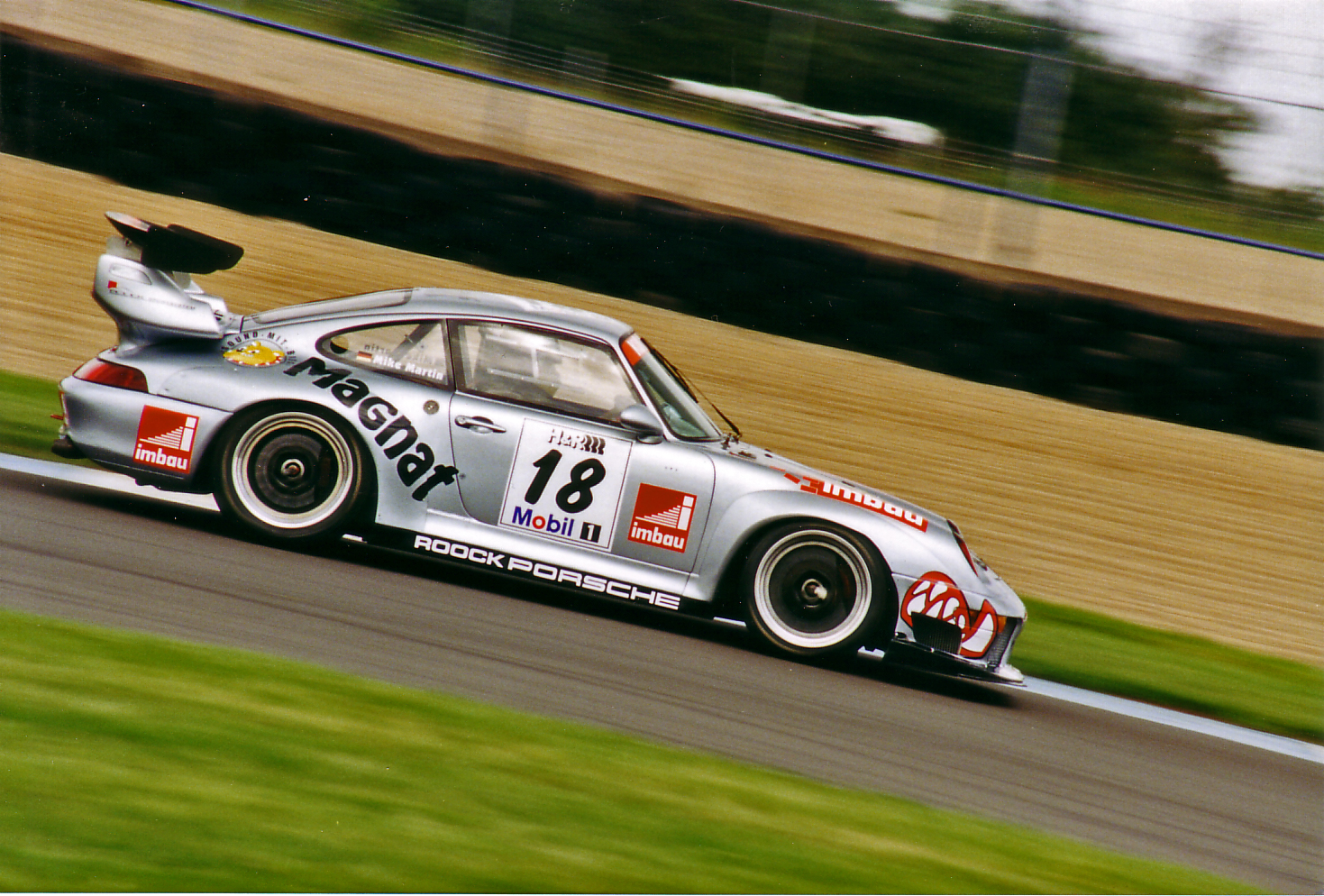
The Porsche GT2 comes from a long line of 911 Porsche Turbo racing cars in international motorsports. Starting with the 1974 911 Carrera turbo for Group 5 racing, followed by the 934 (a racing version of the 930) for Group 4 racing, then the famous Porsche 935 which dominated Group 5 and IMSA racing through 1984. In 1986 a Porsche 961 (racing version of the 959) would be created with little racing success but a leap forward in technology and development such as AWD, 4 valves per cylinder and water-cooled heads (which first appeared in the 1978 Porsche 935 Moby-Dick, used in the Porsche 956/962 GroupC prototypes and then in the 959/961). In 1993, Porsche had experimented with the extensively modified turbo 964, named the Turbo S LM-GT. Seeing the car's potential to be fast and reliable, as well as customer demand for a car to replace the 964 Carrera RSRs, Porsche chose to develop the turbocharged 993 for customer use.
The 993 GT2 race car featured a stripped interior, integrated rollcage for safety, minor adjustments to the bodywork and wings in order to decrease weight as well as increase downforce, and wider fenders to handle racing slicks. The suspension was modified to improve racing performance, while the engine was slightly tweaked for endurance. Twin KKK turbochargers, fitted with required air restrictors, allowed for 335.7 kW.
At the same time, Porsche also developed a GT2 Evo, able to race in the GT1 category. The Evo saw an increase in power to 447.6 kW through the use of larger turbochargers. Other modifications included a new, higher-mounted rear wing, larger fenders to house the wider tires allowed in the GT1 class, and a decrease in weight to 1100 kg. The GT2 Evo was short-lived, however, as Porsche decided to replace it with the purpose-built 911 GT1 in 1996.
The GT2 and GT2 Evo were initially campaigned in the BPR Global GT Series as well as several other smaller national series, and earned seven wins in their class out of eleven rounds during their first full BPR season in 1996, as well as a class victory in the 1996 and 1997 24 Hours of Le Mans. In the new FIA GT Championship that year, although Porsche faced factory-backed competition from Chrysler, the 911 GT2s managed to win three races. By 1998, however, the capabilities of the GT2 were unable to combat the increased number of Chrysler Viper GTS-Rs in the series, earning only a single victory.
By 1999, the GT2s had been largely overpowered by the Vipers, as well as newcomers Lister. Despite this, a GT2 prepared by Roock Racing managed to win the GT2 class at the 24 Hours of Daytona. An increase in engine displacement to 3.8 liters in 2000 was unable to help Porsche, and support for the project ended. Porsche chose instead to concentrate on the new N-GT category with the GT3-R that same year. GT2s continued to be used by private teams until 2004.
With the launch of the 996 generation GT2, several privateers attempted to continue on the motorsports history by building their own racing versions. Belgian PSI Motorsports' 996 Bi-Turbo and German A-Level Engineering's 996 GT2-R were used with moderate success in national series such as the Spanish GT Championship and Belcar.
Modern GT2
Porsche became the first manufacturer to commit to the new SRO GT2 category launched in 2018, with the Porsche 911 GT2 RS clubsport. The car has since competed in GT Sports Club America in 2020 and in the GT2 European Series from 2021 onward. An Evo kit for the car was introduced in 2023.
References
References
- "1995 Porsche 911 GT2". Porsche Cars North America.
- Hardiman, Paul. (February 2013). "1996 Porsche 911S GT2". [[Sports Car Market]].
- Swan, Tony. (May 2001). "2002 Porsche 911 GT2 - A Hardcore 911 Turbo". [[Car and Driver]].
- "2003 Porsche 911 GT2 996".
- (21 March 2005). "2005 Mercedes-Benz SLR McLaren - First Drive & Road Test Review - Motor Trend".
- (March 2023). "Porsche 911 GT2 im Test - Technische Daten". [[Auto motor und sport]].
- (16 July 2007). "New 911 GT2 with 530 Horsepower". Porsche AG.
- "Porsche 911 GT1 Straßenversion: Auktion - Rekordsumme für 911-Renner".
- "2008 Porsche 911 GT2: Exclusive First U.S. Test!". Motor Trend.
- "2008/09 997 GT2 (3.6L North America) {{!}} Concours By Appointment".
- (16 July 2007). "2007 Porsche 997 GT2 - Images, Specifications, and Information". ultimatecarpage.com.
- (2011-07-08). "Tested: 2011 Porsche 911 GT2 RS". Car and Driver.
- "997 GT2 RS".
- (11 June 2017). "Porsche announces a new 911 at E3".
- (30 June 2017). "700HP 2018 Porsche 911 GT2 RS Is The Most Powerful 911 Of All Time".
- (23 May 2022). "991.2 Porsche 911 GT2 RS review - monstrous performance drives 911 to a new level {{!}} evo".
- (21 June 2017). "2018 Porsche GT2 RS Production Numbers, Already Sold Out". Autofluence.
- Mate Petrany. (19 March 2019). "Porsche Is Restarting 911 GT2 RS Production to Replace Cars Lost at Sea". Road and Track.
- "Porsche 911 GT2 RS claims Nurburgring lap record". Auto Express.
- "GT2 RS is the fastest 911 of all time at 6 minutes, 47.3 seconds".
- "911 GT2 RS world record at the Nürburgring Nordschleife. Full onboard-footage.".
- (28 September 2017). "How the Porsche 911 GT2 RS Is So Fast at the Nurburgring". [[Road & Track]].
- "Porsche 911 GT2 RS breaks Nürburgring record with 6:47.3 lap time". MotorMag.com.au.
- "Setting the bar high – 911 GT2 RS around The Bend".
- "Porsche 911 GT2 RS sets production car lap record at The Bend Motorsport Park".
- "Porsche achieves new lap record on the Nürburgring-Nordschleife".
- "911 GT2 RS MR is the fastest road-legal sports car on the 'Ring'".
- (2 November 2018). "A Modified Porsche 911 GT2 RS Set a 6:40 at the Nurburgring". [[Road & Track]].
- "Porsche 911 GT2 RS sets production car lap record at Michelin Raceway Road Atlanta".
- "Porsche 911 GT2 RS sets production car lap record at Michelin Raceway Road Atlanta".
- "Porsche 911 GT2 RS sets production car lap record at Road America – David Donohue onboard camera".
- "Porsche 911 GT2 RS sets production car lap record at Road America".
- (19 July 2019). "Porsche 911 GT2 RS Record Lap at Canadian Tire Motorsport Park".
- "Porsche 911 GT2 RS - Porsche USA". porsche.com.
- "Porsche 911 GT2 RS - Porsche Deutschland". porsche.de.
- Katsianis, Jordan. (28 November 2018). "New Porsche 911 GT2 RS Clubsport revealed". [[Evo (magazine).
- Golson, Daniel. (30 November 2018). "The 700-HP Porsche 911 GT2 RS Clubsport Is a Race Car for Regular People". [[Car and Driver]].
- Kew, Ollie. (30 November 2018). "The Porsche 911 GT2 RS Clubsport is a track-only turbo racecar". [[Top Gear (magazine).
- Silvestro, Brian. (11 February 2019). "The Porsche 911 GT2 RS Clubsport Is Going Racing". [[Road & Track]].
- "1995 Porsche 911 GT2 Evo". Porsche Cars North America.
- "Porsche 996 Bi-Turbo GT2-R - Complete Archive - Racing Sports Cars".
- (2018-11-29). "Porsche 911 GT2 RS Clubsport Revealed In LA".
- . (2021). ["Performance boost for Porsche's GT2 racing car"](https://www.porschesport.com/news/performance-boost-for-porsches-gt2-racing-car).
This article was imported from Wikipedia and is available under the Creative Commons Attribution-ShareAlike 4.0 License. Content has been adapted to SurfDoc format. Original contributors can be found on the article history page.
Ask Mako anything about Porsche 911 GT2 — get instant answers, deeper analysis, and related topics.
Research with MakoFree with your Surf account
Create a free account to save articles, ask Mako questions, and organize your research.
Sign up freeThis content may have been generated or modified by AI. CloudSurf Software LLC is not responsible for the accuracy, completeness, or reliability of AI-generated content. Always verify important information from primary sources.
Report