From Surf Wiki (app.surf) — the open knowledge base
Poporo
Tool specifically made to assist in the chewing of coca leaves
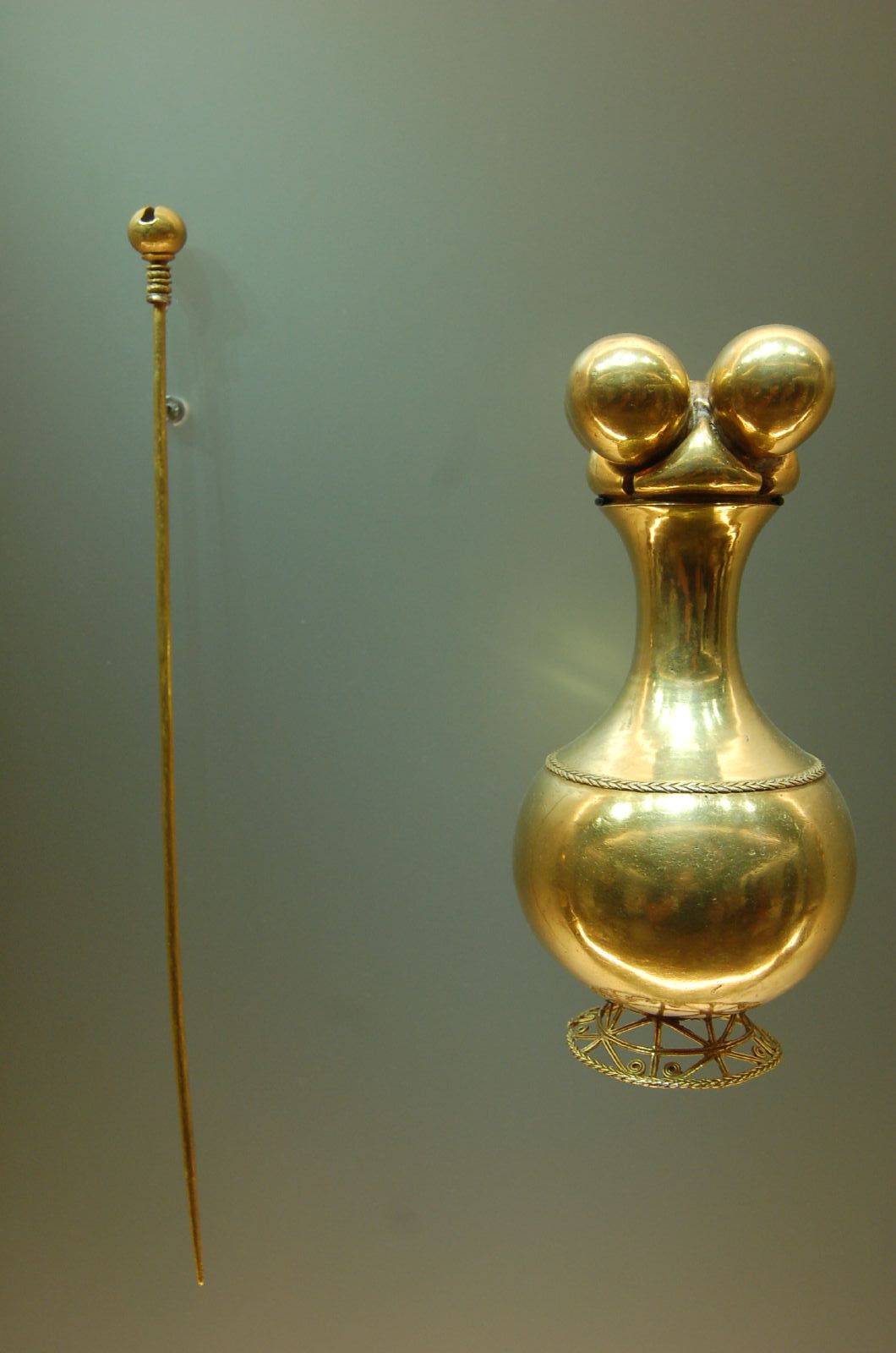
Tool specifically made to assist in the chewing of coca leaves
A Poporo is a device used by indigenous cultures in present and pre-Columbian South America for storage of small amounts of lime produced from burnt and crushed sea-shells. It consists of two pieces: the receptacle and the lid, which includes a pin that is used to carry the lime to the mouth while a person is chewing coca leaves. Since the chewing of coca is sacred for the indigenous people, the poporos are also believed to have mystical powers and social status.
In Colombia, poporos are found in archaeological remains from the Chibcha, Muisca, and Quimbaya cultures among others. The materials used in the early periods are mainly pottery and carved stone. In classic periods gold and tumbaga are the most frequent: an example of this is the Poporo Quimbaya, which is a national symbol and is exhibited in the Gold Museum. In the early 21st century, the indigenous people of Sierra Nevada de Santa Marta still use poporos in the traditional way of more than one thousand years ago. They are made with the dried fruits of a plant of genus cucurbita (totumo).
Poporo Quimbaya
One particularly famous poporo, the Poporo Quimbaya, is a pre-Columbian artpiece of the classic quimbaya period, currently exhibited in the Gold Museum in Bogotá, Colombia. Its primary use was as a ceremonial device for chewing of coca leaves during religious ceremonies. It was made around 300 CE with a lost-wax casting process.
It is believed the artpiece was found at, and stolen from a burial chamber during the first half of the 19th century, at a place named Loma de Pajarito located between the current Yarumal, Angostura, and Campamento municipalities, northeast Antioquia, during a time when grave robbing at pre-Columbian indigenous tombs (locally deemed as guaquería) was still very common.
In 1939 the Banco de la República, the central bank of Colombia, purchased the Poporo Quimbaya, in an effort to preserve it from destruction. This began a larger project of preservation of pre-Columbian goldwork that led to the creation of the Gold Museum in Bogotá.
The Poporo Quimbaya is an unusual piece, made of tumbaga, with oddly minimalistic lines, that give it a modern look. It is one of the most recognized pre-Columbian artpieces, being often used as a symbol of the indigenous pre-Columbian culture. It has been depicted in the Colombian currency, in coins and bills. A reproduction served as the winner's trophy for the 2019 and 2020 editions of the Tour Colombia cycling race.
A poporo made of copper alloy with details
File:Copper object.JPG|Full view File:Poporo – side A.jpg|With the pin outside File:Poporo – head of the pin.jpg|Head of the pin Image:Poporo_by_Turista_Perene.jpg|Poporo Quimbaya and pestle
Notes
References
- "Mujeres, calabazos, brillo y tumbaga. Símbolos de vida y transformación en la orfebrería Quimbaya Temprana". Universidad de Antioquia.
- "Datos curiosos sobre algunos 'objetos maestros' del Museo del Oro". Banco de la República.
- "El tesoro de los Quimbayas". Cronica del Quindio.
- "Etapa 6, 173.8 km, Tour Colombia 2.1 2019. Las Palmas, 17-02-2019, Tour Colombia 2.1 2019". Vizzor Image.
- "The ‘monster’ Higuita begins to build his story".
This article was imported from Wikipedia and is available under the Creative Commons Attribution-ShareAlike 4.0 License. Content has been adapted to SurfDoc format. Original contributors can be found on the article history page.
Ask Mako anything about Poporo — get instant answers, deeper analysis, and related topics.
Research with MakoFree with your Surf account
Create a free account to save articles, ask Mako questions, and organize your research.
Sign up freeThis content may have been generated or modified by AI. CloudSurf Software LLC is not responsible for the accuracy, completeness, or reliability of AI-generated content. Always verify important information from primary sources.
Report