From Surf Wiki (app.surf) — the open knowledge base
Polynomial lemniscate
Plane algebraic curve
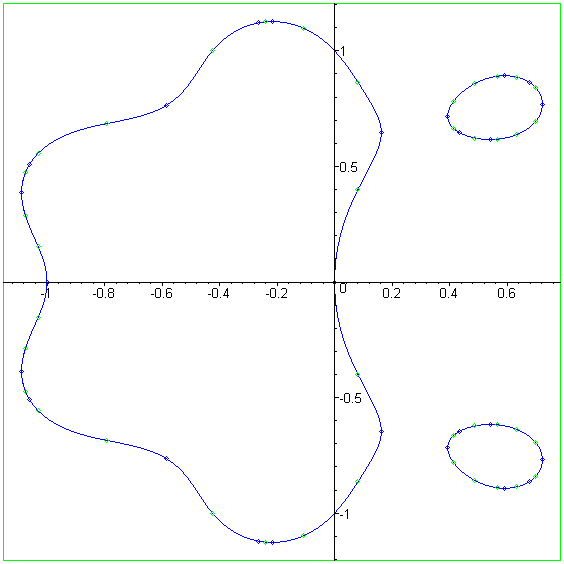
Plane algebraic curve
z^2+z+1|=1]] In mathematics, a polynomial lemniscate or polynomial level curve is a plane algebraic curve of degree 2n, constructed from a polynomial p with complex coefficients of degree n.
For any such polynomial p and positive real number c, we may define a set of complex numbers by |p(z)| = c. This set of numbers may be equated to points in the real Cartesian plane, leading to an algebraic curve ƒ(x, y) = c2 of degree 2n, which results from expanding out p(z) \bar p(\bar z) in terms of z = x + iy.
When p is a polynomial of degree 1 then the resulting curve is simply a circle whose center is the zero of p. When p is a polynomial of degree 2 then the curve is a Cassini oval.
Erdős lemniscate

A conjecture of Erdős which has attracted considerable interest concerns the maximum length of a polynomial lemniscate ƒ(x, y) = 1 of degree 2n when p is monic, which Erdős conjectured was attained when p(z) = zn − 1. This is still not proved but Fryntov and Nazarov proved that p gives a local maximum. first1=A| last1=Fryntov| first2=F| last2=Nazarov| title=New estimates for the length of the Erdos-Herzog-Piranian lemniscate| year=2008| journal=Linear and Complex Analysis| volume=226| pages=49–60| arxiv=0808.0717| bibcode=2008arXiv0808.0717F}} In the case when n = 2, the Erdős lemniscate is the Lemniscate of Bernoulli
:(x^2+y^2)^2=2(x^2-y^2),
and it has been proven that this is indeed the maximal length in degree four. The Erdős lemniscate has three ordinary n-fold points, one of which is at the origin, and a genus of (n − 1)(n − 2)/2. By inverting the Erdős lemniscate in the unit circle, one obtains a nonsingular curve of degree n.
Generic polynomial lemniscate
In general, a polynomial lemniscate will not touch at the origin, and will have only two ordinary n-fold singularities, and hence a genus of (n − 1)2. As a real curve, it can have a number of disconnected components. Hence, it will not look like a lemniscate, making the name something of a misnomer.
An interesting example of such polynomial lemniscates are the Mandelbrot curves. If we set p0 = z, and p**n = p**n−12 + z, then the corresponding polynomial lemniscates Mn defined by |p**n(z)| = 2 converge to the boundary of the Mandelbrot set. The Mandelbrot curves are of degree 2n+1.
Notes
References
- Alexandre Eremenko and Walter Hayman, On the length of lemniscates, Michigan Math. J., (1999), 46, no. 2, 409–415 http://projecteuclid.org/Dienst/UI/1.0/Summarize/euclid.mmj/1030132418
- O. S. Kusnetzova and V. G. Tkachev, Length functions of lemniscates, Manuscripta Math., (2003), 112, 519–538 https://arxiv.org/abs/math.CV/0306327
References
- [https://www.desmos.com/calculator/coamqcajzq Desmos.com - The Mandelbrot Curves]
- (2007). "High-Dimensional Chaotic and Attractor Systems: A Comprehensive Introduction". Springer.
This article was imported from Wikipedia and is available under the Creative Commons Attribution-ShareAlike 4.0 License. Content has been adapted to SurfDoc format. Original contributors can be found on the article history page.
Ask Mako anything about Polynomial lemniscate — get instant answers, deeper analysis, and related topics.
Research with MakoFree with your Surf account
Create a free account to save articles, ask Mako questions, and organize your research.
Sign up freeThis content may have been generated or modified by AI. CloudSurf Software LLC is not responsible for the accuracy, completeness, or reliability of AI-generated content. Always verify important information from primary sources.
Report