From Surf Wiki (app.surf) — the open knowledge base
Polynomial interpolation
Form of interpolation
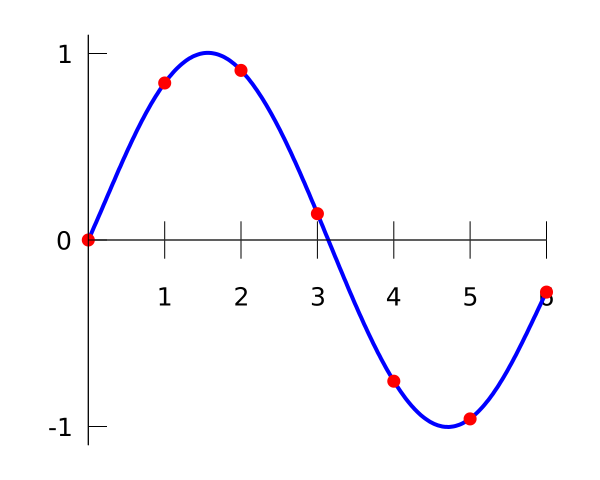
Form of interpolation
In numerical analysis, polynomial interpolation is the interpolation of a given data set by the polynomial of lowest possible degree that passes through the points in the dataset.
Given a set of n + 1 data points (x_0,y_0), \ldots, (x_n,y_n), with no two x_j the same, a polynomial function p(x)=a_0+a_1x+\cdots+a_nx^n is said to interpolate the data if p(x_j)=y_j for each j\in{0,1,\dotsc,n}.
There is always a unique such polynomial, commonly given by two explicit formulas, the Lagrange polynomials and Newton polynomials.
Applications
The original use of interpolation polynomials was to approximate values of important transcendental functions such as natural logarithm and trigonometric functions. Starting with a few accurately computed data points, the corresponding interpolation polynomial will approximate the function at an arbitrary nearby point. Polynomial interpolation also forms the basis for algorithms in numerical quadrature (Simpson's rule) and numerical ordinary differential equations (multigrid methods).
In computer graphics, polynomials can be used to approximate complicated plane curves given a few specified points, for example the shapes of letters in typography. This is usually done with Bézier curves, which are a simple generalization of interpolation polynomials (having specified tangents as well as specified points).
In numerical analysis, polynomial interpolation is essential to perform sub-quadratic multiplication and squaring, such as Karatsuba multiplication and Toom–Cook multiplication, where interpolation through points on a product polynomial yields the specific product required. For example, given a = f(x) = a0x0 + a1x1 + ··· and b = g(x) = b0x0 + b1x1 + ···, the product ab is a specific value of W(x) = f(x)g(x). One may easily find points along W(x) at small values of x, and interpolation based on those points will yield the terms of W(x) and the specific product ab. As fomulated in Karatsuba multiplication, this technique is substantially faster than quadratic multiplication, even for modest-sized inputs, especially on parallel hardware.
In computer science, polynomial interpolation also leads to algorithms for secure multi party computation and secret sharing.
Interpolation theorem
For any n+1 bivariate data points (x_0,y_0),\dotsc,(x_n,y_n) \in \R^2, where no two x_j are the same, there exists a unique polynomial p(x) of degree at most n that interpolates these points, i.e. p(x_0)=y_0, \ldots, p(x_n)=y_n.
Equivalently, for a fixed choice of interpolation nodes x_j, polynomial interpolation defines a linear bijection L_n between the (n+1)-tuples of real-number values (y_0,\ldots,y_n)\in \R^{n+1} and the vector space P(n) of real polynomials of degree at most n: L_n : \mathbb{R}^{n+1} \stackrel{\sim}{\longrightarrow}, P(n).
This is a type of unisolvence theorem. The theorem is also valid over any infinite field in place of the real numbers \R, for example the rational or complex numbers.
First proof
Consider the Lagrange basis functions L_0(x),\ldots,L_n(x) given by: L_j(x)=\prod_{i=0,i\neq j}^{n}\frac{x-x_i}{x_j-x_i} = \frac{(x-x_0)\cdots(x-x_{j-1})(x-x_{j+1})\cdots(x-x_n)} {(x_j-x_0)\cdots(x_j-x_{j-1})(x_j-x_{j+1})\cdots(x_j-x_n)}.
Notice that L_j(x) is a polynomial of degree n, and we have L_j(x_k)=0 for each j\neq k, while L_k(x_k)=1. It follows that the linear combination: p(x) = \sum_{j=0}^n y_j L_j(x) has p(x_k)=\sum_j y_j ,L_j(x_k) = y_k , so p(x) is an interpolating polynomial of degree n.
To prove uniqueness, assume that there exists another interpolating polynomial q(x) of degree at most n, so that p(x_k)=q(x_k) for all k=0,\dotsc,n. Then p(x)-q(x) is a polynomial of degree at most n which has n+1 distinct zeros (the x_k). But a non-zero polynomial of degree at most n can have at most n zeros, so p(x)-q(x) must be the zero polynomial, i.e. p(x)=q(x).
Second proof
Write out the interpolation polynomial in the form Substituting this into the interpolation equations p(x_j) = y_j, we get a system of linear equations in the coefficients a_j, which reads in matrix-vector form as the following multiplication: \begin{bmatrix} x_0^n & x_0^{n-1} & x_0^{n-2} & \ldots & x_0 & 1 \ x_1^n & x_1^{n-1} & x_1^{n-2} & \ldots & x_1 & 1 \ \vdots & \vdots & \vdots & & \vdots & \vdots \ x_n^n & x_n^{n-1} & x_n^{n-2} & \ldots & x_n & 1 \end{bmatrix} \begin{bmatrix} a_n \ a_{n-1} \ \vdots \ a_0 \end{bmatrix} = \begin{bmatrix} y_0 \ y_1 \ \vdots \ y_n \end{bmatrix}.
An interpolant p(x) corresponds to a solution A = (a_n,\ldots,a_0) of the above matrix equation X \cdot A = Y. The matrix X on the left is a Vandermonde matrix, whose determinant is known to be \textstyle \det(X) = \prod_{0 \le i which is non-zero since the nodes x_j are all distinct. This ensures that the matrix is invertible and the equation has the unique solution A = X^{-1}\cdot Y; that is, p(x) exists and is unique.
Corollary
If f(x) is a polynomial of degree at most n, then the interpolating polynomial of f(x) at n+1 distinct points is f(x) itself.
Constructing the interpolation polynomial
Lagrange interpolation
Main article: Lagrange polynomial
We may write down the polynomial immediately in terms of Lagrange polynomials as: \begin{align} p(x) &= \frac{(x-x_1)(x-x_2)\cdots(x-x_n)}{(x_0-x_1)(x_0-x_2)\cdots(x_0-x_n)} y_0 \ [4pt] &+ \frac{(x-x_0)(x-x_2)\cdots(x-x_n)}{(x_1-x_0)(x_1-x_2) \cdots(x_1-x_n)}y_1 \ [4pt] &+ \cdots\ [4pt] &+\frac{(x-x_0)(x-x_1)\cdots(x-x_{n-1})}{(x_n-x_0)(x_n-x_1)\cdots(x_n-x_{n-1})}y_n \ [7pt] &=\sum_{i=0}^n \Biggl( \prod_{\stackrel{!0,\leq, j,\leq, n}{j,\neq, i}} \frac{x-x_j}{x_i-x_j} \Biggr) y_i =\sum_{i=0}^n \frac{p(x)}{p'(x_i)(x-x_i)},y_i \end{align}For matrix arguments, this formula is called Sylvester's formula and the matrix-valued Lagrange polynomials are the Frobenius covariants.
:
Newton interpolation
Theorem
For a polynomial p_n of degree less than or equal to n, that interpolates f at the nodes x_i where i = 0,1,2,3,\cdots,n. Let p_{n+1} be the polynomial of degree less than or equal to n+1 that interpolates f at the nodes x_i where i = 0,1,2,3,\cdots,n, n+1. Then p_{n+1} is given by:p_{n+1}(x) = p_n(x) +a_{n+1}w_n(x) where w_n(x) := \prod_{i=0}^n (x-x_i) also known as Newton basis and a_{n+1} :={f(x_{n+1})-p_n(x_{n+1}) \over w_n(x_{n+1})} .
Proof:
This can be shown for the case where i = 0,1,2,3,\cdots,n:p_{n+1}(x_i) = p_n(x_i) +a_{n+1}\prod_{j=0}^n (x_i-x_j) = p_n(x_i) and when i = n+1:p_{n+1}(x_{n+1}) = p_n(x_{n+1}) +{f(x_{n+1})-p_n(x_{n+1}) \over w_n(x_{n+1})} w_n(x_{n+1}) = f(x_{n+1}) By the uniqueness of interpolated polynomials of degree less than n+1, p_{n+1}(x) = p_n(x) +a_{n+1}w_n(x) is the required polynomial interpolation. The function can thus be expressed as:
p_{n}(x) = a_0+a_1(x-x_0)+a_2(x-x_0)(x-x_1)+\cdots + a_n(x-x_0)\cdots(x-x_{n-1}) .
Polynomial coefficients
To find a_i, we have to solve the lower triangular matrix formed by arranging p_{n} (x_i)=f(x_i)=y_i from above equation in matrix form: : \begin{bmatrix} 1 & & \ldots & & 0 \ 1 & x_1-x_0 & & & \ 1 & x_2-x_0 & (x_2-x_0)(x_2-x_1) & & \vdots \ \vdots & \vdots & & \ddots & \ 1 & x_k-x_0 & \ldots & \ldots & \prod_{j=0}^{n-1}(x_n - x_j) \end{bmatrix} \begin{bmatrix} a_0 \ \ \vdots \ \ a_{n} \end{bmatrix} = \begin{bmatrix} y_0 \ \ \vdots \ \ y_{n} \end{bmatrix}
The coefficients are derived as : a_j := [y_0,\ldots,y_j]
where
: [y_0,\ldots,y_j]
is the notation for divided differences. Thus, Newton polynomials are used to provide a polynomial interpolation formula of n points.
| Proof |
|---|
Newton forward formula
The Newton polynomial can be expressed in a simplified form when x_0, x_1, \dots, x_k are arranged consecutively with equal spacing.
If x_0, x_1, \dots, x_k are consecutively arranged and equally spaced with {x}{i}={x}{0}+ih for i = 0, 1, ..., k and some variable x is expressed as {x}={x}_{0}+sh, then the difference x-x_i can be written as (s-i)h. So the Newton polynomial becomes
: \begin{align} N(x) &= [y_0] + [y_0,y_1]sh + \cdots + [y_0,\ldots,y_k] s (s-1) \cdots (s-k+1){h}^{k} \ &= \sum_{i=0}^{k}s(s-1) \cdots (s-i+1){h}^{i}[y_0,\ldots,y_i] \ &= \sum_{i=0}^{k}{s \choose i}i!{h}^{i}[y_0,\ldots,y_i]. \end{align}
Since the relationship between divided differences and forward differences is given as:[y_j, y_{j+1}, \ldots , y_{j+n}] = \frac{1}{n!h^n}\Delta^{(n)}y_j,Taking y_i=f(x_i), if the representation of x in the previous sections was instead taken to be x=x_j+sh, the Newton forward interpolation formula is expressed as:f(x) \approx N(x)=N(x_j+sh) = \sum_{i=0}^{k}{s \choose i}\Delta^{(i)} f(x_j) which is the interpolation of all points after x_j. It is expanded as:f(x_j+sh)=f(x_j)+\frac{s}{1!}\Delta f(x_j)+ \frac{s(s-1)}{2!}\Delta^2 f(x_j)+\frac{s(s-1)(s-2)}{3!}\Delta^3 f(x_j)+\frac{s(s-1)(s-2)(s-3)}{4!}\Delta^4 f(x_j)+\cdots
Newton backward formula
If the nodes are reordered as {x}{k},{x}{k-1},\dots,{x}_{0}, the Newton polynomial becomes
: N(x)=[y_k]+{y}{k}, {y}{k-1}+\cdots+{y}{k},\ldots,{y}{0}(x-{x}{k-1})\cdots(x-{x}{1}).
If {x}{k},;{x}{k-1},;\dots,;{x}{0} are equally spaced with {x}{i}={x}{k}-(k-i)h for i = 0, 1, ..., k and {x}={x}{k}+sh, then,
: \begin{align} N(x) &= [{y}{k}]+ [{y}{k}, {y}{k-1}]sh+\cdots+[{y}{k},\ldots,{y}{0}]s(s+1)\cdots(s+k-1){h}^{k} \ &=\sum{i=0}^{k}{(-1)}^{i}{-s \choose i}i!{h}^{i}[{y}{k},\ldots,{y}{k-i}]. \end{align}
Since the relationship between divided differences and backward differences is given as:[{y}{j}, y{j-1},\ldots,{y}{j-n}] = \frac{1}{n!h^n}\nabla^{(n)}y_j, taking y_i=f(x_i), if the representation of x in the previous sections was instead taken to be x=x_j+sh, the Newton backward interpolation formula is expressed as:f(x) \approx N(x) =N(x_j+sh)=\sum{i=0}^{k}{(-1)}^{i}{-s \choose i}\nabla^{(i)} f(x_j). which is the interpolation of all points before x_j. It is expanded as:f(x_j+sh)=f(x_j)+\frac{s}{1!}\nabla f(x_j)+ \frac{s(s+1)}{2!}\nabla^2 f(x_j)+\frac{s(s+1)(s+2)}{3!}\nabla^3 f(x_j)+\frac{s(s+1)(s+2)(s+3)}{4!}\nabla^4 f(x_j)+\cdots
Lozenge diagram
A Lozenge diagram is a diagram that is used to describe different interpolation formulas that can be constructed for a given data set. A line starting on the left edge and tracing across the diagram to the right can be used to represent an interpolation formula if the following rules are followed:

- Left to right steps indicate addition whereas right to left steps indicate subtraction
- If the slope of a step is positive, the term to be used is the product of the difference and the factor immediately below it. If the slope of a step is negative, the term to be used is the product of the difference and the factor immediately above it.
- If a step is horizontal and passes through a factor, use the product of the factor and the average of the two terms immediately above and below it. If a step is horizontal and passes through a difference, use the product of the difference and the average of the two terms immediately above and below it.
The factors are expressed using the formula:C(u+k,n)=\frac{(u+k)(u+k-1)\cdots(u+k-n+1)}{n!}
Proof of equivalence
If a path goes from \Delta^{n-1}y_s to \Delta^{n+1}y_{s-1} , it can connect through three intermediate steps, (a) through \Delta^{n}y_{s-1} , (b) through C(u-s ,n) or (c) through \Delta^{n}y_s . Proving the equivalence of these three two-step paths should prove that all (n-step) paths can be morphed with the same starting and ending, all of which represents the same formula.
Path (a):
C(u-s, n) \Delta^n y_{s-1}+C(u-s+1, n+1) \Delta^{n+1} y_{s-1}
Path (b):
C(u-s, n) \Delta^n y_s + C(u-s, n+1) \Delta^{n+1} y_{s-1}
Path (c):
C(u-s, n) \frac{\Delta^n y_{s-1}+\Delta^n y_{s}}{2} \quad+\frac{C(u-s+1, n+1)+C(u-s, n+1)}{2} \Delta^{n+1} y_{s-1}
Subtracting contributions from path a and b:
\begin{aligned} \text{Path a - Path b}= & C(u-s, n)(\Delta^n y_{s-1}-\Delta^n y_s) +(C(u-s+1, n+1)-C(u-s, n-1)) \Delta^{n+1} y_{s-1} \ = & - C(u-s, n)\Delta^{n+1} y_{s-1} + C(u-s, n) \frac{(u-s+1)-(u-s-n)}{n+1} \Delta^{n+1} y_{s-1} \ = & C(u-s, n)(-\Delta^{n+1} y_{s-1}+\Delta^{n+1} y_{s-1} )=0 \ \end{aligned}
Thus, the contribution of either path (a) or path (b) is the same. Since path (c) is the average of path (a) and (b), it also contributes identical function to the polynomial. Hence the equivalence of paths with same starting and ending points is shown. To check if the paths can be shifted to different values in the leftmost corner, taking only two step paths is sufficient: (a) y_{s+1} to y_{s} through \Delta y_{s} or (b) factor between y_{s+1} and y_{s} , to y_{s} through \Delta y_{s} or (c) starting from y_{s} .
Path (a)
y_{s+1}+C(u-s-1,1) \Delta y_s - C(u-s, 1) \Delta y_s
Path (b)
\frac{y_{s+1}+y_s}{2}+\frac{C(u-s-1,1)+C(u-s, 1)}{2} \Delta y_s - C(u-s, 1) \Delta y_s
Path (c)
y_{s}
Since \Delta y_{s} = y_{s+1}-y_s , substituting in the above equations shows that all the above terms reduce to y_{s} and are hence equivalent. Hence these paths can be morphed to start from the leftmost corner and end in a common point.
Newton formula
Taking negative slope transversal from y_0 to \Delta^n y_0 gives the interpolation formula of all the n+1 consecutively arranged points, equivalent to Newton's forward interpolation formula:
\begin{aligned} y(s) &=y_0+C(s, 1) \Delta y_0+C(s, 2) \Delta^2 y_0+C(s, 3) \Delta^3 y_0+\cdots \ & =y_0+s \Delta y_0+\frac{s(s-1)}{2} \Delta^2 y_0+\frac{s(s-1)(s-2)}{3 !} \Delta^3 y_0+\frac{s(s-1)(s-2)(s-3)}{4 !} \Delta^4 y_0+\cdots \end{aligned}
whereas, taking positive slope transversal from y_n to \nabla^n y_n = \Delta^n y_0 , gives the interpolation formula of all the n+1 consecutively arranged points, equivalent to Newton's backward interpolation formula:
\begin{aligned} y(u) & = y_k+C(u-k, 1) \Delta y_{k-1}+C(u-k+1,2) \Delta^2 y_{k-2} +C(u - k+2,3) \Delta^3 y_{k-3}+\cdots \ & = y_k+(u-k) \Delta y_{k-1} +\frac{(u-k+1) (u-k)}{2} \Delta^2 y_{k-2}+\frac{(u-k+2)(u-k+1)(u-k)}{3 !} \Delta^3 y_{k-3}+\cdots \ y(k+s) & = y_k+(s) \nabla y_{k} +\frac{(s+1) s}{2} \nabla^2 y_{k}+\frac{(s+2)(s+1) s}{3 !} \nabla^3 y_{k}+\frac{(s+3)(s+2)(s+1) s}{4 !} \nabla^4 y_{k}+\cdots \ \end{aligned}
where s=u-k is the number corresponding to that introduced in Newton interpolation.
Gauss formula
Taking a zigzag line towards the right starting from y_0 with negative slope, we get Gauss forward formula:
y(u)=y_0+u \Delta y_0+\frac{u(u-1)}{2} \Delta^2 y_{-1} +\frac{(u+1)u\left(u-1\right)}{3 !} \Delta^3 y_{-1}+ \frac{(u+1)u\left(u-1\right)(u-2)}{4 !} \Delta^4 y_{-2} + \cdots
whereas starting from y_0 with positive slope, we get Gauss backward formula:
y(u)=y_0+u \Delta y_{-1}+\frac{(u+1)u}{2} \Delta^2 y_{-1} +\frac{(u+1)u\left(u-1\right)}{3 !} \Delta^3 y_{-2}+ \frac{(u+2)(u+1)u\left(u-1\right)}{4 !} \Delta^4 y_{-2} + \cdots
Stirling formula
By taking a horizontal path towards the right starting from y_0 , we get Stirling formula:
\begin{aligned} y(u)&= y_0 +u \frac{\Delta y_0+\Delta y_{-1}}{2}+\frac{C(u+1,2)+C(u, 2)}{2} \Delta^2 y_{-1} +C(u+1,3) \frac{\Delta^3 y_{-2}+\Delta^3 y_{-1}}{2}+\cdots \ & = y_0+u \frac{\Delta y_0+\Delta y_{-1}}{2}+\frac{u^2}{2} \Delta^2 y_{-1}+\frac{u(u^2-1)}{3 !} \frac{\Delta^3 y_{-2}+\Delta^3 y_{-1}}{2}+\frac{u^2(u^2-1)}{4!}\Delta^4 y_{-2}+\cdots \end{aligned}
Stirling formula is the average of Gauss forward and Gauss backward formulas.
Bessel formula
By taking a horizontal path towards the right starting from factor between y_0 and y_1 , we get Bessel formula:
\begin{align} y(u)&=1{\frac{y_{0}+y_{1}}{2}}+{\frac{C(u,1)+C(u-1,1)}{2}}\Delta y_{0}+C(u,2){\frac{\Delta^{2}y_{-1}+\Delta^{2}y_{0}}{2}}+\cdots\ &= \frac{y_{0}+y_{1}}{2}+\left(u-{\frac{1}{2}}\right)\Delta y_{0}+\frac{u(u-1)}{2}\frac{\Delta^{2}y_{-1} +\Delta^{2}y_{0}}{2}+\frac{\left(u-{\frac{1}{2}}\right)u\left( u-1\right)}{3!}\Delta^{3} y_{0}
- \frac{(u+1)u(u-1)(u-2)}{4!}\frac{\Delta^{4}y_{-1}+\Delta^{4}y_{-2}}{2}+\cdots\ \end{align}
Vandermonde algorithms
The Vandermonde matrix in the second proof above may have large condition number, causing large errors when computing the coefficients ai if the system of equations is solved using Gaussian elimination.
Several authors have therefore proposed algorithms which exploit the structure of the Vandermonde matrix to compute numerically stable solutions in O(n2) operations instead of the O(n3) required by Gaussian elimination. These methods rely on constructing first a Newton interpolation of the polynomial and then converting it to a monomial form.
Non-Vandermonde algorithms
To find the interpolation polynomial p(x) in the vector space P(n) of polynomials of degree n, we may use the usual monomial basis for P(n) and invert the Vandermonde matrix by Gaussian elimination, giving a computational cost of O(n3) operations. To improve this algorithm, a more convenient basis for P(n) can simplify the calculation of the coefficients, which must then be translated back in terms of the monomial basis.
One method is to write the interpolation polynomial in the Newton form (i.e. using Newton basis) and use the method of divided differences to construct the coefficients, e.g. Neville's algorithm. The cost is O(n2) operations. Furthermore, you only need to do O(n) extra work if an extra point is added to the data set, while for the other methods, you have to redo the whole computation.
Another method is preferred when the aim is not to compute the coefficients of p(x), but only a single value p(a) at a point x = a not in the original data set. The Lagrange form computes the value p(a) with complexity O(n2).
The Bernstein form was used in a constructive proof of the Weierstrass approximation theorem by Bernstein and has gained great importance in computer graphics in the form of Bézier curves.
Interpolations as linear combinations of values
Given a set of (position, value) data points (x_0, y_0), \ldots, (x_j, y_j), \ldots, (x_n, y_n) where no two positions x_j are the same, the interpolating polynomial y(x) may be considered as a linear combination of the values y_j, using coefficients which are polynomials in x depending on the x_j. For example, the interpolation polynomial in the Lagrange form is the linear combination y(x) := \sum_{j=0}^{k} y_j c_j(x) with each coefficient c_j(x) given by the corresponding Lagrange basis polynomial on the given positions x_j: c_j(x) = L_j(x_0,\ldots,x_n;x) = \prod_{ 0 \le i \le n \atop i \neq j } \frac{x-x_i}{x_j-x_i} = \frac{(x-x_0)}{(x_j-x_0)} \cdots \frac{(x-x_{j-1})}{(x_j-x_{j-1})} \frac{(x-x_{j+1})}{(x_j-x_{j+1})} \cdots \frac{(x-x_n)}{(x_j-x_n)}.
Since the coefficients depend only on the positions x_j, not the values y_j, we can use the same coefficients to find the interpolating polynomial for a second set of data points (x_0, v_0), \ldots, (x_n, v_n) at the same positions: v(x) := \sum_{j=0}^{k} v_j c_j(x).
Furthermore, the coefficients c_j(x) only depend on the relative spaces x_i-x_j between the positions. Thus, given a third set of data whose points are given by the new variable t = ax+b (an affine transformation of x, inverted by x=\tfrac{t-b}{a}): (t_0, w_0), \ldots, (t_j, w_j) \ldots, (t_n, w_n) \qquad \text{with}\qquad t_j = ax_j + b, we can use a transformed version of the previous coefficient polynomials:\tilde c_j(t) := c_j(\tfrac{t-b}{a}) = c_j(x), and write the interpolation polynomial as:w(t) := \sum_{j=0}^{k} w_j \tilde c_j(t).Data points (x_j,y_j) often have equally spaced positions, which may be normalized by an affine transformation to x_j = j. For example, consider the data points(0,y_0), (1,y_1), (2,y_2).The interpolation polynomial in the Lagrange form is the linear combination \begin{align} y(x) := \sum_{j=0}^2 y_j c_j(x) &= y_0 \frac{(x-1)(x-2)}{(0-1)(0-2)} + y_1 \frac{(x-0)(x-2)}{(1-0)(1-2)} + y_2 \frac{(x-0)(x-1)}{(2-0)(2-1)} \ &= \tfrac12 y_0 (x-1)(x-2) - y_1 (x-0)(x-2) + \tfrac12 y_2 (x-0)(x-1). \end{align}
For example, y(3) = y_3 = y_0 - 3y_1 + 3y_2 and y(1.5) = y_{1.5} = \tfrac18 (-y_0 + 6y_1 + 3y_2).
The case of equally spaced points can also be treated by the method of finite differences. The first difference of a sequence of values v={v_j}{j=0}^\infty is the sequence \Delta v = u = {u_j}{j=0}^\infty defined by u_j = v_{j+1}-v_j . Iterating this operation gives the nth difference operation \Delta^n v = u, defined explicitly by u_j = \sum_{k=0}^n (-1)^{n-k} {n\choose k} v_{j+k}.
A polynomial y(x) of degree d defines a sequence of values at positive integer points, y_j = y(j), and the (d+1)^{\text{th}} difference of this sequence is identically zero: \Delta^{d+1} y = 0. Thus, given values y_0,\ldots,y_n at equally spaced points, where n=d+1 , we have: (-1)^n y_0 + (-1)^{n-1} \binom{n}{1} y_1 + \cdots - \binom n{n-1} y_{n-1} + y_n= 0. For example, 4 equally spaced data points y_0,y_1,y_2,y_3 of a quadratic y(x) obey 0 = -y_0 + 3y_1 - 3y_2 + y_3, and solving for y_3 gives the same interpolation equation obtained above using the Lagrange method.
Interpolation error: Lagrange remainder formula
When interpolating a given function f by a polynomial p_n of degree n at the nodes x0,..., x**n we get the error f(x) - p_n(x) = f[x_0,\ldots,x_n,x] \prod_{i=0}^n (x-x_i) where f[x_0,\ldots,x_n,x] is the (n+1)st divided difference of the data points (x_0,f(x_0)),\ldots,(x_n,f(x_n)),(x,f(x)) .Furthermore, there is a Lagrange remainder form of the error, for a function f which is n + 1 times continuously differentiable on a closed interval I, and a polynomial p_n(x) of degree at most n that interpolates f at n + 1 distinct points x_0,\ldots,x_n\in I. For each x\in I there exists \xi\in I such that f(x) - p_n(x) = \frac{f^{(n+1)}(\xi)}{(n+1)!} \prod_{i=0}^n (x-x_i).
This error bound suggests choosing the interpolation points xi to minimize the product \left | \prod (x - x_i) \right |, which is achieved by the Chebyshev nodes.
Proof of Lagrange remainder
Set the error term as R_n(x) = f(x) - p_n(x) , and define an auxiliary function: Y(t) = R_n(t) - \frac{R_n(x)}{W(x)} W(t) \qquad\text{where}\qquad W(t) = \prod_{i=0}^n (t-x_i). Thus: Y^{(n+1)}(t) = R_n^{(n+1)}(t) - \frac{R_n(x)}{W(x)} \ (n+1)!
But since p_n(x) is a polynomial of degree at most n, we have R_n^{(n+1)}(t) = f^{(n+1)}(t) , and: Y^{(n+1)}(t) = f^{(n+1)}(t) - \frac{R_n(x)}{W(x)} \ (n+1)!
Now, since xi are roots of R_n(t) and W(t), we have Y(x)=Y(x_j)=0 , which means Y has at least n + 2 roots. From Rolle's theorem, Y^\prime(t) has at least n + 1 roots, and iteratively Y^{(n+1)}(t) has at least one root ξ in the interval I. Thus: Y^{(n+1)}(\xi) = f^{(n+1)}(\xi) - \frac{R_n(x)}{W(x)} \ (n+1)! = 0
and: R_n(x) = f(x) - p_n(x) = \frac{f^{(n+1)}(\xi)}{(n+1)!} \prod_{i=0}^n (x-x_i) .
This parallels the reasoning behind the Lagrange remainder term in the Taylor theorem; in fact, the Taylor remainder is a special case of interpolation error when all interpolation nodes xi are identical. Note that the error will be zero when x = x_i for any i. Thus, the maximum error will occur at some point in the interval between two successive nodes.
Equally spaced intervals
In the case of equally spaced interpolation nodes where x_i = a + ih, for i=0,1,\ldots,n, and where h = (b-a)/n, the product term in the interpolation error formula can be bound as \left|\prod_{i=0}^n (x-x_i)\right| = \prod_{i=0}^n \left|x-x_i\right| \leq \frac{n!}{4} h^{n+1}.
Thus the error bound can be given as \left|R_n(x)\right| \leq \frac{h^{n+1}}{4(n+1)} \max_{\xi\in[a,b]} \left|f^{(n+1)}(\xi)\right|
However, this assumes that f^{(n+1)}(\xi) is dominated by h^{n+1}, i.e. f^{(n+1)}(\xi) h^{n+1} \ll 1. In several cases, this is not true and the error actually increases as n → ∞ (see Runge's phenomenon). That question is treated in the section Convergence properties.
Lebesgue constants
Main article: Lebesgue constant
We fix the interpolation nodes x0, ..., x**n and an interval [a, b] containing all the interpolation nodes. The process of interpolation maps the function f to a polynomial p. This defines a mapping X from the space C([a, b]) of all continuous functions on [a, b] to itself. The map X is linear and it is a projection on the subspace P(n) of polynomials of degree n or less.
The Lebesgue constant L is defined as the operator norm of X. One has (a special case of Lebesgue's lemma): \left|f-X(f)\right| \le (L+1) \left|f-p^*\right|.
In other words, the interpolation polynomial is at most a factor (L + 1) worse than the best possible approximation. This suggests that we look for a set of interpolation nodes that makes L small. In particular, we have for Chebyshev nodes: L \le \frac2\pi \log(n+1) + 1.
We conclude again that Chebyshev nodes are a very good choice for polynomial interpolation, as the growth in n is exponential for equidistant nodes. However, those nodes are not optimal.
Convergence properties
It is natural to ask, for which classes of functions and for which interpolation nodes the sequence of interpolating polynomials converges to the interpolated function as n → ∞? Convergence may be understood in different ways, e.g. pointwise, uniform or in some integral norm.
The situation is rather bad for equidistant nodes, in that uniform convergence is not even guaranteed for infinitely differentiable functions. One classical example, due to Carl Runge, is the function f(x) = 1 / (1 + x2) on the interval [−5, 5]. The interpolation error f − pn∞ grows without bound as n → ∞. Another example is the function f(x) = |x| on the interval [−1, 1], for which the interpolating polynomials do not even converge pointwise except at the three points x = ±1, 0.
One might think that better convergence properties may be obtained by choosing different interpolation nodes. The following result seems to give a rather encouraging answer:
The defect of this method, however, is that interpolation nodes should be calculated anew for each new function f(x), but the algorithm is hard to be implemented numerically. Does there exist a single table of nodes for which the sequence of interpolating polynomials converge to any continuous function f(x)? The answer is unfortunately negative:
The proof essentially uses the lower bound estimation of the Lebesgue constant, which we defined above to be the operator norm of X**n (where X**n is the projection operator on Πn). Now we seek a table of nodes for which
\lim_{n \to \infty} X_n f = f,\text{ for every }f \in C([a,b]).
Due to the Banach–Steinhaus theorem, this is only possible when norms of X**n are uniformly bounded, which cannot be true since we know that
|X_n|\geq \tfrac{2}{\pi} \log(n+1)+C.
For example, if equidistant points are chosen as interpolation nodes, the function from Runge's phenomenon demonstrates divergence of such interpolation. Note that this function is not only continuous but even infinitely differentiable on [−1, 1]. For better Chebyshev nodes, however, such an example is much harder to find due to the following result:
Notes
Citations
References
References
- (2020). "Foundations of Applied Mathematics Volume 2: Algorithms, Approximation, Optimization". Society for Industrial and Applied Mathematics.
- Epperson, James F.. (2013). "An introduction to numerical methods and analysis". Wiley.
- (2011). "Numerical Analysis". Cengage Learning.
- Hamming, Richard W.. (1986). "Numerical methods for scientists and engineers". Dover.
- Gautschi, Walter. (1975). "Norm Estimates for Inverses of Vandermonde Matrices". Numerische Mathematik.
- Higham, N. J.. (1988). "Fast Solution of Vandermonde-Like Systems Involving Orthogonal Polynomials". IMA Journal of Numerical Analysis.
- Björck, Å. (1970). "Solution of Vandermonde Systems of Equations". American Mathematical Society.
- (1993). "Fast Inversion of Vandermonde-Like Matrices Involving Orthogonal Polynomials". BIT.
- R.Bevilaqua, D. Bini, M.Capovani and O. Menchi (2003). ''Appunti di Calcolo Numerico''. Chapter 5, p. 89. Servizio Editoriale Universitario Pisa - Azienda Regionale Diritto allo Studio Universitario.
- "Errors in Polynomial Interpolation".
- "Notes on Polynomial Interpolation".
- {{Harvtxt. Watson. 1980. Bernstein. 1912.
- {{Harvtxt. Watson. 1980. Faber. 1914.
- Krylov, V. I.. (1956). "Сходимость алгебраического интерполирования покорням многочленов Чебышева для абсолютно непрерывных функций и функций с ограниченным изменением". Doklady Akademii Nauk SSSR.
This article was imported from Wikipedia and is available under the Creative Commons Attribution-ShareAlike 4.0 License. Content has been adapted to SurfDoc format. Original contributors can be found on the article history page.
Ask Mako anything about Polynomial interpolation — get instant answers, deeper analysis, and related topics.
Research with MakoFree with your Surf account
Create a free account to save articles, ask Mako questions, and organize your research.
Sign up freeThis content may have been generated or modified by AI. CloudSurf Software LLC is not responsible for the accuracy, completeness, or reliability of AI-generated content. Always verify important information from primary sources.
Report