From Surf Wiki (app.surf) — the open knowledge base
Polynesians
Austronesian ethnolinguistic group
Austronesian ethnolinguistic group
| Field | Value |
|---|---|
| group | Polynesians |
| image | Maori dance.jpg |
| image_caption | Māori people in the North Island, New Zealand |
| population | 2,000,000 |
| region1 | New Zealand |
| pop1 | 1,157,478 |
| ref1 | |
| region2 | United States |
| pop2 | 988,519 |
| ref2 | |
| region3 | Australia |
| pop3 | 409,805 |
| region4 | French Polynesia |
| pop4 | 215,000 |
| ref4 | |
| region5 | Samoa |
| pop5 | 192,342 |
| region6 | Tonga |
| pop6 | 103,036 |
| region7 | Cook Islands |
| pop7 | 17,683 |
| region8 | Canada |
| pop8 | 10,760 |
| ref8 | |
| region9 | Tuvalu |
| pop9 | 10,645 |
| ref9 | |
| region10 | Chile |
| pop10 | 9,399 |
| languages | Polynesian languages (Hawaiian, Māori, Rapa Nui, Samoan, Tahitian, Tongan, Tuvaluan and others), English, French and |
| religions | Christianity (96.1%) and Polynesian mythology |
| related | other Austronesian peoples, Euronesians |
Spanish
Polynesians are an ethnolinguistic group comprising closely related ethnic groups native to Polynesia, which encompasses the islands within the Polynesian Triangle in the Pacific Ocean. They trace their early prehistoric origins to Island Southeast Asia and are part of the larger Austronesian ethnolinguistic group, with an Urheimat in Taiwan. They speak the Polynesian languages, a branch of the Oceanic subfamily within the Austronesian language family. The Indigenous Māori people form the largest Polynesian population, followed by Samoans, Native Hawaiians, Tahitians, Tongans, and Cook Islands Māori.
, there were an estimated 2 million ethnic Polynesians (both full and part) worldwide. The vast majority either inhabit independent Polynesian nation-states (Samoa, Niue, Cook Islands, Tonga, and Tuvalu) or form minorities in countries such as Australia, Chile (Easter Island), New Zealand, France (French Polynesia and Wallis and Futuna), and the United States (Hawaii and American Samoa), as well as in the British Overseas Territory of the Pitcairn Islands. New Zealand had the highest population of Polynesians, estimated at 110,000 in the 18th century.
Polynesians have acquired a reputation as great navigators, with their canoes reaching the most remote corners of the Pacific and allowing the settlement of islands as far apart as Hawaii, Rapanui (Easter Island), and Aotearoa (New Zealand). The people of Polynesia accomplished this voyaging using ancient navigation skills, including reading stars, currents, clouds, and bird movements—skills that have been passed down through successive generations to the present day.{{cite web |url= https://www.npr.org/sections/thesalt/2013/01/22/169980441/how-the-sweet-potato-crossed-the-pacific-before-columbus|title= How The Sweet Potato Crossed The Pacific Way Before The Europeans Did|last= DOUCLEFF|first= MICHAELEEN|date= 23 January 2013|website= NPR|access-date= 25 January 2020
Origins
Main article: Austronesian peoples, Polynesia#History
Polynesians, including Samoans, Tongans, Niueans, Cook Islands Māori, Tahitian Mā'ohi, Hawaiian Māoli, Marquesans, and New Zealand Māori, are a subset of the Austronesian peoples. They share the same origins as the indigenous peoples of Taiwan, Maritime Southeast Asia, Micronesia, and Madagascar. This is supported by genetic, linguistic and archaeological evidence.

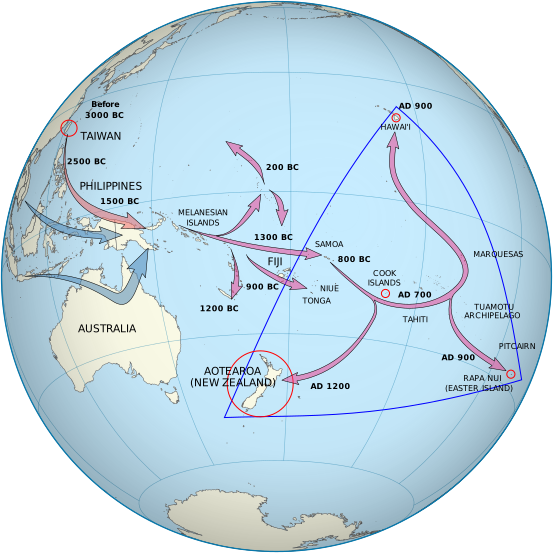
There are multiple hypotheses regarding the ultimate origin and mode of dispersal of the Austronesian peoples, but the most widely accepted theory is that modern Austronesians originated from migrations out of Taiwan between 3000 and 1000 BC. Using relatively advanced maritime innovations such as the catamaran, outrigger boats, and crab claw sails, they rapidly colonized the islands of both the Indian and Pacific oceans. They were the first humans to cross vast distances of water on ocean-going boats. Despite the popularity of rejected hypotheses, such as Thor Heyerdahl's belief that Polynesians are descendants of "bearded white men" who sailed on primitive rafts from South America, Polynesians are believed to have originated from a branch of the Austronesian migrations in Island Melanesia.
The direct ancestors of the Polynesians are believed to be the Neolithic Lapita culture. This group emerged in Island Melanesia and Micronesia around 1500 BC from a convergence of Austronesian migration waves, originating from both Island Southeast Asia to the west and an earlier Austronesian migration to Micronesia to the north. The culture was distinguished by dentate-stamped pottery. However, their eastward expansion halted when they reached the western Polynesian islands of Fiji, Samoa, and Tonga by around 900 BC. This remained the furthest extent of the Austronesian expansion in the Pacific for approximately 1,500 years, during which the Lapita culture in these islands abruptly lost the technology of pottery-making for unknown reasons. They resumed their eastward migrations around 700 AD, spreading to the Cook Islands, French Polynesia, and the Marquesas. From here, they expanded further to Hawaii by 900 AD, Easter Island by 1000 AD, and finally New Zealand by 1200 AD.
A popular theory among scholars and native Royal Polynesian Monarchy (Tongan, Tahitian, Hawaiian; Monarchies) is that the genesis point from which Polynesia was finally populated was through the Polynesian Island archipelagos of Samoa (Sacred Center). The Islands of Samoa are theorized to have been the gestation point from which the initial roots of Polynesia patiently formulated religion, philosophy, spirituality, language, arts, culture over time and then spread forth through eastern Polynesia alongside Samoa's Religion (Aitu, Kahuna, Tafuna). Through their Polynesian Aitu religion, the worship of animal, human deities and a pantheon of Gods and Demi-Gods which would grow exponentially in Eastern Polynesia, with the construction of monolithic Tiki Deities in Tahiti, Rapanui and the spread of the spiritual belief of Mana; a Polynesian spiritual life force which governs all living beings.--
Genetic studies

Analysis by Kayser et al. (2008) found that only 21% of the Polynesian autosomal gene pool is of Australo-Melanesian origin, with the remaining 79% being of Austronesian origin. Another study by Friedlaender et al. (2008) also confirmed that Polynesians are genetically closer to Micronesians, Taiwanese Aborigines, and Islander Southeast Asians. The study concluded that Polynesians moved through Melanesia fairly rapidly, allowing only limited admixture between Austronesians and Papuans. Polynesians predominantly belong to Haplogroup B (mtDNA), particularly to mtDNA B4a1a1 (the Polynesian motif). The high frequencies of mtDNA B4 in Polynesians are the result of genetic drift and represent the descendants of a few Austronesian females who mixed with Papuan males. The Polynesian population experienced a founder effect and genetic drift due to the small number of ancestors. As a result of the founder effect, Polynesians are distinctively different both genotypically and phenotypically from the parent population, due to the establishment of a new population by a very small number of individuals from a larger population, which also causes a loss of genetic variation.
Soares et al. (2008) argued for an older pre-Holocene Sundaland origin in Island Southeast Asia (ISEA) based on mitochondrial DNA. The "out of Taiwan" model was challenged by a study from Leeds University published in Molecular Biology and Evolution. Examination of mitochondrial DNA lineages indicates that they have been evolving in ISEA for longer than previously believed. Ancestors of the Polynesians arrived in the Bismarck Archipelago of Papua New Guinea at least 6,000 to 8,000 years ago.
A 2014 study by Lipson et al., using whole genome data, supports the findings of Kayser et al. Modern Polynesians were shown to have lower levels of admixture with Australo-Melanesians than Austronesians in Island Melanesia. Nonetheless, both groups show admixture, along with other Austronesian populations outside of Taiwan, indicating varying degrees of intermarriage between the incoming Neolithic Austronesian settlers and the preexisting Paleolithic Australo-Melanesian populations of Island Southeast Asia and Melanesia.
Studies from 2016 and 2017 also support the idea that the earliest Lapita settlers mostly bypassed New Guinea, coming directly from Taiwan or the northern Philippines. The intermarriage and admixture with Australo-Melanesian Papuans evident in the genetics of modern Polynesians (as well as Islander Melanesians) occurred after the settlement of Tonga and Vanuatu.
A 2020 study found that Polynesians and the Indigenous peoples of South America came in contact around 1200 AD, centuries before Europeans interacted with either group.
People


and many of partial Polynesian descent worldwide, the majority of whom live in Polynesia, the United States, Australia, and New Zealand. The Polynesian peoples are listed below in their distinctive ethnic and cultural groupings, with estimates of the larger groups provided:
Polynesia:
- Māori: New Zealand (Aotearoa) – 892,200,(not including 170,057 residing in Australia, worldwide: c. 1,062,257)
- Samoans: Samoa, American Samoa – 249,000 (worldwide: 500,000–600,000, including the 109,000 residing in the US and 145,000 in New Zealand)
- Tahitians (Māohi): Tahiti – 178,000 (including multiracial: 250,000+)
- Hawaiians (Māoli): Hawaii – 140,000 (including multiracial: 400,000)
- Tongans: Tonga – 104,000 (worldwide: 300,000, including 43,465 residing in Australia, 67,221 in U.S.A, & 82,839 in New Zealand)
- Cook Islands Māori: Cook Islands – 98,000+ (including 62,000 in New Zealand and 16,000 residing in Australia)
- Niueans: Niue – 20,000–25,000 (95% of whom live in New Zealand)
- Rotumans: Rotuma – 15,000–20,000 (5% reside on Rotuma Island, 75% live on mainland Fiji and 20% live elsewhere (specifically in Australia and New Zealand)
- Tuamotu: Tuamotu Archipelago – 16,000
- Tuvaluans: Tuvalu – 13,500 (including 3,500 diasporans in New Zealand)
- Marquesas Islanders: Marquesas Islands – 11,000
- Tokelauans: Tokelau – 8,000 (including 6,500 diasporans in New Zealand)
- Austral Islanders: Austral Islands – 7,000
- Rapanui: Easter Island – 5,000 (including mixtures and those living in Chile)
- Mangareva: Gambier Islands – 1,600
- Moriori: Chatham Islands (Rēkohu) – 738 (2013 New Zealand Census)
- Uvea and Futuna: Wallis and Futuna
Polynesian outliers:
- Kapingamarangi and Nukuoro: Federated States of Micronesia
- Nuguria, Nukumanu and Takuu: Papua New Guinea
- Anuta, Bellona, Ontong Java, Rennel, Sikaiana, Tikopia and Vaeakau-Taumako: Solomon Islands
- Emae, Makata, Mele (Erakoro, Eratapu), Aniwa, and Futuna: Vanuatu
- Fagauvea: Ouvéa (New Caledonia)
- Kioa (Fiji Islands)
References
References
- [http://www.dol.govt.nz/publications/research/population-movement-pacific-perspective-future-prospects/05.asp Population Movement in the Pacific: A Perspective on Future Prospects. Wellington: New Zealand Department of Labour] {{webarchive. link. (7 February 2013)
- "Chuukese and Papua New Guinean Populations Fastest Growing Pacific Islander Groups in 2020".
- ''Landfalls of Paradise: Cruising Guide to the Pacific Islands'', Earl R. Hinz & Jim Howard, University of Hawaii Press, 2006, page 80.
- (8 February 2017). "Census Profile, 2016 Census".
- (11 April 2012). "Population of communities in Tuvalu". world-statistics.org.
- "Síntesis de Resultados Censo 2017".
- [https://web.archive.org/web/20130815184022/http://wwwgordonconwell.com/netcommunity/CSGCResources/ChristianityinitsGlobalContext.pdf Christianity in its Global Context, 1970–2020 Society, Religion, and Mission], Center for the Study of Global Christianity
- Wellington, Victoria University of. (1 December 2017). "Arts, humanities and social sciences".
- "Māori population estimates: At 30 June 2022".
- King, Michael. (2003). "The Penguin History of New Zealand". Penguin.
- (1 February 2011). "High-precision radiocarbon dating shows recent and rapid initial human colonization of East Polynesia". Proceedings of the National Academy of Sciences.
- (2005). "The Austronesians: historical and comparative perspectives". ANU E Press.
- (2005). "Mitochondrial DNA Provides a Link between Polynesians and Indigenous Taiwanese". PLOS Biology.
- (27 January 2009). "Pacific People Spread From Taiwan, Language Evolution Study Shows". ScienceDaily.
- (2006). "Austronesian Disapora and the Ethnogenesis of People in Indonesian Archipelago. Proceedings of the International Symposium". LIPI Press.
- (2013). "eLS".
- Dr. Martin Richards. "Climate Change and Postglacial Human Dispersals in Southeast Asia". Oxford Journals.
- (March 2016). "White-Skinned Gods: Thor Heyerdahl, the Kon-Tiki Museum, and the Racial Theory of Polynesian Origins". TDR/The Drama Review.
- (2016). "Trouble in Paradise: Revising Identity in Two Texts by Thor Heyerdahl". Scandinavian Studies.
- (2017). "New Perspectives in Southeast Asian and Pacific Prehistory". ANU Press.
- (January 2013). "The Pottery Trail From Southeast Asia to Remote Oceania". The Journal of Island and Coastal Archaeology.
- Kuykendall, Ralph S.. (1967). "The Hawaiian Kingdom: 1874–1893, the Kalakaua dynasty". University of Hawaii Press.
- (2008). "Genome-wide analysis indicates more Asian than Melanesian ancestry of Polynesians". The American Journal of Human Genetics.
- (2008). "The genetic structure of Pacific Islanders". PLOS Genetics.
- Assessing Y-chromosome Variation in the South Pacific Using Newly Detected, By Krista Erin Latham
- (2021). "Paths and timings of the peopling of Polynesia inferred from genomic networks". Nature.
- (21 July 1998). "Testing migration patterns and estimating founding population size in Polynesia by using human mtDNA sequences". Proceedings of the National Academy of Sciences.
- (2004). "Ernst Mayr: Genetics and speciation". Genetics.
- (1980). "The theory of speciation via the founder principle". Genetics.
- Martin Richards. "Climate Change and Postglacial Human Dispersals in Southeast Asia". Oxford Journals.
- [https://www.nytimes.com/2011/02/08/science/08obpolynesia.html?_r=0 ''DNA Sheds New Light on Polynesian Migration'', by Sindya N. Bhanoo, Feb. 7, 2011, The New York Times]
- (2014). "Reconstructing Austronesian population history in Island Southeast Asia". Nature Communications.
- (19 August 2014). "Reconstructing Austronesian population history in Island Southeast Asia". Nature Communications.
- (November 2006). "Melanesian and Asian Origins of Polynesians: mtDNA and Y Chromosome Gradients Across the Pacific". Molecular Biology and Evolution.
- Pontus Skoglund. (27 October 2016). "Genomic insights into the peopling of the Southwest Pacific". Nature.
- (3 October 2016). "Genomic insights into the peopling of the Southwest Pacific". Nature.
- (December 2016). "First ancestry of Ni-Vanuatu is Asian: New DNA Discoveries recently published". Island Business.
- "DNA reveals Native American presence in Polynesia centuries before Europeans arrived".
- (2020). "Native American gene flow into Polynesia predating Easter Island settlement". Nature.
- "The Pacific Islands & New Zealand".
- "Māori population estimates: At 30 June 2022 {{!}} Stats NZ".
- "Ancestry {{!}} Australia {{!}} Community profile".
- (2022-01-12). "Cultural diversity: Census, 2021 {{!}} Australian Bureau of Statistics".
This article was imported from Wikipedia and is available under the Creative Commons Attribution-ShareAlike 4.0 License. Content has been adapted to SurfDoc format. Original contributors can be found on the article history page.
Ask Mako anything about Polynesians — get instant answers, deeper analysis, and related topics.
Research with MakoFree with your Surf account
Create a free account to save articles, ask Mako questions, and organize your research.
Sign up freeThis content may have been generated or modified by AI. CloudSurf Software LLC is not responsible for the accuracy, completeness, or reliability of AI-generated content. Always verify important information from primary sources.
Report