From Surf Wiki (app.surf) — the open knowledge base
Poltava Oblast
Oblast (region) of Ukraine

Oblast (region) of Ukraine
| Field | Value |
|---|---|
| name | Poltava Oblast |
| native_name | Полтавська область |
| native_name_lang | uk |
| official_name | Poltavska oblast |
| nickname | Полтавщина (uk) |
| settlement_type | Oblast |
| image_flag | Flag_of_Poltava_Oblast.svg |
| flag_alt | Flag of Poltava Oblast |
| image_shield | Coat_of_Arms_of_Poltava_Oblast.svg |
| shield_alt | Coat of arms of Poltava Oblast |
| image_map | Poltava in Ukraine.svg |
| mapsize | 280px |
| image_map1 | |
| mapsize1 | 200px |
| map_caption1 | Interactive map of Poltava Oblast in Ukraine |
| coordinates | |
| subdivision_type | Country |
| subdivision_name | |
| parts_type | Largest cities |
| parts_style | para |
| seat_type | Administrative center |
| seat | Poltava |
| leader_title | Governor |
| leader_name | Oleksii Shpak (acting) |
| leader_title1 | Oblast council |
| leader_name1 | 84 seats |
| leader_title2 | Chairperson |
| leader_name2 | Oleksandr Bilenky |
| unit_pref | Metric |
| area_total_km2 | 28847 |
| area_total_sq_mi | 11138 |
| area_rank | Ranked 6th |
| population_footnotes | |
| population_total | 1352283 |
| population_rank | Ranked 12th |
| population_as_of | 2022 |
| population_blank1_title | Annual growth |
| population_density_km2 | auto |
| demographics_type1 | GDP |
| demographics1_footnotes | |
| demographics1_title1 | Total |
| demographics1_info1 | ₴ 267 billion |
| (€6.9 billion) | |
| demographics1_title2 | Per capita |
| demographics1_info2 | ₴ 195,825 |
| (€5,100) | |
| blank5_name_sec1 | HDI (2022) |
| blank5_info_sec1 | 0.727 |
| blank_name_sec1 | Raions |
| blank_info_sec1 | 4 |
| blank1_name_sec1 | Cities |
| blank1_info_sec1 | 15 |
| timezone1 | EET |
| utc_offset1 | +2 |
| timezone1_DST | EEST |
| utc_offset1_DST | +3 |
| postal_code_type | Postal code |
| postal_code | 36000-38999 |
| area_code_type | Area code |
| area_code | +380-53 |
| iso_code | UA-53 |
| registration_plate_type | Vehicle registration |
| registration_plate | ВІ, НІ |
| blank_name_sec2 | FIPS 10-4 |
| blank_info_sec2 | UP18 |
| blank1_name_sec2 | NUTS statistical regions of Ukraine |
| blank1_info_sec2 | UA11 |
| website |
(€6.9 billion) (€5,100)
Poltava Oblast (), also referred to as Poltavshchyna (), is an oblast (province) of central Ukraine. The administrative center of the oblast is the city of Poltava. Most of its territory was part of the southern regions of the Cossack Hetmanate. Population:
Three other important cities in the oblast are Horishni Plavni, Kremenchuk, and Lubny.
History
The Poltava Oblast was established on 22 September 1937 by a resolution of the Central Executive Committee of the Soviet Union. It was based mostly on rayons (districts) that were part of Kharkiv Oblast, with some from Kyiv Oblast. The region approximately corresponds to the earlier Poltava Governorate (1802–1925).
During the Nazi Germany occupation in 1941–43, most of the region belonged to Kiew Generalbezirke (general district), while the rest was part of the German military rear area. After the withdrawal of German forces, the region was reinstated almost to the same borders. In the 1950s it lost some of its territories to the newly created Cherkasy Oblast. Some were submerged with the creation of the Kremenchuk Reservoir in 1959. In 2020, as part of a general Ukrainian administrative reform, Poltava Oblast reduced the number of its raions by increasing them in size.
During the Russian invasion of Ukraine, the town of Myrhorod was bombed. However, there has been no ground fighting and the province remains completely under Ukrainian control.
Geography
Poltava Oblast is situated in the central part of Ukraine. Located on the left bank of the Dnieper, the Poltava region was part of the Cossack Hetmanate. It has an area of 28,800 km2. The oblast borders Chernihiv, Sumy, Kharkiv, Dnipropetrovsk, Kirovohrad, Cherkasy and Kyiv oblasts. The oblast does not contain any notable landforms apart from the Dnieper river, the land is gently undulating.
Demographics
According to the 2001 Ukrainian census, ethnic Ukrainians accounted for 91.4% of the population of Poltava Oblast, and ethnic Russians for 7.2%.
, its population was 1,400,000 and population density was 49 people per 1 km2.
Language
Due to the Russification of Ukraine during the Soviet era, the share of Ukrainian speakers in the population of Poltava Oblast gradually decreased, while the share of Russian speakers increased. Native language of the population of Poltava Oblast according to the results of population censuses:
| 1959 | 1970 | 1989 | 2001 | |||||
|---|---|---|---|---|---|---|---|---|
| Ukrainian | ||||||||
| Russian | ||||||||
| Other |
Native language of the population of the raions, cities and city councils of Poltava Oblast according to the 2001 Ukrainian census:
| Ukrainian | Russian | |||
|---|---|---|---|---|
| Poltava Oblast | ||||
| City of Poltava | ||||
| City of Kremenchuk | ||||
| City of Lubny | ||||
| City of Myrhorod | ||||
| Komsomolsk (city council) | ||||
| Velyka Bahachka Raion | ||||
| Hadiach Raion | ||||
| Hlobyne Raion | ||||
| Hrebinka Raion | ||||
| Dykanka Raion | ||||
| Zinkiv Raion | ||||
| Karlivka Raion | ||||
| Kobeliaky Raion | ||||
| Kozelshchyna Raion | ||||
| Kotelva Raion | ||||
| Kremenchuk Raion | ||||
| (in pre-2020 borders) | ||||
| Lokhvytsia Raion | ||||
| Lubny Raion | ||||
| (in pre-2020 borders) | ||||
| Mashivka Raion | ||||
| Myrhorod Raion | ||||
| (in pre-2020 borders) | ||||
| Novi Sanzhary Raion | ||||
| Orzhytsia Raion | ||||
| Pyriatyn Raion | ||||
| Poltava Raion | ||||
| (in pre-2020 borders) | ||||
| Reshetylivka Raion | ||||
| Semenivka Raion | ||||
| Khorol Raion | ||||
| Chornukhy Raion | ||||
| Chutove Raion | ||||
| Shyshaky Raion |
Ukrainian is the only official language on the whole territory of Poltava Oblast.
According to a poll conducted by Rating from 16 November to 10 December 2018 as part of the project «Portraits of Regions», 80% of the residents of Poltava Oblast believed that the Ukrainian language should be the only state language on the entire territory of Ukraine. 9% believed that Ukrainian should be the only state language, while Russian should be the second official language in some regions of the country. 8% believed that Russian should become the second state language of the country. 3% found it difficult to answer.
On 3 December 2024, Poltava Oblast Council approved the «Programme for the Development and Functioning of the Ukrainian Language as the State Language in All Spheres of Public Life in Poltava Oblast for 2025—2030», the main objectives of which are to strengthen the positions of the Ukrainian language in various spheres of public life in the oblast and to Ukrainianize the refugees from other regions of Ukraine.
According to the research of the Content Analysis Centre, conducted from 15 August to 15 September 2024, the topic of which was the ratio of Ukrainian and Russian languages in the Ukrainian segment of social media, 76.0% of posts from Poltava Oblast were written in Ukrainian (63.9% in 2023, 60.0% in 2022, 15.5% in 2020), while 24.0% were written in Russian (36.1% in 2023, 40.0% in 2022, 84.5% in 2020).
After Ukraine declared independence in 1991, Poltava Oblast, as well as Ukraine as a whole, experienced a gradual Ukrainization of the education system, which had been Russified during the Soviet era. Dynamics of the ratio of the languages of instruction in general secondary education institutions in Poltava Oblast:
According to the State Statistics Service of Ukraine, in the 2023—2024 school year, all 134,575 pupils in general secondary education institutions in Poltava Oblast were studying in classes where Ukrainian was the language of instruction.
Age structure
: 0–14 years: 13.2% (male 99,444/female 93,949) : 15–64 years: 69.9% (male 483,389/female 530,911) : 65 years and over: 16.9% (male 81,435/female 164,861) (2013 official)
Median age
: total: 41.4 years : male: 38.0 years : female: 44.7 years (2013 official)
Points of interest

The following historic-cultural sites were nominated for the Seven Wonders of Ukraine:
- Gogol Museum-Reserve
- Kotliarevsky Museum and Manor
- Saint Nicholas Church
- Poltava Museum of Local Lore
- Exaltation of the Holy Cross Monastery Other points of interest include the site of the Battle of Poltava and the Bilsk hillfort. Opishnia is a centre for the production of decorative ceramics and is the location of the .
Economy
Industry
The oblast is a center of Ukraine's oil and natural gas industry, with many wells and pipelines situated here. There is a major oil refinery plant in the city of Kremenchuk. Important iron ore processing facilities also present. In general, there are 374 large industrial organization and 618 small industrial organizations.
Agriculture
In 1999 the gross grain yield was about 14,529 thousand tons, sugar beets – 1,002,900 tons, sunflower seeds – 166,200 tons, potatoes – 279,900 tons. The oblast also produced 120,500 tons of meat, 645,900 tons of milk and 423,200,00 eggs. At the beginning of 1999 there were 1,311 registered farms in the region.
Administrative divisions
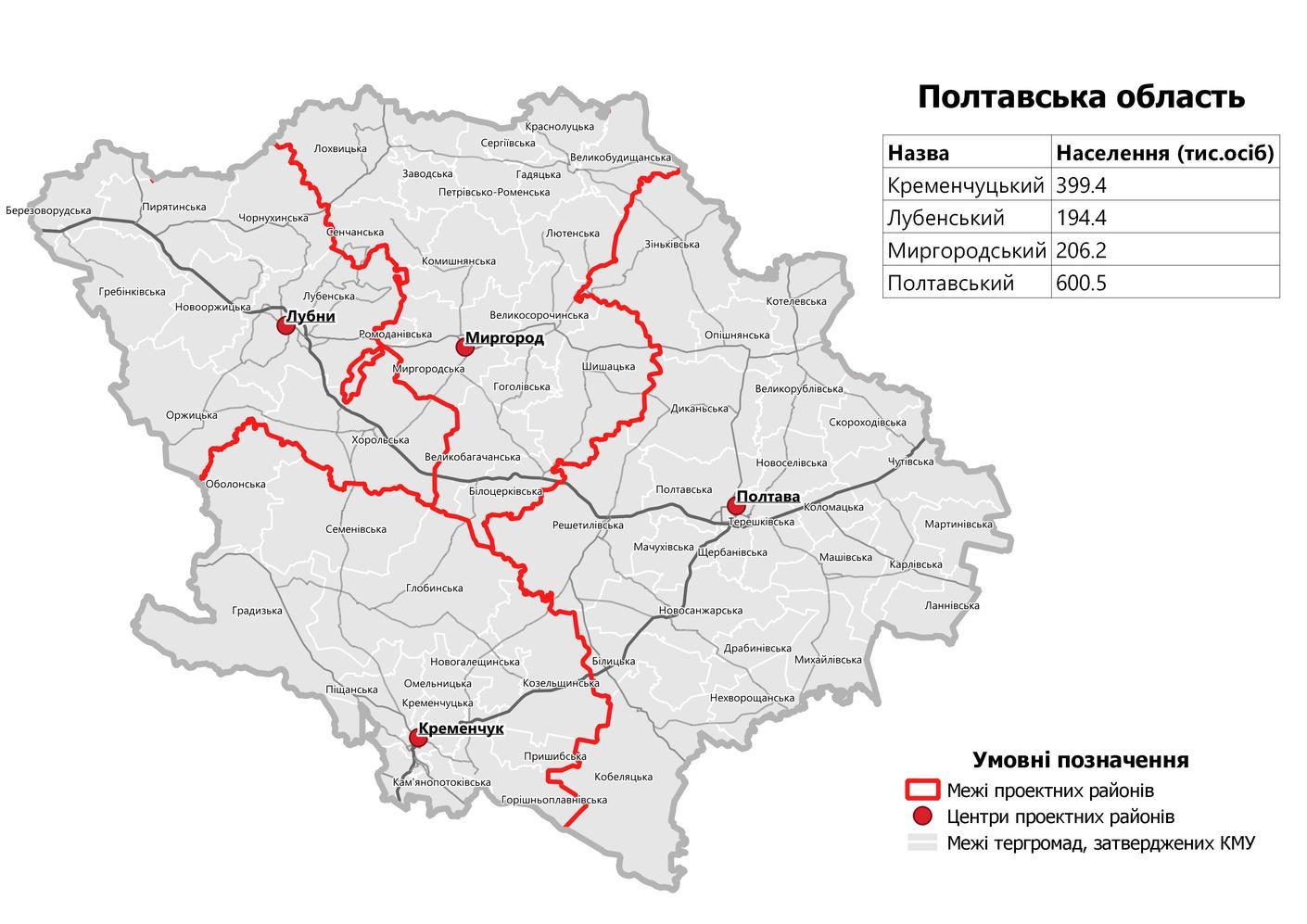
Main article: Administrative divisions of Poltava Oblast
The oblast is divided into 4 districts and 60 hromadas.
The local administration of the oblast is controlled by the Poltava Oblast Rada. The governor of the oblast is the Poltava Oblast Rada speaker, appointed by the President of Ukraine.
The following data incorporates the number of each type of administrative divisions of the Poltava Oblast:
- Administrative centre – 1 (Poltava)
- Raions – 4
- Hromadas – 60 On 18 July 2020, the number of raions was reduced to four. These are:
- Kremenchuk Raion (Кременчуцький район), the center is in the city of Kremenchuk;
- Lubny Raion (Лубенський район), the center is in the city of Lubny;
- Myrhorod Raion (Миргородський район), the center is in the city of Myrhorod;
- Poltava Raion (Полтавський район), the center is in the city of Poltava.
Until 2020
| Name | Ukrainian name | Area | ||
|---|---|---|---|---|
| (km2) | Population | |||
| census 2015 | Admin. center | Urban population | ||
| Poltava | ||||
| Horishni Plavni | ||||
| Kremenchuk | ||||
| Lubny | ||||
| Myrhorod | ||||
| Chornukhy Raion | ||||
| Chutove Raion | ||||
| Dykanka Raion | ||||
| Hadiach Raion | ||||
| Hlobyne Raion | ||||
| Hrebinka Raion | ||||
| Karlivka Raion | ||||
| Khorol Raion | ||||
| Kobeliaky Raion | ||||
| Kotelva Raion | ||||
| Kozelshchyna Raion | ||||
| Kremenchuk Raion | ||||
| Lokhvytsia Raion | ||||
| Lubny Raion | ||||
| Mashivka Raion | ||||
| Myrhorod Raion | ||||
| Novi Sanzhary Raion | ||||
| Orzhytsia Raion | ||||
| Poltava Raion | ||||
| Pyriatyn Raion | ||||
| Reshetylivka Raion | ||||
| Semenivka Raion | ||||
| Shyshaky Raion | ||||
| Velyka Bahachka Raion | ||||
| Zinkiv Raion |
Note: Asterisks (*) Though the administrative center of the raion is housed in the city that it is named after, cities do not answer to the raion authorities only towns do; instead they are directly subordinated to the oblast government and therefore are not counted as part of raion statistics.
Nomenclature
Most of Ukraine's oblasts are named after their capital cities, officially referred to as "oblast centers" (, translit. oblasnyi tsentr). The name of each oblast is a relative adjective, formed by adding a feminine suffix to the name of respective center city: Poltava is the center of the *Poltavs'ka oblast''' (Poltava Oblast). Most oblasts are also sometimes referred to in a feminine noun form, following the convention of traditional regional place names, ending with the suffix "-shchyna", as is the case with the Poltava Oblast, *Poltavshchyna''.
Gallery
File:Украина, Полтава - Корпусный сад 02.jpg|Corpus garden File:Фонтан біля Кредмашу.jpg|Kremenchuk File:Володимирський Майдан.jpg|Lubny File:Myrgorod-resort entrance.JPG|Myrhorod File:У центрі Гадяча.JPG|Hadiach File:Karlivka2.jpg|Karlivka File:Хорол. Успенська церква.JPG|Khorol File:Троїцька церква. Котельва.JPG|Kotelva File:Залізничний вокзал (Кременчук).jpg|Railway station in Kremenchuk File:Пам'ятник Загиблим у Великій Вітчизняній Війні. с. Оболонь. Полтавська область.jpg|Monument to those killed in the Second World War File:Russian Field Artillery - Detail of Diorama of Battle of Poltava - Battle of Poltava History Museum.jpg|Detail of Diorama of Battle of Poltava File:Deevka.jpg|Deivka
References
References
- (2011). "Toponymic Guidelines for Map and Other Editors for International Use". DerzhHeoKadastr and Kartographia.
- "Валовий регіональний продукт".
- "Sub-national HDI - Area Database - Global Data Lab".
- Law, Gwillim. (2010). "Administrative Subdivisions of Countries: A Comprehensive World Reference, 1900 through 1998". McFarland & Company, Inc., Publishers.
- {{in lang. uk [http://pop-stat.mashke.org/ukraine-ethnic2001.htm Етнічний склад населення України, 2001 рік]
- [http://db.ukrcensus.gov.ua/MULT/Database/Census/databasetree_en.asp Банк даних, перепис 2001 року]
- "Poltava Oblast, Ukraine Travel Guide".
- "Динамика численности этнических украинцев в УССР: на основе итогов Всесоюзных переписей населения 1959 г., 1970 г. и 1979 г.".
- Итоги Всесоюзной переписи населения 1959 года: Украинская ССР, стр. 168—193
- Численность и состав населения СССР: по данным Всесоюзной переписи населения 1979 года. Центральное статистическое управление СССР, 1984
- ''Чорний С.'' Національний склад населення України в ХХ сторіччі (2001)
- Итоги Всесоюзной переписи населения 1970 года. Том IV — М., Статистика, 1973
- "Всеукраїнський перепис населення 2001. Розподіл населення за національністю та рідною мовою".
- "Перепис 1989. Розподіл населення за національністю та рідною мовою (0,1)".
- "Розподіл населення за національністю та рідною мовою, Полтавська область".
- "Про забезпечення функціонування української мови як державної".
- (2018-12-26). ""ПОРТРЕТИ РЕГІОНІВ": ПІДСУМКИ. Зведені дані, порівняльний аналіз між областями". [[Rating (sociological group).
- (2022-12-03). "Функціонування критичної інфраструктури, реорганізація МСЕК, "мовна" програма: відбулася сесія Полтавської обласної ради". Новини Полтавщини.
- "Про Програму розвитку та функціонування української мови як державної в усіх сферах суспільного життя у Полтавській області на 2025–2030 роки". Полтавська обласна рада.
- (2024-10-28). "Частка дописів українською мовою в соцмережах зросла до 56 %, — Центр контент-аналізу".
- ""Радикальний прогрес". У соцмережах української стало набагато більше, — дослідження".
- Barbara A. Anderson and Brian D. Silver, "Equality, Efficiency, and Politics in Soviet Bilingual Education Policy, 1934-1980," American Political Science Review 78 (December 1984): 1019-1039.
- "Джерело".
- "Збірник «Статистичний щорічник України» за 2008 рік". [[State Statistics Service of Ukraine.
- "Збірник «Статистичний щорічник України» за 2012 рік". [[State Statistics Service of Ukraine.
- "Збірник «Статистичний щорічник України» за 2018 рік". [[State Statistics Service of Ukraine.
- link. link
- link. link. ()
- "Збірник «Статистичний щорічник України» за 2022 рік". [[State Statistics Service of Ukraine.
- "Загальна середня освіта в Україні у 2023 році".
- "Oposhnya. Pottery capital of Ukraine {{!}} Igor Sikorsky Kyiv Polytechnic Institute".
- (2020-07-18). "Про утворення та ліквідацію районів. Постанова Верховної Ради України № 807-ІХ.".
- "Нові райони: карти + склад". Міністерство розвитку громад та територій України.
- "Population Quantity".
This article was imported from Wikipedia and is available under the Creative Commons Attribution-ShareAlike 4.0 License. Content has been adapted to SurfDoc format. Original contributors can be found on the article history page.
Ask Mako anything about Poltava Oblast — get instant answers, deeper analysis, and related topics.
Research with MakoFree with your Surf account
Create a free account to save articles, ask Mako questions, and organize your research.
Sign up freeThis content may have been generated or modified by AI. CloudSurf Software LLC is not responsible for the accuracy, completeness, or reliability of AI-generated content. Always verify important information from primary sources.
Report