From Surf Wiki (app.surf) — the open knowledge base
Pollok
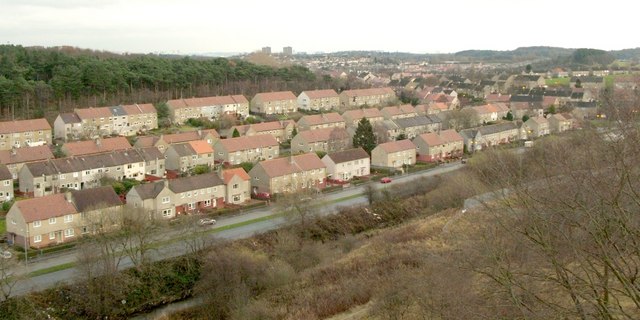
| Field | Value |
|---|---|
| country | Scotland |
| official_name | Pollok |
| gaelic_name | Pollag |
| scots_name | Powk |
| os_grid_reference | NS531620 |
| coordinates | |
| unitary_scotland | Glasgow City Council |
| lieutenancy_scotland | Glasgow |
| constituency_westminster | Glasgow South West |
| constituency_scottish_parliament | Glasgow Pollok |
| post_town | Glasgow |
| postcode_district | G53 |
| postcode_area | G |
| dial_code | 0141 |
| static_image_name | Braidcraft Road - geograph.org.uk - 1319679.jpg |
| static_image_caption | Houses on Braidcraft Road |
Pollok (, ) is a large housing estate on the south-western side of the city of Glasgow, Scotland. The estate was built either side of World War II to house families from the overcrowded inner city. Housing 30,000 at its peak, its population has since declined due to the replacement of substandard housing with lower-density accommodation. As of 2021, the population was recorded at 81,951 people.
The main features of the area are the nearby Pollok Country Park, where the Burrell Collection is now housed, the ruins of Crookston Castle (within the north part of residential Pollok) which Mary, Queen of Scots once visited, and the Silverburn Centre, one of Glasgow's major indoor retail complexes.
Location
The country park and the White Cart Water which flows through it form the northern and eastern boundary of the district, with Corkerhill and Cardonald the closest northern suburbs. Recent developments in the late 20th and early 21st century have created an adjoining neighbourhood to the west of Pollok at Crookston, Glasgow, stretching from Rosshall to Roughmussel and including conversions of the original buildings of Leverndale Hospital, alongside its newer facilities. Haugh Hill Woodland partially provides a natural barrier between Pollok and Crookston.
The Levern Water, a tributary of the White Cart, flows through Pollok from the south-west where the Househillwood and Priesthill residential areas are situated, with the Brock Burn bordering them and meeting the Levern Water in the centre of Pollok. In some contexts these neighbourhoods are referred to as separate localities, and otherwise are considered parts of 'Greater Pollok' (a ward of Glasgow City Council), along with Nitshill, South Nitshill, Parkhouse and Darnley further south which share the same G53 postcode; Househillwood is next to the district's central amenities and bus terminus.
History
Previously farmland which was purchased by the city from the Stirling-Maxwell family in 1935, Pollok was built by the old Glasgow Corporation and was the first of the 'big four' peripheral housing schemes constructed to improve Glasgow's slum housing conditions in the inner city.
.jpg)
The building of Old Pollok, as the first sector retrospectively became known, commenced in the 1930s but was interrupted by World War II. The urgent need for housing after the war along with budgetary constraints meant that the original plan to build a 'garden suburb' was abandoned in favour of higher density, lower quality housing. Unusually, one of the 'new' churches in Pollok (St James') was transplanted from Pollokshields, 2+1/2 mi away.Titwood Parish Church (Glasgow School of Art Archives, 1890s), The Glasgow Story
Pollok suffered the same social problems that also emerged from the other large housing schemes (Castlemilk, Drumchapel and Easterhouse). The slum clearance programme disrupted the networks of the old communities and the extended family. There were few shops (a central shopping centre was not added for three decades), People lived far away from their places of work and there were very few employment opportunities locally.
.jpg)
The post-war tenement buildings were of poor quality and suffered from damp, condensation and lack of soundproofing. Glasgow Corporation (later Glasgow District Council) could not maintain the buildings in the face of budgetary cuts imposed by central Government. Local manufacturing jobs were outsourced to overseas countries and unemployment rates grew to unprecedented levels. Those who were able to left the area, the remaining population enduring poverty, lack of opportunities, ill-health and lower life expectancy.
In recent years there has been a sustained effort to improve the area. Most of the post-war tenement housing has been demolished or refurbished, and new private housing has also been built among the individual houses, which lasted more successfully than the multi-floor blocks.
To the east of the residential area, Pollok House is a Georgian building constructed in 1752 with many fine paintings, and Pollok Country Park was chosen to house the "Burrell Collection" in a modern contemporary and clean air green space.
Education
.jpg)
Pollok has one secondary school: St Paul's High School, recognised as one of the 'schools of ambition' in Scotland. It was built on the site of another former school, Craigbank Secondary, which had lain empty for some years, However, St Paul's associated primary schools are in neighbourhoods to the south of Pollok proper, whereas the Pollok-based primaries are part of the 'learning community' of Lourdes Secondary School in Cardonald.
The nondenominational Rosshall Academy (completed in 2002) serves a large catchment area including much of Pollok, but replaced Penilee Secondary and Crookston Castle Secondary so was built on a site between its predecessors which falls outwith Pollok across the White Cart. In 2009 the area lost a local primary school, Bonnyholm Primary, which was merged with other schools to create Crookston Castle Primary School. It was officially opened in August 2007 on the grounds of the former Crookston Castle Secondary, close to the castle.
The former Cardonald College, now a campus of the merged Glasgow Clyde College, is near to Pollok between Cardonald and Mosspark.
Shopping

Pollok is home to the Silverburn Centre which opened in October 2007, replacing the old Pollok Shopping Centre dating from the late 1970s which itself was previously tenement housing built in the late 1940s which survived barely 30 years before being torn down. The largest of its kind in Scotland, Silverburn has brought hundreds of jobs to the area. Key stores include a 24-hour Tesco Extra adjoining the centre. This was the largest store in Scotland when it opened in July 2006. Other anchor stores are M&S, Debenhams (now closed) and Next. Altogether, the centre houses 95 shopping units and 14 restaurants and cafés. A cinema complex with further restaurants was later added as an extension in 2015.
Other amenities
.jpg)
Next to the Silverburn Centre is the Pollok civic realm, renovated in 2009 containing an extended Health Centre and the Pollok Library and Swimming Pool. There is another sports centre, Nethercraigs, at the north-east of Pollok near Corkerhill.
Transport
Pollok is about 7 mi from Glasgow International Airport, and 24 mi from Glasgow Prestwick Airport. The area is accessible from Junctions 2 and 3 of the M77 motorway, and the main bus terminus is Silverburn bus station.
Pollok is served by five nearby railway stations which run to central Glasgow, although none in the district itself; these are , and to the south on the Glasgow South Western Line, and and to the north on the Paisley Canal line.
References
- A History of Mearns Parish by J.A. Stang 1939 hand-typed document circa 500 pages donated to the Mitchel Library Glasgow ref Shelfmark: 597928-30 A History of Mearns Parish by J.A. Stang, 1939, hand-typed document circa 500 pages donated to the Mitchell Library Glasgow ref Shelfmark: 597928-30
References
- "statistics.gov.scot : http://statistics.gov.scot/data/population-estimates-2011-datazone-linked-dataset/year/2021/S16000119/age/all/sex/all/people/count".
- [http://www.storypilgrim.co.uk/artwork/dragon-Haugh hill The Dragon of Haughhill], Owen Pilgrim, February 2015
- [http://blueskyscotland.blogspot.com/2014/01/pollokpriesthillnitshillthe.html?m=1 Pollok.Priesthill.Nitshill.The Bundy.Gowanbank.Silverburn.Schools, Memories, and Pubs], Alex and Bob's Blue Sky Scotland, 21 January 2014
- [https://www.theglasgowstory.com/image/?inum=TGSH00013&t=2 Greenend and Braidcraft (Pollok House, 1830)], The Glasgow Story
- [https://www.theglasgowstory.com/image/?inum=TGSH00043&t=2 Honey Mugs (Pollok House, 1830)], The Glasgow Story
- [https://www.theglasgowstory.com/image/?inum=TGSH00024&t=2 The Byres (Pollok House, 1830)], The Glasgow Story
- [https://www.theglasgowstory.com/image/?inum=TGSH00017&t=2 The Linthaugh (Pollok House, 1830)], The Glasgow Story
- [https://www.theglasgowstory.com/story/?id=TGSEG03 No Mean City: 1914 to 1950s: Neighbourhoods: Pollok], The Glasgow Story
- [https://www.theglasgowstory.com/image/?inum=TGSA00776&t=1 Pollok Housing (Glasgow City Archives, Department of Architectural and Civic Design, 1938)], The Glasgow Story
- [https://www.theglasgowstory.com/image/?inum=TGSA05270&t=2 Bridgend Road (Glasgow City Archives, Department of Architectural and Civic Design, 1949)], the Glasgow Story
- [https://www.theglasgowstory.com/image/?inum=TGSA05274&t=2 Kempsthorn Road (Glasgow City Archives, Department of Architectural and Civic Design, 1950)], The Glasgow Story
- [https://www.theglasgowstory.com/image/?inum=TGSA05271&t=2 Maukinfauld Road (Glasgow City Archives, Department of Architectural and Civic Design, 1947)], The Glasgow Story
- [https://www.eveningtimes.co.uk/lifestyle/13222070.memories-twisting-tale-of-moving-church/ Memories: Twisting tale of moving church], Evening Times, 15 June 2011
- [https://canmore.org.uk/site/166350/glasgow-183-meiklerig-crescent-st-james-pollok-church Glasgow, 183 Meiklerig Crescent, St James Pollok Church], [[Canmore (database). Canmore]]
- no pubs, cinemas or leisure facilities. Even schools, something which eventually were well provisioned, were not built until some years after the main wave of housing, with pupils being transported to facilitates elsewhere at considerable cost and disruption.[https://api.parliament.uk/historic-hansard/commons/1950/apr/18/housing-estates-Glasgow-schools Housing Estates, Glasgow (Schools)], [[Hansard]], 18 April 1950
- [https://canmore.org.uk/site/289342/glasgow-36-damshot-road-st-pauls-rc-high-school Glasgow, 36 Damshot Road, St Paul's Rc High School], [[Canmore (database). Canmore]]
- [https://www.heraldscotland.com/news/12152443.bellarmine-celebration/ Bellarmine celebration], 7 October 2000
- [http://www.st-paulshigh.glasgow.sch.uk/PlainText/PlainText.aspx?SectionId=810398a5-4e16-4366-9b94-67cc826989ae Learning Community], [[St Paul's High School, Glasgow]]
- [https://blogs.glowscotland.org.uk/gc/LourdesSecondarySchool/our-school/our-community/primary-schools/ Primary Schools], [[Lourdes Secondary School]]
- [https://www.theglasgowstory.com/story/?id=TGSFG11 Modern Times: 1950s to The Present Day: Neighbourhoods: Pollok, 1979)], The Glasgow Story
- [https://www.urbanrealm.com/news/1455/Pollok_civic_realm_opens.html Pollok civic realm opens], Urban Realm, 20 May 2009
- [https://www.eveningtimes.co.uk/news/13261172.library-users-anger-as-wi-fi-is-removed/ Library users' anger as wi-fi is removed], Evening Times, 5 August 2013
- [https://www.theglasgowstory.com/image/?inum=TGSA00917 Pollok Leisure Pool (Mitchell Library, Glasgow Collection, Bulletin Photographs, 1986)], The Glasgow Story
- [https://www.glasgowlife.org.uk/sport/venues/glasgow-club-pollok Glasgow Club Pollok], Glasgow Life
- [https://www.glasgowlife.org.uk/sport/venues/glasgow-club-nethercraigs Glasgow Club Nethercraigs], Glasgow Life
- (1 January 2018). "Frequency Guide". [[First Glasgow]].
- (1 January 2018). "Glasgow Network Map". [[First Glasgow]].
This article was imported from Wikipedia and is available under the Creative Commons Attribution-ShareAlike 4.0 License. Content has been adapted to SurfDoc format. Original contributors can be found on the article history page.
Ask Mako anything about Pollok — get instant answers, deeper analysis, and related topics.
Research with MakoFree with your Surf account
Create a free account to save articles, ask Mako questions, and organize your research.
Sign up freeThis content may have been generated or modified by AI. CloudSurf Software LLC is not responsible for the accuracy, completeness, or reliability of AI-generated content. Always verify important information from primary sources.
Report