From Surf Wiki (app.surf) — the open knowledge base
Poll taxes in the United States
Tax required to vote

Tax required to vote
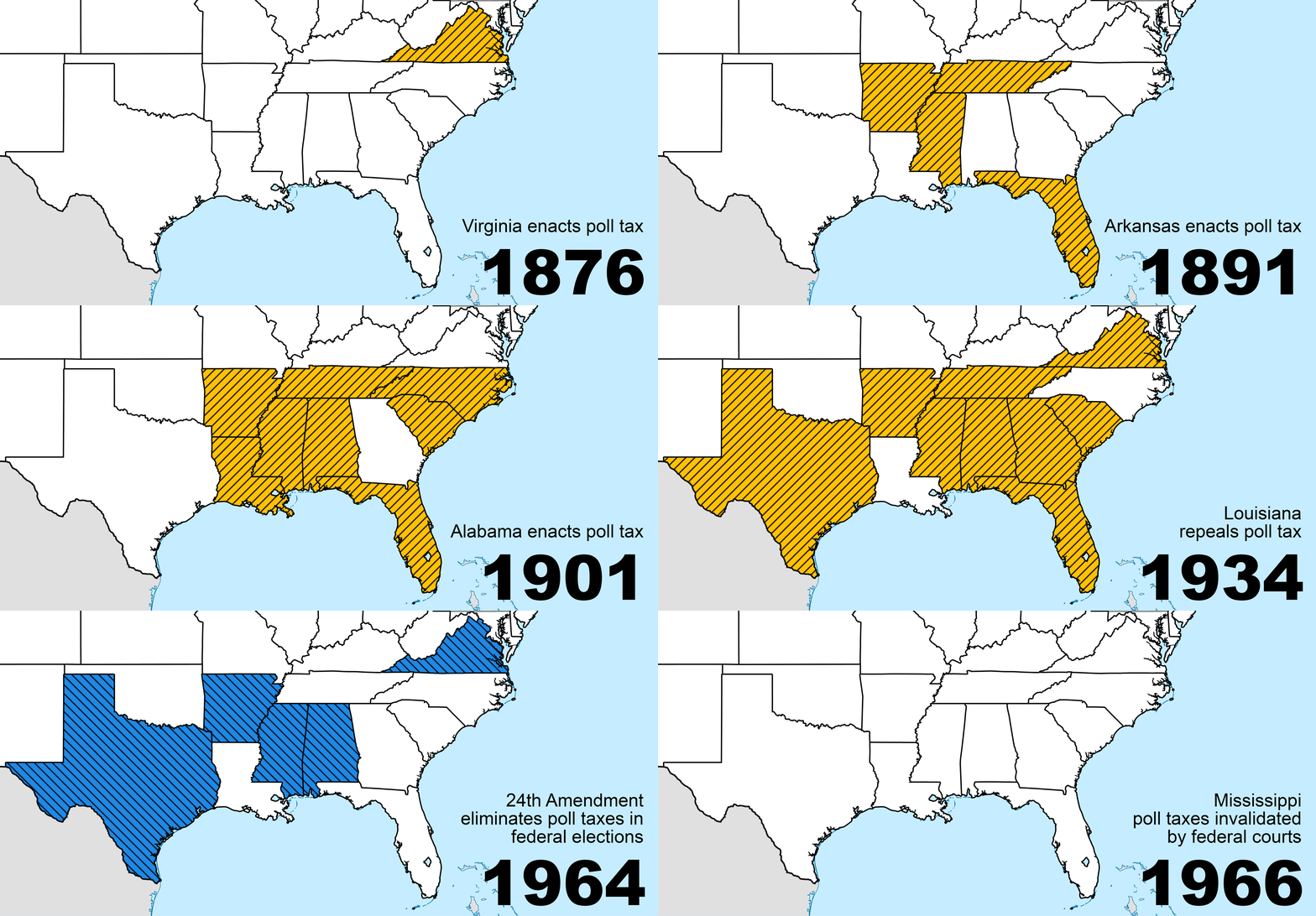
Poll taxes were used in the United States until they were outlawed under section 10 of the Voting Rights Act of 1965. Poll taxes (taxes of a fixed amount on every liable individual, regardless of their income) had also been a major source of government funding among the colonies and states which went on to form the United States. Poll taxes became a tool of disenfranchisement in the South during Jim Crow, following the end of Reconstruction. The 24th Amendment, ratified 23 January 1964, abolished the use poll taxes for Federal elections in the United States. The operative clause reads:
The ratification of the 24th Amendment was followed by the passage of the Voting Rights Act of 1965, to which section 10 empowered the United States Attorney General to bring lawsuits to enjoin poll taxes in State and local elections. Finally, in Harper v. Virginia State Board of Elections (1966), the Supreme Court held that poll taxes violated the Equal Protection Clause of the 14th Amendment.
Description
A poll tax is a tax of a fixed sum on every liable individual (typically every adult), without reference to income or resources. Various privileges of citizenship, including voter registration or issuance of driving licenses and resident hunting and fishing licenses, were conditioned on payment of poll taxes to encourage the collection of this tax revenue. In places that instituted a cumulative poll tax, missed poll taxes from prior years must also be paid to receive the restricted privileges.
History
Although often associated with states of the former Confederate States of America, poll taxes were also in place in some northern and western states, including California, Connecticut, Maine, Massachusetts, Minnesota, New Hampshire, Ohio, Pennsylvania, Vermont, Rhode Island, and Wisconsin. Poll taxes had been a major source of government funding among the colonies which formed the United States. For instance, poll taxes made up from one-third to one-half of the tax revenue of colonial Massachusetts.
Property taxes assumed a larger share of tax revenues as land values rose when population increases encouraged settlement of the American West. Some western states found no need for poll tax requirements; but poll taxes and payment incentives remained in eastern states.
Voter registration
Poll taxes became a tool of disenfranchisement in the South during Jim Crow, following the end of Reconstruction. Payment of a poll tax was a prerequisite to the registration for voting in a number of states until 1965. The tax emerged in some states of the United States in the late nineteenth century as part of the Jim Crow laws. After the right to vote was extended to all races by the enactment of the Fifteenth Amendment to the United States Constitution, a number of states enacted poll tax laws as a device for restricting voting rights. The laws often included a grandfather clause, which allowed any adult male whose father or grandfather had voted in a specific year prior to the abolition of slavery to vote without paying the tax. These laws, along with unfairly implemented literacy tests and extra-legal intimidation, such as by the Ku Klux Klan, achieved the desired effect of disenfranchising Asian-American, Native American voters and poor whites as well, but in particular the poll tax was disproportionately directed at African-American voters.
Proof of payment of a poll tax was a prerequisite to voter registration in Florida, Alabama, Tennessee, Arkansas, Louisiana, Mississippi, Georgia (1877), North and South Carolina, Virginia (until 1882 and again from 1902 with its new constitution), and Texas (1902). The Texas poll tax, instituted on people who were eligible to vote in all other respects, was between $1.50 and $1.75 . This was "a lot of money at the time, and a big barrier to the working classes and poor."
The poll tax requirements applied to whites as well as blacks, and also adversely affected poor citizens. The laws that allowed the poll tax did not specify a certain group of people. This meant that anyone, including white women, could also be discriminated against when they went to vote. One example is in Alabama where white women were discriminated against and then organized to secure their right to vote. One group of women that did this was the Women's Joint Legislative Council of Alabama (WJLC). Gaffney sued for her right to vote after having been stopped from registering to vote two years earlier. As a result of her suing the county the mailman did not deliver her mail for quite some time.
Many states required payment of the tax at a time separate from the election, and then required voters to bring receipts with them to the polls. If they could not locate such receipts, they could not vote. In addition, many states surrounded registration and voting with complex record-keeping requirements. These were particularly difficult for sharecropper and tenant farmers to comply with, as they moved frequently.
The poll tax was sometimes used alone or together with a literacy qualification. In a kind of grandfather clause, North Carolina in 1900 exempted from the poll tax those men entitled to vote as of January 1, 1867. This excluded all blacks, who did not then have suffrage.
Judicial challenge
In 1937, in Breedlove v. Suttles, 302 U.S. 277 (1937), the United States Supreme Court found that poll tax as a prerequisite for registration to vote was constitutional. The case involved the Georgia poll tax of $1 (). Georgia abolished its poll tax in 1945. Florida repealed its poll tax in 1937.{{cite book |editor1-first=David R. |editor1-last=Colburn |editor2-first=Jane L. |editor2-last=Landers}}
The 24th Amendment, ratified in 1964, abolished the use of the poll tax (or any other tax) as a pre-condition for voting in federal elections, but made no mention of poll taxes in state elections. The Voting Rights Act of 1965 made clarifying remarks which helped to outlaw the practice nationwide, as well as make it enforceable by law.
In the 1966 case of Harper v. Virginia State Board of Elections, the Supreme Court reversed its decision in Breedlove v. Suttles to also include the imposition of poll taxes in state elections as violating the Equal Protection Clause of the 14th Amendment to the United States Constitution.
The Harper ruling was one of several that relied on the Equal Protection clause of the 14th Amendment rather than the more direct provision of the 24th Amendment. In a two-month period in the spring of 1966, Federal courts declared unconstitutional poll tax laws in the last four states that still had them, starting with Texas on February 9. Decisions followed for Alabama (March 3) and Virginia (March 25). Mississippi's $2.00 poll tax () was the last to fall, declared unconstitutional on April 8, 1966, by a federal panel. Virginia attempted to partially abolish its poll tax by requiring a residence certification, but the Supreme Court rejected the arrangement in 1965 in Harman v. Forssenius.
Poll taxes by state
| State | Cost | Implementation | Repeal | |||||||||||||||
|---|---|---|---|---|---|---|---|---|---|---|---|---|---|---|---|---|---|---|
| Alabama | $1.50 | last1=Williams | first1=Frank B. Jr. | title=The Poll Tax as a Suffrage Requirement in the South, 1870-1901 | journal=The Journal of Southern History | date=November 1952 | volume=18 | issue=4 | pages=469–496 | doi=10.2307/2955220 | url=https://www.jstor.org/stable/2955220 | access-date=28 October 2020 | publisher=Southern Historical Association | location=Athens, Georgia | jstor=2955220 | issn=0022-4642 | url-access=subscription }} | 1966 |
| Arkansas | $1.00 | 471}} | 1964 | |||||||||||||||
| California | $2.00 | 1850 | 1914 | |||||||||||||||
| Connecticut | ? | 1649 | 1947 | |||||||||||||||
| Delaware | ? | 471}} | ||||||||||||||||
| Florida | $1.00 | 471}} | 1937 | |||||||||||||||
| Georgia | $1.00 | last=Ogden | first=Frederic D. | title=The Poll Tax in the South | url=https://archive.org/details/polltaxinsouth00ogde/page/4/mode/1up | year=1958 | publisher=University of Alabama Press | location=Birmingham, Alabama | oclc=918357443 | page=4}} | 1945 | |||||||
| Louisiana | $1.00 | 471}} | 1934 | |||||||||||||||
| Maine | $3.00 | 1845 | 1973 | |||||||||||||||
| Massachusetts | $3.00 | 470}} | 470}} | |||||||||||||||
| Minnesota | $1.00 | 1863 | ? | |||||||||||||||
| Mississippi | $2.00 | 471}} | 1966 | |||||||||||||||
| New Hampshire | ? | ? | ? | |||||||||||||||
| North Carolina | ? | 471}} | 1920 | |||||||||||||||
| Ohio* | ? | ? | ? | |||||||||||||||
| Oklahoma | $2.00 | 1907 | 1986 | |||||||||||||||
| Pennsylvania | ? | 470}} | 1933 | |||||||||||||||
| Rhode Island | $1.00 | 470}} | ? | |||||||||||||||
| South Carolina | $1.00 | 471}} | 1951 | |||||||||||||||
| Tennessee | $1.00 | 471}} | 1953 | |||||||||||||||
| Texas | $1.50 to 1.75 | 471}} | 1966 | |||||||||||||||
| Vermont | $1.00 | 1778 | 1982 | |||||||||||||||
| Virginia | $65.00 in 2021 | 471}} | 1966 | |||||||||||||||
| Wisconsin | ? | ? | ? |
References
Informational notes
Citations
Further reading
References
- (January 31, 1964). "The Constitution: The 24th Amendment". TIME.
- "Doctrine on Abolition of Poll Tax {{!}} Constitution Annotated {{!}} Congress.gov {{!}} Library of Congress".
- Erb, Kelly Phillips. "For Election Day, A History Of The Poll Tax In America".
- (2023-08-08). "How Jim Crow‑Era Laws Suppressed the African American Vote for Generations".
- "Interpretation: The Twenty-Fourth Amendment {{!}} Constitution Center".
- State of Maine Special Tax Commission. (1890). "Report of the Special Tax Commission of Maine". Burleigh & Flynt.
- Bullock, Charles J.. (1916). "The Taxation of Property and Income in Massachusetts". The Quarterly Journal of Economics.
- Greenblatt, Alan. (22 October 2013). "The Racial History Of The 'Grandfather Clause'". NPR.
- "Civil Rights Movement – Voting Rights: Are You "Qualified" to Vote? Take a "Literacy Test" to Find Out".
- "Virginia's Constitutional Convention of 1901–1902". Virginia Historical Society.
- Dabney, Virginius. (1971). "Virginia, The New Dominion". University Press of Virginia.
- "Historical Barriers to Voting". University of Texas.
- "Atlanta in the Civil Rights Movement". Atlanta Regional Council for Higher Education.
- (2002). "The Second Battle for Woman Suffrage: Alabama White Women, the Poll Tax, and V. O. Key's Master Narrative of Southern Politics". The Journal of Southern History.
- Jones-Branch, Cherisse. (2006). ""To Speak When and Where I Can": African American Women's Political Activism in South Carolina in the 1940s and 1950s". The South Carolina Historical Magazine.
- (July 2006). "'To Speak When and Where I Can': African American Women's Political Activism in South Carolina in the 1940s and 1950s". The South Carolina Historical Magazine.
- Andrews, E. Benjamin. (1912). "History of the United States". Charles Scribner's Sons.
- (2000). "Democracy, Anti-Democracy, and the Canon". Constitutional Commentary.
- Novotny, Patrick. (2007). "This Georgia Rising: Education, Civil Rights, and the Politics of Change in Georgia in The 1940s". Mercer University Press.
- Jillson, Cal. (2011-02-22). "Texas Politics: Governing the Lone Star State". Taylor & Francis.
- (1966). "The World Almanac and Book of Facts: 1966". New York World-Telegram.
- (November 1952). "The Poll Tax as a Suffrage Requirement in the South, 1870-1901". [[Southern Historical Association]].
- . (8 April 1966). ["Federal Judges Strike State's Poll Tax"](https://www.newspapers.com/clip/62809444/the-anniston-star/). *[[The Anniston Star]]*.
- (Autumn 2010). "Another Look at Disfranchisement in Arkansas, 1888—1894". [[Arkansas Historical Association]].
- (1965). "The Poll Tax: Its Impact on Racial Suffrage". [[University of Kentucky College of Law]].
- Room, Anne T. Kent California. (2021-06-18). "History of the California Poll Tax".
- "Poll Tax Receipts".
- (6 June 1937). "Dade Men Hail Teachers' Aid, Poll Tax Death". Daily News Bureau.
- Ogden, Frederic D.. (1958). "The Poll Tax in the South". [[University of Alabama Press]].
- (20 August 2020). "Constitutional Convention of 1877". Georgia Humanities.
- (2015-04-08). "State Constitution of Louisiana, 1898, Suffrage and Elections".
- (1998). "Illusion of Suffrage: Female Voting Rights and the Women's Poll Tax Repeal Movement after the Nineteenth Amendment". [[University of Notre Dame]].
- (1973). "Maine Senate Votes Repeal of Poll Tax on Adult Males". [[New York Times]].
- "Poll Tax Receipts".
- . (8 April 1966). ["Rule State Poll Tax Is Unconstitutional"](https://www.newspapers.com/clip/62636893/hattiesburg-american/). *[[Hattiesburg American*.
- "Oklahoma Repeal Poll Tax, State Question 590 (1986)".
- (Fall 2020). "Speaking of Rights and Wrongs: Fighting for Black Women's Suffrage, Part Two". Northampton County Historical and Genealogical Society.
- . (February 13, 1951). ["Poll Tax Dropped as S. C. Voting Requirement"](https://www.newspapers.com/clip/65208417/the-index-journal/). *The Index-Journal*.
- (2002). "Disfranchising Laws". [[Tennessee Historical Society]].
- (29 April 2015). "1963, 1966: Campaigns to Repeal Texas Poll Taxes".
- Congress, United States. (1965). "Congressional Record: Proceedings and Debates of the ... Congress". U.S. Government Printing Office.
- . (25 March 1966). ["High Court Kills Virginia's Poll Tax in 6-to-3 Decision (pt. 1)"](https://www.newspapers.com/clip/62831282/the-danville-register/). *[[The Danville Register]]*.
- . (25 March 1966). ["Court (pt. 2)"](https://www.newspapers.com/clip/62831461/the-danville-register/). *[[The Danville Register]]*.
This article was imported from Wikipedia and is available under the Creative Commons Attribution-ShareAlike 4.0 License. Content has been adapted to SurfDoc format. Original contributors can be found on the article history page.
Ask Mako anything about Poll taxes in the United States — get instant answers, deeper analysis, and related topics.
Research with MakoFree with your Surf account
Create a free account to save articles, ask Mako questions, and organize your research.
Sign up freeThis content may have been generated or modified by AI. CloudSurf Software LLC is not responsible for the accuracy, completeness, or reliability of AI-generated content. Always verify important information from primary sources.
Report