From Surf Wiki (app.surf) — the open knowledge base
Poles in Sweden
Citizens and residents of Sweden who emigrated from Poland
Citizens and residents of Sweden who emigrated from Poland
| Field | Value |
|---|---|
| image | PIZ 1946 Foto.jpg |
| image_caption | Poles in Sweden, 1946 |
| group | Poles in Sweden |
| Svenskpolacker | |
| Szwedzcy Polacy | |
| population | 118,060 (2024) |
| popplace | Stockholm, Malmö |
| rels | Predominantly Christianity (Roman Catholicism, Protestantism) and minority: Judaism, Irreligious |
| langs | Polish, Yiddish, Swedish |
| related | Poles, Ashkenazi Jews |
Svenskpolacker Szwedzcy Polacy Poles in Sweden () are citizens and residents of Sweden who emigrated from Poland.
Demographics
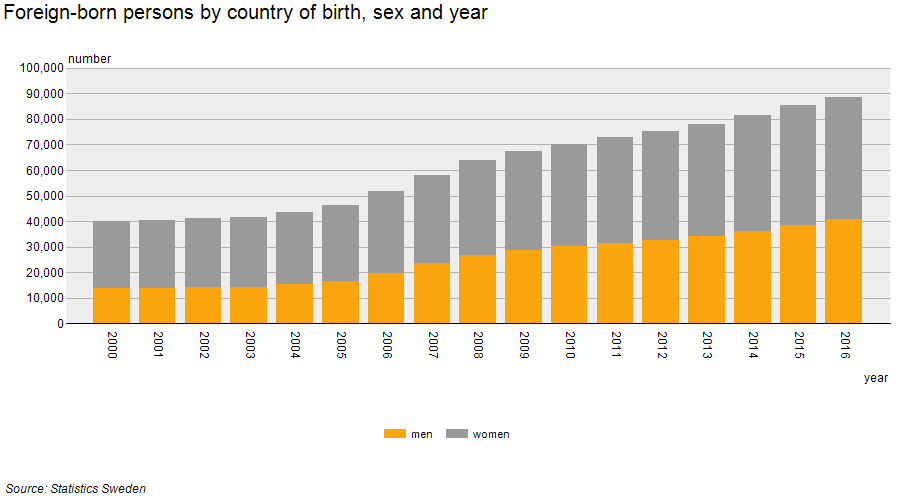
According to Statistics Sweden, as of 2024, there are a total 100,062 Poland-born immigrants living in Sweden. Both native Poles, as well as descendants of Polish Jewish immigrants from Poland.
History
Sweden was the main destination for many immigrants from partitioned Poland. In 1797, Polish national hero Tadeusz Kościuszko stayed in Stockholm and Gothenburg.
In the spring of 1863, armed Polish volunteers from Western Europe assisted by foreigners of various nationalities attempted to reach partitioned Poland by sea via Sweden. This Lapinski expedition stopped on the island of Öland and in Malmö, where it was met with sympathy of the local Swedes. The Swedish authorities, fearing Russia, were forced to put the Poles under arrest, so the Poles departed in May 1863 to attempt a naval landing near Klaipėda.
Some 200 Poles lived in Sweden in the 1920s.
During World War II, the Polish resistance movement, in cooperation with Polish outposts in Sweden, organized escapes of Poles from German-occupied Poland to Sweden by sea.
In 1948, the Polish Veterans Association in Gothenburg was established by former Polish prisoners of Nazi German concentration camps, and in 1962 it was transformed into the Polish Cultural Association in Gothenburg.
Education
In 2010, there were 4,186 students with Polish as their mother tongue who participated in the state-run Swedish for Immigrants adult language program. Of these pupils, 251 had 0–6 years of education in their home country (Antal utbildningsår i hemlandet), 241 had 7–9 years of education in their home country, and 3,694 had 10 years education or more in their home country. As of 2012, 5,100 pupils with Polish as their mother tongue and 5,079 Poland-born students were enrolled in the language program.
Organizations
There are several Polish organizations in Sweden, incl. the Polish Institute in Stockholm, the Polish Cultural Association in Gothenburg, and Polonia Center in Gothenburg.
Notable people
- Anna Anka
- Dorotea Bromberg
- Paula Bieler
- Anitha Bondestam
- Paweł Cibicki
- Wonna I DeJong
- Henrik Dorsin
- Jerzy Einhorn
- Greekazo
- Peter Jablonski
- Catherine Jagiellon
- Peter Jewszczewski
- Katrine Marcal (born Kielos to Polish immigrant parents)
- Kissie (Alexandra Nilsson-Petroniak, her mother is a Polish immigrant)
- Oscar Lewicki
- Henryk Lipp
- Stefan Liv
- Jerzy Luczak-Szewczyk
- Bea Malecki
- Dominika Peczynski
- Martin Rolinski
- Eliza Roszkowska Öberg
- Thomas Rusiak
- Jerzy Sarnecki
- Danny Saucedo
- Izabella Scorupco
- Sebastian Siemiatkowski
- Czeslaw Slania
- Amanda Sokolnicki (political editor of DN)
- Bea Szenfeld
- Robert Wahlström
- Cissi Wallin born in Sweden to Polish parents
- Michael Winiarski (journalist in DN)
- Peter Wolodarski
- Michal Zajkowski
- Maciej Zaremba
- Małgorzata Pieczyńska
- Z.E. (born to Polish parents as Józef Wojciechowicz)
- Katrin Zytomierska
Notes
References
References
- "Foreign-born persons by country of birth, age, sex and year". Statistics Sweden.
- (2007). "Immigration, Gender, and Family Transitions to Adulthood in Sweden". University Press of America.
- Zieliński, Stanisław. (1913). "Bitwy i potyczki 1863-1864. Na podstawie materyałów drukowanych i rękopiśmiennych Muzeum Narodowego w Rapperswilu". Fundusz Wydawniczy [[Polish Museum, Rapperswil.
- Żukow-Karczewski, Marek. (1989). "Polonia zagraniczna w czasach II Rzeczypospolitej".
- Chrzanowski, Bogdan. "Organizacja sieci przerzutów drogą morską z Polski do Szwecji w latach okupacji hitlerowskiej (1939–1945)". Stutthof. Zeszyty Muzeum.
- "Polski Związek Kulturalny w Göteborgu".
- (2010). "Statistical Yearbook of Sweden 2010". Statistiska Centralbyran.
- "Utbildning och forskning - Statistisk årsbok 2014". Statistics Sweden.
- "Polski Związek Kulturalny w Göteborgu".
- "Dorotea Bromberg {{!}} Medverkande personer".
- (2010-10-08). "Spion från Rinkeby god för en miljard".
- (2025-04-05). "Henrik Dorsin: ”Jag hade svårt att sova och fick domningar i ansiktet”".
- "Peter Jezewski: "Ett direkt påhopp på yttrandefriheten"".
- "Doldisen var med och byggde jättarna – här är hans nya satsning".
- "Rapparen Z.E slår tillbaka mot gangsterstämpeln: "Vi gör något större än oss"".
This article was imported from Wikipedia and is available under the Creative Commons Attribution-ShareAlike 4.0 License. Content has been adapted to SurfDoc format. Original contributors can be found on the article history page.
Ask Mako anything about Poles in Sweden — get instant answers, deeper analysis, and related topics.
Research with MakoFree with your Surf account
Create a free account to save articles, ask Mako questions, and organize your research.
Sign up freeThis content may have been generated or modified by AI. CloudSurf Software LLC is not responsible for the accuracy, completeness, or reliability of AI-generated content. Always verify important information from primary sources.
Report