From Surf Wiki (app.surf) — the open knowledge base
Polaris
Northern pole-star; brightest star in Ursa Minor

Northern pole-star; brightest star in Ursa Minor
| x%=49.54 | y%=4.775
| r-i = | v-r = | b-v = 0.60 | u-b = 0.38 | j-h = | j-k = | r-i2 = | v-r2 = | b-v2 = 0.42 | u-b2 = 0.01 | j-h2 = | j-k2 = 3.6 (α UMi Ab) 3.1 (α UMi B)
Polaris is a star in the northern circumpolar constellation of Ursa Minor. It is designated α Ursae Minoris (Latinized to Alpha Ursae Minoris) and is commonly called the North Star. With an apparent magnitude that fluctuates around 1.98, The position of the star lies less than 1° away from the north celestial pole, making it the current northern pole star. The stable position of the star in the Northern Sky makes it useful for navigation.
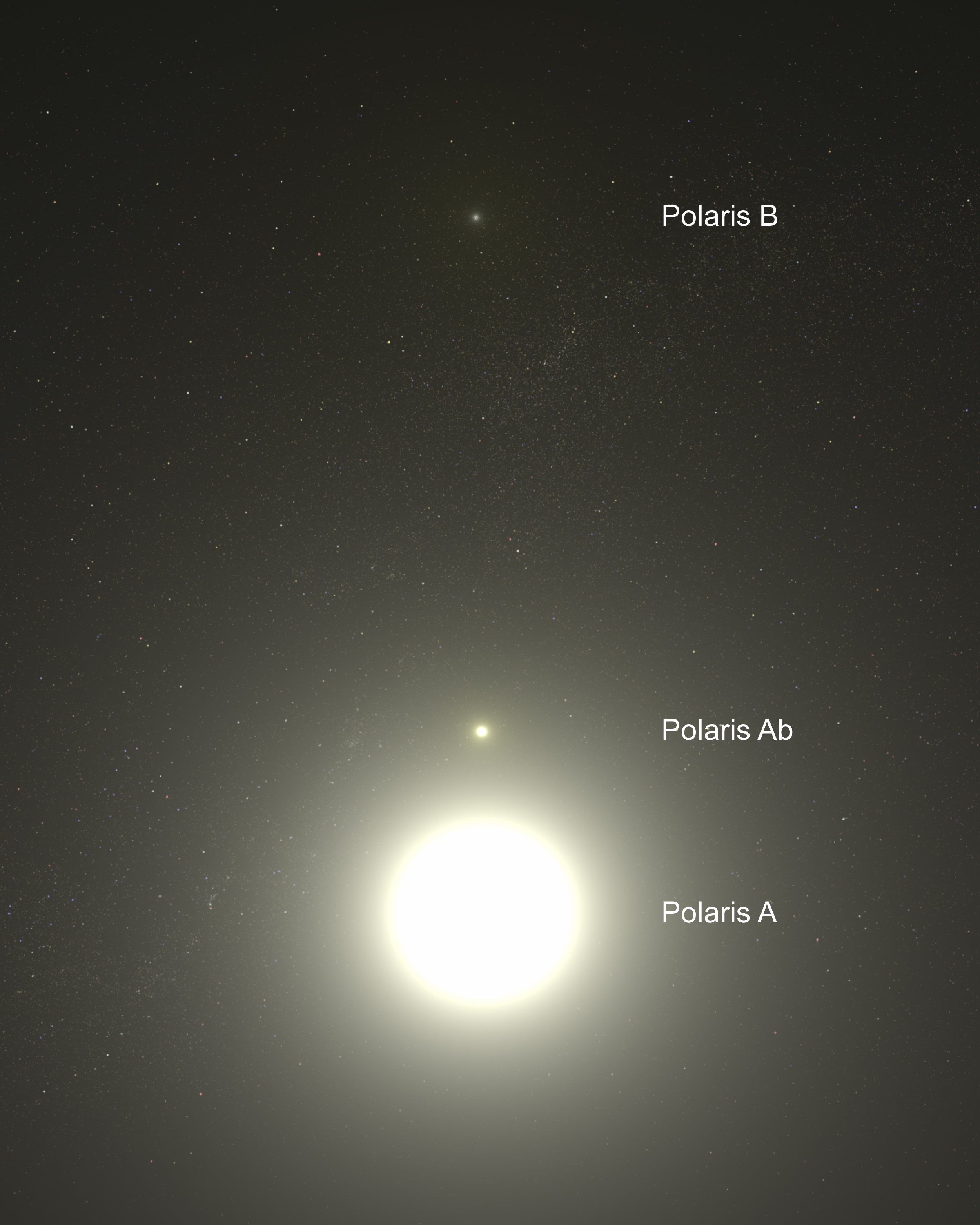
Although appearing to the naked eye as a single point of light, Polaris is a triple star system, composed of the primary, a yellow supergiant designated Polaris Aa, in orbit with a smaller companion, Polaris Ab; the pair is almost certainly in a wider orbit with Polaris B. The outer companion B was discovered in August 1779 by William Herschel, with the inner Aa/Ab pair only confirmed in the early 20th century.
As the closest Cepheid variable, Polaris Aa's distance is a foundational part of the cosmic distance ladder. The revised Hipparcos stellar parallax gives a distance to Polaris A of about (ly) ( (pc)), while the successor mission Gaia gives a distance of () for Polaris B.
Stellar system
Polaris Aa is an evolved yellow supergiant of spectral type F7Ib with 5.4 solar masses (). It is the first classical Cepheid to have a mass determined from its orbit. The two smaller companions are Polaris B, a F3 main-sequence star orbiting at a distance of (AU), and Polaris Ab (or P), a very close F6 main-sequence star with a mass of .
Polaris B can be resolved with a modest telescope. William Herschel discovered the star in August 1779 using a reflecting telescope of his own, one of the best telescopes of the time.{{cite book | display-authors=1 | first1=Bob | last1=Argyle
The variable radial velocity of Polaris A was reported by W. W. Campbell in 1899, which suggested this star is a binary system.{{cite journal | doi-access=free}}
As part of her doctoral thesis, in 1955 E. Roemer used radial velocity data to derive an orbital period of 30.46 y for the Polaris A system, with an eccentricity of 0.64.{{cite journal
There were once thought to be two more widely separated components—Polaris C and Polaris D—but these have been shown not to be physically associated with the Polaris system.
Observation
Variability

Polaris Aa, the supergiant primary component, is a low-amplitude population I classical Cepheid variable, although it was once thought to be a type II Cepheid due to its high galactic latitude. Cepheids constitute an important standard candle for determining distance, so Polaris, as the closest such star, is heavily studied. The variability of Polaris had been suspected since 1852; this variation was confirmed by Ejnar Hertzsprung in 1911.{{cite journal
The range of brightness of Polaris is given as 1.86–2.13, but the amplitude has changed since discovery. Prior to 1963, the amplitude was over 0.1 magnitude and was very gradually decreasing. After 1966, it very rapidly decreased until it was less than 0.05 magnitude; since then, it has erratically varied near that range. It has been reported that the amplitude is now increasing again, a reversal not seen in any other Cepheid.
The period, roughly 4 days, has also changed over time. It has steadily increased by around 4.5 seconds per year except for a hiatus in 1963–1965. This was originally thought to be due to secular redward evolution across the Cepheid instability strip, but it may be due to interference between the primary and the first-overtone pulsation modes. Authors disagree on whether Polaris is a fundamental or first-overtone pulsator and on whether it is crossing the instability strip for the first time or not.
The temperature of Polaris varies by only a small amount during its pulsations, but the amplitude of this variation is variable and unpredictable. The erratic changes of temperature and the amplitude of temperature changes during each cycle, from less than to at least , may be related to the orbit with Polaris Ab.

Research reported in Science suggests that Polaris is 2.5 times brighter today than when Ptolemy observed it, changing from third to second magnitude. Astronomer Edward Guinan considers this to be a remarkable change and is on record as saying that "if they are real, these changes are 100 times larger than [those] predicted by current theories of stellar evolution".
Torres 2023 published a broad historical compilation of radial velocity and photometric data. He concludes that the change in the Cepheid period has reversed and is now decreasing since roughly 2010. Torres notes that TESS data is of limited utility: as a survey telescope, TESS is optimized for dimmer stars than Polaris, so Polaris significantly over-saturates TESS's cameras. Determining an accurate total brightness for Polaris from TESS is extremely difficult, although it remains suitable for timing the period.
Furthermore, apparent irregularities in Polaris Aa's behavior may coincide with the periastron passage of Ab, although imprecision in the data prevents a definitive conclusion. At the Gaia distance, the Aa-Ab closest approach is ; the radius of the primary supergiant is , meaning that the periastron separation is about 29 times its radius. This implies tidal forcing upon Aa's upper atmosphere by Ab. Such binary tidal forcing is known from heartbeat stars, where eccentric periastron approaches cause rich multimode pulsation akin to an electrocardiogram.
Szabados 1992 suggests that, among Cepheids, "phase slips" similar to what happened to Polaris in the mid 1960s are associated with binary systems.
In 2024, researchers led by Nancy Evans at the Harvard & Smithsonian published a study with fresh data on the inner binary using the interferometric CHARA Array. They improved the solution of the orbit: combining CHARA data with previous Hubble data, and in tandem with the Gaia distance of light-years, they confirmed the Cepheid radius estimate of and re-determined its mass at . The corresponding Polaris Ab mass is . Polaris remains overluminous compared to the best Cepheid evolution models, something also seen in V1334 Cygni. Polaris's rapid period change and pulsation amplitude variations are still peculiar compared to other Cepheids, but may be related to the first-overtone pulsations.
Evans et al also tentatively succeeded in imaging features on the surface of Polaris Aa: large bright and dark patches appear in close-up images, changing over time. Follow up imaging campaigns are required to confirm this detection. Polaris's age is difficult to model; current best estimates find the Cepheid to be much younger than the two main sequence components, seemingly enough to exclude a common origin, which would be quite unlikely for a triple star system.
Torres 2023 and Evans et al 2024 both suggest that recent literature cautiously agree that Polaris is a first overtone pulsator.
Role as pole star
Main article: Pole star

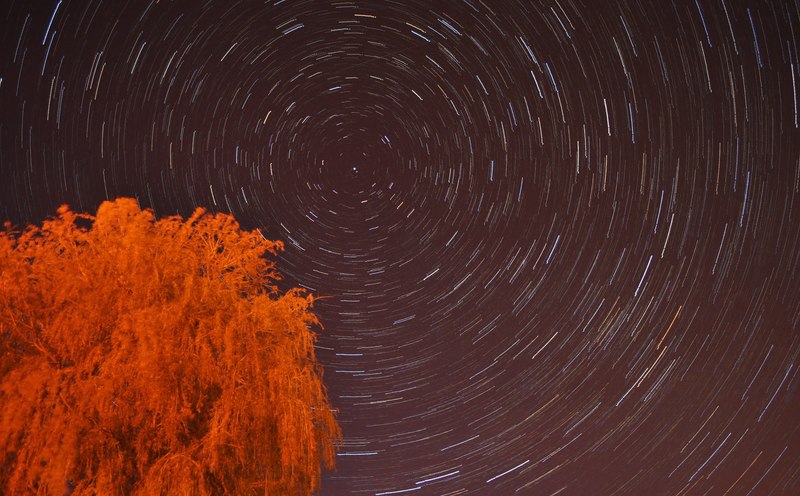

Because Polaris lies nearly in a direct line with the Earth's rotational axis above the North Pole, it stands almost motionless in the sky, and all the stars of the northern sky appear to rotate around it. It thus provides a nearly fixed point from which to draw measurements for celestial navigation and for astrometry. The elevation of the star above the horizon gives the approximate latitude of the observer.
In 2018 Polaris was 0.66° (39.6 arcminutes) away from the pole of rotation (1.4 times the Moon disc) and so revolves around the pole in a small circle 1.3° in diameter. It will be closest to the pole (about 0.45 degree, or 27 arcminutes) soon after the year 2100. Because it is so close to the celestial north pole, its right ascension is changing rapidly due to the precession of Earth's axis, going from 2.5h in AD 2000 to 6h in AD 2100. Twice in each sidereal day Polaris's azimuth is true north; the rest of the time it is displaced eastward or westward, and the bearing must be corrected using tables or a rule of thumb. The best approximation is made using the leading edge of the "Big Dipper" asterism in the constellation Ursa Major. The leading edge (defined by the stars Dubhe and Merak) is referenced to a clock face, and the true azimuth of Polaris worked out for different latitudes.
The apparent motion of Polaris towards and, in the future, away from the celestial pole, is due to the precession of the equinoxes. The celestial pole will move away from α UMi after the 21st century, passing close by Gamma Cephei by about the 41st century, moving towards Deneb by about the 91st century.
The celestial pole was close to Thuban around 2750 BCE, and during classical antiquity it was slightly closer to Kochab (β UMi) than to Polaris, although still about from either star. It was about the same angular distance from β UMi as to α UMi by the end of late antiquity. The Greek navigator Pytheas in ca. 320 BC described the celestial pole as devoid of stars. However, as one of the brighter stars close to the celestial pole, Polaris was used for navigation at least from late antiquity, and described as ἀεί φανής (aei phanēs) "always visible" by Stobaeus (5th century), also termed Λύχνος (Lychnos) akin to a burner or lamp and would reasonably be described as stella polaris from about the High Middle Ages and onwards, both in Greek and Latin. On his first trans-Atlantic voyage in 1492, Christopher Columbus had to correct for the "circle described by the pole star about the pole". In Shakespeare's play Julius Caesar, written around 1599, Caesar describes himself as being "as constant as the northern star", although in Caesar's time there was no constant northern star. Despite its relative brightness, it is not, as is popularly believed, the brightest star in the sky.
Polaris was referenced in the classic Nathaniel Bowditch maritime navigation book American Practical Navigator (1802), where it is listed as one of the navigational stars.
Names
The modern name Polaris is shortened from the Neo-Latin stella polaris ("polar star"), coined in the Renaissance when the star had approached the celestial pole to within a few degrees.
Gemma Frisius, writing in 1547, referred to it as stella illa quae polaris dicitur ("that star which is called 'polar'"), placing it 3° 8' from the celestial pole.
In 2016, the International Astronomical Union organized a Working Group on Star Names (WGSN) to catalog and standardize proper names for stars. The WGSN's first bulletin of July 2016 included a table of the first two batches of names approved by the WGSN; which included Polaris for the star α Ursae Minoris Aa.
In antiquity, Polaris was not yet the closest naked-eye star to the celestial pole, and the entire constellation of Ursa Minor was used for navigation rather than any single star. Polaris moved close enough to the pole to be the closest naked-eye star, even though still at a distance of several degrees, in the early medieval period, and numerous names referring to this characteristic as polar star have been in use since the medieval period. In Old English, it was known as scip-steorra ("ship-star").
In the "Old English rune poem", the T-rune is apparently associated with "a circumpolar constellation", or the planet Mars.
In the Hindu Puranas, it became personified under the name Dhruva ("immovable, fixed").
In the later medieval period, it became associated with the Marian title of Stella Maris "Star of the Sea" (so in Bartholomaeus Anglicus, c. 1270s), due to an earlier transcription error.
An older English name, attested since the 14th century, is lodestar "guiding star", cognate with the Old Norse leiðarstjarna, Middle High German leitsterne.
The ancient name of the constellation Ursa Minor, Cynosura (from the Greek κυνόσουρα "the dog's tail"), became associated with the pole star in particular by the early modern period. An explicit identification of Mary as stella maris with the polar star (Stella Polaris), as well as the use of Cynosura as a name of the star, is evident in the title Cynosura seu Mariana Stella Polaris (i.e. "Cynosure, or the Marian Polar Star"), a collection of Marian poetry published by Nicolaus Lucensis (Niccolo Barsotti de Lucca) in 1655.

Its name in traditional pre-Islamic Arab astronomy was al-Judayy الجدي ("the kid", in the sense of a juvenile goat ["le Chevreau"] in Description des Etoiles fixes),{{cite book
It was invoked as a symbol of steadfastness in poetry, as "steadfast star" by Spenser. Shakespeare's sonnet 116 is an example of the symbolism of the north star as a guiding principle: "[Love] is the star to every wandering bark / Whose worth's unknown, although his height be taken."
In Julius Caesar, Shakespeare has Caesar explain his refusal to grant a pardon: "I am as constant as the northern star/Of whose true-fixed and resting quality/There is no fellow in the firmament./The skies are painted with unnumbered sparks,/They are all fire and every one doth shine,/But there's but one in all doth hold his place;/So in the world" (III, i, 65–71). Of course, Polaris will not "constantly" remain as the north star due to precession, but this is only noticeable over centuries.
In Inuit astronomy, Polaris is known as Nuutuittuq (syllabics: ᓅᑐᐃᑦᑐᖅ).
In traditional Lakota star knowledge, Polaris is named "Wičháȟpi Owáŋžila". This translates to "The Star that Sits Still". This name comes from a Lakota story in which he married Tȟapȟúŋ Šá Wíŋ, "Red Cheeked Woman". However, she fell from the heavens, and in his grief Wičháȟpi Owáŋžila stared down from "waŋkátu" (the above land) forever.
The Plains Cree call the star in Nehiyawewin: acâhkos êkâ kâ-âhcît "the star that does not move" (syllabics: ᐊᒑᐦᑯᐢ ᐁᑳ ᑳ ᐋᐦᒌᐟ).
In Mi'kmawi'simk the star is named Tatapn.
In the ancient Finnish worldview, the North Star has also been called taivaannapa and naulatähti ("the nailstar") because it seems to be attached to the firmament or even to act as a fastener for the sky when other stars orbit it. Since the starry sky seemed to rotate around it, the firmament is thought of as a wheel, with the star as the pivot on its axis. The names derived from it were sky pin and world pin.
Distance
Since Leavitt's discovery of the Cepheid variable period-luminosity relationship, and corresponding utility as a standard candle, the distance to Polaris has been highly sought-after by astronomers. It is the closest Cepheid to Earth, and thus key to calibrating the Cepheid standard candle; Cepheids form the base of the cosmic distance ladder by which to probe the cosmological nature of the universe.
Distance measurement techniques depend on whether or not components A and B are a physical pair, that is, gravitationally bound. If they are, then their estimated distance can be presumed to be equal. Gravitational binding of this pair is well supported by observations, and the presumption of common distance is widely adopted in historical and recent estimates.
For most of the 20th century, available observation technologies remained inadequate to precisely measure absolute parallax. or Cepheid modeling.
Further progress was thus limited until the advent of Hipparcos, the first instrument able to engage in all-sky absolute parallax astrometry. Its first data release was in 1997.
| Published | Component | Distance | Source | Notes | ly | pc | 1966 | 1977 | 1978 | 1996 | 1997 | 2004-2013 | 2007 | 2008 | 2014 | 2018 | 2018 | 2020 | |||||||||||||||||||||
|---|---|---|---|---|---|---|---|---|---|---|---|---|---|---|---|---|---|---|---|---|---|---|---|---|---|---|---|---|---|---|---|---|---|---|---|---|---|---|---|
| B | () | () | last1=Fernie | first1=J. D. | title=Classical Cepheids with companions. II. Polaris. | journal=Astronomical Journal | date=1966 | volume=71 | page=732 | doi=10.1086/110179 | bibcode=1966AJ.....71..732F}} | Photometry and modeling of B | |||||||||||||||||||||||||||
| B | () | () | last1=Turner | first1=D. G. | title=A Note on the Reddening of Polaris B | journal=Publications of the Astronomical Society of the Pacific | date=1977 | volume=89 | page=550 | doi=10.1086/130161 | bibcode=1977PASP...89..550T }} | Photometry and modeling of B | |||||||||||||||||||||||||||
| A | last1=Gauthier | first1=R. P. | last2=Fernie | first2=J. D. | title=The reddening of Polaris | journal=Publications of the Astronomical Society of the Pacific | date=1978 | volume=90 | page=739 | doi=10.1086/130422 | bibcode=1978PASP...90..739G }} | Modeling extinction and Cepheid evolution of A | |||||||||||||||||||||||||||
| B | Kamper | Photometry and modeling of B, reproducing prior estimates | |||||||||||||||||||||||||||||||||||||
| A | last1=Feast | first1=M. W. | last2=Catchpole | first2=R. M. | title=The Cepheid period-luminosity zero-point from HIPPARCOS trigonometrical parallaxes | journal=Monthly Notices of the Royal Astronomical Society | date=1997 | volume=286 | issue=1 | pages=L1–L5 | doi=10.1093/mnras/286.1.L1 | doi-access=free | bibcode=1997MNRAS.286L...1F }} | last1=Brown | first1=Anthony G. A. | title=Microarcsecond Astrometry: Science Highlights from Gaia | journal=Annual Review of Astronomy and Astrophysics | date=2021 | volume=59 | page=59 | doi=10.1146/annurev-astro-112320-035628 | arxiv=2102.11712 | bibcode=2021ARA&A..59...59B }} parallax observations, of the primary variable | ||||||||||||||||
| A, B | Turner/Turner et al | Cepheid evolution modeling, photometry and modeling of B, spectral line ratios of A calibrated on yellow supergiants | |||||||||||||||||||||||||||||||||||||
| A | last1 = Van Leeuwen | first1 = F. | title = Validation of the new Hipparcos reduction | doi = 10.1051/0004-6361:20078357 | journal = Astronomy and Astrophysics | volume = 474 | issue = 2 | pages = 653–664 | year = 2007 | arxiv = 0708.1752 | bibcode = 2007A&A...474..653V | s2cid = 18759600 }} | All-sky/absolute parallax observations, revised analysis, of the primary variable | ||||||||||||||||||||||||||
| B | Usenko & Klochkova | Photometry and modeling of B | |||||||||||||||||||||||||||||||||||||
| A | bibcode=2014A&A...563A..48N | title=Revisiting the fundamental properties of the Cepheid Polaris using detailed stellar evolution models | journal=Astronomy & Astrophysics | volume=563 | pages=A48 | last1=Neilson | first1=H. R. | date=2014 | doi=10.1051/0004-6361/201423482 | arxiv = 1402.1177 | s2cid=119252434}} | Cepheid evolution modeling, independent of any distance prior | |||||||||||||||||||||||||||
| B | bibcode=2018ApJ...853...55B | title=Hubble Space Telescope Trigonometric Parallax of Polaris B, Companion of the Nearest Cepheid | journal=The Astrophysical Journal | volume=853 | issue=1 | pages=55 | last1=Bond | first1=Howard E | last2=Nelan | first2=Edmund P | last3=Remage Evans | first3=Nancy | last4=Schaefer | first4=Gail H | last5=Harmer | first5=Dianne | year=2018 | arxiv=1712.08139 | doi=10.3847/1538-4357/aaa3f9 | s2cid=118875464 | doi-access=free }} | Relative parallax of the wide component referencing photometrically-calibrated background stars | |||||||||||||||||
| B | Gaia DR2 | name=table2018 | Statistical distance calculated using a weak distance prior}} | ||||||||||||||||||||||||||||||||||||
| B | Gaia DR3 | All-sky/absolute parallax observations, of the wide component |
After the arrival of the Hipparcos data, the distance to Polaris and consequent analysis of its Cepheid variation was controversial. The Hipparcos distance for Polaris was broadly but not universally adopted. Immediately, the Hipparcos data for the nearest few hundred Cepheids appeared to clarify Cepheid models and to clear up then-tension in higher rungs of the distance ladder.
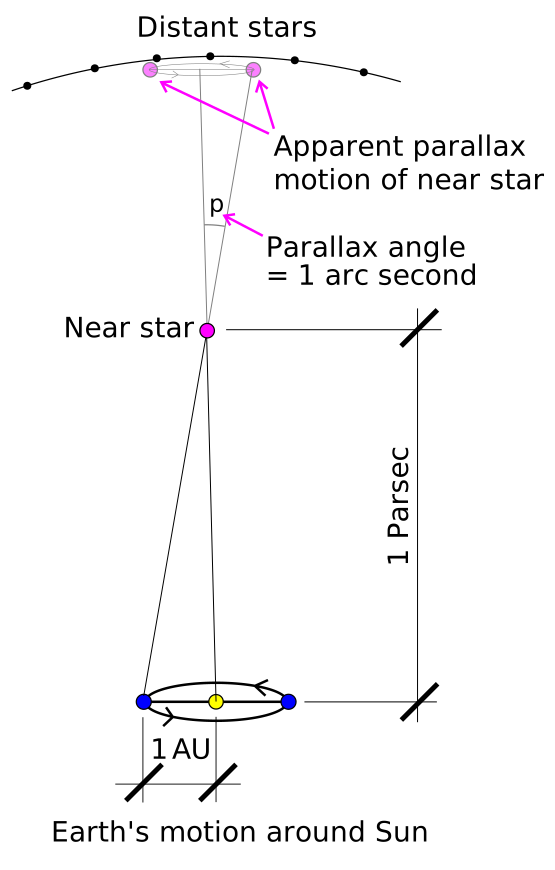
In 2018, Bond et al used the Hubble Space Telescope to provide an alternate direct measurement of Polaris's parallax; they summarize the back-and-forth:
However, Turner et al. (2013, hereafter TKUG13) argue that the parallax of Polaris is considerably larger, 10.10 ± 0.20 mas (d = pc). The evidence cited by TKUG13 for this “short” distance includes (1) a photometric parallax for Polaris B based on measured photometry, spectral classification, and main-sequence fitting; (2) a claim that there is a sparse cluster of A-, F-, and G-type stars within 3° of Polaris, with proper motions and radial velocities similar to that of the Cepheid, for which the Hipparcos parallaxes combined with main-sequence fitting give a distance of 99 pc; and (3) a determination of the absolute visual magnitude of Polaris based on line ratios in high-resolution spectra, calibrated against supergiants with well-established luminosities. [...]
[...]
In a critique of the TKUG13 paper, van Leeuwen (2013, hereafter L13) defended the Hipparcos parallax by presenting details of the solution, concluding that “the Hipparcos data cannot in any way support” the large parallax advocated by TKUG13. Using Hipparcos data, L13 also questioned the reality of the sparse cluster proposed by TKUG13, presenting evidence against it both from the color versus absolute-magnitude diagram for stars within 3° of Polaris, and their non-clustered distribution of proper motions. Lastly, L13 examined the absolute magnitudes of nearly 400 stars of spectral type F3 V in the Hipparcos catalog with parallax errors of less than 10%, and showed that the absolute magnitude of Polaris B would fall well within the observed MV distribution for F3 V stars, based on either the Hipparcos parallax of A or the larger parallax proposed by TKUG13. Thus, he concluded that the photometric parallax of B does not give a useful discriminant.
Bond et al go on to find a trigonometric parallax (independent of Hipparcos) that implies a distance further-still than the "long" Hipparcos distance, well outside the plausible range of the "short" distance estimates.
The next major step in high precision parallax measurements comes from Gaia, a space astrometry mission launched in 2013 and intended to measure stellar parallax to within (μas). Although it was originally planned to limit Gaia's observations to stars fainter than magnitude 5.7, tests carried out during the commissioning phase indicated that Gaia could autonomously identify stars as bright as magnitude 3. When Gaia entered regular scientific operations in July 2014, it was configured to routinely process stars in the magnitude range 3 – 20. Beyond that limit, special procedures are used to download raw scanning data for the remaining 230 stars brighter than magnitude 3; methods to reduce and analyse these data are being developed; and it is expected that there will be "complete sky coverage at the bright end" with standard errors of "a few dozen μas".
Gaia DR2 does not include a parallax for Polaris A, but a distance inferred from Polaris B is (), somewhat further than most previous estimates and (in principle) considerably more accurate. There are known to be considerable systematic uncertainties in DR2.
Gaia DR3 significantly improved both the statistical and systematic uncertainties, although the latter remain numerous and on the order of ; the new estimate is () using the baseline parallax zeropoint correction.
Gaia DR4 (expected December 2026) will further improve the statistical and systematic uncertainties in general, and the data pipelines for variable and multiple stars in particular. Multistar orbital solutions will become available, greatly aiding the study of Cepheids and Polaris, and in particular, may enable solving the outer AB orbit.
In popular culture
Polaris is depicted in the flag and coat of arms of the Canadian Inuit territory of Nunavut, the flag of the U.S. states of Alaska and Minnesota, and the flag of the U.S. city of Duluth, Minnesota.
Vexillology
Flag of Nunavut.svg|Flag of Nunavut Flag of Alaska.svg|Flag of Alaska Flag of Minnesota.svg|Flag of Minnesota Flag of Duluth, Minnesota.svg|Flag of Duluth, Minnesota Flag of Maine.svg|Flag of Maine Flag of Maine (1901–1909).svg|Flag of Maine (1901–1909) Pan American Exposition Flag.svg|Flag of the Pan-American Exposition (1901) Francis Leopold McClintock's sledge flag (1852–1854).svg|Sledge flag used by Francis Leopold McClintock in the Arctic (1852–1854)
Heraldry
Coat of arms of Nunavut.svg|Coat of arms of Nunavut Seal of Minnesota.svg|Seal of Minnesota Seal of Maine.svg|Seal of Maine Utsjoki.vaakuna.svg|Coat of arms of Utsjoki
Ships
- The Chinese spy ship Beijixing is named after Polaris.
- USS Polaris is named after Polaris
Gallery
UrsaMinorCC.jpg|Polaris is the brightest star in the constellation of Ursa Minor (upper right). Ursa Major - Ursa Minor - Polaris.jpg|Big Dipper and Ursa Minor in relation to Polaris Polaris star and companion.jpg|A view of Polaris in a small telescope. Polaris B is separated by 18 arc seconds from the primary star, Polaris A. File:Integrated Flux Nebula Surrounding Polaris - Kush Chandaria.jpg|Polaris, its surrounding integrated flux nebula, and NGC188
Notes
References
References
- "Polaris {{pipe}} meaning in the Cambridge English Dictionary".
- (2008). "Direct Detection of the Close Companion of Polaris with The Hubble Space Telescope". The Astronomical Journal.
- (2017). "General Catalogue of Variable Stars". Astronomy Reports.
- Campbell, William Wallace. (1913). "The radial velocities of 915 stars". Lick Observatory Bulletin.
- (2015). "Evolutionary status of Polaris". Monthly Notices of the Royal Astronomical Society.
- (2005). "Polaris, the nearest Cepheid in the Galaxy: Atmosphere parameters, reddening and chemical composition". Monthly Notices of the Royal Astronomical Society.
- (2001). "Catalogue of [Fe/H] determinations for FGK stars: 2001 edition". Astronomy and Astrophysics.
- (2008). "Precise Radial Velocities of Polaris: Detection of Amplitude Growth". The Astronomical Journal.
- (2021). "The Curious Case of the North Star: The Continuing Tension Between Evolution Models and Measurements of Polaris".
- (2008). "Polaris B, an optical companion of the Polaris (α UMi) system: Atmospheric parameters, chemical composition, distance and mass". Monthly Notices of the Royal Astronomical Society: Letters.
- Kaler, Jim. "Polaris (Alpha Ursae Minoris)".
- McNamee, Gregory. (2021-05-26). "How the stars, planets and other celestial objects got their names".
- (2000). "Polaris: Astrometric orbit, position, and proper motion". Astronomy and Astrophysics.
- (2010). "Chandra Observation of Polaris: Census of Low-mass Companions". The Astronomical Journal.
- "MAST: Barbara A. Mikulski Archive for Space Telescopes". Space Telescope Science Institute.
- (2002). "Polaris: Amplitude, Period Change, and Companions". The Astrophysical Journal.
- (2005). "The Period Changes of Polaris". Publications of the Astronomical Society of the Pacific.
- (2012). "The Period Change of the Cepheid Polaris Suggests Enhanced Mass Loss". The Astrophysical Journal.
- (2018). "Toward Ending the Polaris Parallax Debate: A Precise Distance to Our Nearest Cepheid from Gaia DR2". Research Notes of the AAS.
- (2004). "American Astronomical Society meeting. As inconstant as the Northern Star". Science.
- (2023). "The spectroscopic orbit of Polaris and its pulsation properties". Monthly Notices of the Royal Astronomical Society.
- (1992). "Effects of Duplicity on the Period Changes of Cepheids". IAU Colloquium 135: Complementary Approaches to Double and Multiple Star Research.
- (2024-08-01). "The Orbit and Dynamical Mass of Polaris: Observations with the CHARA Array". The Astrophysical Journal.
- "A visual method to correct a ship's compass using Polaris using Ursa Major as a point of reference".
- (1990). "Polaris and the North Pole". Journal of the British Astronomical Association.
- (2004). "Norton's Star Atlas". Pearson Education.
- Ridpath, Ian. (2018). "Ursa Minor, the Little Bear". Star Tales.
- Columbus, Ferdinand. (1960). "The Life of the Admiral Christopher Columbus by His Son Fredinand". Folio Society.
- Geary, Aidan. (June 30, 2018). "Look up, be patient and 'think about how big the universe is': Expert tips for stargazing this summer". [[Canadian Broadcasting Corporation]].
- (2002). "The American practical navigator : an epitome of navigation". Paradise Cay Publications.
- "IAU Catalog of Star Names".
- (1556). "Gemmae Frisii de astrolabo catholico liber: quo latissime patentis instrumenti multiplex usus explicatur, & quicquid uspiam rerum mathematicarum tradi possit continetur". Steelsius.
- (2006). "A Dictionary of Modern star Names: A Short Guide to 254 Star Names and Their Derivations". [[Sky and Telescope.
- "International Astronomical Union {{!}} IAU".
- "Bulletin of the IAU Working Group on Star Names, No. 1".
- Dickins, Bruce. (1915). "Runic and heroic poems of the old Teutonic peoples".
- Daniélou, Alain. (1991). "The Myths and Gods of India: The Classic Work on Hindu Polytheism". Princeton/Bollingen (1964); Inner Traditions/Bear & Co.
- (1856). "The Works of William Shakespeare".
- {{Catholic Encyclopedia
- (1943). "Etymologisches Wörterbuch der deutschen Sprache". Walter de Gruyter.
- Ridpath, Ian. (2018-06-28). "Star Tales". Lutterworth Press.
- Beach, Richard. (2012-06-25). "Teaching to Exceed the English Language Arts Common Core State Standards: A Literacy Practices Approach for 6-12 Classrooms". Routledge.
- Penprase, Bryan E.. (2011). "The Power of Stars". Springer.
- Wind, Dakota. (2019-12-27). "Winter Solstice is Sacred Time a Time to Carry One Another by Dakota Wind". Last Real Indians.
- "Polaris".
- (2022-09-29). "Mi'kmaw astronomer says we should acknowledge we live under Indigenous skies".
- (2013). "The HIPPARCOS parallax for Polaris". Astronomy and Astrophysics.
- (1966). "Classical Cepheids with companions. II. Polaris.". Astronomical Journal.
- (1977). "A Note on the Reddening of Polaris B". Publications of the Astronomical Society of the Pacific.
- (1978). "The reddening of Polaris". Publications of the Astronomical Society of the Pacific.
- (1997). "The Cepheid period-luminosity zero-point from HIPPARCOS trigonometrical parallaxes". Monthly Notices of the Royal Astronomical Society.
- (2021). "Microarcsecond Astrometry: Science Highlights from Gaia". Annual Review of Astronomy and Astrophysics.
- (2005). "Is Polaris Leaving the Cepheid Instability Strip?". Odessa Astronomical Publications.
- (2007). "Validation of the new Hipparcos reduction". Astronomy and Astrophysics.
- (2014). "Revisiting the fundamental properties of the Cepheid Polaris using detailed stellar evolution models". Astronomy & Astrophysics.
- (2018). "Hubble Space Telescope Trigonometric Parallax of Polaris B, Companion of the Nearest Cepheid". The Astrophysical Journal.
- (2021). "Gaia Early Data Release 3. Parallax bias versus magnitude, colour, and position". Astronomy and Astrophysics.
- (2013). "The Pulsation Mode of the Cepheid Polaris". The Astrophysical Journal Letters.
- (2012). "The expected performance of stellar parametrization with Gaia spectrophotometry". Monthly Notices of the Royal Astronomical Society.
- (2014). "Enabling Gaia observations of naked-eye stars". Space Telescopes and Instrumentation 2014: Optical.
- T. Prusti. (2016). "The ''Gaia'' mission". Astronomy and Astrophysics.
- (2018). "Estimating Distance from Parallaxes. IV. Distances to 1.33 Billion Stars in Gaia Data Release 2". The Astronomical Journal.
- (2019). "New light on the Gaia DR2 parallax zero-point: Influence of the asteroseismic approach, in and beyond the Kepler field". Astronomy and Astrophysics.
- (2023). "Investigating Gaia EDR3 parallax systematics using asteroseismology of cool giant stars observed by Kepler, K2, and TESS. II. Deciphering Gaia parallax systematics using red clump stars". Astronomy and Astrophysics.
- {{cite Gaia DR3. 576402619921510144
- (2025). "Gaia: Ten Years of Surveying the Milky Way and Beyond".
- "The Coat of Arms of Nunavut. (n.d.)".
- Swanson, Stephen. (2023-12-15). "YouTuber's critique of Minnesota state flag finalists draws 1 million views".
- (2019-08-14). "Duluth Picks New City Flag". Fox 21.
- Van Daele, Kate. (2019-08-14). "City of Duluth selects new flag". City of Duluth.
- "Pan-American Flag". panam1901.org.
- "Sir Francis McClintock Explorer - Arctic Fox Exhibition, Louth County Museum (Gallery Section)". arcticfoxtrail.com.
This article was imported from Wikipedia and is available under the Creative Commons Attribution-ShareAlike 4.0 License. Content has been adapted to SurfDoc format. Original contributors can be found on the article history page.
Ask Mako anything about Polaris — get instant answers, deeper analysis, and related topics.
Research with MakoFree with your Surf account
Create a free account to save articles, ask Mako questions, and organize your research.
Sign up freeThis content may have been generated or modified by AI. CloudSurf Software LLC is not responsible for the accuracy, completeness, or reliability of AI-generated content. Always verify important information from primary sources.
Report