From Surf Wiki (app.surf) — the open knowledge base
Polar stratospheric cloud
Clouds occurring in the stratosphere in high-latitude regions

Clouds occurring in the stratosphere in high-latitude regions
| Field | Value |
|---|---|
| name | Polar stratospheric cloud |
| image location | Nacreous clouds Antarctica.jpg |
| image name | Antarctic stratospheric cloud (nacreous clouds) |
| abbreviation | PSC |
| altitude_m | 15,000–25,000 |
| altitude_ft | 49,000–82,000 |
| level | other |
| appearance | Glowing brightly with vivid iridescent colors |
| precipitation | No |

A polar stratospheric cloud (PSC) is a cloud that forms in the winter polar stratosphere at altitudes from 15000 to. They are best observed during civil twilight, when the Sun is between 1° and 6° below the horizon, as well as in winter and in more northerly latitudes. The other main type consists only of ice crystals, which are not harmful. This type of PSC is also called nacreous (; from nacre, or mother of pearl), due to its iridescence.
Formation

The stratosphere is very dry; unlike the troposphere, it rarely allows clouds to form. In the extreme cold of the polar winter, however, stratospheric clouds of different types may form, which are classified according to their physical state (super-cooled liquid or ice) and chemical composition.
Due to their high altitude and the curvature of the surface of the Earth, these clouds will receive sunlight from below the horizon and reflect it to the ground, shining brightly well before dawn or after dusk.
PSCs form at very low temperatures, below -78 C. These temperatures can occur in the lower stratosphere in polar winter. In the Antarctic, temperatures below -88 C frequently cause type II PSCs. Such low temperatures are rarer in the Arctic. In the Northern Hemisphere, the generation of lee waves by mountains may locally cool the lower stratosphere and lead to the formation of lenticular (lens-shaped) PSCs.

Forward scattering of sunlight within the clouds produces a pearly-white appearance. Particles within the optically thin clouds cause colored interference fringes by diffraction. The visibility of the colors may be enhanced with a polarising filter.
Types

PSCs are classified into two main types, each of which consists of several subtypes.
-
Type I clouds have a generally stratiform appearance resembling cirrostratus or haze. They are sometimes sub-classified according to their chemical composition which can be measured using LIDAR. The technique also determines the height and ambient temperature of the cloud. The effects on ozone depletion arise because they support chemical reactions that produce active chlorine which catalyzes ozone destruction, and also because they remove gaseous nitric acid, perturbing nitrogen and chlorine cycles in a way which increases ozone depletion.
- Type Ia clouds consist of large, aspherical particles, consisting of nitric acid trihydrate (NAT).
- Type Ib clouds contain small, spherical particles (non-depolarising), of a liquid supercooled ternary solution (STS) of sulfuric acid, nitric acid, and water.
- Type Ic clouds consist of metastable water-rich nitric acid in a solid phase.
-
Type II clouds, which are very rarely observed in the Arctic, have cirriform and lenticular sub-types and consist of water ice only.
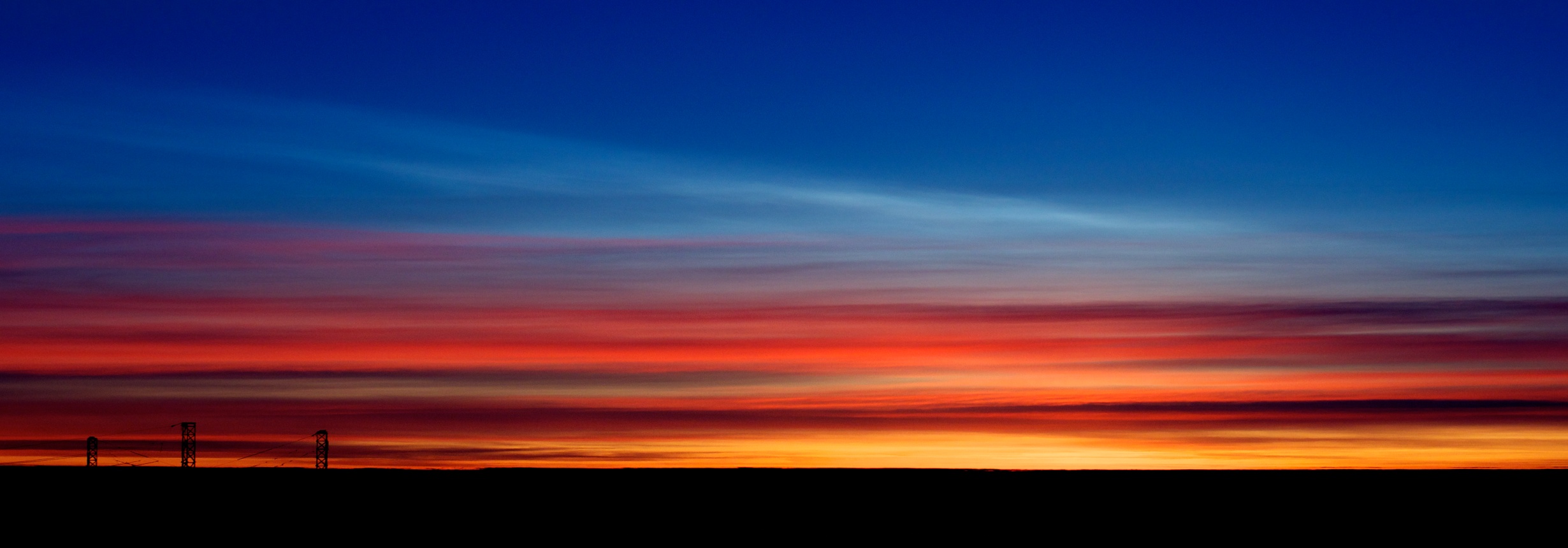
Only Type II clouds are necessarily nacreous whereas Type I clouds can be iridescent under certain conditions, just as any other cloud. The World Meteorological Organization no longer uses the alpha-numeric nomenclature seen in this article, and distinguishes only between super-cooled stratiform acid-water PSCs and cirriform-lenticular water ice nacreous PSCs.
References
References
- "Why is the ozone hole over Antarctica?". [[United States Environmental Protection Agency.
- (2008). "Polar stratospheric cloud microphysics and chemistry". Journal of Atmospheric and Solar-Terrestrial Physics.
- (2017). "Nitric acid and water PSC, International Cloud Atlas".
- (16 September 2023). "Nacreous and Polar Stratospheric Clouds".
- (2002). "Scientific Assessment of Ozone Depletion". [[World Meteorological Organization]].
- (2008-03-28). "Polar Stratospheric Clouds".
- "The presence of metastable HNO3/H2O solid phases in the stratosphere inferred from ER 2 data". [[Journal of Geophysical Research]].
- (2017). "Nacreous PSC, International Cloud Atlas".
- Maturilli, Maturilli. "Polar Stratospheric Clouds Above Spitsbergen". [[Alfred Wegener Institute for Polar and Marine Research]].
- "Polar stratospheric clouds / Observations". [[Australian Antarctic Division]].
- (2017). "Upper atmospheric clouds, International Cloud Atlas".
This article was imported from Wikipedia and is available under the Creative Commons Attribution-ShareAlike 4.0 License. Content has been adapted to SurfDoc format. Original contributors can be found on the article history page.
Ask Mako anything about Polar stratospheric cloud — get instant answers, deeper analysis, and related topics.
Research with MakoFree with your Surf account
Create a free account to save articles, ask Mako questions, and organize your research.
Sign up freeThis content may have been generated or modified by AI. CloudSurf Software LLC is not responsible for the accuracy, completeness, or reliability of AI-generated content. Always verify important information from primary sources.
Report