From Surf Wiki (app.surf) — the open knowledge base
Pohang
City in North Gyeongsang, South Korea

City in North Gyeongsang, South Korea
| Field | Value | |
|---|---|---|
| name | Pohang | |
| native_name | 포항시 | |
| settlement_type | Specific city | |
| translit_lang1 | Korean | |
| translit_lang1_type1 | Hangul | |
| translit_lang1_info1 | 포항시 | |
| translit_lang1_type2 | Hanja | |
| translit_lang1_info2 | 浦項市 | |
| translit_lang1_type3 | Revised Romanization | |
| translit_lang1_info3 | Pohang-si | |
| translit_lang1_type4 | McCune–Reischauer | |
| translit_lang1_info4 | P'ohang-si | |
| image_skyline | {{multiple image | |
| caption_align | center | |
| border | infobox | |
| total_width | 300 | |
| perrow | 1/2/2 | |
| color | white | |
| image1 | Pohang skyline.jpg | |
| caption1 | Night view of Pohang | |
| image2 | Pohang spot2.jpg | |
| caption2 | Yeonorang and Seonyeo Theme Park | |
| image3 | Pohang canal.jpg | |
| caption3 | Pohang Canal | |
| image4 | Homigot 20240113 002.jpg | |
| caption4 | Homigot | |
| image5 | SpaceWalk (walkable sculpture, Pohang 2021) Mutter Genth 03.jpg | |
| caption5 | Pohang Space Walk | |
| image_map | North Gyeongsang-Pohang.svg | |
| map_caption | Location in South Korea | |
| subdivision_type | Country | |
| subdivision_name | South Korea | |
| subdivision_type1 | Region | |
| subdivision_name1 | Yeongnam | |
| population_blank1_title | Dialect | |
| population_blank1 | Gyeongsang | |
| area_total_km2 | 1,128.76 | |
| population_as_of | September 2024 | |
| population_total | 492,041 | |
| population_density_km2 | 442.40 | |
| population_demonym | Pohangite | |
| parts_type | Administrative divisions | |
| parts | 2 gu, 15 dong, 4 eup, 10 myeon | |
| area_code | +82-54-2xx | |
| blank_emblem_type | Emblem of Pohang | |
| <!-- government type, leaders --> | government_footnotes | tags -- |
| leader_title | Mayor | |
| leader_name | Lee Kang-deok (People Power) | |
| leader_name1 | ||
| image_flag | Flag of Pohang.svg | |
| <!-- time zone(s) --------------> | timezone1 | Korea Standard Time |
| utc_offset1 | +9 |
Pohang (; ), formerly spelled Po-Hang, is the largest city in North Gyeongsang Province, South Korea, with a population of 499,363 as of 2022, bordering the East Sea to the east, Yeongcheon to the west, Gyeongju to the south, and Cheongsong and Yeongdeok County to the north.
The city has food, textile, and metal industries. Agricultural products such as grapes, persimmons and garlic chives are abundant, and the city's proximity to the East Sea has led to the development of a fishing industry. Hagfish is a local specialty.
The South Korean Marine Corps 1st Division is stationed in Pohang, and their Education and Training Command is located there as well.
Tourist attractions include the Jukdo Fish Market, where fresh seafood is sold, as well as the Yeongildae Beach, Wolpo Beach, and Pohang Songdo Beach. Naejangsan Mountain divides Pohang and Yeongdeok and has twelve waterfalls.
History
The earliest evidence of human occupation in the Pohang area is from the Mumun Pottery Period (1500–300 BC). Archaeologists have unearthed small villages and megalithic burials (dolmen) from this period. Still a small fishing village at the dawn of the 20th century, the earliest steps toward developing Pohang into a place of greater significance were taken in 1930 with the construction of a modern harbour. Pohang grew rapidly afterward, attaining the designation of town (eup) in 1931 and then earning the status of city (si) in 1949.
Pohang's road arteries and shipping port made it a place of strategic significance during the Korean War. An unopposed landing of UN forces at Pohang on July 18, 1950 was the first large-scale amphibious operation since World War II, and the region around Pohang saw fierce clashes between South Korea's 3rd Infantry Division and North Korea's 5th Infantry Division during August–September 1950.
By the 1960s, Pohang was a small coastal city with a population of 50,000. The next major development in Pohang's growth came in 1968 with the inauguration of the steel maker POSCO, and the local plant's commencement of production in 1972. The introduction of heavy industry to the city brought the local economy to a blend of iron, steel, shipbuilding and fisheries through the end of the 20th century.
The early 21st century and the age of globalization has brought new economic challenges to companies such as POSCO, giving rise to beliefs that Pohang would be wise to not be overly reliant on heavy industry to maintain its prosperity. In response, the Pohang of today presents itself as having an eye to the future, striving to become a diversified city of environmentalism and advanced learning, as well as a centre of arts and culture.
During the Silla Dynasty the area was made up of four hyeon, Toehwa-hyeon (), Jidap-hyeon (), Geunoji-hyeon (), Haea-hyeon (). Then during the Goryeo Dynasty these four were renamed to Heunghae-gun (흥해군/興海郡), Janggi-hyeon (), Yeongil-hyeon (), Cheongha-hyeon () respectively.
On 4 August 1896, the three remaining hyeon, which at that time were Janggi, Yeonil (; originally Yeongil) and Cheongha were reassigned as counties or gun as part of the change to the 13-province division of the Korean Empire.
On 1 March 1914, the four counties were unified as one Yeongil-gun (), which was subdivided into 18 myeons.
On 1 April 1931, Pohang-myeon () was designated as an eup, thus giving Yeongil-gun 1 eup and 17 myeon.
On 1 April 1934, Jukbuk-myeon () and Juknam-myeon () were united to make Jukjang-myeon (), while Janggi-myeon () and Bongsan-myeon () united to make Jihaeng-myeon (), so that there were 1 eup and 15 myeon.
On 1 October 1938, Hyeongsan-myeon () was incorporated into Pohang-eup, leaving Yeongil-gun with 1 eup and 14 myeon.
On 1 October 1942 Changju-myeon () was renamed and reclassified as Guryongpo-eup (구룡포읍/九龍浦邑), leaving 2 eup and 13 myeon.
On 15 August 1949, Pohang-eup was designated as Pohang-si (), leaving Yeongil with 1 si, 1 eup, 13 myeon and 1 local office.
On 8 July 1956, Heunghae-myeon () and Gokgang-myeon () are incorporated into Uichang-myeon () leaving 1 si, 1 eup and 12 myeon.
On 29 October 1957, Daljeon-myeon () is abolished and incorporated into Heunghae-myeon and Yeonil-myeon () leaving 1 si, 1 eup and 11 myeons.
On 1 March 1967, the Gibuk Local Office () of Gigye-myeon (기계면/杞溪面) is established.
On 1 July 1973, Uichang-myeon is designated as Uichang-eup () leaving 1 si, 2 eup, 10 myeon and 3 local offices.
On 1 December 1980, Yeonil-myeon and Ocheon-myeon () are both designated as eup leaving 1 si, 4 eup, 8 myeon and 3 local offices.
On 1 September 1982, Haedo-dong () and Sangdae-dong () are separated into Haedo 1 and 2-dong and Sangdae 1 and 2-dong respectively.
On 1 April 1986, Daebo Local Office () and Gibuk Local Office are designated as myeon leaving 1 si, 4 eup, 10 myeon and 1 local office.
On 1 January 1995, a united Pohang absorbs all of Yeongil-gun, composed of 1 si, 2 gu, 4 eup, 10 myeon, 25 dong and 1 local office.
On 1 September 1998, the unification of Small-dong left Pohang with 1 si, 2 gu, 4 eup, 10 myeon, 19 dong and 1 local office.
On 1 January 2009, the unification of Small-dong left Pohang with 1 si, 2 gu, 4 eup, 10 myeon, 15 dong and 1 local office.
Geography and climate
Pohang is located along the coast of Yeongil Bay.
Under the Köppen climate classification, Pohang has a humid subtropical climate (Cfa). The mean temperature in the coldest month, January, is relatively mild at 2.2 °C. The warmest month is August, when the mean temperature is 26.0 °C. On average, Pohang receives 1,152 mm of precipitation per year. The driest month is December, when the city receives a scant 25.7 mm of precipitation on average. However, the mean amount of precipitation for the wettest month, August, is 227.4 mm.
| Jan record high C = 17.5 | Feb record high C = 24.9 | Mar record high C = 27.1 | Apr record high C = 32.8 | May record high C = 36.1 | Jun record high C = 37.7 | Jul record high C = 38.6 | Aug record high C = 39.3 | Sep record high C = 35.9 | Oct record high C = 30.5 | Nov record high C = 28.0 | Dec record high C = 21.5 | year record high C = 39.3
| Jan record low C = -14.4 | Feb record low C = -13.4 | Mar record low C = -9.9 | Apr record low C = -2.3 | May record low C = 3.7 | Jun record low C = 8.2 | Jul record low C = 10.8 | Aug record low C = 14.0 | Sep record low C = 8.9 | Oct record low C = 0.6 | Nov record low C = -8.3 | Dec record low C = -13.1 | year record low C = -14.4
| archive-url = https://web.archive.org/web/20220129211110/https://data.kma.go.kr/resources/normals/pdf_data/korea_pdf_0106_v2.pdf | archive-date = 29 January 2022 | access-date = 4 April 2022 | access-date = 4 April 2022 | script-title = ko:순위값 - 구역별조회 | archive-url = https://web.archive.org/web/20161207185450/http://www.kma.go.kr/down/Climatological_2010.pdf | archive-date = 7 December 2016 | access-date = 8 December 2016
Administrative Organization
- Head office: 1 head office, 4 office, 6 team, 25 department
- Executive office: 1 office 7 experts
- Direct organizations: three centers and six departments
- Business offices: 11 offices and 7 departments
- Nam-gu and Buk-gu office: 12 departments Eup, Myeon and Dong: 4 Eup, 10 Myeon and 15 Dong
- (The number of public officials: 1,960)
- Mayor
- Globalization strategy headquarter
- Self-governing Administration Bureau
- Economy & Industries Bureau
- Welfare environment office
- Construct and Urban Planning Bureau
- Nam-gu & Buk-gu Public Health Centers
- Agricultural Technology Center
- Construction Environment Office
- Water Supply Office
- Other centers
- Culture & arts center
- Municipal library
- Municipal art gallery
- Agricultural product wholesale market management office
- Women's culture center
- Park management office
- Vehicle registration office
Transportation
The city is served by several trains a day from Seoul and Daegu. Pohang is the terminus for a number of ferry routes serving the adjacent Sea of Japan, including the main tourist route for Ulleung Island and Liancourt Rocks. Pohang is the home of POSCO (the Pohang Steel Company), one of the largest steel producers in the world, and a host of related industries. As a result, the port shipped a total of 54.8 million tons in 2006.
Several flights per day to Seoul Gimpo Airport and Jeju Airport are available at Pohang Gyeongju Airport.
Local transportation is served by only city buses. They run about 20 different ways of the city and some of them reach to the mountain folk. Also, the buses are classified into 2 kinds – one is Ilban-bus (normal bus) and the other is Jwaseok-bus (full of seats and a little more expensive than Ilban-bus). They run 15~25 minutes intervals along their own way. The bus routes are listed in both Korean and English but the Korean version is interactive, and thus more helpful.
There are two main bus terminals - Shiwae () and Gosok () which roughly translate into intercity/city and express. The Shiwae bus terminal () also acts as the cross-country bus terminal from which access to nearby metropolitan cities such as Daegu and Busan (~1.5 hrs each depending on traffic) is available. Their website is only in Korean and only accessible in Internet Explorer. The Gosok bus terminal () website is in both English and Korean. From Gosok bus terminal one can travel to Seoul and Gwangju.
Pohang is also serviced by two train stations - Pohang station () and Wolpo station (). Times and destinations are available on the Korail website which is in English and Korean.
Passengers using the KTX had to go to Gyeongju station () until 2015. However, since 2015, the KTX travels directly to Pohang station ().
Education
Universities with graduate schools
- Pohang University of Science and Technology (POSTECH)
- Handong Global University
Other institutes of higher education
- Pohang College
- Sunlin College
Health
There are some hospitals to treat people; two types of hospitals exist: public, and private. Public hospitals are run by the government, and supported by the government. Conversely, private hospitals are managed by the individuals. For example, S Pohang hospital is sponsored by the Ministry of Public Administration and Security which means it is supported by the government ("Introduction of the hospital" 1). They provide the treatments of brain disease, and spine disease. For private hospital, Pohang Sunlin Hospital is run by Hyunsu Shin ("Introduction of the head of the hospital" 1).
Culture
Thousands flock to see the fireworks festival at Yeongildae Beach each summer. People travel from all over the country to watch the show. The Culture & Arts Center, opened in 1995, holds performances and exhibitions in its various galleries and theaters. Pohang is known for gwamegi and holds an annual Gwamegi Festival. Gwamegi Festival is available on November annually. In 2015, the festival invited individuals from different ages. Numerous people can enjoy the festival, and the festival is sponsored by banks such as Suhyeop, Nonghyeop, Shinhan, and POSCO. During the festival, it is available to experience the old traditional Korean culture such as competing with person who sell Yeot. Furthermore, many singers from various places including Philippines are invited to demonstrate their talent to people ("Schedule" 1). In this place, Guryongpo, it is possible to try Gwamegi, Pidegi which is dried squid, and big crabs ("Information about the products in Guryongpo" 1).
Museums
- Guryongpo Gwamegi Culture Museum
- Guryongpo Modern History Museum
- The National Lighthouse Museum
- Yeongil Folk History Museum
- The Posco Museum
- Pohang Museum Of Steel Art
- Pohang Canal PR Hall
- Robo Life Museum
Monuments
- Sabang Memorial Park
- Saemaul Memorial Hall
- New Millennium Memorial Hall
Villages
- Deokdong Culture Village
- Duksil Village
- Sangok-ri
Experiences
- Botanical Garden of Gyeongsangbukdo
- Yeonorang Seonyeo Theme Park
- Key-Chungsan Botanical Garden
- Yeongilman Cruise
- Pohang Ship Experience
Other important spots
- Posco
- Pohang Accelerator Laboratory
- Korea Institute of Robotics & Technology Convergence
Industry
Steel and Metal Industry
The city is home to the headquarters and large production facilities of POSCO, one of the world's largest steelmakers. Besides steel, the city has a burgeoning industry in electric vehicle battery materials through POSCO's subsidiary POSCO Future M. The city expects 70 trillion won in annual revenue from cathode materials alone produced in the city by companies such as POSCO and EcoPro BM.
Sports
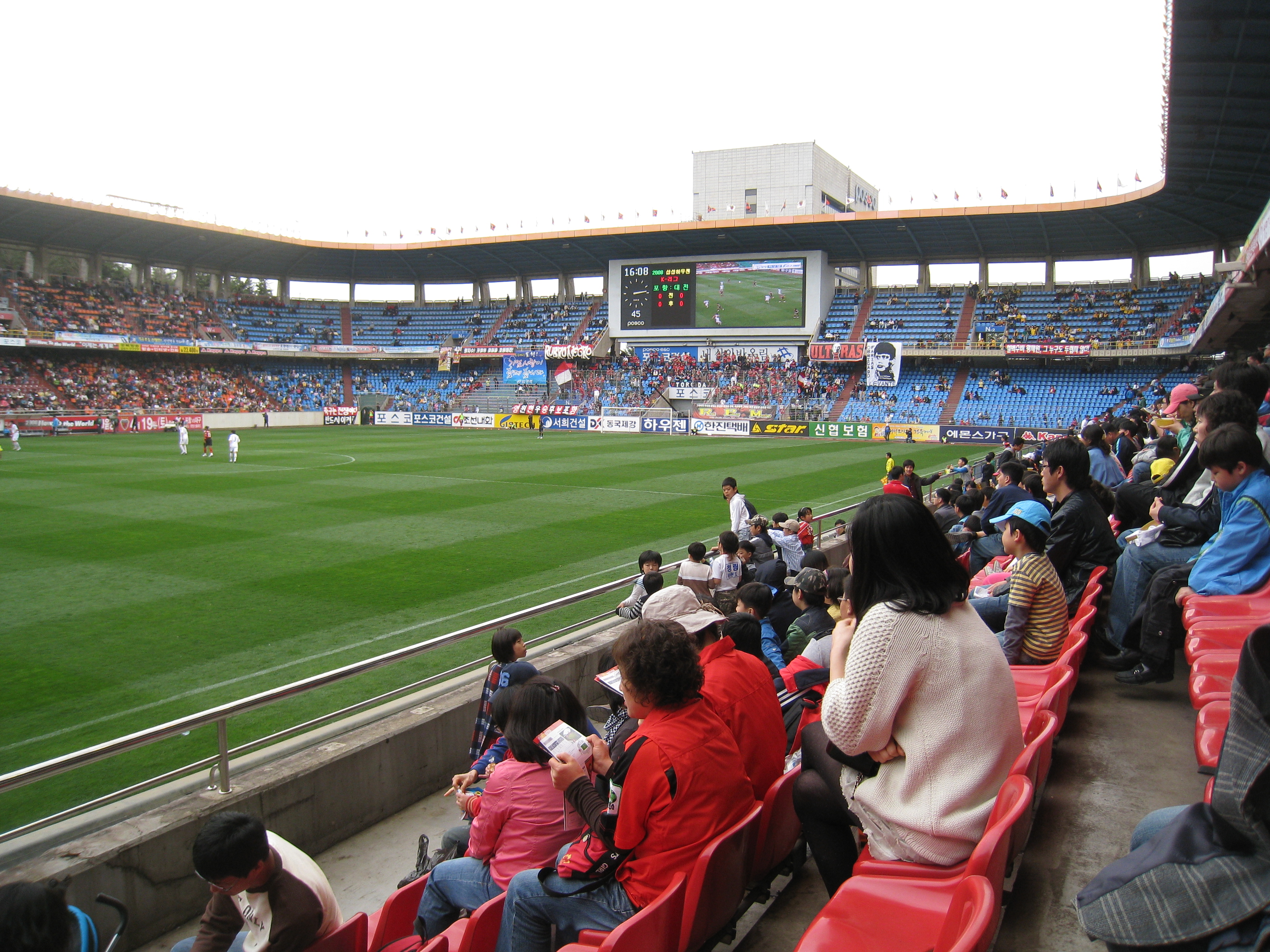
The city is home to the Pohang Steelers of K League 1. Also, there is the Pohang Baseball Stadium, which Samsung Lions belonging to KBO League is using as the second stadium.
Points of interest
The Jukdo Market is a large, bustling traditional market near the centre of the city, close to the port. It is well known throughout Korea as an important seafood market. There are many raw-fish restaurants in the market. The fish is cheaper here than in Seoul or Daegu.
Bukbu Beach is located in Duho-dong in the northern part of the city's built-up area. The beach front has been the focus of commercial developments such as bars, restaurants, and budget accommodations called Yeogwan. A number of beaches on the Sea of Japan can be found just north of the built-up area, including Chilpo and Wolpo.
Homigot, a point of land jutting out into the Sea of Japan, is located to the east of urban Pohang in Daebo-myeon. Homigot is one of the easternmost points on the Korean peninsula and as such serves every year as a gathering place for thousands to greet Korea's first sunrise of the New Year. The beach is also home to the 'Hands of Harmony' sculpture.
Bogyeongsa is a major Buddhist temple nestled in a steep green valley at the foot of Mount Naeyeon (710m) in Songna-myeon, an area in the extreme northern part of Pohang. Yeonsan Waterfall is located nearby in the same mountain valley. There are hiking trails leading from the temple up into the mountains. Bogyeongsa also has a number of mountain hermitages in the vicinity.
Oeosa is a temple located in the extreme southern part of Pohang, just inside the mountains south of the coastal plain formed by the Naengcheon River. It is located at the foot of Mt. Unjae (481m) in a steep valley in Daesong-myeon. Signs placed in and around Oeosa claim that the temple was founded by Wonhyo, the well-travelled Silla monk.
Space Walk is a roller-coaster like walkable art installation design by German artists Heike Mutter and Ulrich Genth and located in Hwanho Park. Constructed over a two-and-a-half-year period by POSCO from 317 tons of steel, the park open November 19, 2021.
Notable people
- Lee Myung-bak, former South Korean President
- Lee Ho-yang (known in the West as Shinsadong Tiger), composer and record producer
- Chan Sung Jung, mixed martial artist, UFC fighter.
- Song Ji-hyo, actress and variety star
- Ray, member of South Korean boy band C-Clown
- Lee Dong-gook, soccer player with Jeonbuk Hyundai Motors
- JinE (Real Name: Shin Hye-jin, ), former member of South Korean girl band Oh My Girl
- Lee Chaeyoung, member of South Korean girl band Fromis 9
- Kang Yeosang (known as Yeosang), member of South Korean boy band ATEEZ
- Yoo Seung-ho, actor in films including The Way Home
- Lee Jaehyeong (known as Jaehyeong), member of South Korean rock band The Rose
- Kim Yong-seung (known as Yongseung), member of South Korean boy band VERIVERY
- Bae Sumin (known as Sumin), leader of South Korean girl band STAYC
- Ah-hee Lee (known as Magenta), member of South Korean rock band QWER and YouTuber
Shopping
The main downtown shopping area is between Yukgeori () and Ogeori () which translate to 6-way intersection and 5-way intersection. The streamlet boardwalk shopping area opens and ends with Pohang Station and Yukgeori, respectively. This shopping area has several stores, restaurants, and a few bars.
Administrative divisions


Pohang is divided into 2 non-autonomous districts, which in turn is divided into 4 eup, 10 myeon and 15 dong.
| District | Hangeul | Hanja | eup/myeon/dong | Hangeul | Hanja |
|---|---|---|---|---|---|
| Buk District | 북구 | 北區 | Heunghae-eup | 흥해읍 | 興海邑 |
| Singwang-myeon | 신광면 | 神光面 | |||
| Cheongha-myeon | 청하면 | 淸河面 | |||
| Songra-myeon | 송라면 | 松羅面 | |||
| Gigye-myeon | 기계면 | 杞溪面 | |||
| Jukjang-myeon | 죽장면 | 竹長面 | |||
| Gibuk-myeon | 기북면 | 杞北面 | |||
| Jungang-dong | 중앙동 | 中央洞 | |||
| Yanghak-dong | 양학동 | 良鶴洞 | |||
| Jukdo-dong | 죽도동 | 島洞 | |||
| Yongheung-dong | 용흥동 | 龍興洞 | |||
| Uchang-dong | 우창동 | 牛昌洞 | |||
| Duho-dong | 두호동 | 斗湖洞 | |||
| Jangryang-dong | 장량동 | 長良洞 | |||
| Hwanyeo-dong | 환여동 | 環汝洞 | |||
| Nam District | 남구 | 南區 | Guryongpo-eup | 구룡포읍 | 九龍浦邑 |
| Yeonil-eup | 연일읍 | 延日邑 | |||
| Ocheon-eup | 오천읍 | 烏川邑 | |||
| Daesong-myeon | 대송면 | 大松面 | |||
| Donghae-myeon | 동해면 | 東海面 | |||
| Janggi-myeon | 장기면 | 長鬐面 | |||
| Homigot-myeon | 호미곶면 | 虎尾串面 | |||
| Sangdae-dong | 상대동 | 上大洞 | |||
| Haedo-dong | 해도동 | 海島洞 | |||
| Songdo-dong | 송도동 | 松島洞 | |||
| Cheongnim-dong | 청림동 | 靑林洞 | |||
| Jecheol-dong | 제철동 | 製鐵洞 | |||
| Hyogok-dong | 효곡동 | 孝谷洞 | |||
| Daei-dong | 대이동 | 大梨洞 |
Twin towns – sister cities
Pohang is twinned with:
- JPN Fukuyama, Japan
- CHN Hunchun, China
- TUR İzmit, Turkey
- JPN Jōetsu, Japan
- USA Pittsburg, United States
- RUS Vladivostok, Russia
Friendly cities
Pohang is cooperating with:
- NZL North Shore City, New Zealand (August 2008)
- CHN Zhangjiagang, China
References
References 2
- Jump up^ 포항공항(Pohang Airport Website) 고객센터(Service Center) 공지사항(Announcement) 포항공항 휴지기간 공지(Announcement about the pause of Pohang Airport)
- Jump up^ 포항공항(Pohang Airport Website) 운항현황(Flight Situation) 실시간 운항정보(Information about current flight available)
- Jump up^ 시설관리공단(Organization which manage facilities) 포항야구장 (Pohang Baseball Stadium) 시설소개(Introduction about the facility)
- Jump up^ 메인 (main website) 홈 http://www.smnews.kr/webbase/section/news_total.asp?section=17(Home) 작은뉴스(Jakeun News)
- Jump up^ 과메기 포항구룡포(Gwamegi Pohang Guryongpo) 구룡포 특산물(Products in Guryongpo)
- Jump up^ 에스포항병원(S Pohang Hospital) 병원소개(Introduction of the hospital)
- Jump up^ 선린병원(Sunlin Hospital) 선린병원소개(Introduction of the hospital) 병원장 인사말(Introduction of the head of the hospital)
- Jump up^ 대한민국 해병대(Marine in South Korea) 해병대모집(gathering people) 모병문의처(Inquiry for each locals)
- Jump up^ 대한민국 해병대(Marine in South Korea) 해병대모집(gathering people) 지원 FAQ(Enrolling FAQ)
Citation
"Announcement about the Pause of Pohang Airport." Pohang Airport. Governor of Pohang, 17 Feb. 2016. Web.
"포항공항(Pohang Airport)." 실시간 운항정보(Flights in Real Time). N.p., n.d. Web. 18 Mar. 2016.
"포항야구장(Pohang Baseball Stadium)." 시설소개. 시설관리공단(Organization That Manages Facility), n.d. Web. 18 Mar. 2016.
Kim, Minje. "전체기사(Whole Articles)." 전체기사(Whole Articles). Jakeun News, 16 Dec. 2015. Web. 18 Mar. 2016.
Kim, Jumdol. "구룡포 과메기 축제(Guryongpo Gwamegi Festival)." 구룡포 과메기 축제(Guryongpo Gwamegi Festival). Jumdol Kim, n.d. Web. 18 Mar. 2016.
"보건복지부 인증 전문병원-에스포항병원(뇌센터, 척추센터)!! :: 병원소개(S Pohang Hospital Introduction of the Hospital)." 보건복지부 인증 전문병원-에스포항병원(뇌센터, 척추센터)!! :: 병원소개(S Pohang Hospital Introduction of the Hospital). Executives and Staff Members, Dec. 2008. Web. 18 Mar. 2016.
Shin, Hyunsu. "병원장 인사말(Introduction by the Head of the Hospital)." Sunlin Hospital. Hyunsu Shin, n.d. Web. 18 Mar. 2016.
"지역별 문의처(Inquiry for Locals)." Marine in South Korea. N.p., n.d. Web. 18 Mar. 2016.
"지원 FAQ(enrolling FAQ)." Marine in South Korea. N.p., n.d. Web. 18 Mar. 2016.
References
- (2024). "Population statistics".
- link
- [http://www.worldportsource.com/ports/KOR_Port_of_Pohang_1487.php WPS - Port of Pohang contact information]. Worldportsource.com. Retrieved on 2013-07-12.
- link. Archive.is. (2012-08-02)
- [http://www.cs.virginia.edu/~kocsea/pohang.htm KASTN] {{Webarchive. link. (2011-06-04 . Cs.virginia.edu (1996-02-01). Retrieved on 2013-07-12.)
- "World Urbanization Prospects".
- "Population Census". [[Statistics Korea]].
- link. Esri.handong.edu
- link. (September 1, 2009)
- [https://www.researchgate.net/publication/364471369_Wave_Height_Reduction_Inside_Pohang_New_Port_Korea_Due_to_the_Construction_of_a_Detached_Breakwater Ryu, K.H.; Jeong, W.M.; Oh, J.-E.; Baek, W.-D.; Chang, Y.S. Wave Height Reduction Inside Pohang New Port, Korea, Due to the Construction of a Detached Breakwater. J. Mar. Sci. Eng. 2022,10, 1537]
- link. [[Korea Meteorological Administration]]
- link. (May 1, 2009)
- (2024-10-08). "US ambassador discusses battery supply chain at Posco Future M plant".
- 조선비즈. (2024-04-17). "'배터리 도시' 포항, 2030년에 양극재 100만t 나온다".
- Bahk, Eun-ji. (11 Jan 2022). "'Space Walk' emerging as popular tourist spot in Pohang". [[The Korea Times]].
- www.etnews.com. (2023-10-18). "'김계란 걸밴드' QWER, '1집→1만집, 지구정복 걸밴드 첫 발!'[종합]".
- "福山市の親善友好都市". Fukuyama.
- "Kardeş Şehirler". İzmit.
- "姉妹・友好都市". Jōetsu.
- "Sister City Links". City of Pittsburg.
- "Города-побратимы". Vladivostok.
- (2016-08-30). "中 장쑤성 장자강시 방문단 포항서 문화관광 교류". Yeongnam.
This article was imported from Wikipedia and is available under the Creative Commons Attribution-ShareAlike 4.0 License. Content has been adapted to SurfDoc format. Original contributors can be found on the article history page.
Ask Mako anything about Pohang — get instant answers, deeper analysis, and related topics.
Research with MakoFree with your Surf account
Create a free account to save articles, ask Mako questions, and organize your research.
Sign up freeThis content may have been generated or modified by AI. CloudSurf Software LLC is not responsible for the accuracy, completeness, or reliability of AI-generated content. Always verify important information from primary sources.
Report