From Surf Wiki (app.surf) — the open knowledge base
Podophyllotoxin
Chemical compound
Chemical compound
| Drugs.com = | elimination_half-life = 1.0 to 4.5 hours.
Podophyllotoxin (PPT) is the active ingredient in Podofilox, a medical cream used to treat genital warts and molluscum contagiosum. It can be applied either by a healthcare provider or the patient themselves.
Podophyllotoxin is a non-alkaloid lignan extracted from the roots and rhizomes of plants of the genus Podophyllum. A less refined form known as podophyllum resin is also available, but has greater side effects.
Podophyllotoxin was first isolated in pure form in 1880 by Valerian Podwyssotzki (1818 – 28 January 1892), a Polish-Russian privatdozent at the University of Dorpat (now Tartu, Estonia) and assistant at the Pharmacological Institute there.See:
- Podwyssotzki named podophyllotoxin on p. 30: " … ich nenne sie bis auf weiteres Podophyllotoxin." ( … for the time being I call it "podophyllotoxin".)
- Obituary:
PPT is on the World Health Organization's List of Essential Medicines.
Medical uses
Podophyllotoxin possesses a large number of medical applications, as it inhibits replication of both cellular and viral DNA by binding necessary enzymes. It can additionally destabilize microtubules and prevent cell division. Because of these interactions it is considered an antimitotic drug. It has been employed in the treatment of a wide range of medical conditions, from infections to cancer, although modern medicine typically relies on less orally toxic derivatives when antimitotic effects are desired.
Podophyllotoxin cream is commonly prescribed as a potent topical antiviral. It is used for the treatment of human papillomavirus (HPV) infections with external warts as well as molluscum contagiosum infections. 0.5% PPT cream is prescribed for twice daily applications for 3 days followed by 4 days with no application; this weekly cycle is repeated for four weeks. PPT can also be prescribed as a gel, as opposed to a cream, and is also sold under the names condyline and warticon.
Adverse effects
The most common side effects of podophyllotoxin cream are typically limited to irritation of tissue surrounding the application site, usually burning, redness, pain, itching, and swelling. Application is sometimes immediately followed by burning or itching. Small sores, itching, and peeling skin may also follow. For these reasons it is recommended that application be done in a way that limits contact with surrounding uninfected tissue.
Neither podophyllin resin nor podophyllotoxin lotions or gels are used during pregnancy because these medications have been shown to be embryotoxic in both mice and rats. Antimitotic agents are in general not typically recommended during pregnancy. Additionally, it has not been determined if podophyllotoxin can pass into breast milk from topical applications and therefore it is not recommended for breastfeeding women.
Though podophyllotoxin cream is safe for topical use, it can cause CNS depression as well as enteritis if ingested. The podophyllum resin from which podophyllotoxin is derived has the same effect.
Mechanism of action
Podophyllotoxin destabilizes microtubules by binding tubulin and thus preventing cell division. In contrast, some of its derivatives display binding activity to the enzyme topoisomerase II (Topo II) during the late S and early G2 stages. For instance, etoposide binds and stabilizes the temporary DNA break caused by the enzyme, disrupts the reparation of the break through which the double-stranded DNA passes, and consequently prevents DNA unwinding, which is necessary for subsequent replication. Mutants resistant to either podophyllotoxin or to its topoisomerase II-inhibitory derivatives such as etoposide (VP-16)p have been described in Chinese hamster cells. The mutually exclusive cross-resistance patterns of these mutants provide a highly specific means to distinguish the two kinds of podophyllotoxin derivatives. Mutant Chinese hamster cells resistant to podophyllotoxin are affected in a protein P1 that was later identified as the mammalian HSP60 or chaperonin protein.
Furthermore, podophyllotoxin is classified as an aryltetralin lignan for its ability to bind and deactivate DNA. It and its derivates bind Topo II and prevent its ability to catalyze the rejoining of DNA which has been broken for replication. Lastly, experimental evidence has shown that these aryltetralin lignans can interact with cellular factors to create chemical DNA adducts, thus further deactivating DNA.
Chemistry
Structural characteristic
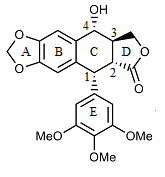
The structure of podophyllotoxin was first elucidated in the 1930s. Podophyllotoxin bears four consecutive chiral centers, labelled C-1 through C-4 in the following image. The molecule also contains four almost planar fused rings. The podophyllotoxin molecule includes a number of oxygen-containing functional groups: an alcohol, a lactone, three methoxy groups, and an acetal.
Derivatives of podophyllotoxin are synthesized as properties of the rings and carbon 1 through 4 are diversified. For example, ring A is not essential to antimitotic activity. Aromatization of ring C leads to loss of activity, possibly from ring E no longer being placed on the axial position. In addition, the stereochemistry at C-2 and C-3 configures a trans-lactone, which has more activity than the cis counterpart. Chirality at C-1 is also important as it implies an axial position for ring E.
Biosynthesis
The biosynthetic route of podophyllotoxin was not completely eludicidated for many years; however, in September 2015, the identity of the six missing enzymes in podophyllotoxin biosynthesis were reported for the first time. Several prior studies have suggested a common pathway starting from coniferyl alcohol being converted to (+)-pinoresinol in the presence of a one-electron oxidant through dimerization of stereospecific radical intermediate. Pinoresinol is subsequently reduced in the presence of co-factor NADPH to first lariciresinol, and ultimately secoisolariciresinol. Lactonization on secoisolariciresinol gives rise to matairesinol. Secoisolariciresinol is assumed to be converted to yatein through appropriate quinomethane intermediates, leading to podophyllotoxin.

A sequence of enzymes involved has been reported to be dirigent protein (DIR), to convert coniferyl alcohol to (+)-pinocresol, which is converted by pinocresol-lariciresinol reductase (PLR) to (-)-secoisolariciresinol, which is converted by sericoisolariciresinol dehydrogenase (SDH) to (-)-matairesinol, which is converted by CYP719A23 to (-)-pluviatolide, which is likely converted by Phex13114 (OMT1) to (-)-yatein, which is converted by Phex30848 (2-ODD) to (-)-deoxypodophyllotoxin. Though not proceeding through the last step of producing podophyllotoxin itself, a combination of six genes from the mayapple enabled production of the etoposide aglycone in tobacco plants.
Chemical synthesis
Podophyllotoxin has been successfully synthesized in a laboratory; however, synthesis mechanisms require many steps, resulting in a low overall yield. It therefore remains more efficient to obtain podophyllotoxin from natural sources.
Four routes have been used to synthesize podophyllotoxin with varying success: an oxo ester route, lactonization of a dihydroxy acid, cyclization of a conjugate addition product, and a Diels-Alder reaction.
Derivatives
Podophyllotoxin and its derivatives are used as cathartic, purgative, antiviral agent, vesicant, antihelminthic, and antitumor agents. Podophyllotoxin derived antitumor agents include etoposide and teniposide. These drugs have been successfully used in therapy against numerous cancers including testicular, breast, pancreatic, lung, stomach, and ovarian cancers.

Natural abundance
Podophyllotoxin is present at concentrations of 0.3% to 1.0% by mass in the rhizome of the American mayapple (Podophyllum peltatum). Another common source is the rhizome of Sinopodophyllum hexandrum Royle (Berberidaceae).
It is biosynthesized from two molecules of coniferyl alcohol by phenolic oxidative coupling and a series of oxidations, reductions and methylations.
References
References
- "What is Condylox?".
- "Podofilox". The American Society of Health-System Pharmacists.
- (2009). "A review on hemisynthesis, biosynthesis, biological activities, mode of action, and structure-activity relationship of podophyllotoxins: 2003-2007". Current Medicinal Chemistry.
- "Podophyllum Resin". The American Society of Health-System Pharmacists.
- (2009). "WHO Model Formulary 2008". World Health Organization.
- (2011). "Anticancer Agents from Natural Products, Second Edition". CRC Press.
- (April 2021). "Podophyllotoxin: History, Recent Advances and Future Prospects". Biomolecules.
- (2021). "World Health Organization model list of essential medicines: 22nd list (2021)". World Health Organization.
- (2016). "Podophyllotoxin: a novel potential natural anticancer agent". Avicenna Journal of Phytomedicine.
- "Podofilox Monograph for Professionals - Drugs.com". Drugs.com.
- "Podophyllotoxin for anogenital warts; Podophyllotoxin info".
- (April 2001). "Condyloma eradication: self-therapy with 0.15-0.5% podophyllotoxin versus 20-25% podophyllin preparations--an integrated safety assessment". Regulatory Toxicology and Pharmacology.
- "PRODUCT INFORMATION WARTEC® SOLUTION". GlaxoSmithKline Australia Pty Ltd.
- (July 1989). "Is Podophyllin Safe for Use in Pregnancy?". Archives of Dermatology.
- "Podophyllotoxin {{!}} DermNet New Zealand".
- (August 1979). "Podophyllum toxicity: case report and literature review". The Journal of Family Practice.
- (2017-06-01). "Podophyllotoxin: a novel potential natural anticancer agent". Avicenna Journal of Phytomedicine.
- (December 2000). "Antitumor properties of podophyllotoxin and related compounds". Current Pharmaceutical Design.
- (January 1982). "Podophyllotoxin-resistant mutants of Chinese hamster ovary cells. Alteration in a microtubule-associated protein". The Journal of Biological Chemistry.
- (April 1983). "Genetic, biochemical, and cross-resistance studies with mutants of Chinese hamster ovary cells resistant to the anticancer drugs, VM-26 and VP16-213". Cancer Research.
- (February 1983). "Podophyllotoxin-resistant mutants of Chinese hamster ovary cells: cross-resistance studies with various microtubule inhibitors and podophyllotoxin analogues". Cancer Research.
- (July 1989). "Molecular cloning of a Chinese hamster mitochondrial protein related to the "chaperonin" family of bacterial and plant proteins". The Journal of Biological Chemistry.
- (May 1989). "Primary structure of a human mitochondrial protein homologous to the bacterial and plant chaperonins and to the 65-kilodalton mycobacterial antigen". Molecular and Cellular Biology.
- (2013). "Pharmacology examination & board review.". McGraw-Hill Medical.
- (September 2001). "Aryltetralin lignans: chemistry, pharmacology and biotransformations". Current Medicinal Chemistry.
- (1932). "Über Podophyllin". Justus Liebigs Ann. Chem..
- (2005). "Podophyllotoxin derivatives: current synthetic approaches for new anticancer agents". Current Pharmaceutical Design.
- (September 2015). "Six enzymes from mayapple that complete the biosynthetic pathway to the etoposide aglycone". Science.
- (June 1981). "Total synthesis of (.+-.)-4'-demethyl-4-epipodophyllotoxin by insertion-cyclization". The Journal of Organic Chemistry.
- (August 1988). "A highly stereoselective synthesis of podophyllotoxin and analogues based on an intramolecular Diels-Alder reaction". The Journal of Organic Chemistry.
- (March 1978). "Synthetic studies on lignan lactones: aryl dithiane route to (.+-.)-podorhizol and (.+-.)-isopodophyllotoxone and approaches to the stegane skeleton". The Journal of Organic Chemistry.
- (December 1971). "Intramolecular Diels-Alder reactions. VII. Electroreduction of .alpha.,.beta.-unsaturated esters. I. Synthesis of rac-deoxypicropodophyllin by intramolecular Diels-Alder reaction plus trans addition of hydrogen". The Journal of Organic Chemistry.
- (September 2004). "Podophyllotoxin: distribution, sources, applications and new cytotoxic derivatives". Toxicon.
- (June 1998). "Podophyllotoxins: current status and recent developments". Current Medicinal Chemistry.
- (May 2000). "Podophyllotoxin". Phytochemistry.
- (January 2015). "Recent progress on C-4-modified podophyllotoxin analogs as potent antitumor agents". Medicinal Research Reviews.
- (2000). "Molecules of Interest: Podophyllotoxin". [[Phytochemistry (journal).
- (1951). "Components of Podophyllin. V. The Constitution of Podophyllotoxin". [[Journal of the American Chemical Society]].
This article was imported from Wikipedia and is available under the Creative Commons Attribution-ShareAlike 4.0 License. Content has been adapted to SurfDoc format. Original contributors can be found on the article history page.
Ask Mako anything about Podophyllotoxin — get instant answers, deeper analysis, and related topics.
Research with MakoFree with your Surf account
Create a free account to save articles, ask Mako questions, and organize your research.
Sign up freeThis content may have been generated or modified by AI. CloudSurf Software LLC is not responsible for the accuracy, completeness, or reliability of AI-generated content. Always verify important information from primary sources.
Report