From Surf Wiki (app.surf) — the open knowledge base
Pochhammer contour
Contour in the complex plane

Contour in the complex plane
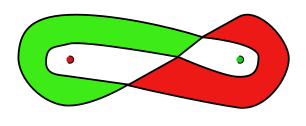
In mathematics, the Pochhammer contour, introduced by and , is a contour in the complex plane with two points removed, used for contour integration. If A and B are loops around the two points, both starting at some fixed point P, then the Pochhammer contour is the commutator ABA−1B−1, where the superscript −1 denotes a path taken in the opposite direction. With the two points taken as 0 and 1, the fixed basepoint P being on the real axis between them, an example is the path that starts at P, encircles the point 1 in the counter-clockwise direction and returns to P, then encircles 0 counter-clockwise and returns to P, after that circling 1 and then 0 clockwise, before coming back to P. The class of the contour is an actual commutator when it is considered in the fundamental group with basepoint P of the complement in the complex plane (or Riemann sphere) of the two points looped. When it comes to taking contour integrals, moving basepoint from P to another choice Q makes no difference to the result, since there will be cancellation of integrals from P to Q and back.
Homologous to zero but not homotopic to zero
Within the doubly punctured plane this curve is homologous to zero but not homotopic to zero. Its winding number about any point is 0 despite the fact that within the doubly punctured plane it cannot be shrunk to a single point.
Applications
The beta function is given by Euler's integral
:\displaystyle \Beta(\alpha,\beta)=\int_0^1 t^{\alpha-1}(1-t)^{\beta-1} , dt
provided that the real parts of α and β are positive, which may be converted into an integral over the Pochhammer contour C as
:\displaystyle (1-e^{2\pi i\alpha})(1-e^{2\pi i\beta})\Beta(\alpha,\beta) =\int_C t^{\alpha-1}(1-t)^{\beta-1} , dt.
The contour integral converges for all values of α and β and so gives the analytic continuation of the beta function. A similar method can be applied to Euler's integral for the hypergeometric function to give its analytic continuation.
Notes
References
References
- Jordan (1887), pp. 243–244
This article was imported from Wikipedia and is available under the Creative Commons Attribution-ShareAlike 4.0 License. Content has been adapted to SurfDoc format. Original contributors can be found on the article history page.
Ask Mako anything about Pochhammer contour — get instant answers, deeper analysis, and related topics.
Research with MakoFree with your Surf account
Create a free account to save articles, ask Mako questions, and organize your research.
Sign up freeThis content may have been generated or modified by AI. CloudSurf Software LLC is not responsible for the accuracy, completeness, or reliability of AI-generated content. Always verify important information from primary sources.
Report