From Surf Wiki (app.surf) — the open knowledge base
Plymouth GTX
.jpg)
| Field | Value |
|---|---|
| name | Plymouth GTX |
| image | 1970 Plymouth GTX.jpg |
| manufacturer | Plymouth (Chrysler) |
| production | 1967–1971 |
| 44,178 units | |
| class | Muscle car |
| assembly | United States: Detroit, Michigan (Lynch Road Assembly) |
| layout | FR layout |
| platform | B-body |
| caption | 1970 Plymouth GTX |
44,178 units The Plymouth GTX is an automobile manufactured by Chrysler and marketed under its Plymouth division from 1967 to 1971. Introduced as the Belvedere GTX, it was positioned as a mid-sized upscale-trimmed performance muscle car through the 1971 model year.
TOC
1967
440 cuin RB V8 3-speed automatic Plymouth Belvedere Plymouth Satellite
The GTX was based on the Belvedere, and was differentiated by a blacked out grille and special rear fascia, fiberglass simulated hood scoops with optional racing stripes, a chrome "pop-open" fuel filler cap, and a tachometer mounted on the center console.
The GTX was positioned as a "gentleman's muscle car". Standard was Plymouth's 440 cuin V8 engine called the "Super Commando 440" rated at 375 hp. Optional was Chrysler's 426 cuin Hemi. A heavy duty suspension system was also standard.
Performance
| Model | 0-60 mph | 1/4 mile time | Source |
|---|---|---|---|
| 1967 440 | 6.5 seconds | 15.2 seconds at 97 mi/h | |
| 1967 426 Hemi | 4.8 seconds | 13.5 seconds at 105 mi/h |
Engines
| Engine | Power | Torque | ||
|---|---|---|---|---|
| 426 Hemi V8 | 425 hp | {{convert | 490 | lbft |
| 440 V8 | 375 hp | {{convert | 480 | lbft |
1968–1970
440 cuin RB V8 3-speed automatic Dodge Charger Plymouth Belvedere Plymouth Satellite
1968

.jpg)
Chrysler introduced major changes in the design of the 1968 model Plymouth B-bodies and the GTX was given a completely new look. A new hourglass body replaced the previous rectilinear design. The high performance 440 was standard in the GTX as was the TorqueFlite automatic transmission, while it was an extra cost option in the Plymouth Road Runner. The GTX used the Sport Satellite trim and was offered in two body styles, a two-door convertible and a two-door hardtop (no B-pillar). All featured dual horizontal "racing stripes" on the lower sides ending with a GTX emblem ahead of the rear wheel openings.
The GTX was positioned to be an upscale model of the Road Runner by adding elements of luxury to performance.
1969
.jpg)
In 1969, the GTX's sales dropped when the Road Runner was also offered in a convertible body style. The GTX received minor cosmetic changes to the tail lights and grille, as well as the side marker lights. An optional "Air Grabber" hood (standard on Hemi-engined cars) featured functional openings on both sides of the hood that were controlled from the dash.
The 1969 GTX had standard black lower-body side paint in place of the previous stripes. The standard 440 V8 was still rated at 375 hp. This was the last year that the convertible model was available on the GTX. Total production was 701 GTX convertibles in 1969. Of those, eleven were equipped with the 426 Hemi; four were 4-speeds and seven had TorqueFlite automatics.
1970
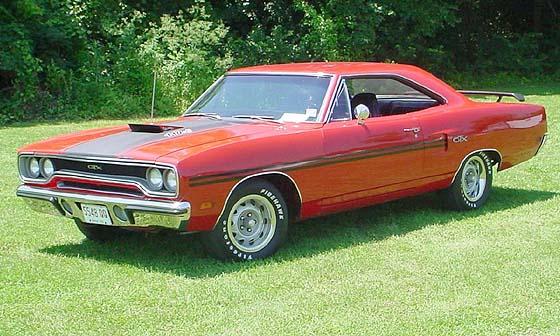
The 1970 GTX received a minor redesign with a new grille and rear taillights. Sales were low as the car did not look much different from the Road Runner. Stylists made the lines smoother, and a "power bulge" hood was introduced, as well as non-functional rear-brake air scoops. The convertible body style was no longer available. The Air Grabber hood returned, but instead of having two narrow openings running length-wise as in 1969, it had one opening scoop located on the power bulge. The GTX was available with the standard 440 four-barrel carburetor. Optional were the 440+6 barrel (three 2-barrel carburetors) and the 426 Hemi. In keeping with the GTX marketing strategy, the 1970 model included many standard features.
The only other performance luxury model in Plymouth's lineup was the full-size Sport Fury GT, built on the C-Body platform. The GT was added to the lineup in 1970.
Engines
| Engine | Power | Torque | Years | ||
|---|---|---|---|---|---|
| 426 Hemi V8 | 425 hp | {{convert | 490 | lbft | abbr=on}} |
| 440 V8 | 375 hp | {{convert | 480 | lbft | abbr=on}} |
| 440 V8 6-bbl | 390 hp | {{convert | 490 | lbft | abbr=on}} |
1971
3-speed automatic 440 cuin RB 440 V8 Dodge Coronet Plymouth Road Runner Plymouth Satellite


The B-body was redesigned for 1971 and featured rounded "fuselage" styling with a raked windshield, hidden cowl, and a loop-type front bumper around a deeply inset grille and headlights. This was the final year for the GTX as a stand-alone model. The convertible body style was dropped.
.jpg)

Engine choices were 440 four-barrel, 440 with three two-barrels (Six Pack), and 426 Hemi. Emission restrictions such as lower compression ratios and faster-acting choke operation lowered the base 440 output by 5 hp, to 370 hp. The 440 Six Pack was down to 385 hp, but the Hemi was still rated at 425 hp. Due partly to rising insurance rates on muscle cars, sales dropped to fewer than 3,000 units in 1971 (2,942), and only 30 cars were equipped with the Hemi engine, which was discontinued after this year.
Engines
| Engine | Power gross | Torque gross | Power net | Torque net | ||
|---|---|---|---|---|---|---|
| 426 Hemi V8 | 425 hp | {{convert | 490 | lbft | abbr=on}} | 350 hp |
| 440 V8 | 370 hp | {{convert | 480 | lbft | abbr=on}} | 305 hp |
| 440-6 V8 | 385 hp | {{convert | 490 | lbft | abbr=on}} | 330 hp |
1972–1974
The GTX as a standalone model was discontinued after the 1971 model year. For 1972 through 1974, any Road Runner ordered with the optional 440 was renamed Road Runner GTX and included the badging of both previous models.
Notes
References
- "1967-1974 Plymouth GTX: muscle cars with all the trimmings".
- (25 March 2015). "Plymouth GTX - History". Musclecarclub.com.
- Eisenschenk, Wes. (2017). "1969 Plymouth Road Runner". CarTech.
- Gunnell, John. (2005). "American Cars of the 1960s: A Decade of Diversity". Krause Publications.
- Holley, Chris. (2020-10-05). "The Last Gentleman's Muscle Car: Al Macdonald's 1971 Plymouth Hemi GTX".
This article was imported from Wikipedia and is available under the Creative Commons Attribution-ShareAlike 4.0 License. Content has been adapted to SurfDoc format. Original contributors can be found on the article history page.
Ask Mako anything about Plymouth GTX — get instant answers, deeper analysis, and related topics.
Research with MakoFree with your Surf account
Create a free account to save articles, ask Mako questions, and organize your research.
Sign up freeThis content may have been generated or modified by AI. CloudSurf Software LLC is not responsible for the accuracy, completeness, or reliability of AI-generated content. Always verify important information from primary sources.
Report