From Surf Wiki (app.surf) — the open knowledge base
Plymouth Barracuda
Car model built by Chrysler Corporation
Car model built by Chrysler Corporation
| Field | Value |
|---|---|
| image | 1970 Plymouth 'Cuda (28085938680).jpg |
| caption | 1970 Plymouth Barracuda Hardtop Coupe |
| name | Plymouth Barracuda |
| manufacturer | Plymouth (Chrysler) |
| production | 1964–1974 |
| assembly | |
| layout | FR layout |
| class | Pony car |
The Plymouth Barracuda is a two-door pony car that was manufactured by Chrysler Corporation from 1964 through 1974 model years.
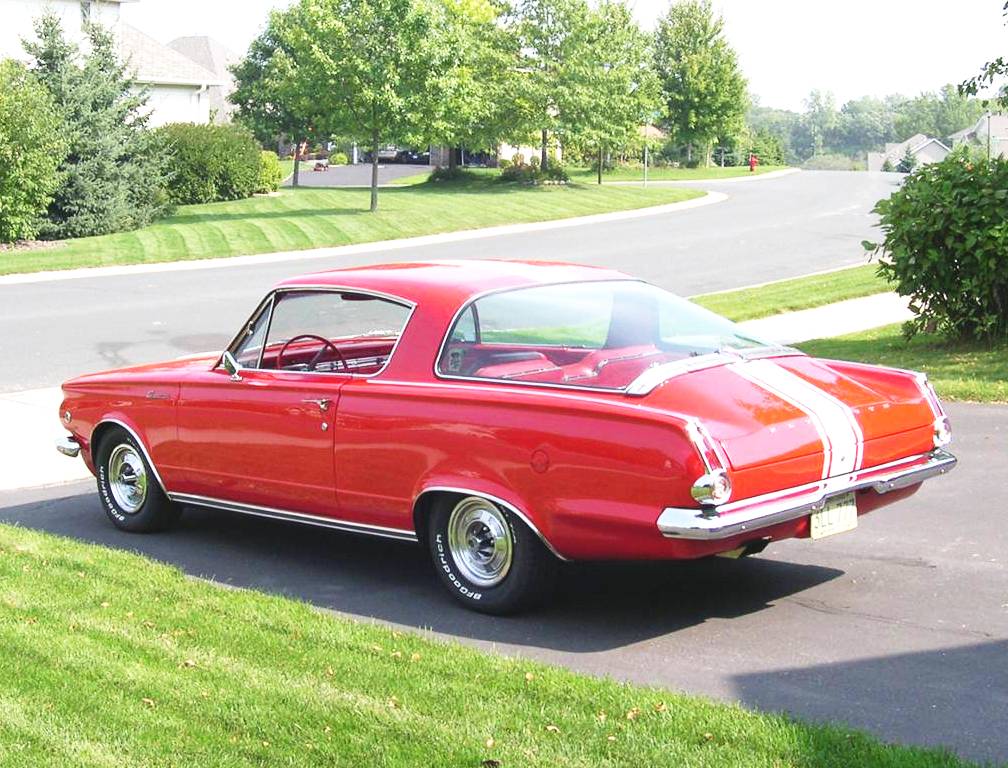
The first-generation Barracuda was based on the Chrysler A-body and was offered from 1964 until 1966. A two-door hardtop (no B-pillar) fastback design, it shared a great majority of parts and bodywork with the Plymouth Valiant, except for the distinctive wraparound rear glass.
The second-generation Barracuda, though still Valiant-based, was heavily redesigned. Built from 1967 through 1969, it was available as a two-door in fastback, notchback, and convertible versions.
The third generation, offered from 1970 until 1974, was based on the Chrysler E-body, exclusive to it, and the slightly larger Dodge Challenger. A completely new design, the two-door Barracuda was available in hardtop and convertible body styles.
First generation (1964–1966)
1964
During the development of the Barracuda, one of the worst-kept secrets was Ford's plan to introduce a new sporty compact car based on the inexpensive Falcon chassis and running gear (which was eventually released as the Mustang in mid-model year 1964); the extent of the other changes was not known. Chrysler stylist Irv Ritchie sketched a fastback version of the compact Valiant. Budgets were limited due to research and development of the Chrysler Turbine Car, but the company's executives wanted to have an entry in this emerging and potentially lucrative sporty-compact car market segment, beginning by siphoning off some of the Chevrolet's Corvair Monza's sales. Plymouth's executives had wanted to name the new model Panda, an idea unpopular with its designers. In the end, John Samsen's suggestion of Barracuda prevailed.
Based on Chrysler's A-body, the Barracuda debuted in fastback form on April 1, 1964. The new model used the Valiant's 106 in wheelbase and the Valiant hood, headlamp bezels, windshield, vent windows, quarter panels, doors, A-pillar, and bumpers; the trunk and some of the glass was new. Using the same hybrid design approach as Ford did turning its Falcon into the Mustang significantly reduced Plymouth's development and tooling cost and time for the new model. The greatest effort was put into creating its distinguishing 14.4 sqft rear window, a collaboration between Pittsburgh Plate Glass (PPG) and Chrysler designers that created the largest ever installed on a standard production car to that time.
Powertrains were identical to the Valiant's, including two versions of Chrysler's slant-6 six-cylinder engine. The standard-equipment engine had a displacement of 170 CID and an output of 101 bhp; the 225 CID option raised the power output to 145 bhp.
The highest-power option for 1964 was Chrysler's all-new 273 CID LA V8. A compact and relatively light engine equipped with a two-barrel carburetor, it produced 180 bhp. The Barracuda sold for a base price of US$2,512 ($ today).
The 1964 model year was the first for the Barracuda and also the last year for push-button control of the optional Torqueflite automatic transmission. This year also marked the first use of the smaller "TorqueFlite 6" (A904) transmission behind a V8.
In the marketplace, the Barracuda was obviously a fastback version of the Valiant that had a frugal family transportation image. The sales brochure for the first Barracudas pitched it as a car "for people of all ages and interests." The more sporty Mustang was marketed with abundant advertising to young professionals and with its youthful image proved widely successful following its mid-1964 introduction. This became known as the "pony car" niche of modestly appointed compact-sized sedans and convertibles, which came with standard 6-cylinder engines and basic interiors, but could be outfitted with powerful V8s and "custom" appointments and luxury features. The success of the Mustang has long obscured the fact that the Barracuda actually predated Ford's introduction by two weeks. The abbreviated sales season for the 1964 Barracuda totaled 23,443 units compared to the 126,538 Mustangs sold during the same time.
1965
In 1965, the 225 slant-6 became the base engine for the U.S. market, though the 170 CID remained the base engine in Canada.
New options were introduced for the Barracuda as the competition among pony cars intensified. The 273 engine was made available as an upgraded Commando version with a four-barrel carburetor, 10.5:1 compression, and a more aggressive camshaft, still with solid tappets. These and other upgrades increased the engine's output to 235 bhp.
A new *Formula 'S' * package included the Commando V8 engine, suspension upgrades, larger wheels and tires, special emblems, and a tachometer. Disc brakes and factory-installed air conditioning became available after the start of the 1965 model year.
1966

For the 1966 model year the Barracuda received new taillamps, new front sheet metal, and a new instrument panel. The latter had room for oil pressure and tachometer gauges on models so equipped. The 1966 front sheet metal which, except for the grille, was shared with the Valiant, gave a more rectilinear contour to the fenders. Deluxe models featured fender-top turn signal indicators with a stylized fin motif. The bumpers were larger, and the grille featured a strong grid theme. A center console was optional for the first time.
Although the first Barracudas were heavily based on the contemporary Valiants, Plymouth wanted them perceived as distinct models. Consequently, the "Valiant" chrome script that appeared on the model's trunk lid was phased out at the end of the 1965 model year in the U.S. market, and the large stylized "V" trim above the deck lid was changed to a unique Barracuda fish logo for 1966, though in markets such as Canada and South Africa, where Valiant was a marque in its own right, the car remained badged as Valiant Barracuda until the A-body Barracuda was discontinued.
Engines
| Engine | Year | Power |
|---|---|---|
| 170 Inline 6 | 1964 | 101 hp |
| 225 Inline 6 | 1964 -1966 | 145 hp |
| 273 V8 | 180 hp | |
| 1965 -1966 | 235 hp |
Second generation (1967–1969)
2-door hardtop coupe 2-door convertible Plymouth Valiant 273 CID LA V8 318 CID LA V8 340 CID LA V8 383 CID B V8 440 CID RB V8 426 CID 2x4bbl HEMI RB V8
1967
.jpg)
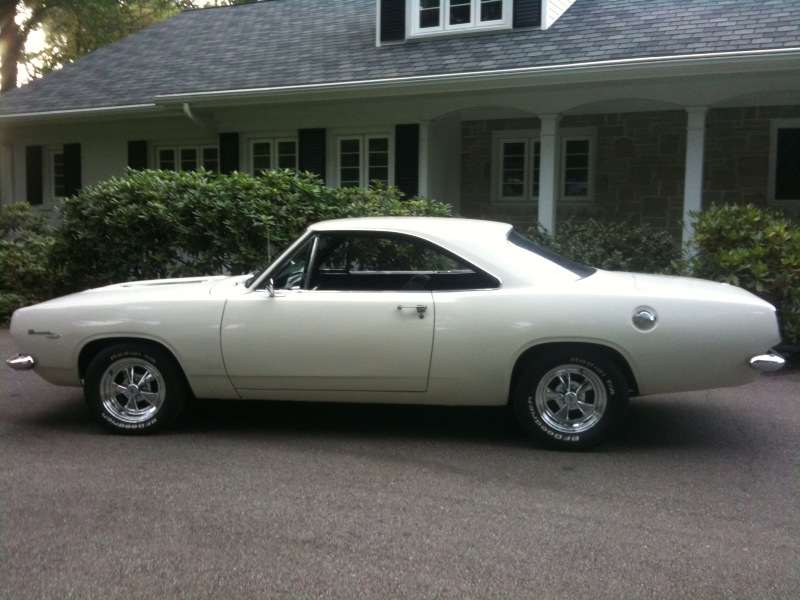
The second-generation Barracuda was redesigned with model-specific sheet metal, yet still shared many components with the Valiant. It rode on a 108 in wheelbase A-body and was available as a convertible, and a notchback coupe, in addition to the fastback design.
The new Barracuda was chiefly the work of John E. Herlitz and John Samsen, with Coke-bottle side contours and heavily revised front and rear ends. Design changes included wider wheel openings, curved side glass, and S-curved roof pillars on the hardtop.
The roofline on the fastback coupe was more streamlined, more steeply raked, and with a much smaller flush rear window in place of the distinctive massive wraparound in the original model. Also, the overall use of chrome trim was more restrained.
During this time the first U.S. Federal auto safety standards were phased in, and Chrysler's response a requirement for side-marker lights distinguishes each model year of the second-generation Barracuda:
- 1967: no sidemarker lamps or reflectors, and backup lights on the rear valance by the license plate.
- 1968: round side marker lamps without reflectors, mostly white tail lamps with backup lights in the tail lamp housing.
- 1969: little changes on the front grille, rectangular side marker reflectors without lamps, and the backup lamps were moved back to the rear valance by the license plate.
As the pony-car class became established and competition increased, Plymouth began to revise the Barracuda's engine options.
.jpg)
In 1967, while the 225 CID slant-6 was still the base engine, the V8 options ranged from the two- and four-barrel versions of the 273 CID to a seldom-ordered 383 CID "B" big-block, rated at 280 bhp, the latter available only with the Formula S package.
.jpg)
1968
In 1968, the 273 was replaced by the 318 CID LA engine as the smallest V8 available, and the new 340 CID LA four-barrel was released. The 383 Super Commando engine was upgraded with the intake manifold, camshaft, and cylinder heads from the Road Runner and Super Bee, but the more restrictive exhaust manifolds specific to the A-body cars limited its output to 300 bhp.
Also in 1968, Chrysler made approximately fifty fastback Barracudas equipped with the 426 CID Hemi for Super Stock drag racing. These cars were assembled by Hurst Performance and featured items such as lightweight Chemcor side glass, fiberglass front fenders, fiberglass hood with scoop, and lightweight front seats, and street features such as rear seats and sound deadener omitted. An included sticker indicated that the car was not for use on public roads; it could run the quarter-mile in the mid-tens in 1968.
For the South African export market, a 190 bhp high-performance version of the 225 slant-6 called Charger Power was offered with 9.3:1 compression, two-barrel carburetor, more aggressive camshaft, and low-restriction exhaust system. A handful of Savage GTs were also built from the second-generation Barracuda.
1969
In 1969, Plymouth placed an increased emphasis on performance. A new option was the Mod Top, a vinyl roof covering with a floral motif, available in 1969 and 1970. Plymouth sold it as a package with seat and door panel inserts done in the same pattern.
The 1969 version of the 383 engine was upgraded to increase power output to 330 bhp, and a new trim package called* 'Cuda* was released. The 'Cuda, based on the Formula S option, was available with either the 340, 383 and, new for 1969, the 440 Super Commando V8.
Engines
| Engine | Year | Power |
|---|---|---|
| 225 Inline 6 | 1967-1969 | 145 hp |
| 273 V8 | 1967 | 180 hp |
| 235 hp | ||
| 318 V8 | 1968-1969 | 230 hp |
| 340 V8 | 275 hp | |
| 383 V8 | 1967 | 280 hp |
| 1968 | 300 hp | |
| 1969 | 330 hp | |
| 440 V8 | 380 hp |
Third generation (1970–1974)
2-door convertible (Dodge Main Assembly Hamtramck, MI plant only) 225 CID Slant-6 318 CID LA V8 340 CID LA V8 360 CID LA V8 383 CID B V8 426 CID Hemi V8 440 CID RB V8 4-speed manual 3-speed TorqueFlite automatic
1970–1971

The all-new 1970 Barracuda was styled by John E. Herlitz and built on a shorter, wider version of Chrysler's existing B platform, called the E-body. The redesign removed all previous commonality with the Valiant. The fastback model was deleted from the line and the Barracuda was only offered in coupe and convertible models. Though sharing its platform with the newly launched Dodge Challenger, no exterior sheet-metal was shared between the two. The Challenger's 110 in wheelbase was 2 in longer than the Barracuda's, and its body 5 in longer.
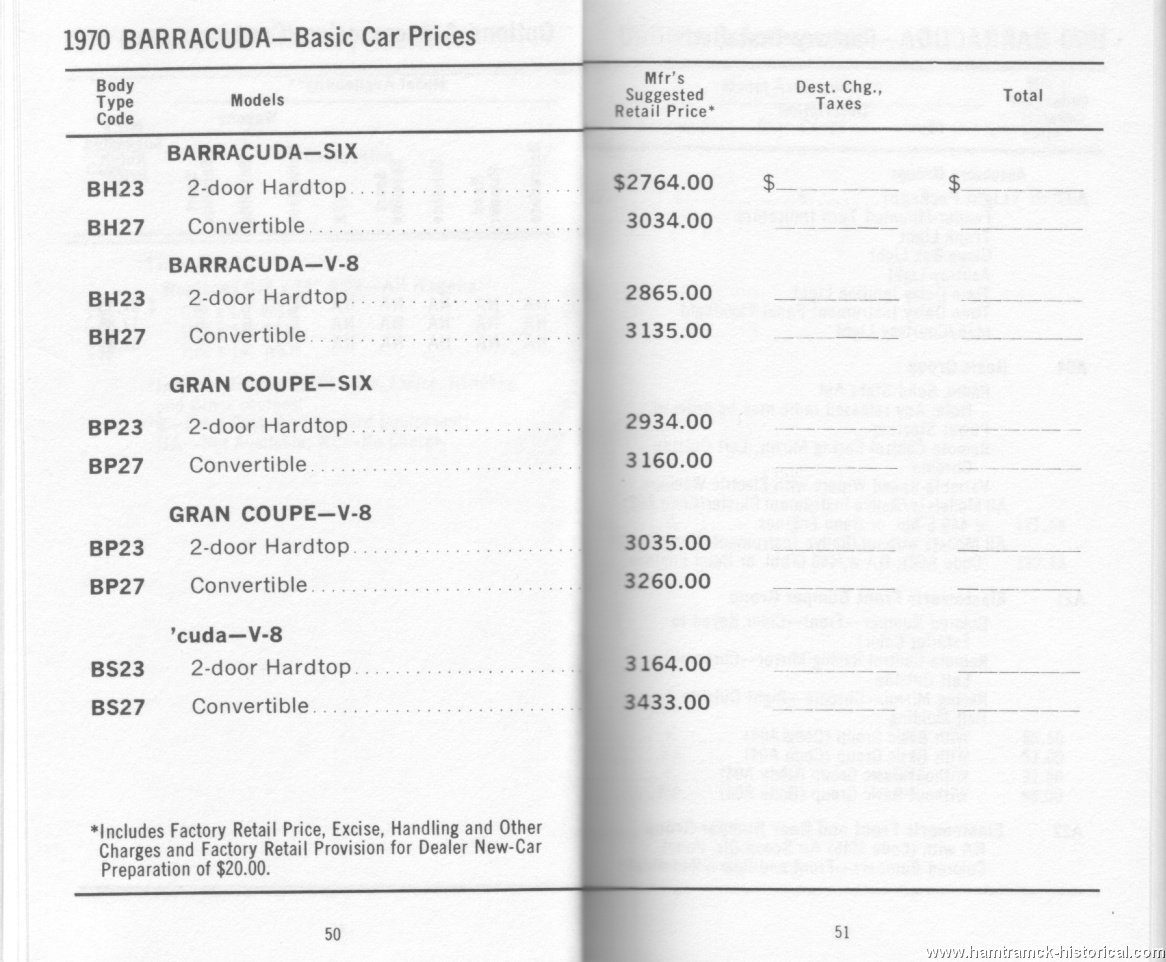
The E-body Barracuda was thus "able to shake the stigma of 'economy car. Three versions were offered for 1970 and 1971: the base Barracuda (BH), the luxury oriented Gran Coupe (BP), and the sport model 'Cuda (BS).
Beginning mid-year 1970, and ending with the 1971 model, there also was the Barracuda Coupe (A93), a low-end model with the 198 CID Slant Six as a base engine, lower-grade interior, and (like other Coupe series Chrysler offered that year) had fixed quarter glass instead of roll-down rear passenger windows. The high-performance models were marketed as* 'Cuda* deriving from the 1969 option. The E-body's engine bay was larger than that of the previous A-body, facilitating the use of Chrysler's 426 CID Hemi.

For 1970 and 1971, the Barracuda and Barracuda Gran Coupe had two slant I6 engines available — a new 198 CID version and the previous 225 — as well as four V8 options: the 318 CID, the 383 CID with a two-barrel carburetor and single exhaust, the 383 with a four-barrel and dual exhausts, and the 383 Magnum with a four-barrel and dual exhausts, producing 330 hp SAE gross.
.jpg)

Other Barracuda options included decal sets, hood modifications, and some unusual "high impact" colors such as "Lime Light", "Bahama Yellow", "Tor Red", "Lemon Twist", "Curious Yellow", "Vitamin C", "In-Violet", "Sassy Grass" and "Moulin Rouge".
.jpg)
The Barracuda was changed slightly for 1971, with a new grille and taillights, seat, and trim differences. This would be the only year that the Barracuda would have four headlights (which the Challenger had for all five years of their concurrent run), and also the only year of the fender "gills" on the 'Cuda model. Only 1970 'Cuda models received a "hockey stick" stripe with an engine call out within it, where as 1971 'Cudas were the only year that had the full side "Billboard" decal with the engine call out inside of the billboard decal.
The 1971 Barracuda engine options would remain the same as that of the 1970 model, except that the 340 6-Bbl was gone, and the four-barrel carbureted 440 V8 engine was no longer on the options list, but could be had via special order and perhaps a dozen cars were built with it installed; otherwise, the 440-powered Barracudas had a six-barrel carburetor setup instead.
In 1971 the big-block power options offered to the customer were:
- 275 hp SAE Gross in the 383-2V
- 300 hp SAE Gross in the 383-4V
- 385 hp SAE Gross in the 440-6V
- 425 hp SAE Gross in the 426-8V
.jpg)
1972–1974
.jpg)
.JPG)
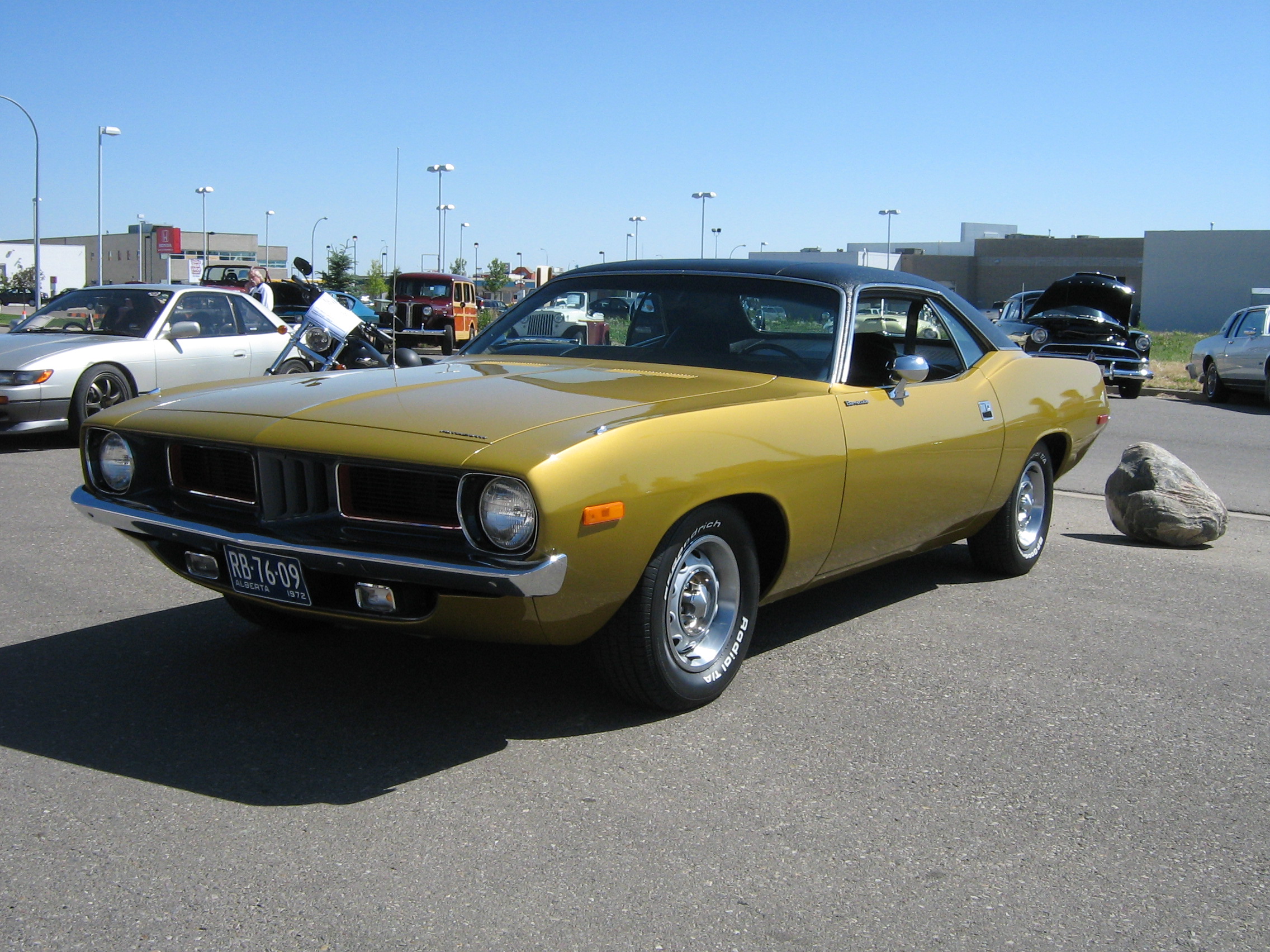
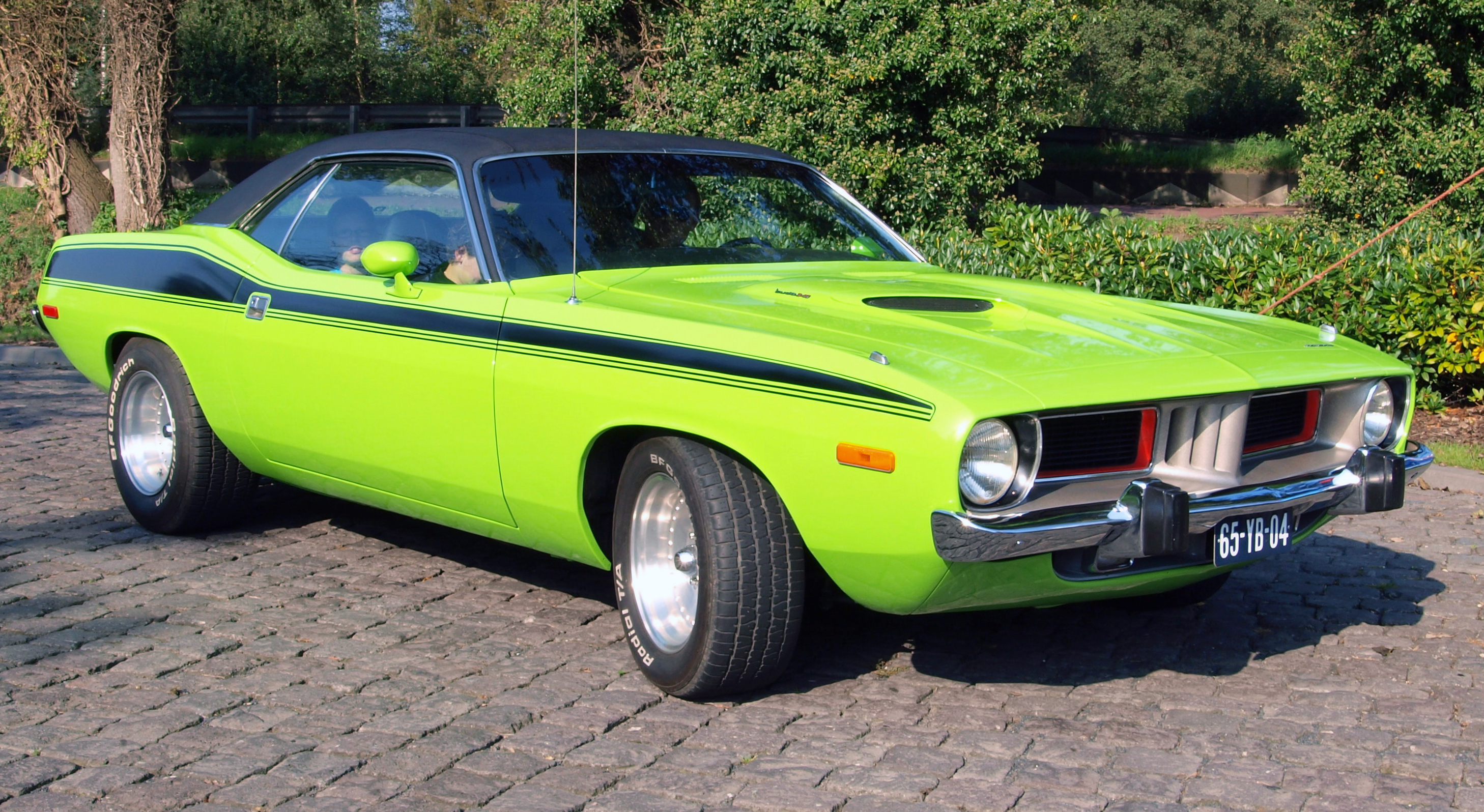
With a new grille and single headlights (very similar to the 1970 model) and four circular taillights for 1972, the Barracuda would remain basically unchanged through 1974, with new bodyside stripes, and minor changes to the bumpers to conform with federal impact standards being the only significant variations. In 1973 the shape of the pedals was changed from a trapezoid shape with a fine horizontal pattern that was original to the shape of the 1970, where as 1973 and later had larger rectangle shaped clutch and brake pedals with thicker horizontal grooves that would remain similar to most all Chrysler products through the 1980s. There was also a corresponding gas pedal that matched the aforementioned brake and clutch style variations. With this change of pedal shape the brake and clutch supporting members were forged differently, and the pads were not interchangeable. 1972 was also the last year for the basket-weave pattern in the seats, where as the next two years, seats had a different cost saving coachman grain pattern vinyl with different bucket seat backs.
Big block engines (383, 440, & 426 Hemi), heavy-duty suspensions, Dana 60 rear axle, large/wide tires mounted on 15 x wheels were no longer offered.
Additionally; the convertible model was dropped; though a few late build 1971 convertibles were built with 1972 grills and back end panels and provided to Paramount Studios for TV and movie work; being seen on Mannix, The Brady Bunch and other shows.
Convenience and comfort items such as power seats, power windows, and upgraded interior (leather seats and plush carpeting) options were dropped, though heavy-duty air conditioning and a sunroof could still be ordered.
For 1972 only, three engine choices were offered: a 225 six, the 318 (base engine for both 'Cuda and Barracuda), and a revised 340 detuned to meet emission standards. In addition, all three were tuned to run on low/no-lead gas and were power rated on the NET (installed) method. Three transmissions were offered: a 3-speed manual, the Torqueflite automatic, and the Hurst shifter equipped four-speed.
For 1973 federally mandated safety bumpers were added front and rear, and the 225 six was dropped, with the 318 and 340 V8s being the only engine choices. For late production 1973 cars, and for 1974 a slightly more powerful 360 V8 (245 E bodyhp) replaced the 340. Since 1970; optional was a four-speed manual transmission (equipped with a Hurst shifter) mated to a performance ratio (3.55 to 1) rear axle for the 340 and 360 engines, though as many as three cars (in both 1973 and 1974) were built with the 318 engine and Hurst 4-speed through special orders or factory errors.
As with other American vehicles of the time, there was a progressive decrease in the Barracuda's performance. To meet increasingly stringent safety and exhaust emission regulations, big-block engine options were discontinued. The remaining engines were detuned year by year to reduce exhaust emissions, which also reduced their power output. There was also an increase in weight as bumpers became larger and, starting in 1970, E-body doors were equipped with heavy steel side-impact protection beams. Higher fuel prices following the 1973 oil crisis and performance-car insurance surcharges deterred many buyers as the interest in high-performance cars waned. Sales of pony cars were on the decline. Sales had dropped dramatically after 1970, and while 1973 showed a sales uptick, Barracuda production ended April 1, 1974, ten years to the day after it had begun.
Engines
Engine choices by Chrysler for the 1970-73 Barracuda included the following:
Engines
| Engine | Years | Power SAE gross | Power SAE net |
|---|---|---|---|
| 198 Inline 6 | 1971 | 125 hp | 105 hp |
| 225 Inline 6 | 1970-1972 | 145 hp | 110 hp |
| 318 V8 | 1972-1974 | 150 hp | |
| 1970-1971 | 230 hp | 155 hp | |
| 340 V8 | 275 hp | 235 hp | |
| 1972-1973 | 240 hp | ||
| 1970 | 290 hp | ||
| 360 V8 | 1974 | 245 hp | |
| 383 V8 | 1970-1971 | 290 hp | 190 hp |
| 1971 | 300 hp | 250 hp | |
| 1970 | 330 hp | ||
| 335 hp | |||
| 426 V8 | 1970-1971 | 425 hp | 350 hp |
| 440 V8 | 1970 | 375 hp | |
| 1971 | 385 hp | 330 hp | |
| 1970 | 390 hp |
- B: 198 cuin Slant 6 I6: 1970–71 125 bhp SAE gross, 1972 100 bhp SAE net
- C: 225 cuin Slant 6 I6: 1970–71 145 bhp SAE gross, 1971-72 110 bhp SAE net
- G: 318 cuin LA V8 (2-barrel carburetor, single exhaust): 1970-71 230 bhp SAE gross, 1971 155 bhp SAE net, 1972-74 150 bhp SAE net
- H: 340 cuin LA V8 (4-barrel carburetor, dual exhaust): 1970-71 275 bhp SAE gross, 1971 235 bhp SAE net, 1972-73 240 bhp SAE net
- J: 340 cuin LA V8 (3×2-barrel carburetor): 1970 290 bhp SAE gross, used in AAR Cuda
- L: 360 cuin LA V8 (4-barrel carburetor, dual exhaust): 1974 245 bhp SAE net
- L: 383 cuin B V8 (2-barrel carburetor, single exhaust): 1970 290 bhp SAE gross, 1971 275 bhp SAE gross, 1971 190 bhp SAE net
- N: 383 cuin B V8 (4-barrel carburetor, dual exhaust): 1970 330 bhp SAE gross
- N: 383 cuin B V8 Magnum (4-barrel carburetor, dual exhaust): 1970 335 bhp at 5,000 rpm SAE gross and 425 lbft at 3,200 rpm of torque, 1971 300 bhp SAE gross, 1971 250 bhp SAE net
- U: 440 cuin RB V8 Magnum 4-barrel Holley AVS-4737S carburetor: 1970 375 bhp at 4,600 rpm and 480 lbft at 3,200 rpm of torque SAE gross, (1971 370 bhp SAE gross, 305 bhp SAE net only in Satellite GTX and Plymouth Sport Fury GT)
- V: 440 cuin RB V8 Six-Pack 3X2-barrel Holley R-4382A/R-4375A/R-4383A carburetors: 1970 390 bhp at 4,700 rpm and 490 lbft at 3,200 rpm of torque SAE gross, 1971 385 bhp SAE gross, 1971 330 bhp SAE net
- R: 426 cuin Hemi V8 2X4-barrel Carter AFB 4742S/AFB4745S carburetors: 1970-71 425 bhp SAE gross at 5,000 rpm and 490 lbfft at 4,000 rpm of torque, 1971 Costing an extra US$1,228 ($ today) with very few sold.
SAE gross hp ratings were tested with no accessories, no air cleaner, or open headers. In 1971, compression ratios were reduced in performance engines, except the 426 cu in and the high-performance 440 cu in, to accommodate regular gasoline. 1971 was the last year for the 426 Hemi.
Chrysler had plans to continue the 1970 Dodge Challenger T/A for 1971, even publishing advertisements for a 1971 Dodge Challenger T/A. However, no 1971 Dodge Challenger T/A was made. Similarly, no 1971 Plymouth AAR Cuda was made.
Production numbers
| Year | Engine | Transmission | Production | Total |
|---|---|---|---|---|
| 1970 | I6 | 3-Speed | 1,892 | 48,867 |
| Auto | 3,695 | |||
| V8 | 3-Speed | 4,031 | ||
| 4-Speed | 9,026 | |||
| Auto | 30,223 | |||
| 1971 | I6 | 3-Speed | 411 | 16,492 |
| Auto | 1,318 | |||
| V8 | 3-Speed | 240 | ||
| 4-Speed | 1,983 | |||
| Auto | 11,815 | |||
| 1972 | I6 | Manual | 224 | 18,490 |
| Auto | 596 | |||
| V8 | Manual | N/A | ||
| Auto | 11,025 | |||
| 1973 | V8 | Manual | N/A | 19,281 |
| Auto | N/A | |||
| 1974 | V8 | Manual | N/A | 11,734 |
| Auto | N/A |
Discontinuation
The Barracuda was discontinued after 1974, a victim of the 1973 energy crisis.
A 1975 Barracuda had been planned before the end of the 1970-74 model cycle. Plymouth engineers sculpted two separate concepts out of clay, both featuring a Superbird-inspired aerodynamic body, and eventually reached a consensus upon which an operational concept car could be built. Due to a rapidly changing automotive market due to the energy crisis, the concepts were scrapped and the Barracuda was not put into production for 1975.
Revival attempts
In 2007, Motor Trend magazine reported a rumor that Chrysler was considering reviving the Barracuda in 2009. A new Barracuda would've been badged as a Chrysler, due to the Plymouth brand having been phased out in 2001. However, the Barracuda has not been reintroduced alongside the third generation Dodge Challenger. Rumors of the Barracuda making a comeback were brought up again by Motor Trend in 2012 when reports leaked that the Barracuda would come back in 2014 under the SRT Marque, replacing the Challenger instead of being built alongside it. It was also stated the car would not be of a retro design. Ultimately, the SRT division was re-consolidated under the Dodge banner and the Challenger remained in production without a Barracuda replacement.
After years of silence, an all-new Barracuda, now under the Dodge brand, was shown to FCA dealers along with other future vehicles on August 25, 2015. Based on stretched underpinnings of the rear-drive Alfa Romeo Giulia, it was rumored to be powered by a turbocharged V6 and arrive within the 2019 model year. As of 2025, a new Barracuda model has not materialized, however, Dodge filed trademarks to secure the "Barracuda" and "'Cuda" nameplates.
Collectibility
The Barracuda (particularly the 1970–1974 E-Body cars) is a collectible car today, with high-performance versions and convertibles commanding the highest prices. The small number of Barracudas remaining in existence is the result of low buyer interest (and low production/sales) when the vehicles were new. The remaining cars of any condition are rare, and the outstanding examples fetch high appraisal values today. Original Hemi super stock Barracudas (and similarly configured Dodge Darts) are now prized collector vehicles, with factory (unaltered) cars commanding high prices.
The 1971 Hemi 'Cuda convertible is now considered one of the most valuable collectible muscle cars. Only thirteen were built, seven of which were sold domestically. The most recent public sale was at the June 2014 Mecum auction in Seattle, where a blue-on-blue 4-speed sold for US$3.5 million (plus buyers premium). Several replica cars were created to look like Hemi 'Cudas and driven by the title character in the late-1990s police procedural Nash Bridges. None of these replica cars had a Hemi V8 under the hood.
References
References
- Mueller, Mike. (2009). "The Complete Book of Classic Dodge and Plymouth Muscle: Every model from 1960 to 1974". Motorbooks.
- "Early Barracuda Production Specifications 2".
- Grist, Peter. (2009). "Dodge Challenger & Plymouth Barracuda: Chrysler's Potent Pony Cars". Veloce Publishing.
- Samsen, John "Dick". "Plymouth Barracuda design history".
- Young, Tony. (1984). "Mighty Mopars 1960–1974". Motorbooks International.
- ''Young'', p. 33
- (January 1964). "SAE Technical Paper Series". Society of Automotive Engineers.
- (November 16, 2020). "The Plymouth Barracuda: First Pony (Fish?) Car".
- Zazarine, Paul. (1992). "Barracuda and Challenger (Muscle Car Color History)". Motorbooks.
- "MoPar Mod Top and Mod Interior Registry".
- (February 2018). "1971 Plymouth album".
- Newhardt, David. (2000). "Dodge Challenger & Plymouth Barracuda". MotorBooks International.
- Newhardt, David. (2000). "Dodge Challenger & Plymouth Barracuda". MotorBooks/MBI.
- "Salesman Pocket Guide - 1970 Basic Car Prices (Barracuda)".
- (17 January 2021). "1970 Dodge Challenger Deputy".
- "1970 Barracuda production totals by powerteam".
- "1970 Chrysler Corporation Paint Chip chart".
- "1970 Trans-Am Box Scores". SCCA.
- Stephens, Bill. (April 29, 2012). "The French Hemi Cuda: Finally Uncovered!". Velocity.
- Redline Restorations. (June 2, 2013). "Display board: 1970 Chrysler France Racing Plymouth Hemicuda at the 2013 Greenwich Concours d'Elegance".
- "1970 Plymouth Cuda Hardtop Hemi TorqueFlite".
- "1970 Plymouth Cuda Hardtop Hemi 4-speed".
- Mitchell, Larry G.. (2000). "AMC Muscle Cars". MBI Publishing.
- (January 14, 2021). "The Mopar slant six engines".
- [https://www.hagerty.com/apps/valuationtools/1971-plymouth-cuda "1971 Plymouth 'Cuda, Model Overview". 340 six-pack available in 1970 only.]
- "Plymouth Barracuda, 1970 MY FB1/2 BH23".
- "Plymouth 'Cuda 440, 1970 MY FB2 BS23".
- "Plymouth 'Cuda 440, 1970 MY FB2 BS23".
- "Plymouth 'Cuda 426 Hemi, 1970 MY FB2 BS23".
- (July 25, 2007). "1970-1971 Plymouth Barracuda Convertibles".
- "1975 Barracuda - The Fish that Got Away".
- Ougarov, Kirill. (April 26, 2007). "Return of the 'Cuda?". Motor Trend Blogs.
- Lassa, Todd. (January 8, 2012). "Hot Detroit Rumor: Chrysler to Replace Dodge Challenger with a Barracuda!".
- Feder, Joel. (August 26, 2015). "Barracuda Coming Back As A Dodge?". Motor Authority.
- Luchian, Elena. (2025-04-21). "Is Dodge Secretly Working To Revive the Barracuda? Here Are the Hints".
- Valdes-Dapena, Peter. (September 11, 2003). "Million-dollar muscle car?".
- "Barrett-Jackson auto auction results 2005". Mopars Unlimited Car Club Vancouver.
- (November 20, 2006). "Covetable 'Cuda".
- Valdes-Dapena, Peter. (December 17, 2012). "1971 Hemi 'Cuda Ultra-rare cars going up for auction at Barrett-Jackson".
- Schild, Jim. (2010). "Challenger and Barracuda 1970-1974". MotorBooks International.
- Ernst, Kurt. (June 27, 2012). "'Nash Bridges' 1970 Plymouth 'Cuda Convertible For Sale On Ebay". Motor Authority.
This article was imported from Wikipedia and is available under the Creative Commons Attribution-ShareAlike 4.0 License. Content has been adapted to SurfDoc format. Original contributors can be found on the article history page.
Ask Mako anything about Plymouth Barracuda — get instant answers, deeper analysis, and related topics.
Research with MakoFree with your Surf account
Create a free account to save articles, ask Mako questions, and organize your research.
Sign up freeThis content may have been generated or modified by AI. CloudSurf Software LLC is not responsible for the accuracy, completeness, or reliability of AI-generated content. Always verify important information from primary sources.
Report