From Surf Wiki (app.surf) — the open knowledge base
Plumeria
Genus of flowering plants endemic to the Americas
Genus of flowering plants endemic to the Americas
Plumeria (), also known as frangipani, is a genus of flowering plants in the subfamily Rauvolfioideae, of the family Apocynaceae. Most species are deciduous shrubs or small trees. The species are native to the Neotropical realm (in Mexico, Central America, and the Caribbean, and as far south as Brazil and as far north as Florida in the United States), but are often grown as cosmopolitan ornamentals in tropical regions, especially in Hawaii, as well as hot desert climates in the Arabian Peninsula with proper irrigation.
Names
The genus Plumeria is named in honour of 17th-century French botanist and Catholic monk Charles Plumier, who traveled to the New World documenting many plant and animal species. Plumeria is also used as a common name, especially in horticultural circles.
The name "frangipani" comes from a 16th-century marquis of the noble Frangipani family in Italy, who created a synthetic plumeria-like perfume. Common names for plants in the genus vary widely according to region, variety, and whim, but frangipani or variations on that theme are the most common.
Description
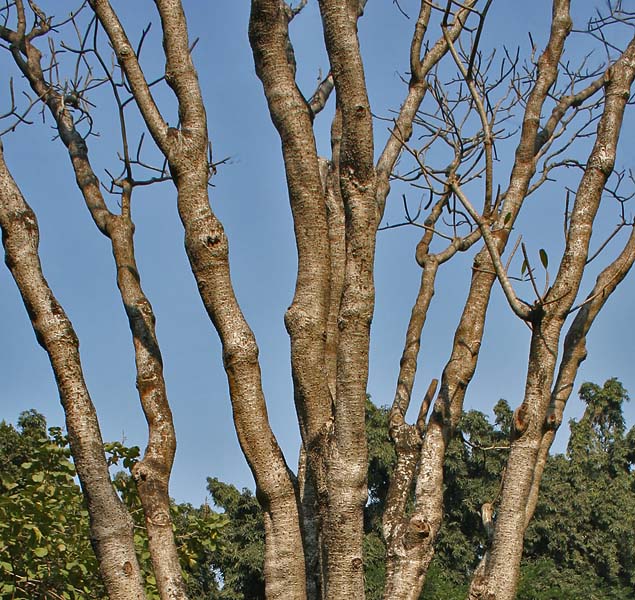
Plumeria branches are succulent. The trunk and branches of the Plumeria species have a milky latex sap that, like many other Apocynaceae, contains poisonous compounds that irritate the eyes and skin.
Leaves


Plumeria species are small trees or low shrubs. The leaves grow at tips of their branches. Various species and cultivar have various leaf shape and arrangements. The leaves of P. alba are narrow and corrugated, whereas leaves of P. pudica have an elongated shape and glossy, dark-green color. P. pudica is one of the everblooming types with nondeciduous, evergreen leaves. Another, semi-deciduous species that retains leaves and flowers in winter is P. obtusa; commonly known as "Singapore plumeria".
Flowers
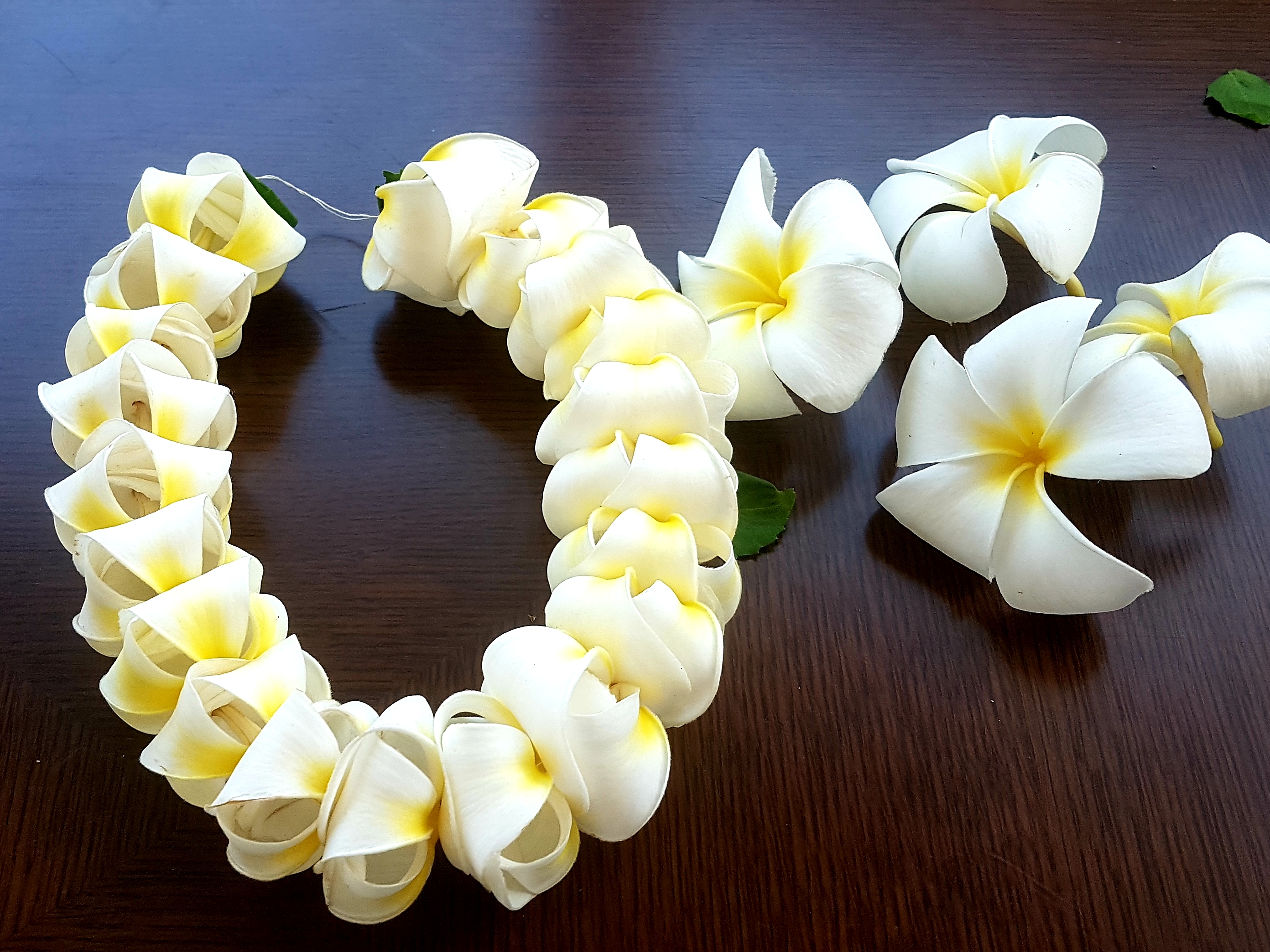
Plumeria trees flower from early summer to fall. Their blossoms grow in clusters on ends of the stems, they are made of tubular corolla with a length of 2-4 in that split sharply into five rounded and waxy petals that overlap each other. These flowers come in many colours including pink, red, white and yellow, orange, or pastel. They have separate anthers.
The flowers are highly fragrant, especially at night. Their scent is perceived to have floral elements of jasmine, citrus, gardenia, fruity aromatic notes of coconut, peach, vanilla, as well as lactonic, woody accords. However, they yield no nectar. Their scent tricks sphinx moths into pollinating them by transferring pollen from flower to flower in their fruitless search for nectar.
Insects or human pollination can help create new varieties of plumeria. Plumeria trees from cross-pollinated seeds may show characteristics of the mother tree or their flowers might just have a distinct appearance.
Its fruit separates into two follicles with winged seeds.
Taxonomy
Species

The genus Plumeria includes about 18 accepted species, with over 100 regarded as synonyms. , Plants of the World Online accepted the following species:
- Plumeria alba L. - Puerto Rico, Lesser Antilles
- Plumeria clusioides Griseb. - Cuba
- Plumeria cubensis Urb. - Cuba
- Plumeria ekmanii Urb. - Cuba
- Plumeria emarginata Griseb. - Cuba
- Plumeria filifolia Griseb. - Cuba
- Plumeria inodora Jacq. - Guyana, Colombia, Venezuela (incl. Venezuelan islands in the Caribbean)
- Plumeria krugii Urb. - Puerto Rico
- Plumeria lanata Britton - Cuba
- Plumeria magna Zanoni & M.M.Mejía - Hispaniola (Dominican Republic)
- Plumeria montana Britton & P.Wilson - Cuba
- Plumeria obtusa L. - West Indies (including Greater Antilles and Bahamas), southern Mexico, Belize, Guatemala, Florida; naturalized in China
- Plumeria pudica Jacq. - Panama, Colombia, Venezuela (incl. Venezuelan islands in Caribbean)
- Plumeria rubra L. - Mexico, Central America, Colombia, Venezuela; naturalized in China, the Himalayas, West Indies, elsewhere in South America, and numerous oceanic islands
- Plumeria × stenopetala Urb. - Hispaniola (Dominican Republic and Haiti)
- Plumeria subsessilis A.DC. - Hispaniola
- Plumeria trinitensis Britton - Cuba
- Plumeria tuberculata G.Lodd. - Hispaniola, possibly Cuba, Bahamas, Jamaica
- Plumeria venosa Britton - Cuba
Synonyms
- The following may be designated to the nominate subspecies of Plumeria obtusa L.:
- Plumeria clusioides Griseb. - Cuba
- Plumeria cubensis Urb. - Cuba
- Plumeria ekmanii Urb. - Cuba
- Plumeria emarginata Griseb. - Cuba
- Plumeria krugii Urb. - Puerto Rico
- Plumeria montana Britton & P.Wilson - Cuba
- Plumeria venosa Britton - Cuba
- The following may be considered synonyms of P. obtusa var. sericifolia (C.Wright ex Griseb.) Woodson:
- Plumeria lanata Britton - Cuba
- Plumeria sericifolia C.Wright ex Griseb. - Cuba
- Plumeria trinitensis Britton - Cuba
- Plumeria tuberculata G.Lodd. - Hispaniola, Bahamas
;Formerly included in genus
- Plumeria ambigua Müll.Arg. = Himatanthus bracteatus (A.DC.) Woodson
- Plumeria angustiflora Spruce ex Müll.Arg. = Himatanthus attenuatus (Benth.) Woodson
- Plumeria articulata Vahl = Himatanthus articulatus (Vahl) Woodson
- Plumeria attenuata Benth = Himatanthus attenuatus (Benth.) Woodson
- Plumeria bracteata A.DC. = Himatanthus bracteatus (A.DC.) Woodson
- Plumeria drastica Mart. = Himatanthus drasticus (Mart.) Plumel
- Plumeria fallax Müll.Arg. = Himatanthus drasticus (Mart.) Plumel
- Plumeria floribunda var floribunda = Himatanthus articulatus (Vahl) Woodson
- Plumeria floribunda var. acutifolia Müll.Arg. = Himatanthus bracteatus (A.DC.) Woodson
- Plumeria floribunda var. calycina Müll.Arg. = Himatanthus bracteatus (A.DC.) Woodson
- Plumeria floribunda var. crassipes Müll.Arg. = Himatanthus bracteatus (A.DC.) Woodson
- Plumeria hilariana Müll.Arg. = Himatanthus obovatus (Müll.Arg.) Woodson
- Plumeria lancifolia Müll.Arg. = Himatanthus bracteatus (A.DC.) Woodson
- Plumeria latifolia Pilg. = Himatanthus obovatus (Müll.Arg.) Woodson
- Plumeria martii Müll.Arg. = Himatanthus bracteatus (A.DC.) Woodson
- Plumeria microcalyx Standl. = Himatanthus articulatus (Vahl) Woodson
- Plumeria mulongo Benth. = Himatanthus attenuatus (Benth.) Woodson
- Plumeria obovata Müll.Arg. = Himatanthus obovatus (Müll.Arg.) Woodson
- Plumeria oligoneura Malme = Himatanthus obovatus (Müll.Arg.) Woodson
- Plumeria phagedaenica Benth. ex Müll.Arg. 1860 not Mart. 1831 = Himatanthus drasticus (Mart.) Plumel
- Plumeria phagedaenica Mart. 1831 not Benth. ex Müll.Arg. 1860= Himatanthus phagedaenicus (Mart.) Woodson
- Plumeria puberula Müll.Arg. = Himatanthus obovatus (Müll.Arg.) Woodson
- Plumeria retusa Lam. = Tabernaemontana retusa (Lam.) Pichon
- Plumeria revoluta Huber = Himatanthus stenophyllus Plumel
- Plumeria speciosa Müll.Arg. = Himatanthus bracteatus (A.DC.) Woodson
- Plumeria sucuuba Spruce ex Müll.Arg. = Himatanthus articulatus (Vahl) Woodson
- Plumeria tarapotensis K.Schum. ex Markgr. = Himatanthus tarapotensis (K.Schum. ex Markgr.) Plumel
- Plumeria velutina Müll.Arg. = Himatanthus obovatus (Müll.Arg.) Woodson
- Plumeria warmingii Müll.Arg. = Himatanthus obovatus (Müll.Arg.) Woodson
Propagation
Plumeria can be propagated by seed or vegetatively propagated by cutting stem tips in spring, allowing them to dry at their bases, then planting in well-drained soil. These are particularly susceptible to rot in moist soil. Applying rooting hormone to the clean fresh-cut end will enable callusing.
Plumeria cuttings can also be propagated by grafting to an already rooted system. The Plumeria Society of America lists 368 registered cultivars of Plumeria as of 2009.
In culture
In Southeast Asia the plumeria tree and flower are considered sacred. A relief in the Penataran temple ruins in East Java shows a plumeria tree with its distinct flower petals and skeleton-like branches. A relief in the Borobudur temple, at the west side 1st zone, also depicts plumeria. These reliefs were created before European exploration. Borobudur was constructed in the 9th century and Penataran in the 14th century. Taken together, their dates fail to establish when plumeria came to Southeast Asia.
In Mesoamerica, plumerias have carried complex symbolic significance for over two millennia, with striking examples from the Maya and Aztec periods into the present. Among the Maya, plumerias have been associated with deities representing life and fertility, and the flowers also became strongly connected with female sexuality. Nahuatl-speaking people during the height of the Aztec Empire used plumerias to signify elite status, and planted plumeria trees in the gardens of nobles.
In the Philippines, where plumerias were introduced early in the 1560s from Mexico, plumerias are associated with graveyards, since the strong smell of the flowers were used to mask the "smell of death". This association spread into neighboring regions in Ternate and into Malaysia and Indonesia. In these two countries, plumerias are still often associated with ghosts and cemeteries. Yangsze Choo in her novel The Night Tiger for example described it as is "the graveyard flower of the Malays". Plumerias often are planted on burial grounds in all three nations. They are also common ornamental plants in houses, parks, parking lots, and other open-air establishments in the Philippines. Balinese Hindus use the flowers in their temple offerings. The plumeria's fragrance is also associated with the Kuntilanak, an evil vampiric spirit of a dead mother in Malaysian-Indonesian folklores.
In several Pacific islands, where plumerias were introduced in the late 19th century, such as Tahiti, Fiji, Samoa, Hawaii, New Zealand, Tonga, and the Cook Islands, Plumeria species are used for making leis. In Hawaii, the flower is called melia. In modern Polynesian culture, the flower can be worn by women to indicate their relationship status—over the right ear if seeking a relationship, and over the left if taken.
Plumeria alba is the national flower of Laos, where it is known under the local name "champa" or "dok champa". It is also used as the logo of Lao Airlines, the national airline of Laos.
In eastern India and Bangladesh, plumeria is traditionally considered as a variety of the champak flower, the golok chapa, meaning the champaka that resides in the heavenly home of Sri Krishna, a Hindu god at the highest realm of heaven. In Sri Lanka it is known as "Araliya" or "Temple Flower". The flower, considered sacred, is also known by the names gulancha and kath golap.
In Bengali culture, most white flowers, and in particular, plumeria (Bengali, chômpa or chãpa), are associated with funerals and death.
Indian incenses scented with Plumeria rubra have "champa" in their names. For example, nag champa is an incense containing a fragrance combining plumeria and sandalwood. While plumeria is an ingredient in Indian champa incense, the extent of its use varies between family recipes. Most champa incenses also incorporate other tree resins, such as Halmaddi (Ailanthus triphysa) and benzoin resin, as well as other floral ingredients, including champaca (Magnolia champaca), geranium (Pelargonium graveolens), and vanilla (Vanilla planifolia) to produce a more intense, plumeria-like aroma.
In the Western Ghats of Karnataka, the bride and groom exchange garlands of cream-coloured plumeria during weddings. Red-colored flowers are not used in weddings in this region. Plumeria plants are found in most of the temples in these regions.
In Sri Lankan tradition, plumeria is associated with worship. One of the heavenly damsels in the frescoes of the fifth-century rock fortress Sigiriya holds a five-petalled flower in her right hand that is indistinguishable from plumeria.
In Eastern Africa, frangipani are sometimes referred to in Swahili love poems.
Some species of plumeria have been studied for their potential medicinal value.
In arts
The Plumeria (commonly known as Pomelia) inspired the composition "Pomelie - Miniature for Two Guitars" by Franco-Austrian composer Carlo Francesco Defranceschi, dedicated to Duo Imbesi Zangarà (Carmelo Imbesi and Carmen Zangarà). The recording of the piece was released in 2021 by the record label Classical Music 3.0, and the sheet music was published the same year by Rugginenti Classica.
Gallery
File:Frangipani 3.jpg|Red plumeria found in Nashik, India File:Kudup dan bunga kemboja (Plumeria).JPG |Red frangipani found in Malaysia File:Bunga kemboja (Plumeria) merah.JPG |Red frangipani found in Malaysia File:Plumeria (Frangipani).jpg|Plumeria in the Jardin des Plantes de Lille, Lille, France File:Fallen Plumeria.JPG|Plumeria found in Bangalore, India File:Bunga Kemboja.jpg |Pink frangipani File:Plumeria White.jpg|White Plumeria, found at Andhra Pradesh File:Chempakam.jpg|White Plumeria, Kozhikode, Kerala File:Plumeria-0006-Zachi-Evenor.jpg|Plumeria rubra in Israel File:Indian champa plumeria.jpg | Plumeria (Indian Champa) in Surat, India File:Hot pink frangipani in full bloom.jpg|Hot pink frangipani in full bloom File:Plumeria-tree-Tel-Aviv-ZE-MK-1.jpg|Flowering tree of Plumeria rubra decorating a garden in Tel Aviv, Israel
References
References
- (14 March 2003). "Genus: ''Champa'' L.". United States Department of Agriculture.
- "''Plumeria'' Tourn. ex L.". Royal Botanic Gardens, Kew.
- (2025). "''Plumeria'' Tourn. ex L., Sp. Pl. [Linnaeus] 1: 209 (1753)". [[Royal Botanic Gardens, Kew]].
- Eggli, Urs. (2002). "Illustrated Handbook on Succulent Plants". Springer.
- (December 2013). "'Plumerias the Color of Roseate Spoonbills'- Continuity and Transition in the Symbolism of ''Plumeria'' L. in Mesoamerica". Ethnobotany Research & Applications.
- Grandtner, M. M.. (2005). "Elsevier's Dictionary of Trees". Elsevier.
- Piesse, George William Septimus. (1867). "The Art of Perfumery and the Methods of Obtaining the Odors of Plants: With Instructions for the Manufacture of Perfumes for the Handkerchief, Scented Powders, Odorous Vinegars, Dentifrices, Pomatums, Cosmetics, Perfumed Soap, Etc., to which is Added an Appendix on Preparing Artificial Fruit-essences, Etc". Lindsay & Blakiston.
- (April 2015). "Making the Synthetic Epic". The Senses and Society.
- "Succulents in the Genus Plumeria".
- [http://www2.ctahr.hawaii.edu/oc/freepubs/pdf/OF-24.pdf College of Tropical Agriculture and Human Resources (CTAHR). Ornamentals and Flowers. Feb. 1998. OF-24.]
- Mahr, Susan. (2023). "Plumeria". [[University of Wisconsin-Madison]].
- "NParks {{!}} Plumeria obtusa".
- (1984). "Pollination by Deceit in a Mass-Flowering Tropical Tree ''Plumeria rubra'' L. (Apocynaceae)". Biotropica.
- (6 August 2022). "Plumeria Blooming".
- http://www.theplantlist.org/tpl1.1/record/kew-161613 The Plant List (RBG, Kew, MBG) access date: 2015-02-26
- http://www.theplantlist.org/tpl1.1/record/kew-161615 The Plant List (RBG, Kew, MBG) access date: 2015-02-26
- Thornton, Sharon H.. (1985). "The Exotic Plumeria (Frangipani)". Plumeria Specialties.
- "Registered Plumeria". The Plumeria Society of America.
- Beragam Tanaman Pada Relief Candi di Jawa Timur Abad 14 Masehi; Skripsi_Regina Yofani_UI 2010
- http://borobudurvirtual.id/borobudurpedia/encyclopedia/kamboja/ {{Dead link. (February 2022)
- "Zumbroich, Thomas J. 2013. 'Plumerias the Color of Roseate Spoonbills'- Continuity and Transition in the Symbolism of ''Plumeria'' L. in Mesoamerica. Ethnobotany Research & Applications 11:341-363".
- (2013). "'Plumerias the Color of Roseate Spoonbills' -Continuity and transition in the symbolism of ''Plumeria'' L. in Mesoamerica". Ethnobotany Research & Applications.
- Bautista, Norby. (22 April 2015). "The summer blooming of the Kalachuchi". Manila Bulletin.
- (22 April 2008). "Hawaii keeps the lei-making tradition alive". [[Los Angeles Times]].
- (16 December 2015). "Symbolism of Wearing Hawaiian Flowers".
- "Equinox Aromatics, LLC - Halmaddi - Ailanthus triphysa - India".
- "Kottegoda, S R, Flowers of Sri Lanka, Colombo, Royal Asiatic Society of Sri Lanka, 1994; pp xiii-xiv".
- (1972). "An Anthology of Swahili Love Poetry". University of California Press.
- (2011). "Phytochemical Constituents, Traditional Uses, and Pharmacological Properties of the Genus Plumeria". Chemistry & Biodiversity.
- Redazione. (February 26, 2021). "Un Omaggio Alla Sicilia. Il Duo Imbesi-Zangarà esegue la musica di Carlo Francesco Defranceschi, nasce "Pomelie"". Sicilia Press.
This article was imported from Wikipedia and is available under the Creative Commons Attribution-ShareAlike 4.0 License. Content has been adapted to SurfDoc format. Original contributors can be found on the article history page.
Ask Mako anything about Plumeria — get instant answers, deeper analysis, and related topics.
Research with MakoFree with your Surf account
Create a free account to save articles, ask Mako questions, and organize your research.
Sign up freeThis content may have been generated or modified by AI. CloudSurf Software LLC is not responsible for the accuracy, completeness, or reliability of AI-generated content. Always verify important information from primary sources.
Report