From Surf Wiki (app.surf) — the open knowledge base
Plancia Magna
Ancient Roman woman

Ancient Roman woman
Plancia Magna () was a prominent woman of Perga in the Roman province of Lycia et Pamphylia who lived in the 1st and 2nd centuries. During her life she was not only a high priestess, but a decurion and preeminent benefactress to the city, funding the restoration of the main city gates between the years AD 119 and 122.
Ancestry, family, and early life
Plancia Magna was the daughter of the Roman Senator Marcus Plancius Varus and the Herodian Princess Julia, daughter of king Tigranes VI of Armenia. The Plancii were among the wealthiest and most notable families of Roman Asia Minor around this time, having arrived in Perga as traders from Latium at the end of the Roman Republic. Both Magna's father and her brother, Gaius Plancius Varus, were given the honorary title ktistes ("founder"), reflecting their local prominence and patronage of the city.
Magna married the Roman Senator Gaius Julius Cornutus Tertullus, suffect consul in 100 with his friend Pliny the Younger. Magna bore Tertullus a son, Gaius Julius Plancius Varus Cornutus.
Activity in Perga
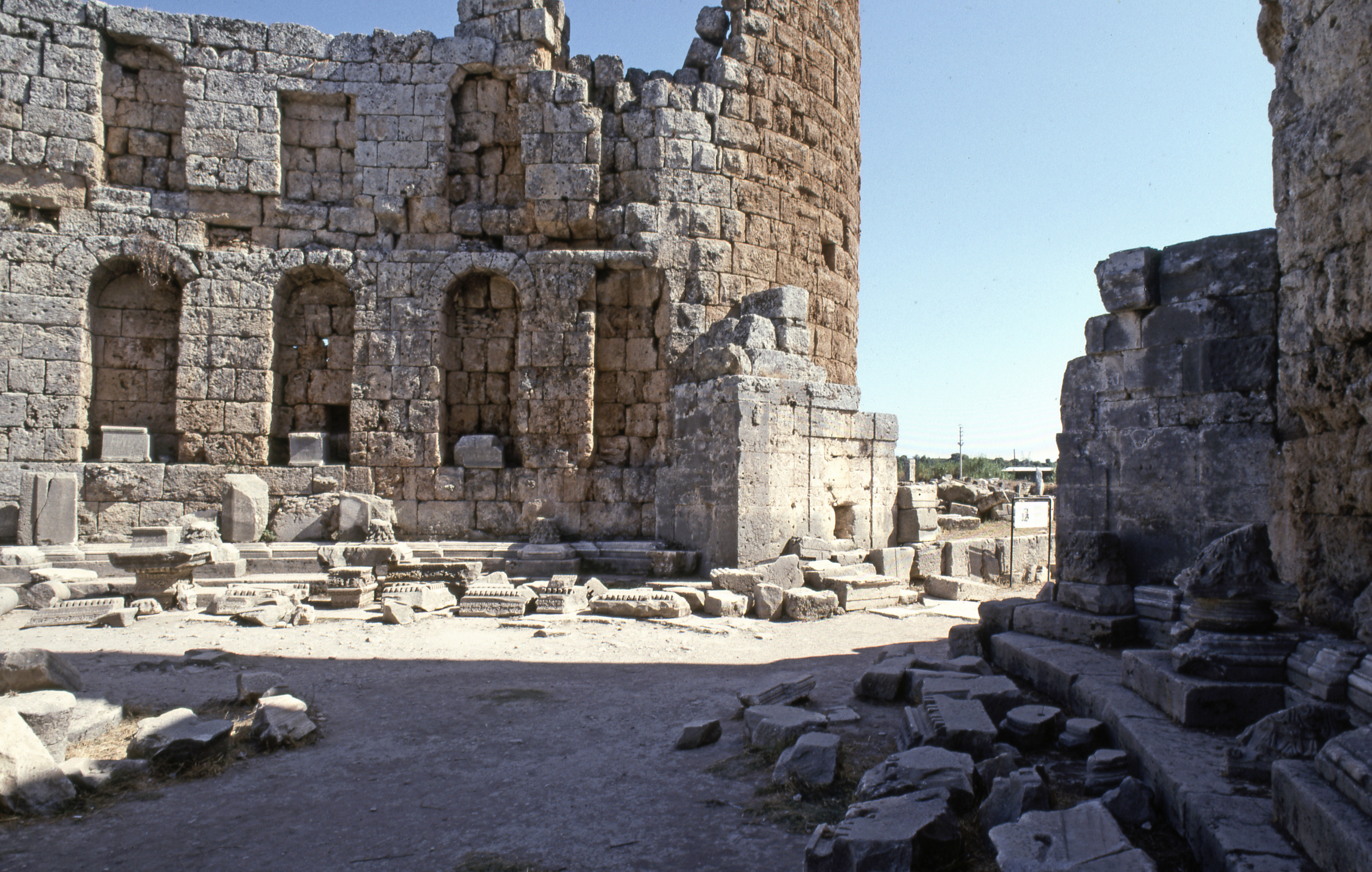
In the reign of Emperor Hadrian, Plancia Magna funded major civic improvements in Perga. These improvements included the restoration and expansion of the Hellenistic southern gate at Perga, a magnificent structure protecting the coast-facing entrance to the city, originally built in the 3rd century BC. The round towers flanking the gate were refurbished, and just past the gate was constructed a horseshoe-shaped courtyard adorned with two tiers of statues, twenty-eight in total. On the lower tier were large statues of various Greek deities, while the upper tier held smaller depictions of historical and mythological figures linked to Perga, including Magna's own father and brother. Adjacent niches, their contents now lost, may have contained statues of Magna's husband or son, also prominent local figures. Uniquely, the inscriptions define Magna's family members in relation to her ("father/brother of Plancia Magna"), establishing a dominance which is unseen in other contemporary female-commissioned statuary.
The exit from the courtyard into the city was through a monumental triple passage arch, which housed further statues of Artemis (Perga's chief deity) and the deified imperial family. The assemblage included more imperial women than men. The inscription for Salonia Matidia (died 119) uses the posthumous title diva, while that of Pompeia Plotina (died 122) does not—thus, the erection of the statues can be approximately dated to within the intervening years. Each statue's inscription included an attribution, identifying them as the product of Magna's beneficence:
Translated from Latin [first two lines]: :to the genius of the city :Plancia Magna daughter of Marcus
Translated from Greek [last two lines]: :to the fortune of the city :Plancia Magna
In addition to her donations, Magna was personally active in the civil and religious society of Perga. She served multiple terms as city magistrate, and held a wealth of titles: priestess of Artemis, high-priestess of the imperial cult, "priestess for life of the mother of the gods", and demiourgos. The last was the highest civil position attainable in the city, and the officeholder's name was used to identify the year in all official documents. Magna is the only known female demiourgos of Perga.
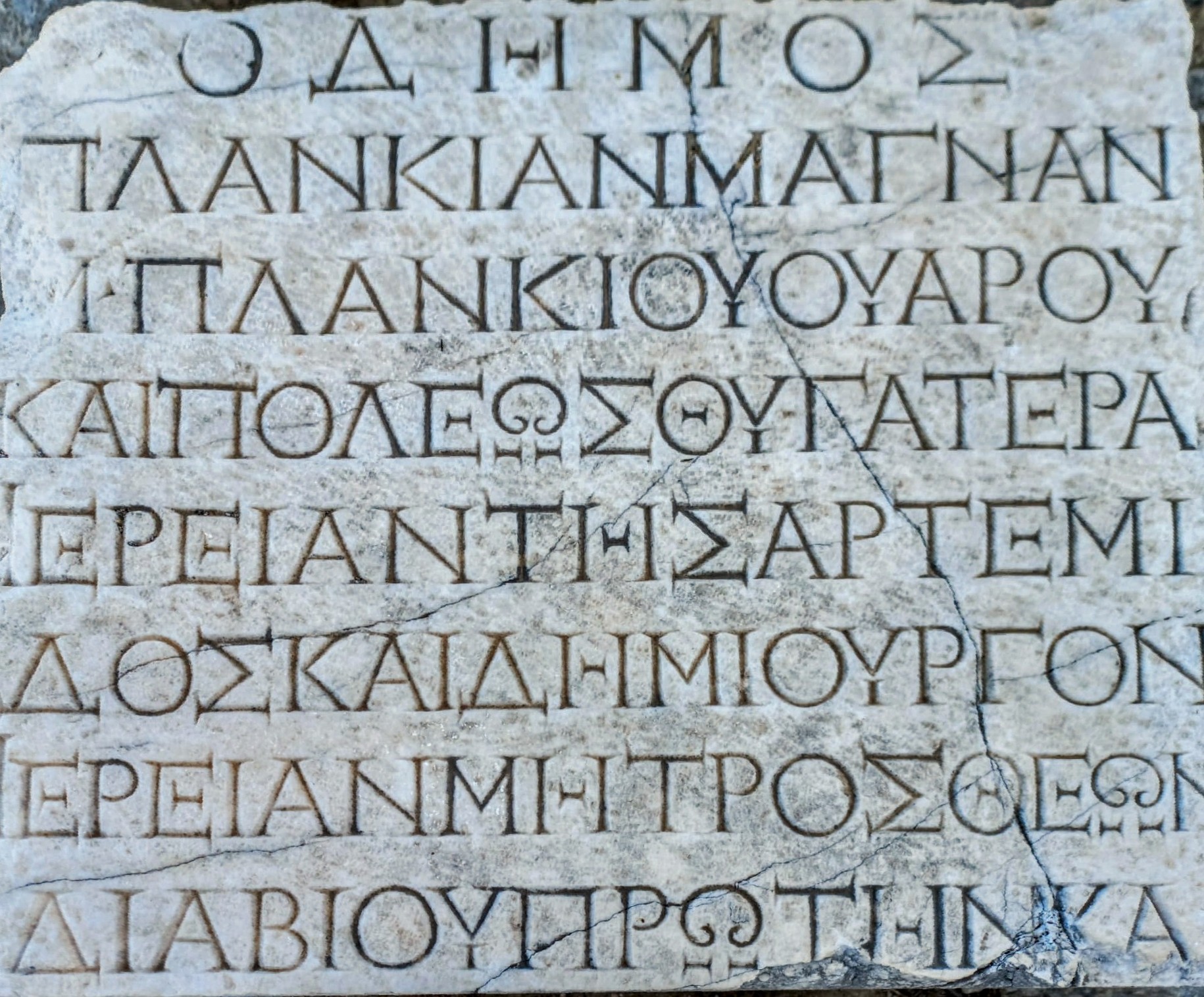
A surviving inscription from the base of a statue erected by the community of Perga reveals her position in the city:
:Plancia Magna :Daughter of Marcus Plancius Varus :and daughter of the city. :Priestess of Artemis :and both first and sole public priestess :of the mother of the gods :for the duration of her life :pious and patriotic.
References
References
- Grainger, John D.. (2003). "Nerva and the Roman Succession Crisis AD 96–99". Routledge.
- Boatwright, Mary T.. (1991). "Women's History and Ancient History". UNC Press Books.
- Jameson, Shelagh. [http://www.jstor.org/stable/297430 "Cornutus Tertullus and the Plancii of Perge"], ''[[Journal of Roman Studies]]'', 55 (1965), pp. 55f
- Caceres-Cerda, Barbara F.. (2018). "The Exceptional Case of Plancia Magna: (Re)analyzing the Role of a Roman Benefactress". [[City University of New York]].
- Gatzke, Andrea F.. (2020). "The Gate Complex of Plancia Magna in Perge: A Case Study in Reading Bilingual Space". The Classical Quarterly.
- Kays, Melissa. (2024). "ZEIT(EN) DES UMBRUCHS Akten des 17. Internationalen Kolloquiums zum provinzialrömischen Kunstschaffen Wien – Carnuntum, 16.–21 Mai 2022". Sonderschriften des Österreichischen Archäologischen Institutes in Wien.
- Tuck, Steven L.. (2015). "The Oxford Handbook of Roman Sculpture". Oxford University Press, USA.
- Jameson, "Cornutus Tertullus", p. 55
- {{AE. 1965. 210
This article was imported from Wikipedia and is available under the Creative Commons Attribution-ShareAlike 4.0 License. Content has been adapted to SurfDoc format. Original contributors can be found on the article history page.
Ask Mako anything about Plancia Magna — get instant answers, deeper analysis, and related topics.
Research with MakoFree with your Surf account
Create a free account to save articles, ask Mako questions, and organize your research.
Sign up freeThis content may have been generated or modified by AI. CloudSurf Software LLC is not responsible for the accuracy, completeness, or reliability of AI-generated content. Always verify important information from primary sources.
Report