From Surf Wiki (app.surf) — the open knowledge base
Planar Fourier capture array
Imaging Technology
Imaging Technology

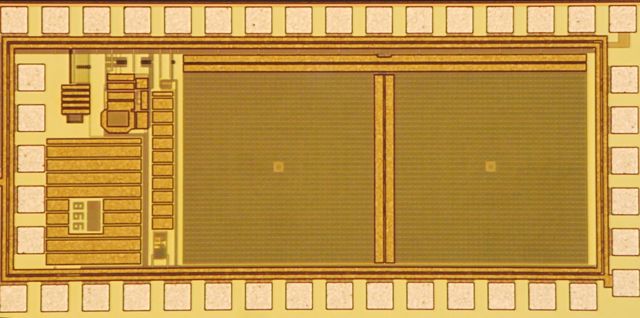
A planar Fourier capture array (PFCA) is a tiny camera that requires no mirror, lens, focal length, or moving parts. It is composed of angle-sensitive pixels, which can be manufactured in unmodified CMOS processes.
Angle-sensitive pixels have a sensitivity to light that is sinusoidal in incident angle along the optically-sensitive axis, which can be interpreted as measuring one component of the 2D Fourier transform of the far-away scene. By making them all unique, each sensor of the PFCA relates a distinct component of the 2D Fourier transform of the far-away scene, and together they relate full Fourier information. Original images are reconstructed computationally after acquisition, or if raw Fourier coefficients are more useful for the application at hand, they are used directly.
PFCAs do not perform an exact Fourier transform since outputs are real-valued and are not perfect sinusoidal transforms of the image. The transform is closer to a Hartley transform, but even this correspondence is not exact. Still, the mathematics underlying completeness of the Fourier transform are useful in designing and understanding PFCAs.
Because PFCAs do not require focusing optics or moving parts, they can be made smaller than the smallest focusing camera. Counting only the active portions of the PFCA (and not the structural substrate giving it physical robustness), PFCAs are a factor of 105 smaller than the smallest focusing camera by volume.
References
References
- [https://opg.optica.org/ol/abstract.cfm?URI=ol-36-15-2949 P. R. Gill, C. Lee, D.-G. Lee, A. Wang, and A. Molnar, "A microscale camera using direct fourier-domain scene capture," Opt. Lett., vol. 36, no. 15, pp. 2949–2951, Aug. 2011.]
- [https://dx.doi.org/10.1088/1748-0221/7/01/C01061 P. R. Gill, C. Lee, S. Sivaramakrishnan, and A. Molnar, "Robustness of planar fourier capture arrays to color changes and lost pixels," Journal of Instrumentation, vol. 7, no. 01, 2012. ]
- [http://www.opticsinfobase.org/abstract.cfm?id=187233 A. Wang, P. Gill, and A. Molnar, "Light field image sensors based on the talbot effect," Applied Optics, vol. 48, no. 31, pp. 5897–5905, 2009. ]
This article was imported from Wikipedia and is available under the Creative Commons Attribution-ShareAlike 4.0 License. Content has been adapted to SurfDoc format. Original contributors can be found on the article history page.
Ask Mako anything about Planar Fourier capture array — get instant answers, deeper analysis, and related topics.
Research with MakoFree with your Surf account
Create a free account to save articles, ask Mako questions, and organize your research.
Sign up freeThis content may have been generated or modified by AI. CloudSurf Software LLC is not responsible for the accuracy, completeness, or reliability of AI-generated content. Always verify important information from primary sources.
Report