From Surf Wiki (app.surf) — the open knowledge base
Pittsburgh and Lake Erie Railroad
Defunct railroad in Pennsylvania and Ohio

Defunct railroad in Pennsylvania and Ohio
| Field | Value |
|---|---|
| railroad_name | Pittsburgh and Lake Erie Railroad |
| logo_filename | Logo of the Pittsburgh and Lake Erie Railroad.png |
| logo_size | 100 |
| gauge | |
| marks | PLE |
| system_map | |
| map_caption | Pittsburgh and Lake Erie Railroad (red) and New York Central system (orange) as of 1918 |
| locale | Pittsburgh, Pennsylvania to Youngstown, Ohio |
| Pittsburgh, Pennsylvania to Connellsville, Pennsylvania | |
| start_year | 1875 |
| end_year | 1993 |
| successor_line | CSX |
| hq_city | Pittsburgh, Pennsylvania |
Pittsburgh, Pennsylvania to Connellsville, Pennsylvania
The Pittsburgh and Lake Erie Railroad (P≤ ), also known as the "Little Giant", was a railroad. It was formed on May 11, 1875. Company headquarters were located in Pittsburgh, Pennsylvania. The line connected Pittsburgh in the east with Youngstown, Ohio, in the Haselton neighborhood in the west and Connellsville, Pennsylvania, to the east. It did not reach Lake Erie (at Ashtabula, Ohio) until the formation of Conrail in 1976. The P&LE was known as the "Little Giant" since the tonnage that it moved was out of proportion to its route mileage. While it operated around one tenth of one percent of the nation's railroad miles, it hauled around one percent of its tonnage. This was largely because the P&LE served the steel mills of the greater Pittsburgh area, which consumed and shipped vast amounts of materials. It was a specialized railroad, deriving much of its revenue from coal, coke, iron ore, limestone, and steel. The eventual closure of the steel mills led to the end of the P&LE as an independent line in 1992.
At the end of 1970 P&LE operated 211 mi of road on 784 mi of track, not including PC&Y and Y&S; in 1970 it reported 1419 million ton-miles of revenue freight, down from 2437 million in 1944.
Route of the P&LE
The P&LE purchased many smaller railroads that operated in the areas of its main train line extending the line north to Youngstown and south to Connellsville. This provided a means of transportation from the steel centers of Pittsburgh to the Great Lakes and St. Lawrence Seaway area.
P&LE Division

The original line ran between Youngstown, Ohio (at Haselton) and 24th Street in Pittsburgh, Pennsylvania near the Jones and Laughlin Iron Works, opened in 1879. The P&LE's passenger terminal in Pittsburgh was on the south bank of the Monongahela River, at the foot of the Smithfield Street Bridge.
The P&LE followed the left downstream bank of the Monongahela River past the terminal to the Golden Triangle, where that waterway meets the Allegheny River and becomes the Ohio River. The railroad continued northwest along the left downstream bank of the Ohio River to the vicinity of Beaver, Pennsylvania, where it crossed the river on the Beaver Bridge. From there it followed the Beaver River to just south of New Castle, Pennsylvania, where it then followed the Mahoning River west-northwest, crossing into Ohio just east of Lowellville. From there it ran northwest into Youngstown, terminating at a junction with the New York Central known as Haselton.
In the table below, mileage is reckoned westbound from the P&LE Terminal in Pittsburgh. The original line continued east past that station for a little over 2 mi (listed in Youghiogheny Branch table below) to near 24th Street in the South Side Flats neighborhood of Pittsburgh, where it met the Monongahela Connecting Railroad and the Pittsburgh, McKeesport & Youghiogheny (PM&Y).
| State | Milepost | City | Station | Lat/long | Old Telegraph Call Letters | Connections and notes |
|---|---|---|---|---|---|---|
| OH | 64 | Haselton | Interchange With NYC | |||
| Youngstown | Youngstown | Interchange With Baltimore and Ohio Railroad | ||||
| East Youngstown | East Youngstown | |||||
| 60 | Struthers | Struthers | JCT for LE&E and Y&S | |||
| Lowellville Junction | ||||||
| 56 | Lowellville | Lowellville | ||||
| Ohio-Pennsylvania state line | ||||||
| PA | Robinson | Robinson | ||||
| 52 | Edinburg | |||||
| Coverts-Crossing | ||||||
| 48 | New Castle | New Castle (Mahoningtown) | ||||
| New Castle Junction | Branch to New Castle | |||||
| West Pittsburg | West Pittsburg Station | B&O Trackage Rights over P&LE to Port Vue | ||||
| Newport | Newport | |||||
| 41 | Wampum | Wampum | ||||
| Rock Point | ||||||
| 36 | West Ellwood Junction Station | Branch to Ellwood City | ||||
| Beaver Falls (College Hill) | College Hill Station | College Yard | ||||
| Beaver Falls | Beaver Falls | |||||
| New Brighton | New Brighton | |||||
| Fallston | Fallston | |||||
| Beaver | Bridgewater | |||||
| Beaver & Monaca | Beaver Bridge over Ohio River | |||||
| 24 | Monaca | Monaca | ||||
| Aliquippa | West Aliquippa | |||||
| 20 | Aliquippa | Aliquippa | ||||
| 18 | Economy | West Economy Station | ||||
| 16 | South Heights | South Heights Station | ||||
| 15 | Glenwillard | Glenwillard | ||||
| 14 | Crescent Twp | Stoops Ferry | ||||
| 11 | Moon Twp | Kendall | ||||
| 9 | Coraoplis | Coraopolis | Interchange With Montour | |||
| 8 | Robinson Twp | Montour Junction Station | Montour Trackage Rights over P&LE to Coraopolis | |||
| 4 | McKees Rocks | McKees Rocks | Yard, Locomotive, Freight Car Shops and Maintenance. JCT with PC&Y. | |||
| 2 | Pittsburgh (West End). Interchange with P&WV | West End | ||||
| 0 | Pittsburgh | P&LE Pittsburgh Terminal | Pittsburgh Terminal and Smithfield Street Bridge |
Youghiogheny Branch

The Pittsburgh, McKeesport and Youghiogheny Railroad ran from 24th Street in Pittsburgh, PA to Connellsville, Pennsylvania, in 1882. The PM&Y followed the Monongahela River to McKeesport, Pennsylvania, then the Youghiogheny River to Connellsville, Pennsylvania.
Mileage on this P&LE branch was reckoned from the passenger terminal back at the Smithfield Street Bridge.
| State | Milepost | City | Station | Lat/long | Connections and notes |
|---|---|---|---|---|---|
| PA | 0 | Pittsburgh | P&LE Pittsburgh Terminal | Original route of the Pittsburgh and Beck's Run Railroad (start) | |
| Pittsburgh | South Side | 20th Street & 24th Street junctions: Interchange with MCRR | |||
| 4 | Pittsburgh | Williamsburg | |||
| 5 | Pittsburgh | Becks Run | End of Pittsburgh and Becks Run Railroad | ||
| 6 | Homestead | Homestead | Site of Homestead Strike | ||
| Munhall | P&LE Munhall Bridge over Monongahela River | ||||
| 8 | Rankin | Rankin | |||
| 10 | Braddock | Braddock | |||
| 11 | McKeesport | McKeesport | Bridge over Youghiogheny River | ||
| 16 | Port Vue | Port Vue | Interchange With B&O. B&O had trackage rights over P&LE to West Pittsburgh. | ||
| 17 | Port Vue | Sinn | |||
| 18 | Dead Man's Hollow | Flemming | Industrial single ended siding at the Union Sewer Pipe Company | ||
| 19 | Boston | ||||
| 22 | Greenock | ||||
| 25 | Stringtown | Dravo | Site of Methodist church that caught fire due to sparks of passing trains. | ||
| 27 | Buena Vista | Buena Vesta | |||
| 33 | West Newton | ||||
| 37 | Cedar Creek | ||||
| 41 | Wickhaven | ||||
| 46 | Kier | ||||
| 49 | Sand Rock | ||||
| 53 | Dickerson Run | ||||
| 56 | Crossland | ||||
| 58 | Connellsville | Connellsville | Interchange With B&O, WM, and NW |
Monongahela Branch
The Pittsburgh, McKeesport & Youghiogheny Railroad also followed the Monongahela River to Brownsville, Pennsylvania.
| State | Milepost | City | Station | Lat/long | Old Telegraph Call Letters | Connections and notes |
|---|---|---|---|---|---|---|
| PA | 16 | Port Vue | Belle Vernon Junction | |||
| 18 | Glassport | Glassport | ||||
| 20 | Pollock | |||||
| 22 | Elizabeth | Wylie Elizabeth | ||||
| 27 | Bunola | |||||
| 31 | East Monongahela | Monongahela | ||||
| 33 | Manown | |||||
| 34 | Sunnyside | |||||
| 36 | Sheppler | |||||
| 40 | Monessen | Monessen | ||||
| 42 | East Charleroi | |||||
| 43 | Belle Vernon | |||||
| 45 | Fayette City | Fayette City | ||||
| 50 | Newell | |||||
| 54 | Brownsville Junction | JCT with Monongahela Railway |
History

In the spring of 1877, the first rails were laid down in Beaver Falls, which had the largest population other than Pittsburgh. The other reason for this was around February 1877 Jacob Henrici of the Harmony Society had business there. Henrici would also become a director in 1877. On July 6, 1877, McCreery resigned and Bennett was elected to president with Jacob Henrici becoming a director. Henrici was the key due to his Harmony Society ties which was a communal religious group founded in 1805. In 1880, William Henry Vanderbilt's Lake Shore and Michigan Southern Railway bought stock to the tune of $200,000 in the P&LE. The P&LE would stay in the Vanderbilt's New York Central system until Conrail. Also in 1877, an agreement between the P&LE and the Atlantic & Great Western (Erie) and the Lake Shore and Michigan Southern Railway was reached for routing traffic at Youngstown, Ohio. The final track laying between Pittsburgh and Youngstown was on January 27, 1879. At the opening in 1879, the P&LE was a poorly built, single track line. Fortunately for the railroad it was an immediate success and money was soon available for improvements.
South Penn and Pittsburgh, McKeesport and Youghiogheny Railroad
In 1881, the P&LE became linked with the notorious South Pennsylvania Railroad (South Penn). This would lead to William Henry Vanderbilt to control of the P&LE as a link in the South Penn and the building of the Pittsburgh, McKeesport and Youghiogheny Railroad. The South Pennsylvania Railroad was planned to connect to the PM&Y. Vanderbilt did this by buying Henry W. Oliver's and the Harmony Society's stock in the P&LE. Then Vanderbilt, aided by Andrew Carnegie, advanced the PM&Y all of the funds to build to Connellsville, Pennsylvania and then lease it to the P&LE for 99 years. The PM&Y in the end was the only part of the South Penn that was built, but it would be an important part of the P&LE. The PM&Y opened in 1883 and leased to the P&LE in 1884. Concurrently in 1883, to get the P&LE ready for the expected new business due to the South Penn linkage, the McKees Rocks shops were built.
Vanderbilt and the "Little Giant"
The company came under more formal control in 1887 by the New York Central Railroad. Lake Shore and Michigan Southern Railway's president, John Newell, took over as president of the P&LE in 1887. Under Newell, Reed and Colonel Schoonmaker; the P&LE would become the "Little Giant". From 1887 to 1927, the P&LE would become a heavy duty railroad, with double track all the way from Pittsburgh to Youngstown. The P&LE operated as an independent subsidiary, even after New York Central and Pennsylvania Railroad merged to form Penn Central.
PM&Y and the Monongahela Railway

The making of coke in Connellsville had been a big part of P&LE traffic, but by the early 20th century it had lessened. The development of by-products distillation processing of coke had moved to the Pittsburgh area. The P&LE then extended up the Monongahela River to Brownsville, Pennsylvania in 1901. The Pennsylvania Railroad at the same time had extended to Brownsville. Both the PRR and the P&LE had plans to extend even further up the river into West Virginia coke fields. Most likely due to the South Penn, they decided to work together by using the Monongahela Railway. The Monongahela Railway then was extended south to Martin, Pennsylvania reaching the Kondike Coke fields. Later in 1915 it reached Fairmont, West Virginia.
Conrail and CSX
When Conrail was formed, the Pittsburgh and Lake Erie Railroad again became an independent company because P&LE was owed $15.2 million by Penn Central, and operated as such until its merger into CSX Transportation (CSX).
Starting in 1934, the Baltimore and Ohio Railroad (B&O) bought trackage rights over P&LE from McKeesport to New Castle. The B&O's route through Pittsburgh had excessive grades and curves. In the last years of the P&LE, CSX used the line more than P&LE leading to the merger. Most of the online customers had long been gone, with only the main line still intact. In 1993 the company was purchased by CSX. The CSX designated the P&LE as a new subsidiary, the Three Rivers Railway. However, in 1993, CSX leased the TRR, and there is currently no de facto distinction between the former P&LE and any other portion of CSX's system.
The portion of the P&LE main line from New Castle, PA to Youngstown, OH has been abandoned and removed in favor of the parallel B&O line.
Company officers

Presidents of the railroad were as follows:
- William McCreery 1875-1877
- James I. Bennett 1877-1881
- Jacob Henrici 1877-1885
- John Newell 1887-1896 After Newell the presidency would be held by the president of the NYC with the active management of the local vice president.
Vice Presidents:
-
James H. Reed 1892-1896
-
Colonel James M. Schoonmaker 1886-1927
-
James B. Yohe 1917-1919 WW1 Supervisor 1920-1929 V.P.
-
Curtis M. Yohe 1929-1953
-
John F. Nash 1953-1956 With Nash the active management went back to the president.
-
John W. Barriger III 1956-1964
-
Curtis D. Buford 1965-1969
-
Henry G. Allyn, Jr c. 1969-1983
-
Richard Thompson c. 1983-1986
-
Gordon Neuenschwander c. 1986-1993
Pittsburgh Terminal and P&LE passenger trains
Main article: Pittsburgh & Lake Erie Railroad Station
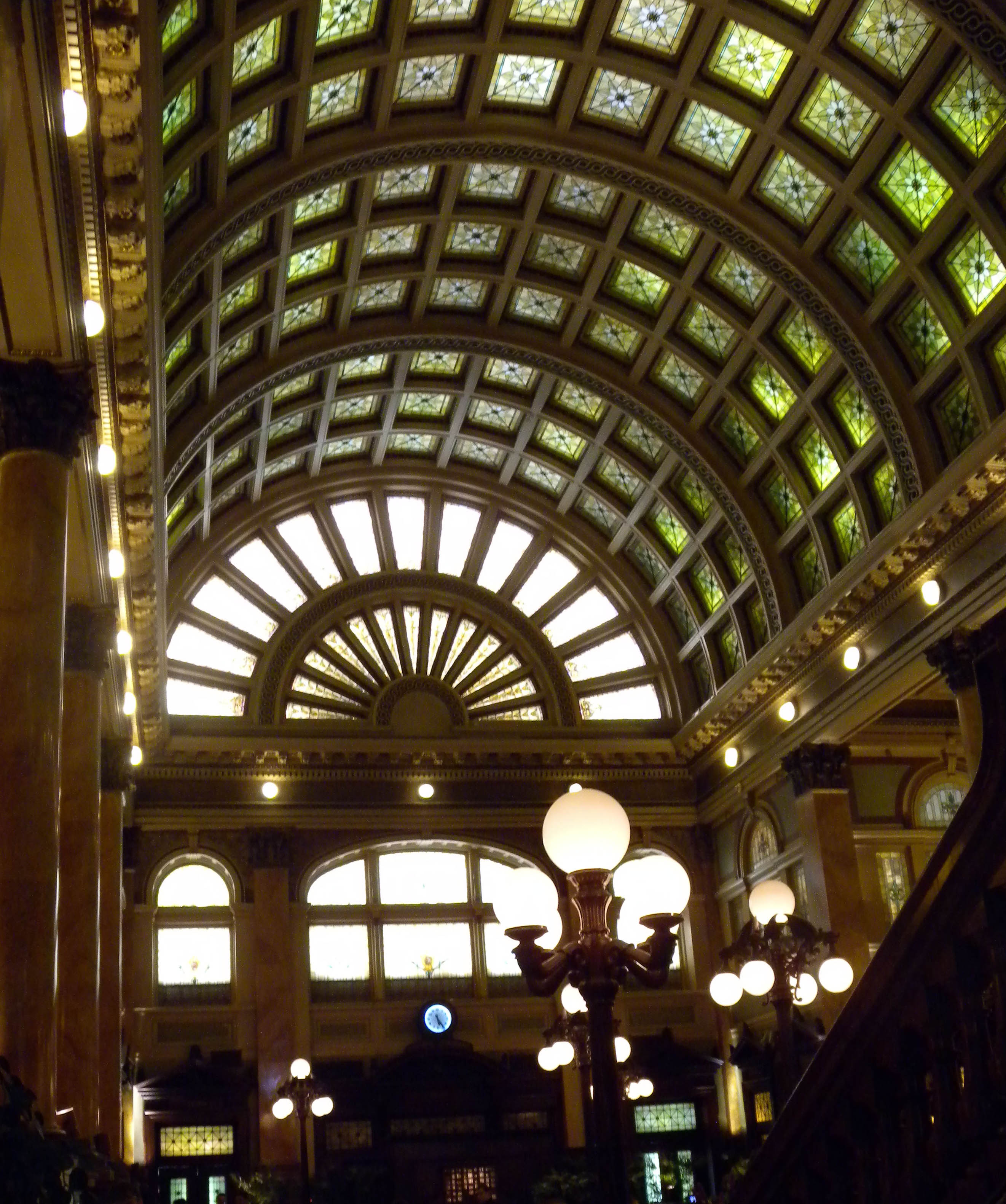
The P&LE's Pittsburgh passenger train station (interior seen in the lower right photo) sat adjacent the south bank of the Monongahela River at the foot of the Smithfield Street Bridge. The Pittsburgh Terminal was the railroad's headquarters, passenger train shed, and freight warehouse complex. In the upper photo, the terminal sits along the Monongahela river. The roof of the freight house is to the right of the terminal train shed. The former P&LE headquarters building at the bottom of the Monongahela Incline has been converted into a present-day shopping center, Station Square. The passenger station has been placed on a list of historic edifices, modernized and converted to a restaurant.
During 1910 - 1930, the P & LE operated 50 passenger daily trains on its 65-mile Pittsburgh - Youngstown portion of its system. Ticketing agreements with the Erie RR and the P & LE's parent New York Central, passengers boarding in Pittsburgh could ride coaches or sleepers west to Toledo, Detroit, Chicago, and St. Louis, and north to Cleveland, Buffalo, Toronto, Albany and Boston. In addition, the P&LE operated many daily passenger trains between Pittsburgh and Connellsville.
The Baltimore & Ohio RR obtained trackage rights in 1934 on the P&LE, and Chicago-New York trains such as the Capitol Limited (Chicago-Washington), Columbian (Chicago-Washington) and Ambassador (Detroit-Baltimore) operated over the P & LE between New Castle Junction and McKeesport. These trains stopped at the Terminal located in Pittsburgh's South Side. The trackage sharing arrangement continued until Amtrak assumed responsibility for the nation's passenger rail service in 1971.
P&LE operated commuter trains into Pittsburgh. In 1964, it ran one round-trip between Youngstown and Pittsburgh as well as one additional southbound and two additional northbound trains on the section between Beaver Falls and Pittsburgh. Latest by 1968, only the section between College Hill, Beaver Falls, Aliquippa and P&LE's Pittsburgh Terminal was served by one single roundtrip commuter train per day. In 1978, P&LE tried to drop that last commuter train, which was met by fierce objections. With state support, P&LE continued to operate the commuter run but eventually ended the service on July 12, 1985, after passenger counts had dropped significantly.
The PATrain commuter operation continued to use some P&LE-trackage until 1989.
Shops and yards
;Gateway Yard The Youngstown Gateway Yard was a major hub location on the railroad, until the creation of Conrail. Gateway Yard was opened in October 1957, to be a modern hump yard. The yard was approximately 200 acre stretching for a distance of just over 5 mi from Lowellville, Ohio to Center Street in Youngstown, Ohio. Gateway Yard was made up of three principal yards, and an assortment of smaller, special-purpose yards. The principal yards were arranged linearly, with the eastern limits of the Departure Yard in Lowellville. The Hump Yard was located in Struthers in the center of the facility, and the Receiving Yard was to the west. The special purpose yards were "Diesel Servicing Facilities", "Gorilla Park" and "Interchange" yards. The "Interchange" yard was made up of six tracks, four were for interchange to and from the B&O Railroad and two of which were for general use. The other interchange was with New York Central Railroad which was a direct interchange. The western yard limit was the end of track for the P&LE. Beyond the western end of the Yard was the NYC mainline that continued to Ashtabula, Ohio. The yard was constructed when the P&LE was under the control of the New York Central Railroad. Conrail routing most of the traffic around P&LE facilities in the area. After the 1993 CSX takeover of P&LE, Gateway Yard was closed and most tracks have been removed. The yard tower still stands but has been heavily vandalized.
;McKees Rocks

The McKees Rocks Yard facility was home to a yard, major locomotive rebuilding and general maintenance, as well as freight car repair and maintenance. On the westernmost end of the McKees Rocks yard, the P&LE interchanged with the PC&Y. However, the PC&Y facilities were just behind the P&LE Locomotive facilities in the main yard, and trackage from the PC&Y crossed the P&LE Mainline at this point, servicing several local businesses in the Bottoms section of McKees Rocks, finally making the previously mentioned interchange. Most of the McKees Rocks facilities are now gone. The entire McKees Rocks locomotive facility, shops, and yard is to be replaced by a regional CSX intermodal facility.
In 1904, P&LE built the O'Donovan Bridge for easier automobile access from Island Avenue to The Bottoms without crossing the railroad tracks. This was replaced in 1931 by the McKees Rocks Bridge, which extended to Ohio River Boulevard but still provided access to The Bottoms via Helen Street exit.
The McKees Rocks Community Development Corporation has plans to adaptively reuse the building.
;College The College Hill neighborhood of Beaver Falls had a small yard located just below Geneva College along the Beaver River. There was also a small roundhouse on the property, plus the College Hill Station. Today, only the station remains.
Subsidiaries
- Pittsburgh, McKeesport and Youghiogheny Railroad (Leased 1888 and merged in 1965)
- Pittsburgh, Chartiers and Youghiogheny Railroad (1/2 P&LE, 1/2 CR)
- Mahoning State Line Railroad (Leased 1885)
- Monongahela Railway (1/3 P&LE, 1/3 B&O, 1/3 CR(PR))
- Montour Railroad
- Lake Erie and Eastern Railroad (1/2 P&LE, 1/2 CR)
- Youngstown and Southern Railway
Notes
References
- December 1992 Trains has info on the CSX sale.
References
- 1956 ''Transport Statistics'' shows 221 route-miles, 33.4 million revenue tons of freight and 1824 million ton-miles for P&LE. Total for Class I railroads was 223,336 miles, 2705 million tons and 647,077 million ton-miles. (The Class I tonnage total may include duplication when a shipment is carried by more than one railroad.)
- Drury, George: "Historical Guide to North American Railroads Book," Kalmbach Publishing, WI. {{ISBN. 9780890240724
- (1883). "Engineering News and American Contract Journal".
- "Guide to the Pittsburgh & Lake Erie Railroad Company Records, 1860-1999 AIS.1982.23 {{!}} Digital Pitt".
- Harold H. McKlean, "Pittsburgh and Lake Erie Railroad." 1980, Golden West Books.
- (1964-10-24). "P&LE passenger timetable, effective 1964-10-24". Pittsburgh and Lake Erie Railroad.
- (1968-10-27). "P&LE passenger timetable, effective 1968-10-27". Pittsburgh and Lake Erie Railroad.
- Snedden, Jeffrey. (2018-04-24). "Histories & Mysteries: The Legacy of The Pittsburgh & Lake Erie Railroad".
- Solomon, Brian. (2014). "North American Railroads: The Illustrated Encyclopedia". Voyageur Press.
This article was imported from Wikipedia and is available under the Creative Commons Attribution-ShareAlike 4.0 License. Content has been adapted to SurfDoc format. Original contributors can be found on the article history page.
Ask Mako anything about Pittsburgh and Lake Erie Railroad — get instant answers, deeper analysis, and related topics.
Research with MakoFree with your Surf account
Create a free account to save articles, ask Mako questions, and organize your research.
Sign up freeThis content may have been generated or modified by AI. CloudSurf Software LLC is not responsible for the accuracy, completeness, or reliability of AI-generated content. Always verify important information from primary sources.
Report