From Surf Wiki (app.surf) — the open knowledge base
Pisces (constellation)
Zodiac constellation straddling the celestial equator
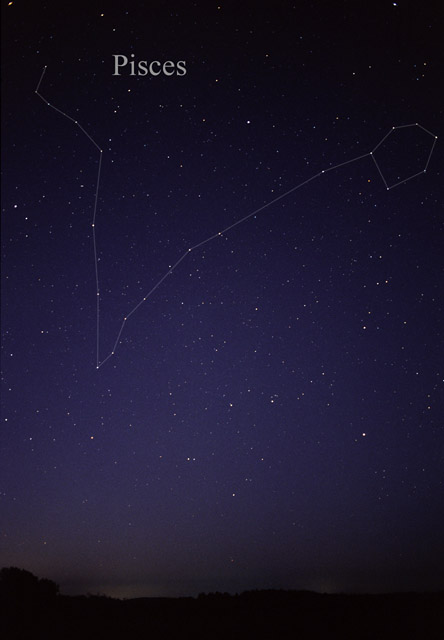
Zodiac constellation straddling the celestial equator
| Field | Value |
|---|---|
| name | Pisces |
| abbreviation | Psc |
| genitive | Piscium |
| pronounce | ; genitive |
| symbolism | the Fishes |
| RA | |
| dec | |
| family | Zodiac |
| quadrant | NQ1 |
| areatotal | 889 |
| arearank | 14th |
| numbermainstars | 18 |
| numberbfstars | 86 |
| numberbrightstars | 0 |
| numbernearbystars | 8 |
| brighteststarname | η Psc (Alpherg) |
| starmagnitude | 3.62 |
| neareststarname | Van Maanen's Star |
| stardistancely | 14.07 |
| stardistancepc | 4.31 |
| numbermessierobjects | 1 |
| meteorshowers | Piscids |
| latmax | 84 |
| latmin | 57 |
| month | November |
the astronomical constellation
- Triangulum
- Andromeda
- Pegasus
- Aquarius
- Cetus
- Aries
Pisces is a constellation of the zodiac. Its vast bulk — and main asterism viewed in most European cultures per Greco-Roman antiquity as a distant pair of fishes connected by one cord each that join at an apex — are in the Northern celestial hemisphere. Its traditional astrological symbol is [[Image:Pisces symbol (fixed width).svg|20px]] (♓︎). Its name is Latin for "fishes". It is between Aquarius, of similar size, to the southwest and Aries, which is smaller, to the east. The ecliptic and the celestial equator intersect within this constellation, at the first point of Aries, and in Virgo, at the first point of Libra. The Sun passes directly overhead of the equator, on average, at approximately this point in the sky, at the March equinox.
The right ascension/declination 00 is located within the boundaries of Pisces.
Features
The March equinox is currently situated in Pisces, directly south of ω Psc, and because of precession, it is gradually drifting westward, just below the western fish and moving toward Aquarius.
Stars
Although Pisces is a large constellation, there are only two stars brighter than magnitude 4 in Pisces. It is also the second dimmest of the zodiac constellations.
Note: magnitude, here, means apparent magnitude
- Alrescha ("the cord"), otherwise Alpha Piscium (α Psc), 309.8 lightyears, class A2, magnitude 3.62, variable binary star
- Fumalsamakah ("mouth of the fish"), otherwise Beta Piscium (β Psc), 492 lightyears, class B6Ve, magnitude 4.48
- Delta Piscium (δ Psc), 305 lightyears, class K5III, magnitude 4.44. Like other stars near the ecliptic, Delta Piscium is subject to lunar occultations.{{citation | display-authors=1 | last1=Meyer | first1=C.
- Epsilon Piscium (ε Psc), 190 lightyears, class K0III, magnitude 4.27. Has a candidate exoplanet.
- Revati ("rich"), otherwise Zeta Piscium (ζ Psc), 148 lightyears, class A7IV, magnitude 5.21. Quintuple star system.{{citation
- Alpherg ("emptying"), otherwise Eta Piscium (η Psc), 349 lightyears, class G7 IIIa, magnitude 3.62. It is a Gamma Cassiopeiae variable{{citation
- Torcular ("thread"), otherwise Omicron Piscium (ο Psc), 258 lightyears, class K0III, magnitude 4.2. It is an evolved red giant star on the horizontal branch.{{citation | display-authors=1 | last1=Reffert | first1=Sabine
- Omega Piscium (ω Psc), 106 lightyears, class F4IV, magnitude 4.03. It is an F-type star that is either a subgiant or on the main sequence.{{citation
- Gamma Piscium (γ Psc), 138 lightyears, magnitude 3.70. The star hosts an exoplanet which was discovered in 2021.
- Van Maanen's Star is the closest-known solitary white dwarf to us, with a dim apparent magnitude. It is located about 2° to the south of the star Delta Piscium, with a relatively high proper motion of 2.978″ annually along a position angle of 155.538°.{{citation | display-authors=1 | display-authors=1 | last1=Limoges | first1=M. -M. | display-authors=1
Due to the dimness of these stars, the constellation is essentially invisible in or near any major city due to light pollution.
Deep-sky objects

NGC 488 is an isolated face-on prototypical spiral galaxy. Two supernovae have been observed in the galaxy.
NGC 520 is a pair of colliding galaxies located 105 million light-years away.{{cite journal | display-authors=1 | journal=Monthly Notices of the Royal Astronomical Society
CL0024+17 is a massive galaxy cluster that lenses the galaxy behind it, creating arc-shaped images of the background galaxy. The cluster is primarily made up of yellow elliptical and spiral galaxies, at a distance of 3.6 billion light-years from Earth (redshift 0.4), half as far away as the background galaxy, which is at a distance of 5.7 billion light-years (redshift 1.67).
3C 31 is an active galaxy and radio source in Pisces 237 million light-years from Earth (redshift 0.0173). Its jets, caused by the supermassive black hole at its center, extend several million light-years in opposing directions, making them some of the largest objects in the universe.
History and mythology
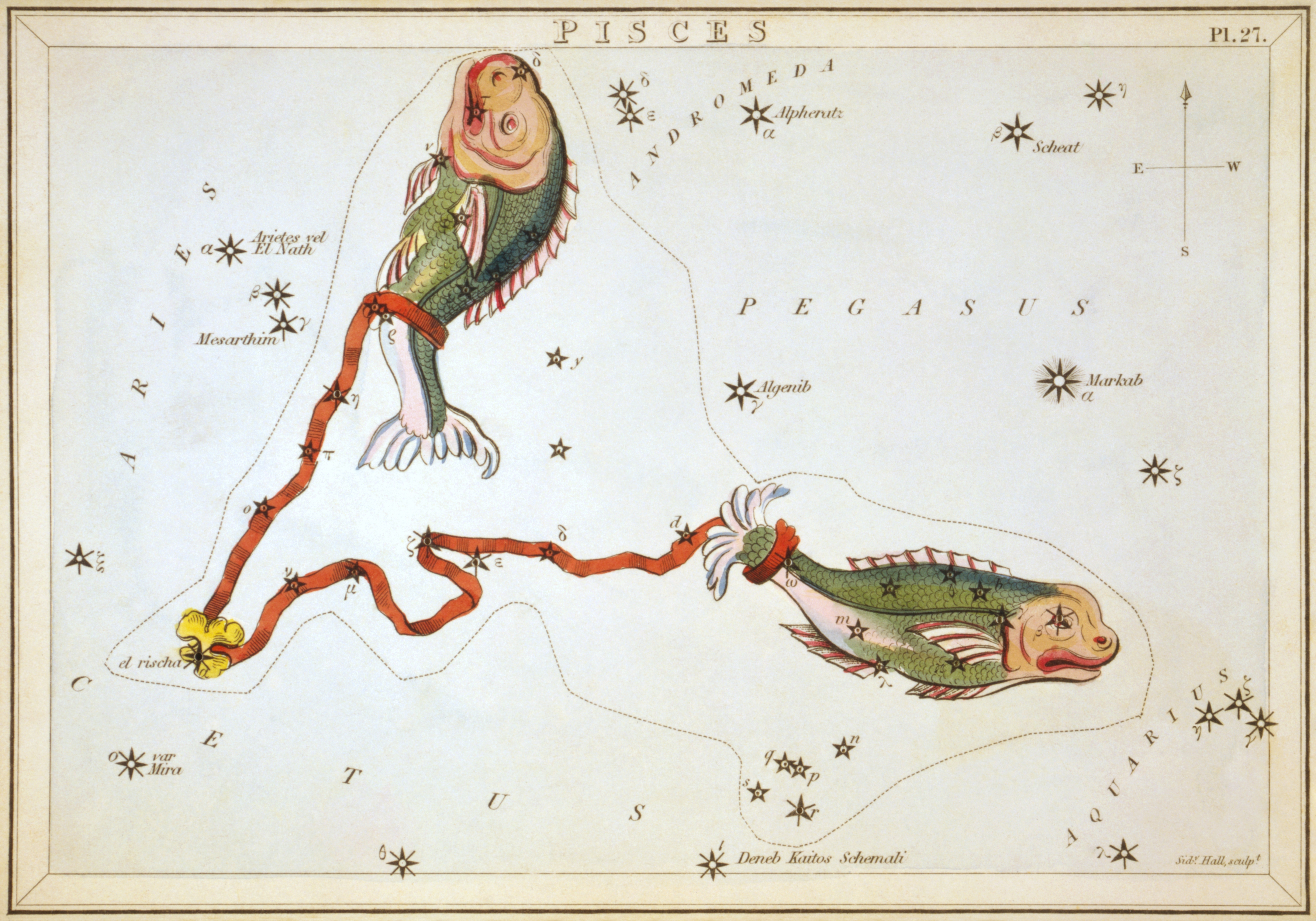
Pisces originates from some composition of the Babylonian constellations Šinunutu4 "the great swallow" in current western Pisces, and Anunitum the "Lady of the Heaven", at the place of the northern fish. In the first-millennium BC texts known as the Astronomical Diaries, part of the constellation was also called DU.NU.NU (Rikis-nu.mi, "the fish cord or ribbon").
Greco-Roman period
Pisces is associated with the Greek legend that Aphrodite and her son Eros either shape-shifted into forms of fishes to escape, or were rescued by two fishes.
In the Greek version according to Hyginus, Aphrodite and Eros while visiting Syria fled from the monster Typhon by leaping into the Euphrates River and transforming into fishes (Poeticon astronomicon 2.30, citing Diognetus Erythraeus). The Roman variant of the story has Venus and Cupid (counterparts for Aphrodite and Eros) carried away from this danger on the backs of two fishes (Ovid Fasti 2.457ff).
There is also a different origin tale that Hyginus preserved in another work. According to this, an egg rolled into the Euphrates, and some fishes nudged this to shore, after which the doves sat on the egg until Aphrodite (thereafter called the Syrian Goddess) hatched out of it. The fishes were then rewarded by being placed in the skies as a constellation (Fabulae 197). This story is also recorded by the Third Vatican Mythographer.
Modern period
.jpg)
In 1690, the astronomer Johannes Hevelius in his Firmamentum Sobiescianum regarded the constellation Pisces as being composed of four subdivisions:
- Piscis Boreus (the North Fish): σ – 68 – 65 – 67 – ψ1 – ψ2 – ψ3 – χ – φ – υ – 91 – τ – 82 – 78 Psc.
- Linum Boreum (the North Cord): χ – ρ,94 – VX(97) – η – π – ο – α Psc.
- Linum Austrinum (the South Cord): α – ξ – ν – μ – ζ – ε – δ – 41 – 35 – ω Psc.
- Piscis Austrinus (the South Fish): ω – ι – θ – 7 – β – 5 – κ,9 – λ – TX(19) Psc.
"Piscis Austrinus" now refers to a separate constellation in its own right, which Hevelius and Bode called Piscis Notius.
In 1754, the botanist and author John Hill proposed to sever a southern zone of Pisces as Testudo (the Turtle). It would host a natural but quite faint asterism in which the star 20 Psc is the head of the turtle. While Admiral Smyth mentioned the proposal, it was largely neglected by other astronomers, and it is now obsolete.
Western folklore
The Fishes are in the German lore of Antenteh, who owned just a tub and a crude cabin when he met two magical fish. They offered him a wish, which he refused. However, his wife begged him to return to the fish and ask for a beautifully furnished home. This wish was granted, but her desires were not satisfied. She then asked to be a queen and have a palace, but when she asked to become a goddess, the fish became angry and took the palace and home, leaving the couple with the tub and cabin once again. The tub is sometimes recognized as the Great Square of Pegasus.
In non-Western astronomy
The stars of Pisces were incorporated into several constellations in Chinese astronomy. Wai-ping ("Outer Enclosure") was a fence that kept a pig farmer from falling into the marshes and kept the pigs where they belonged. It was represented by Alpha, Delta, Epsilon, Zeta, Mu, Nu, and Xi Piscium. The marshes were represented by the four stars designated Phi Ceti. The northern fish of Pisces was a part of the House of the Sandal, Koui-siou.
References
Sources
- Richard Hinckley Allen, Star Names, Their Lore and Legend, New York, Dover: various dates.
- Thomas Wm. Hamilton, Useful Star Names, Strategic Books, 2008.
References
- (2012). "A photometric study of chemically peculiar stars with the STEREO satellites - I. Magnetic chemically peculiar stars". Monthly Notices of the Royal Astronomical Society.
- "Naming Stars". IAU.org.
- (2022). "Regular radial velocity variations in nine G- and K-type giant stars: Eight planets and one planet candidate". Publications of the Astronomical Society of Japan.
- (2018). "Fundamental Parameters of 87 Stars from the Navy Precision Optical Interferometer". The Astronomical Journal.
- Burnham, Robert. (1978). "Burnham's celestial handbook: an observer's guide to the universe beyond the solar system". Courier Dover Publications.
- (December 2009). "The White Dwarfs Within 20 Parsecs of the Sun: Kinematics and Statistics". The Astronomical Journal.
- van Maanen, A.. (December 1917). "Two Faint Stars with Large Proper Motion". Publications of the Astronomical Society of the Pacific.
- (March 1999). "Chemically decoupled nucleus and the structure of the nuclear region in the spiral galaxy NGC 488". Astronomy Letters.
- [http://www.cbat.eps.harvard.edu/lists/Supernovae.html List of Supernovae] ''[[IAU]] Central Bureau for Astronomical Telegrams''. Retrieved 29 December 2015.
- [http://adsabs.harvard.edu/abs/1998JBAA..108....9R Origins of the ancient constellations: I. The Mesopotamian traditions] by J. H. Rogers 1998, [http://articles.adsabs.harvard.edu/cgi-bin/nph-iarticle_query?bibcode=1998JBAA..108....9R&db_key=AST&page_ind=10&plate_select=NO&data_type=GIF&type=SCREEN_GIF&classic=YES page 19] [http://articles.adsabs.harvard.edu/cgi-bin/nph-iarticle_query?bibcode=1998JBAA..108....9R&db_key=AST&page_ind=18&plate_select=NO&data_type=GIF&type=SCREEN_GIF&classic=YES page 19 (table 3, rows 2-3) and page 27]
- "Pisces as depicted by Bode and Hevelius". Ian Ridpath’s Star Tales (online edition).
- 24 – 27 – YY(30) – 33 – 29 Psc.,Ciofi, Claudio; Torre, Pietro, [http://astrocultura.uai.it/mitologia/antiche/costellazioniperdute2.htm Costellazioni Estinte (nate dal 1700 al 1800)]: Sezione di Ricerca per la Cultura Astronomica
- Smyth, W. H., (1884) ''[https://books.google.com/books?id=aEo1AQAAMAAJ&pg=PA23 The Bedford Catalogue]'', p. 23
- Allen, R. H.. (1963). "[[Star Names: Their Lore and Meaning]]". [[Dover Publications]] Inc..
- Van Berg, Paul-Louis. (1972). "Corpus Cultus Deae Syriae - Ccds: Les Sources Litteraires - Repertoire Des Sources Grecques Et Latines - Sauf Le De Dea Syria -". Brill Archive.
- Publius Ovidius Naso. (1995). "Ovid's Fasti: Roman Holidays". [[Indiana University Press]].
- Rigoglioso, Marguerite. (2009). "The Cult of Divine Birth in Ancient Greece". Springer.
- (April 2024). "The Initial Mass Function Based on the Full-sky 20 pc Census of ~3600 Stars and Brown Dwarfs". [[The Astrophysical Journal Supplement Series]].
This article was imported from Wikipedia and is available under the Creative Commons Attribution-ShareAlike 4.0 License. Content has been adapted to SurfDoc format. Original contributors can be found on the article history page.
Ask Mako anything about Pisces (constellation) — get instant answers, deeper analysis, and related topics.
Research with MakoFree with your Surf account
Create a free account to save articles, ask Mako questions, and organize your research.
Sign up freeThis content may have been generated or modified by AI. CloudSurf Software LLC is not responsible for the accuracy, completeness, or reliability of AI-generated content. Always verify important information from primary sources.
Report