From Surf Wiki (app.surf) — the open knowledge base
Pilsner
Type of pale lager
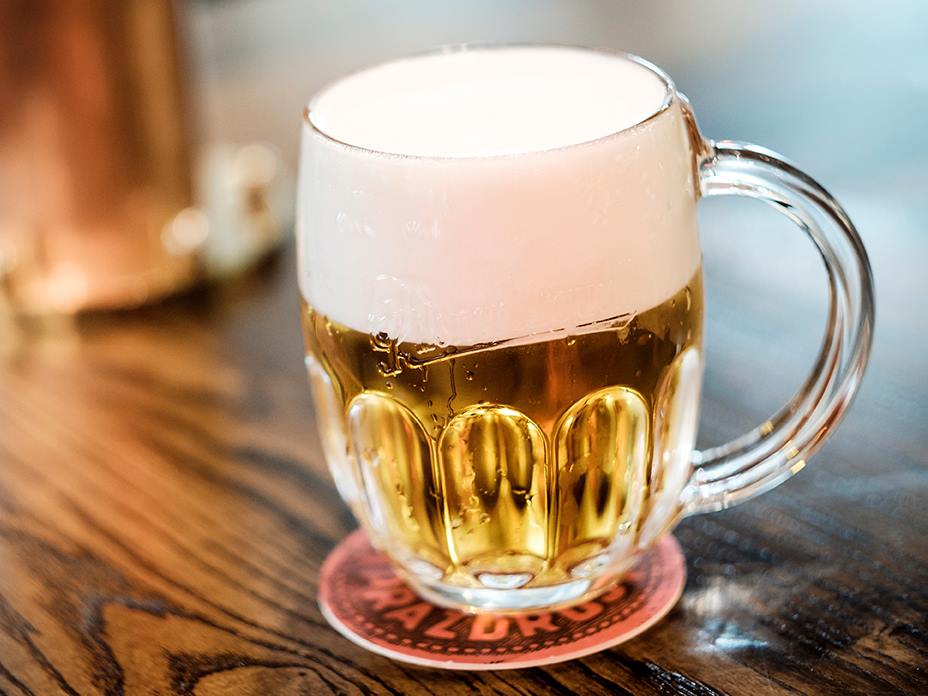
Type of pale lager
Pilsner (also pilsener or simply pils) is a type of pale lager. It takes its name from the Bohemian city of Plzeň (), where the world's first pale lager (now known as Pilsner Urquell) was produced in 1842 by Pilsner Urquell Brewery.
History


Origin
The city of Plzeň was granted brewing rights in 1307. Until the mid-1840s, most Bohemian beers were top-fermented. The Pilsner Urquell Brewery, originally called in (, ), is where Pilsen beer was first brewed.
Brewers had begun aging beer made with cool fermenting yeasts in caves (lager, i.e., [stored]), which improved the beer's clarity and shelf-life. Part of this research benefited from the knowledge already expounded on in a book (printed in German in 1794, in Czech in 1799) written by Czech brewer František Ondřej Poupě () (1753–1805) from Brno.
The Plzeň brewery recruited the Bavarian brewer Josef Groll (1813–1887) who, using the local ingredients, produced the first batch of pale lager on 5 October 1842. The combination of Plzeň's remarkably soft water, local Saaz noble hops from nearby Žatec, low-protein Moravian barley malt prepared by indirectly heated kilning, and Bavarian-style lagering produced a clear, golden beer.
By 1853, the beer was available at 35 pubs in Prague. In 1856, it came to Vienna and in 1862 to Paris. In 1859, Pilsner Bier was registered as a brand name at the Chamber of Commerce and Trade in Plzeň. In 1898, the Pilsner Urquell trademark was created to put emphasis on being the original brewery (Urquell, meaning 'original source').
Some beers are labeled Urtyp Pilsener (UP) meaning they are brewed according to the original process, although many breweries use this accolade for their top beer.
Modern developments
The introduction of modern refrigeration to Germany by Carl von Linde in the late 19th century eliminated the need for caves for beer storage, enabling the brewing and storing of cool fermenting beer in many new locations.
Until 1993 the Pilsner Urquell brewery fermented its beer using open barrels in the cellars beneath their brewery. This changed in 1993 with the use of large cylindrical tanks. Small samples are still brewed in a traditional way for taste comparisons.
A modern pale lager termed a pilsner may have a very light, clear colour from pale to golden yellow, with varying levels of hop aroma and flavour. The alcohol strength of beers termed pilsner vary but are typically around 4.5%–5% (by volume). There are categories such as "European-Style Pilsner" at beer competitions such as the World Beer Cup. Pilsner style lagers are marketed internationally by numerous small brewers and larger conglomerates.
Styles
;Czech-style Pilsner: Bright golden colour, moderately bitter and distinct aroma, brewed with malt and Saaz hops. In the Czech Republic, only Pilsner Urquell is named as "pilsner". However, outside of the Czech Republic, Czech-style Pilsner is synonymous with any such lager beers (including any Czech brand) – for example Pilsner Urquell, Budweiser Budvar, Gambrinus, Kozel, Radegast, Staropramen, Starobrno and Krušovice.

;German-style Pilsner:Light straw to golden colour with more bitter or earthy taste – such as Beck's, Bitburger, Flensburger, Fürstenberg, Holsten, Jever, König, Krombacher, Radeberger, St. Pauli Girl, Veltins, Warsteiner, Wernesgrüner and Einbecker.
;European-style Pilsner:Has a slightly sweet taste, can be produced from grains other than barley malt – such as the Dutch: Amstel, Grolsch and Heineken or Belgian: Jupiler, Maes and Stella Artois.
;American-style Pilsner: German immigrants brought pilsner style beers to America in the mid-19th century. American pilsners today are still closer to the German style, but a traditional grist may contain up to 25% corn and/or rice. American pilsners have “significantly less flavor, hops, and bitterness than traditional European Pilsners,” according to the Beer Judge Certification Program.{{cite web
;West Coast-style Pilsner : Modern iteration, light to golden color brewed with American or southern hemisphere hops, possibly dry-hopped. Developed on the West Coast of the United States. Clean and light, with more pronounced hop flavor and aroma.
;Australian-style Pilsner: Light straw to golden colour with more crisp, clean earthy taste.
References
References
- Jackson, Michael. "Prague: twinned with Burton-upon-Trent". The Beer Hunter.
- "German Beer Institute, PILS".
- "Traces of the Pilsen History". City of Plzeň.
- "Plzeňský Prazdroj, a. s.". prazdroj.cz.
- Basařová G.: Der legendäre böhmische Brauer František Ondřej Poupě (Franz Andreas Paupie) 1753–1805. Jahrbuch 2003 Gesellschaft für die Geschichte und Bibliographie des Brauwesens e.V. (GGB), (2003) 1, 128–146.
- "The Oxford Companion to Beer Definition of Pilsner Urquell".
- "RateBeer".
- "Urtyp on the ''Craft Beer and Brewing'' website".
- "Altbier im Alltag" by Genno Fonk, 1999, page 11
- "Heineken bier – Pils gebrouwen door Heineken Brouwerij".
- "Michael Jackson's Beer Hunter – Belgium's Great Beers".
- (2 October 2023). "Writing the Rules of West Coast Pilsner (So They Can Be Broken)".
This article was imported from Wikipedia and is available under the Creative Commons Attribution-ShareAlike 4.0 License. Content has been adapted to SurfDoc format. Original contributors can be found on the article history page.
Ask Mako anything about Pilsner — get instant answers, deeper analysis, and related topics.
Research with MakoFree with your Surf account
Create a free account to save articles, ask Mako questions, and organize your research.
Sign up freeThis content may have been generated or modified by AI. CloudSurf Software LLC is not responsible for the accuracy, completeness, or reliability of AI-generated content. Always verify important information from primary sources.
Report