From Surf Wiki (app.surf) — the open knowledge base
Pilatus PC-7
Trainer aircraft family by Pilatus of Switzerland

Trainer aircraft family by Pilatus of Switzerland
| Field | Value |
|---|---|
| name | PC-7 |
| image | File:Swiss Air Force Pilatus PC-7 (cropped).jpg |
| caption | PC-7 Team of the Swiss Air Force |
| type | Trainer aircraft |
| manufacturer | Pilatus Aircraft |
| first_flight | PC-7: |
| (prototype) | |
| (production) | |
| PC-7 Mk.II M: | |
| introduction | PC-7: 1978 |
| PC-7 Mk.II M: 1994 | |
| PC-7 MKX: 2021 | |
| status | In service |
| primary_user | Mexican Air Force |
| more_users | Indian Air Force |
| South African Air Force | |
| Royal Malaysian Air Force | |
| produced | 1966–present |
| number_built | 618 |
| developed_from | Pilatus P-3 |
| developed_into | Pilatus PC-9 |
(prototype) (production) PC-7 Mk.II M:
PC-7 Mk.II M: 1994 PC-7 MKX: 2021 South African Air Force Royal Malaysian Air Force
The Pilatus PC-7 Turbo Trainer is a low-wing tandem-seat training aircraft, designed and manufactured in Switzerland by Pilatus Aircraft. The aircraft is capable of all basic training functions, including aerobatics, instrument, tactical, and night flying.
The PC-7 was developed from the preceding piston-powered Pilatus P-3, largely differing by the adoption of a turboprop engine, a bubble canopy, and a new one-piece wing. Introduced during the 1970s, it has since developed a sizable presence of the global trainer market. The type has been adopted by in excess of twenty air forces as their ab initio trainer, as well as multiple civilian operators. Over one million hours have reportedly been flown by PC-7s worldwide. In addition to training operations, some aircraft are armed and have been used for combat missions by several customers, including Chad, Iran, and Mexico, often in violation of the relevant export agreement between the customer and the Swiss government.
An improved model of the aircraft, the PC-7 Mk.II M, was developed during the 1990s, by combining the newer airframe and avionics from the PC-9 with the PC-7's smaller turbine engine. Reportedly, in excess of 600 PC-7s have been sold to various operators, the majority of which are in service. In Pilatus' range of aircraft, the PC-7 has been succeeded by the newer PC-9 and PC-21 trainers.
Development
Origins
Work on what would become the PC-7 commenced during the 1960s. It was based on the earlier piston-powered Pilatus P-3, the initial prototype being produced from the existing prototype P-3, principally differing by the substitution of its Lycoming O-435 engine with a Pratt & Whitney PT6A-20 turboprop power-plant. The termination of work was reportedly driven by a lack of market interest.
During 1973, it was decided to restart work on the programme; factors for its revival had included the 1973 oil crisis, the launch of the rival Beechcraft T-34C Turbo-Mentor, and the increasing age of existing trainer aircraft. To support the relaunch, another P-3 was obtained from the Swiss Air Force. After modifications, this aircraft first flew on . Further extensive modifications followed later in the programme, including the adoption of a new one-piece wing complete with integral fuel tanks, along with an altered tail fin and a bubble canopy. The flight test programme came to a close during Autumn 1977.
On , the first production aircraft made its first flight. Over time, sales of the PC-7 generated considerable profits, allowing the company to finance the development of further types of aircraft.
Further development
The PC-7 Mk.II M is a development of the PC-9's airframe and avionics, which was powered by the PC-7's smaller turbine engine, which reportedly achieved lower operating and maintenance costs. This variant was developed at the behest of the South African Air Force (SAAF), who later adopted the type. A batch of 60 PC-7 Mk.II Ms were locally assembled in South Africa using kits supplied by Pilatus for the SAAF; due to political considerations, these aircraft were not fitted with the armament hardpoints. Deliveries to the SAAF took place between late 1994 and 1996.
In addition to Pilatus' own improvement programmes, several third-party companies have independently developed their own upgrades for customer's PC-7. During the late 1990s, Israeli engineering firm Radom began offering a kit of new avionics for the type, which included a new mission computer, a wide-angle head-up display, along with various replacement communications and weapons-delivery systems.
During July 1998, Pilatus announced that it has come to an agreement with American company Western Aircraft, for the latter to act as a distributor for the PC-7 across the North American civil aviation market.
Operational history
General use
All export sales of the PC-7 are subject to approval by the Swiss Government, whose authorisation is required prior to any delivery taking place. The sale of combat-capable aircraft has been a controversial matter at times, and political pressure has been applied for PC-7s to be shipped without the fittings for armaments being installed. The Swiss government has occasionally held up or outright refused to issue export licences for some nations, a move which has reportedly led to the loss of several potential sales, such as to South Korea and Mexico.

In addition to its adoption by numerous military customers, the PC-7 has also been used by private customers. It has been certified for civil use by both the Federal Office of Civil Aviation (FOCA) and the U.S. Federal Aviation Administration (FAA) as compliant with regulations pertaining to general aviation (GA) operations in both Europe and the United States. Amongst its uses in the civilian sector has been aerobatic displays.
During the 1990s, the PC-7 Mk.II M was adopted as the basic trainer of the Royal Brunei Air Force (RBAirF) alongside the BAE Systems Hawk jet trainer; the acquisition was seen a key to its expanded operations with fixed-wing aircraft.
During June 2011, the Indian Air Force (IAF) selected the PC-7 Mk.II M as its new basic trainer, signing a contract for an initial batch of 75 aircraft, with an option for buying an additional 38 PC-7 Mk.II Ms; the Indian military had a total requirement of 181 trainers. The fast-tracked decision to procure a foreign aircraft over a domestically developed alternative proposed by Hindustan Aeronautics Limited (HAL) was a controversial one; retired Air Marshal Anil Chopra argued that HAL had no viable design for the role, and that the IAF could not have reasonably afforded the delay involved in the development of such an aircraft. The procurement of an additional 106 trainers under the 'Make & Buy' (Indian) category was repeatedly deferred. In 2017, the maintenance agreement with Pilatus lapsed, resulting in the IAF becoming solely responsible for performing these activities. In 2018, India announced that it had chosen to exercise the option of buying a batch of 38 trainers. However, as of 2020, the additional orders for PC-7 aircraft from IAF were cancelled in favour of the indigenous HAL HTT-40 from Hindustan Aeronautics, the orders for which was placed in 2022.
Combat use
A number of PC-7s were employed by the Guatemalan Air Force in air strikes and for close air support (CAS) during the Guatemalan civil war, starting in 1982, until the end of the conflict in 1996. The PC-7s were typically deployed from the airfield in La Aurora, being armed with a mixture of gun pods and rocket pods.
During the lengthy Iran–Iraq War of the 1980s, amid tensions between Iran and the United States, it is alleged that Iranian officials threatened to arm its PC-7 fleet with explosives and use them to launch suicide attacks against United States Navy (USN) vessels present in the Persian Gulf. Iran reportedly trained a number of suicide pilots and flew some operational missions, training was performed at Bushehr Air Base in Iran and overseas in North Korea. In early 1984, an Iranian attack helicopter AH-1J Sea Cobra was shot down by an Iraqi PC-7 during Operation Khyber (Iranian pilots Reza Moghadam and Mohammad Yazdi were rescued).
In 1994, the Mexican Air Force used several armed PC-7s to attack units of the Zapatista Army of National Liberation during the Chiapas conflict in Mexico. This action was considered illegal by the Swiss government because the aeroplanes were sold for training purposes only, and as result, Switzerland issued a ban on the sale of additional units to Mexico. At the time, the Mexican Air Force was the largest single export operator of the type, and had been seeking to acquire further PC-7s, thus the sales ban was viewed as an economic blow to Pilatus.
During the mid to late 1990s, Executive Outcomes, a private military contractor led by Eeben Barlow, utilised three armed PC-7s (ex-Bophuthatswana Air Force aircraft) to provide close air support (CAS) during its operations in Sierra Leone.
During the late 2000s, the Chadian Air Force reportedly used its small fleet of PC-7s to bomb rebel positions both in their own territory and in neighbouring Sudan. The Swiss government summoned the Chad's ambassador to request an explanation for these reports, as these actions breached the export agreements previously struck for the sale of the type to Chad.
Variants
- PC-7 : two-seat basic trainer aircraft, powered by PT6A-25A engine rated at 410 kW.
- PC-7 Mk.II M : a development of the PC-9's airframe and avionics, retaining the PC-7's wing to mount external stores. Powered by PT6A-25C of 522 kW rather than more powerful PT6A-62 of PC-9. Developed for the South African Air Force (SAAF), and known as the 'Astra'; the aircraft is a hybrid PC-7 and PC-9, either a PC-7 'Heavy' or a PC-9 'Lite', depending on point of configuration.
- NCPC-7 : upgraded version of the standard PC-7 with fully IFR glass cockpit avionics, developed for the Swiss Air Force. The designation NCPC-7 has been provisionally used in the Swiss Air Force to differentiate modernized PC-7s (NC for New Cockpit) from those which were not yet done. It was removed after the improvement of the last of the 28 aircraft in 2009. Consequently, all the Turbo-Trainer took again the designation PC-7.
- PC-7 WE: upgraded variant of the NCPC-7 for the Swiss Air Force that includes: modification of the communication system, a TCAS (traffic collision avoidance system), ADF system extended (radiocompas), complete disassembly of the avionic and antennas to check for problems, complete disassembly and reassembly of the cables and repairs.
- PC-7 MKX: an updated version of the PC-7 Mk.II, with new avionics, cockpit displays, and integration with the ground-based training system (GBTS). The GBTS includes computer and simulator technology, along with new tools such as virtual reality and mixed reality. PC-7 MKX was announced at the Dubai Airshow in November 2021.
Operators

Military operators


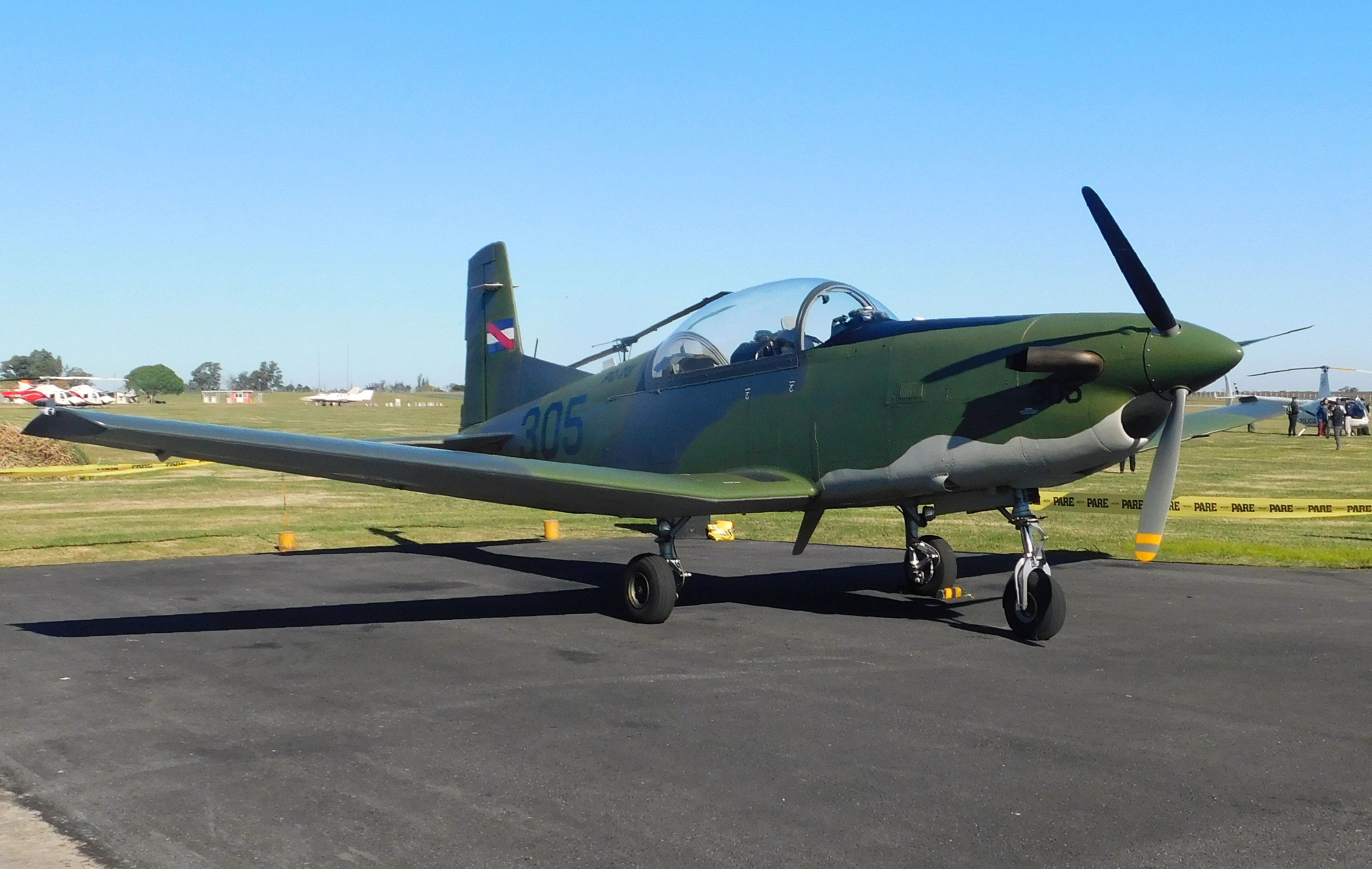
An incomplete list of the users of the PC-7:
; Angola : National Air Force of Angola: 12 PC-7 ordered in 1981, with deliveries starting in 1982, 8 others delivered in 1990. 5 aircraft lost. 16 PC-7 in service in 1994, 9 in 2003, 5 in 2016. ; Austria : Austrian Air Force: 16 PC-7 aircraft in service as of October 2008, 13 aircraft remain in service as of December 2021. ; Bolivia : Bolivian Air Force: 24 PC-7 aircraft in service as of October 2008, 2 remain in service as of December 2021. ; Botswana : Botswana Defence Force Air Wing: seven PC-7 (delivered from 1990) aircraft in service as of October 2008, to be replaced by five PC-7 Mk.II M in 2013; five PC-7 Mk.II M aircraft formally accepted into service on 8 February 2013, removing six original PC-7s from service. ; Brunei : Royal Brunei Air Force: four PC-7 Mk.II M aircraft in service as of October 2008, currently operated by No. 73 Squadron, and are also used by the RBAirF Alap-Alap Formation aerobatic display team. ; Chad : Chad Air Force: two PC-7 aircraft remaining in service as of December 2021. ; Chile : Chilean Navy: ten PC-7 aircraft in service as of October 2008, seven aircraft remain in service as of December 2021. ; France : Direction générale de l'armement: six PC-7 aircraft in service as of October 2008. ; Guatemala : Guatemalan Air Force: 12 PC-7 aircraft in service as of October 2008, one aircraft remaining in service as of December 2021. ; India : Indian Air Force: 74 PC-7 Mk.II M, Additional order for 38 units cancelled. Orders placed for HAL HTT-40. Two PC-7s have been lost in crashes in December 2023 and November 2025. ; Iran : Islamic Republic of Iran Air Force: 35 PC-7 aircraft in service as of October 2008, 34 aircraft remain in service as of December 2021. ; Malaysia : Royal Malaysian Air Force: 30 PC-7 Turbo Trainers out of a first order of 44 (delivered from 1983), 45 PC-7 aircraft in service as of October 2008; 17 PC-7 Mk.II M out of a second order of 19 (delivered in two batches, nine from 2001 and ten from 2007); total of 47 currently in service; the type is also used by the Taming Sari aerobatic display team. ; Mexico : Mexican Air Force: 88 PC-7 aircraft (first delivery May 1979) in service as of October 2008. ; Myanmar : Myanmar Air Force: first customer of the PC-7, deliveries in early 1979, 17 PC-7 aircraft in service as of October 2008, 16 aircraft remain in service as of December 2021. ; Netherlands : Royal Netherlands Air and Space Force: 13 PC-7 (first generation) aircraft in service, that will be replaced by 8 PC-7 MKX that were selected in October 2024, and with 2 simulators. ; South Africa : South African Air Force: first customer of the PC-7 Mk.II M delivered 30 November 1994, 60 PC-7 Mk.II M aircraft in service as of October 2008, the type is also used by the Silver Falcons aerobatic display team. ; Switzerland : Swiss Air Force: 40 PC-7 aircraft delivered from 1979 that remained in service as of October 2008 Nine have been used by the aerobatic display team PC-7 Team since 1989. : 28 PC-7 upgraded with new cockpit in service in 2011 (standard NCPC). As of 2024, 27 remain in service. RUAG and Pilatus have been tasked to modernise the fleet to the standard PC-7 WE (valuation programme). The intention is to keep it in service until 2040. ; United Arab Emirates : United Arab Emirates Air Force: 31 PC-7 aircraft in service as of October 2008, 31 aircraft remain in service as of December 2021. ; Uruguay : Uruguayan Air Force: 6 PC-7 aircraft in service as of October 2008, 5 aircraft remain in service as of December 2021.
Aircraft ordered
;Belgium : Belgian Air Force: 18 PC-7 MKX were selected in November 2025. ;France : French Air and Space force and French Naval Aviation: 22 PC-7 MKX ordered as primary trainer with 12 simulators developed by Exail in December 2024. It will replace the Cirrus SR20 and the Grob G120A. Pilatus won the programme "Mentor 2". Babcock France will provide the training for the French military. ;Netherlands : Royal Netherlands Air and Space Force: 8 PC-7 MKX were selected in October 2024, with 2 simulators, the contract was signed in February 2025.
Civilian operators
At least seven PC-7 aircraft are in service by various unspecified civilian operators as of October 2008.
Former military operators
; Bophuthatswana : Bophuthatswana Air Force: two PC-7 (delivered from 1989), later transferred to South Africa Air Force and subsequently served in the Sierra Leone civil war and Chad) ; Iraq : Iraq Air Force: 52 PC-7 (delivered from 1980) ; Nigeria : Nigerian Air Force had two aircraft in service. ; Suriname : Suriname Air Force had two PC-7 aircraft in service as of October 1986 of three ordered (one transferred to civilian operations).
Former civil operators
; Switzerland : Swissair
Accidents and incidents

- The South African Air Force (SAAF) grounded their fleet of PC-7 Mk.II M aircraft after a crash on 15 January 2008. The aircraft went down shortly after takeoff from Overberg Air Force Base in the Western Cape Province. SAAF Lieutenant-Colonel Chris Meiring, 58, died shortly after the crash. The aircraft was flying to Langebaanweg Air Force Base for maintenance but shortly after takeoff it rolled and flew into the ground. The cause is believed to have been a structural problem.
- In March 2010, a pilot was killed when his Royal Malaysian Air Force (RMAF) aircraft exploded and caught fire in midair during a solo airshow. This is the fifth accident involving Royal Malaysian Air Force PC-7 aircraft.
- In June 2010, two Mexican pilots were killed when their Mexican Air Force PC-7 crashed after taking off from Pie de la Cuesta, a district in the resort city of Acapulco, Mexico. The PC-7 crashed into the sea near Acapulco.
- On 20 October 2011, two PC-7s of the Botswana Defence Force were involved in a mid-air collision over Letlhakeng 100 km west of Gaborone. Two of the four aircrew involved were killed in the accident.
- On 12 September 2017, a pilot was killed when his Swiss Air Force PC-7 crashed at the Schreckhorn in Canton Bern on its way from Base aérienne Payerne to Base aérienne Locarno.
- On 4 December 2023, a PC-7 of the Indian Air Force crashed in Medak, Telangana, India. Both pilots died in the crash. The aircraft had taken off on a training flight from Hyderabad. The crash is currently under investigation.
- On 14th November 2025, another PC-7 of the Indian Air Forced crashed near Tambaram, during a training mission. The sole pilot ejected safely.
Specifications (PC-7)
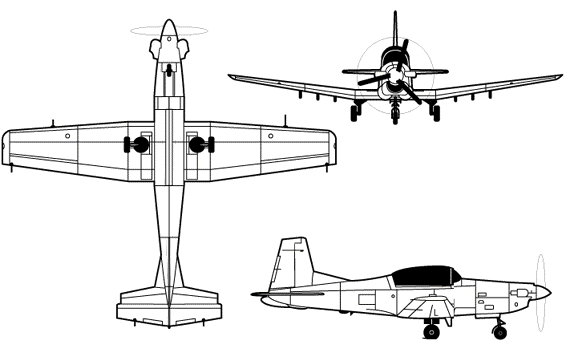
|prime units? = met 2x 240 L external fuel drop tanks |max takeoff weight kg= 2700 • Max landing weight: 2,565 kg |never exceed speed kmh= 500 |never exceed speed note= EAS take-off run 780 m at max take-off weight, landing run 505 m at max landing weight
References
Citations
Bibliography
References
- (3 October 2008). "Pilatus PC-7 (inc. list of users)". Military Aviation.
- (10 July 2001). "Training - Bridging the gap". [[Flight International]].
- (14 August 2001). "Elementary training role for PC-21?". [[Flight International]].
-
-
- 12
-
- (September 1999). "Pilatus PC-7 Turbo Trainer". [[Forecast International]].
- Wastnage, Justin. (26 February 2002). "Pilatus ponders additions to civilian aircraft offering". [[Flight International]].
- Wastnage, Justin. (30 April 2002). "Peace dividend". [[Flight International]].
- (25 November 1998). "Radom offers PC-9 upgrade for training and combat". [[Flight International]].
- (22 July 1998). "Pilatus appoints Western to market PC-7 trainer". [[Flight International]].
- (18 October 1996). "Brunei finalises MPA configuration". [[Flight International]].
- (12 March 1997). "Sultan of Brunei confirms Hawk deal". [[Flight International]].
- (24 May 2012). "India selects Pilatus basic trainer". Pilatus.
- Chopra, Anil. (7 October 2013). "Stuck at the basics of aircraft design". [[Hindu Business Line]].
- Raghuvanshi, Vivek. (20 July 2017). "Swiss Firm not expanding maintenance deal for India's PC-7 trainers".
- (14 July 2018). "IAF gets its 75th Pilatus training aircraft PC-7 MkII". The Economic Times, [[India Times]].
- Cooper, Tom. "Guatemala since 1954".
- Razoux 2015, pp. 421–422.
- Bodansky 1993, p. 14.
- Cordesman and Wagner 1991, p. 285.
- "Потери ВВС Ирана".
- Aranda, Jesús. (13 November 2009). "Ahora que la FAM pretende renovar su flota no puede adquirir aviones Pilatus C-9". La Jornada.
- (8 February 1998). "Government veto blocks PC-9 sale to Mexico". [[Flight International]].
- Barlow, Eeben. "Executive Outcomes: against all odds". Galago.
- (21 August 1996). "Gunships for hire". [[Flight International]].
- Wezeman, Pieter D.. (August 2009). "Arms flows to the conflict in Chad".
- (17 January 2008). "Chad likely armed Swiss-made aircraft".
- ''Air International'' September 1979, p. 115.
- Taylor 1999, pp. 96–97.
- [https://www.vtg.admin.ch/en/einsatzmittel/luft/pc-7-turbo-trainer.html#upgrades Pilatus PC-7 Turbo-Trainer], vtg.admin.ch.
- (7 November 2024). "Mesures d'accompagnement anticipées pour le PC-7 Maintien de la valeur sur la bonne voie".
- (2022-03-10). "PC-7 MKX – The Latest Trainer From Pilatus". Pilatus.
- Duke, Jon. (2022-01-21). "Ground-based training technology is key to success for PC-7 MKX". Skies Mag.
- [[International Institute for Strategic Studies]]. (November 2025). "The Military Balance 2016". Routledge.
- (3 October 2008). "Pilatus PC-7 (inc. list of users)". Military Aviation.
- {{harvnb. Hoyle ''Flight International'' 2021
- (3 October 2008). "Pilatus PC-7 (inc. list of users)". Military Aviation.
- {{harvnb. Hoyle ''Flight International'' 2021
- (3 October 2008). "Pilatus PC-7 (inc. list of users)". Military Aviation.
- (20 April 2011). "Botswana Defence selects PC-7 MkII turboprop trainer aircraft worth SF 40 Mil". Frontier India.
- Hoyle, Craig. (11 February 2013). "Botswana introduces new PC-7 MkII trainers". [[Flight International]], Reed Elsevier.
- (3 October 2008). "Pilatus PC-7 (inc. list of users)". Military Aviation.
- (3 October 2008). "Pilatus PC-7 (inc. list of users)". Military Aviation.
- {{harvnb. Hoyle ''Flight International'' 2021
- (3 October 2008). "Pilatus PC-7 (inc. list of users)". Military Aviation.
- {{harvnb. Hoyle ''Flight International'' 2021
- (3 October 2008). "Pilatus PC-7 (inc. list of users)". Military Aviation.
- (3 October 2008). "Pilatus PC-7 (inc. list of users)". Military Aviation.
- {{harvnb. Hoyle ''Flight International'' 2021
- (14 July 2018). "IAF gets its 75th Pilatus training aircraft PC-7 MkII". [[The Economic Times]], Bennett, Coleman & Co. Ltd..
- (19 May 2020). "IAF shelves 3 major acquisition projects for Make in India, other reasons/".
- Peri, Dinakar. (20 October 2022). "IAF-HAL conclude ₹6,800 crore contract for 70 HTT-40 trainer aircraft".
- (2023-12-04). "wo pilots killed in an Indian Air Force trainer aircraft crash in Telangana’s Medak".
- (2025-11-14). "IAF training aircraft crashes near Chennai; pilot ejects safely". The Times of India.
- (2025-11-14). "Indian Air Force aircraft crashes in Chennai, pilot ejects safely".
- (3 October 2008). "Pilatus PC-7 (inc. list of users)". Military Aviation.
- {{harvnb. Hoyle ''Flight International'' 2021
- (3 October 2008). "Pilatus PC-7 (inc. list of users)". Military Aviation.
- (3 October 2008). "Pilatus PC-7 (inc. list of users)". Military Aviation.
- Jackson 2003, p. 454.
- (3 October 2008). "Pilatus PC-7 (inc. list of users)". Military Aviation.
- {{harvnb. Hoyle ''Flight International'' 2021
- Mukherjee, Upasana. (2024-10-16). "Netherlands MoD selects Pilatus for eight PC-7 MkX aircraft".
- (3 October 2008). "Pilatus PC-7 (inc. list of users)". Military Aviation.
- (3 October 2008). "Pilatus PC-7 (inc. list of users)". Military Aviation.
- "Archived copy".
- "Pilatus NCPC-7 (PC-7 Turbo-Trainer)". [[Swiss Air Force]]; Federal Department of Defence, Civil Protection and Sport.
- (2024-11-07). "RUAG and Pilatus partner to extend service life of Swiss Air Force’s PC-7 trainer fleet".
- (3 October 2008). "Pilatus PC-7 (inc. list of users)". Military Aviation.
- {{harvnb. Hoyle ''Flight International'' 2021
- (3 October 2008). "Pilatus PC-7 (inc. list of users)". Military Aviation.
- {{harvnb. Hoyle ''Flight International'' 2021
- Orban, André. (2025-11-07). "Belgium approves purchase of new Pilatus PC-7 MKX training aircraft".
- Lagneau, Laurent. (2025-01-10). "Le Pilatus PC-7 a été retenu pour assurer la formation initiale des futurs pilotes de l'armée de l'Air et de la Marine".
- (2025-02-07). "L'Armée de l'air Royale Néerlandaise signe pour le PC-7 MKX !".
- (3 October 2008). "Pilatus PC-7 (inc. list of users)". Military Aviation.
- (3 October 2008). "Pilatus PC-7 (inc. list of users)". Military Aviation.
- (3 October 2008). "Pilatus PC-7 (inc. list of users)". Military Aviation.
- (3 October 2008). "Pilatus PC-7 (inc. list of users)". Military Aviation.
- (26 March 2010). "Nasional Karnival konvokesyen UUM bertukar tragedi". Bharian.
- "Cae avión militar en Acapulco". El Debate.
- "Two die in military plane crash in Mexico". [[Latin American Herald Tribune]].
- "Two BDF planes collide, killing two pilots". Mmegi online.
- "PC-7 crash on Schreckhorn".
- (2023-12-04). "wo pilots killed in an Indian Air Force trainer aircraft crash in Telangana’s Medak".
- https://www.ndtv.com/india-news/indian-air-force-aircraft-crashes-near-chennai-pilot-safe-9635959/amp/1
- ''Air International'' September 1979, p. 113.
This article was imported from Wikipedia and is available under the Creative Commons Attribution-ShareAlike 4.0 License. Content has been adapted to SurfDoc format. Original contributors can be found on the article history page.
Ask Mako anything about Pilatus PC-7 — get instant answers, deeper analysis, and related topics.
Research with MakoFree with your Surf account
Create a free account to save articles, ask Mako questions, and organize your research.
Sign up freeThis content may have been generated or modified by AI. CloudSurf Software LLC is not responsible for the accuracy, completeness, or reliability of AI-generated content. Always verify important information from primary sources.
Report