From Surf Wiki (app.surf) — the open knowledge base
Pig iron
Iron alloy
Iron alloy
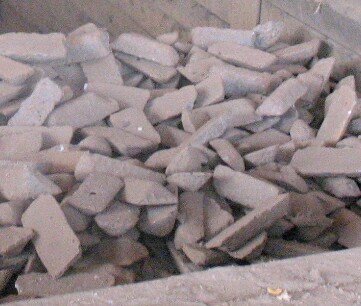
Pig iron, also known as crude iron, is an intermediate good used by the iron industry in the production of steel. It is developed by smelting iron ore in a blast furnace. Pig iron has a high carbon content, typically 3.8–4.7%, along with silica and other dross, which makes it brittle and not useful directly as a material except for limited applications.{{cite web |access-date = 5 December 2016 |url-status = live |archive-url = https://web.archive.org/web/20140314103940/http://www.thehopkinthomasproject.com/TheHopkinThomasProject/TimeLine/GenealogyPortraits/DavidThomasBios/SamThomaReminiscence.htm |archive-date = 14 March 2014
Etymology
The traditional shape of the molds used for pig iron ingots is a branching structure formed in sand, with many individual ingots at right angles to a central channel or "runner", resembling a litter of piglets being nursed by a sow. When the metal had cooled and hardened, the smaller ingots (the "pigs") were simply broken from the runner (the "sow"), hence the name "pig iron". As pig iron is intended for remelting, the uneven size of the ingots and the inclusion of small amounts of sand are insignificant when compared to the ease of casting and handling.
The expression “sweat like a pig” comes from the iron smelting process. As the iron cools, the surrounding air reaches its dew point, and beads of moisture form on the surface of the "pigs". This indicates that the iron has cooled enough to be safely handled.
History

The Chinese were already making pig iron during the later Zhou dynasty (which ended in 256 BC). Furnaces, such as Lapphyttan in Sweden, may date back to the 12th century and some in the County of Mark to the 13th century, which is now part of Westphalia, Germany. It is unclear whether these northern European developments were derived from the Chinese ones or independent inventions. Wagner has postulated a possible link via Persian contacts with China along the Silk Road and Viking contacts with Persia, but there is a chronological gap between the Viking period and Lapphyttan. The step from bloomery to blast furnace is not big: all that is needed is to make the furnace higher and have more powerful bellows.
Smelting and producing wrought iron were known in ancient Europe and the Middle East, but it was produced in bloomeries by direct reduction. Small prills of pig iron dispersed in slag are produced in all iron furnaces, but the operator of a bloomery had to avoid conditions causing the phase transition of the iron into liquid in the furnace, as the prill globules or any resulting pig iron are not malleable so can't be hammered in a single piece. Alternatively, decarburizing the pig iron into steel was an extremely tedious process using medieval technology, so in Europe before the Middle Ages the prills were discarded with the slag.
Uses
Traditionally, pig iron was worked into wrought iron in finery forges, later puddling furnaces, and more recently, it is worked into steel. In these processes, pig iron is melted and a strong current of air is directed over it while it is stirred or agitated. This causes the dissolved impurities (such as silicon) to be thoroughly oxidized. An intermediate product of puddling is known as refined pig iron, finers metal, or refined iron.
Pig iron can also be used to produce gray iron. This is achieved by remelting pig iron, often along with substantial quantities of steel and scrap iron, removing undesirable contaminants, adding alloys, and adjusting the carbon content. Ductile iron can also be produced using certain high purity grades of pig iron; depending on the grade of ductile iron being produced, the pig irons chosen may be low in the elements silicon, manganese, sulfur and phosphorus. High purity pig iron is used to dilute any elements in a ductile iron charge which may be harmful to the ductile iron process (except carbon).
Modern uses
Pig iron was historically poured directly out of the bottom of the blast furnace through a channel into a ladle car for transfer to the steel mill in mostly liquid form; in this state, the pig iron was referred to as hot metal. The hot metal was then poured into a steelmaking vessel to produce steel, typically an electric arc furnace, induction furnace or basic oxygen furnace, where the excess carbon is burned off and the alloy composition controlled. Earlier processes for this included the finery forge, the puddling furnace, the Bessemer process, and the open hearth furnace.
Modern steel mills and direct-reduction iron plants transfer the molten iron to a ladle for immediate use in the steel making furnaces or cast it into pigs on a pig-casting machine for reuse or resale. Modern pig casting machines produce stick pigs, which break into smaller 4–10 kg piglets at discharge.
References
References
- Camp, James McIntyre. (1920). "The Making, Shaping and Treating of Steel". Carnegie Steel Co..
- (2003). "Glossary of Metalworking Terms". [[Industrial Press]].
- (1999). "The Making, Shaping, and Treating of Steel: Ironmaking volume". AISE Steel Foundation.
- "Sweating like a pig".
- Wagner, Donald. ''Iron and Steel in Ancient China''. Leiden 1996: [[Brill Publishers]]{{ISBN?{{page needed. (September 2022)
- Several papers in ''The importance of ironmaking: technical innovation and social change: papers presented at the Norberg Conference, May 1995'' ed. Gert Magnusson (Jernkontorets Berghistoriska Utskott H58, 1995), 143–179.
- (1995). "Donald B. Wagner : Iron and Steel in Ancient China". Bulletin de l'École Française d'Extrême-Orient.
- "Medieval Iron in Society II. Papers and discussions presented at the symposium in Norberg, May 6–10, 1985.".
- R. F. Tylecote, ''A history of metallurgy'' (2nd edition, Institute of Materials, London, 1992).
- Rajput, R.K.. (2000). "Engineering Materials". S. Chand.
This article was imported from Wikipedia and is available under the Creative Commons Attribution-ShareAlike 4.0 License. Content has been adapted to SurfDoc format. Original contributors can be found on the article history page.
Ask Mako anything about Pig iron — get instant answers, deeper analysis, and related topics.
Research with MakoFree with your Surf account
Create a free account to save articles, ask Mako questions, and organize your research.
Sign up freeThis content may have been generated or modified by AI. CloudSurf Software LLC is not responsible for the accuracy, completeness, or reliability of AI-generated content. Always verify important information from primary sources.
Report