From Surf Wiki (app.surf) — the open knowledge base
Piezoluminescence
Emission of light created by pressure
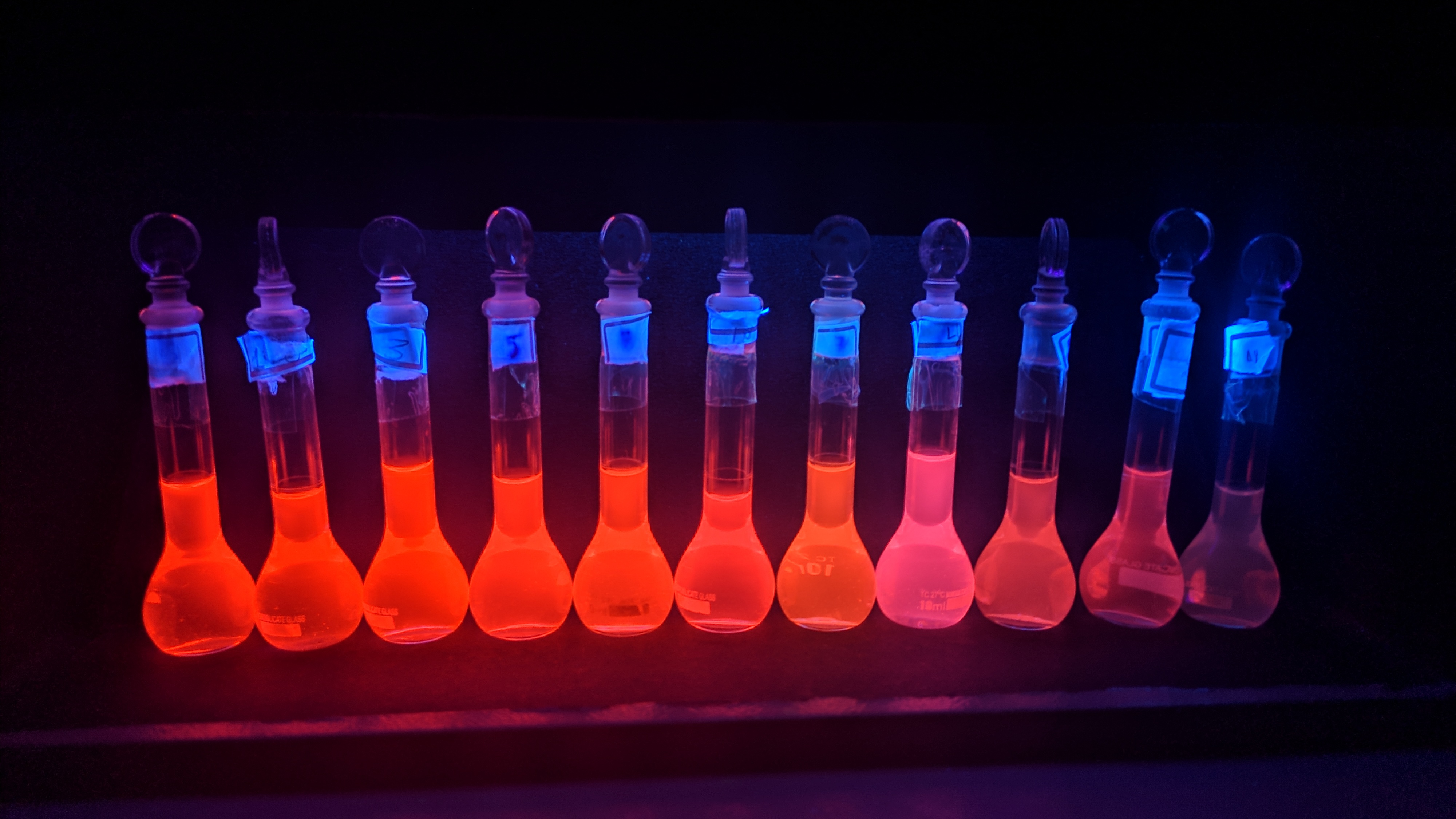
Emission of light created by pressure
Piezoluminescence is a form of luminescence created by pressure upon certain solids. This phenomenon is characterized by recombination processes involving electrons, holes, and impurity ion centres.{{cite journal | last=Atari | first=N.A. | date=June 1982 | title=Piezoluminescence phenomenon | journal=Physics Letters A | volume=90 | issue=1–2 | pages=93–96 | doi=10.1016/0375-9601(82)90060-3| bibcode=1982PhLA...90...93A }} Some piezoelectric crystals give off a certain amount of piezoluminescence when under pressure. Irradiated salts, such as NaCl, KCl, KBr, and polycrystalline chips of LiF (TLD-100), have been found to exhibit piezoluminescent properties. It has also been discovered that ferroelectric polymers exhibit piezoluminescence upon the application of stress.
In the folk-literature surrounding psychedelic production, DMT, 5-MeO-DMT, and LSD have been reported to exhibit piezoluminescence. As specifically noted in the book Acid Dreams, it is stated that Augustus Owsley Stanley III, one of the most prolific producers of LSD in the 1960s, observed piezoluminescence in the compound's purest form, an observation confirmed by Alexander Shulgin: "A totally pure salt, when dry and when shaken in the dark, will emit small flashes of white light."
References
References
- On Piezoluminescence in Irradiated Alkali Halides, by A. Al-Hashimi, A.M. Eid, K.V. Ettinger and J.R. Mallard, ''Radiation Protection Dosimetry'' (1983) 6 (1–4): 203–205.
- Reynolds, George (1997). Piezoluminescence from a ferroelectric polymer and quartz. ''Journal of Luminescence'' (Princeton) 75 (4): 295–299.
- ''Acid Dreams: The Complete Social History of LSD: The CIA, the Sixties, and Beyond'' by Martin A. Lee and Bruce Shlain, pg 174
- TiHKAL. [[Alexander Shulgin]] and [[Ann Shulgin]]. http://www.erowid.org/library/books_online/tihkal/tihkal26.shtml
This article was imported from Wikipedia and is available under the Creative Commons Attribution-ShareAlike 4.0 License. Content has been adapted to SurfDoc format. Original contributors can be found on the article history page.
Ask Mako anything about Piezoluminescence — get instant answers, deeper analysis, and related topics.
Research with MakoFree with your Surf account
Create a free account to save articles, ask Mako questions, and organize your research.
Sign up freeThis content may have been generated or modified by AI. CloudSurf Software LLC is not responsible for the accuracy, completeness, or reliability of AI-generated content. Always verify important information from primary sources.
Report