From Surf Wiki (app.surf) — the open knowledge base
Pietà
Artistic subject of the Virgin Mary cradling the dead body of Jesus
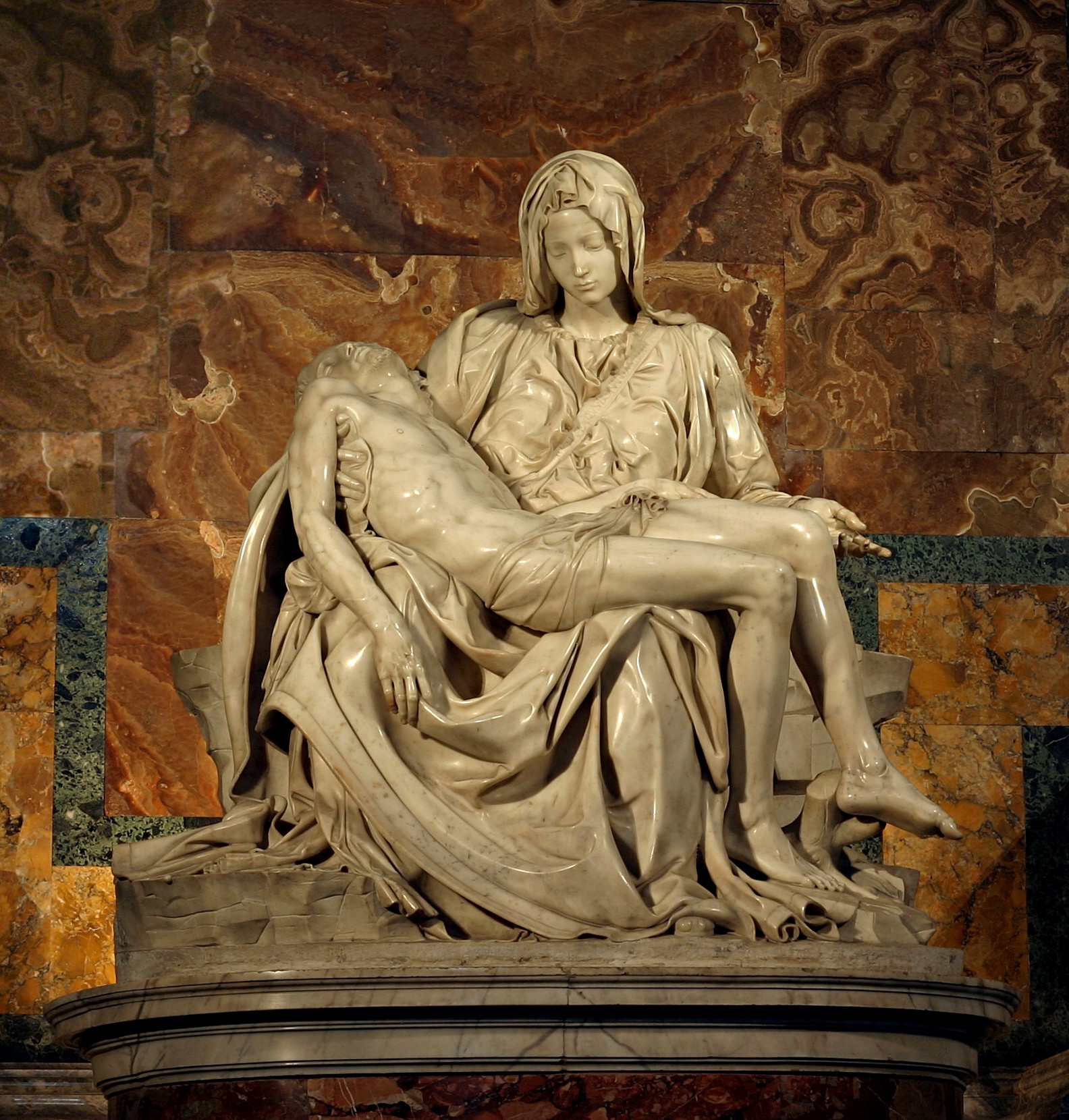
Artistic subject of the Virgin Mary cradling the dead body of Jesus
The Pietà (; meaning "pity", "compassion") is a subject in Christian art depicting the Blessed Virgin Mary cradling the mortal body of Jesus Christ after his Descent from the Cross. It is most often found in sculpture. The Pietà is a specific form of the Lamentation of Christ in which Jesus is mourned by the Virgin Mary alone. However, in practice works called a Pietà may include angels, the other figures usual in Lamentations, and even donor portraits.
An image consisting only of a dead Christ with angels is also called a Pietà, at least in German, where Engelpietà (literally "Angel Pietà") is the term for what is usually called Dead Christ supported by angels in English.
Several namesake images have merited a Pontifical decree of coronation, including the Pieta of Saint Peter's Basilica in Rome, in the Marienthal Basilica in France, the Franciscan church in Leuven, Belgium, at the Kamp-Bornhofen, Germany, and Our Lady of Charity in Cartagena, Spain.
Context and development
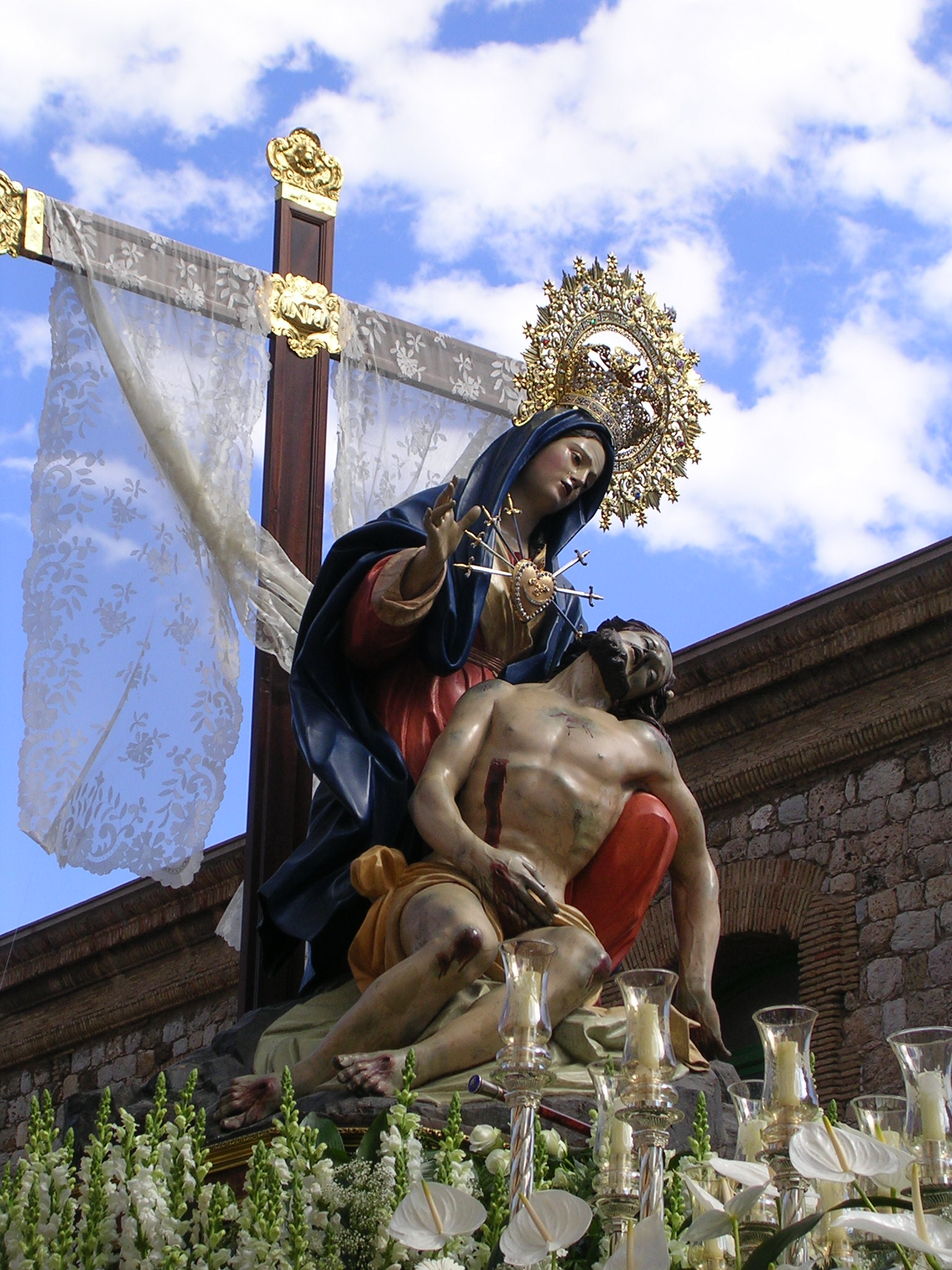
The Pietà is one of the three common artistic representations of a sorrowful Virgin Mary, the other two being the Mater Dolorosa ("dolorous mother") and the Stabat Mater ("standing mother"). The other two representations are most commonly found in paintings, rather than sculpture, although combined forms exist.
The Pietà developed in Germany (where it is called Vesperbild) about 1300, reached Italy about 1400, and was especially popular in Central European Andachtsbilder. Many German and Polish 15th-century examples in wood greatly emphasise Christ's wounds. Although the subject was known in Italy, the name may have been slower to be adopted, and the Florentine diarist Luca Landucci, after describing a painting in an entry for June 1482, added "which is called by some a Pietà".

The Deposition of Christ and the Lamentation or Pietà form the 13th of the Stations of the Cross, as well as one of the Seven Sorrows of the Virgin.
Although the Pietà most often shows the Virgin Mary holding Jesus, there are other compositions, including those where God the Father participates in holding Jesus Christ. In Spain the Virgin often holds up one or both hands, sometimes with Christ's body slumped to the floor.
Michelangelo
Main article: Pietà (Michelangelo)

A famous example by the Italian sculptor Michelangelo in marble is in Saint Peter's Basilica in the Vatican City. The body of Christ is different from most earlier Pietà statues, which were usually smaller and in wood. The Virgin is also unusually youthful, and in repose, rather than the older, sorrowing Mary of most Pietàs. She is shown as youthful for two reasons: God is the source of all beauty and she is one of the closest to God, and because the exterior is thought as the revelation of the interior; therefore, the virgin is morally beautiful. Michelangelo's Pieta sculpture is also unique in the fact that it is the only one of his works that he ever signed. Upon hearing that visitors thought it had been sculpted by Cristoforo Solari, a competitor, he carved his signature into Mary's sash as "MICHAELA[N]GELUS BONAROTUS FLORENTIN[US] FACIEBA[T]": "Michelangelo Buonarroti the Florentine made this".
In a lesser known Michelangelo Pietà, The Deposition (), it is not the Virgin Mary who is holding Christ's body, but rather Nicodemus (or possibly Joseph of Arimathea), Mary Magdalene, and the Virgin Mary. There is some indication that the man in the hood is based on a self-portrait of the artist. The sculpture is housed in the Museo dell'Opera del Duomo in Florence and is also known as the Florentine Pietà.
A generation later, the Spanish painter Luis de Morales painted a number of highly emotional Pietàs, with examples in the Louvre and Museo del Prado.
''Dead Christ supported by angels''
This related subject is called Engelpietà (literally "Angel Pietà") in German, and included here for that reason. It is a variant of the Man of Sorrows (Imago Pietatis) type of andachtsbilder, but showing a Christ who is clearly dead (in Man of Sorrows images he tends to have his eyes open). Typically the half-length body of the dead Christ sits on a ledge, held up by smaller angels at each side. Christ is naked down to a loin-cloth and his wounds are visible. But there are many variants of this composition, especially after about 1500. It was common in both sculpture and painting from the 14th century until the Counter Reformation, but found through the Baroque period as well.
Comic book art and popular culture
The iconography of Piéta, with a figure holding a body in their arms, has been regularly used in comic book art, especially on covers. One of the most famous examples is the cover for Crisis on Infinite Earths #7, which features Superman holding the dead body of Supergirl.
Lana Del Rey's 2012 music video "Born to Die" features the scene of a man holding the corpse of the singer in a Piéta-like pose.
St. Vincent's song Pietà references her father holding her in a Holiday Inn pool for her baptism "like an inverse-Piéta". This song was released on the deluxe version of the album St. Vincent.
The ending to John Steinbeck’s The Grapes of Wrath is often interpreted to symbolize a pietà, with Rose of Sharon cradling a dying old man.
Image gallery
File:Meister der Pietà von Avignon 004.jpg|The Avignon Pietà, Enguerrand Charonton, 15th century File:Köln st severin pieta.jpg|15th-century German wood Pietà from Cologne File:Jean Malouel - Large Round Pietà - WGA13901.jpg|Pieta Tondo by Jean Malouel, between 1400 and 1410 (Louvre) File:Museo diocesano di klagenfurt, pietà, 1420 circa, da st. michael am zollfeld.JPG|Austrian Pietà, File:Pietà - Abside dell'Oratorio di Santa Maria - Garbagna Novarese.jpg|Pietà at Oratorio di Santa Maria, Garbagna Nov. (Italy), early 15th century File:Van-der-Weyden-Pieta.jpg|Rogier van der Weyden, Museo del Prado, Madrid, with Saint John and a donor, -1450 File:Kraków Pietà of Tubądzin.jpg|Kraków, File:German or Netherlandish 15th Century, Pietà, c. 1450-1500, NGA 3155.jpg|German or Netherlandish 15th Century, Pietà, –1500, National Gallery of Art File:Pietro Perugino cat19.jpg|Pietro Perugino, Uffizi, 1490 File:Vesperbild Schwaben um 1500.jpg|Swabian painted wood Pietà of c. 1500 File:Accademia - Pietà Martinengo by Giovanni Bellini Cat.883.jpg|Giovanni Bellini, c. 1505 File:DiefflerPietàL1010653 (2).JPG|Dieffler Pietà, Wooden sculpture, presumably 15th or 18th century, former chapel of St Wendelin in Diefflen, Saarland Museum, Old Collection File:El Greco Pietà.jpg|El Greco, Pietà, 1571–1576, Philadelphia Museum of Art File:Annibale Carracci 1560-1609 Pieta.jpg|Pietà, c. 1600, Annibale Carracci, National Museum of Capodimonte File:Gregorio Fernandez-Piedad.jpg|Pietà by Gregorio Fernández, 1616–1619, National Sculpture Museum, painted wood for a processional float File:Andechs Kloster interior 027.JPG|18th-century Bavarian example with Rococo setting File:A Pietà by Michelangelo, in the Galleria dell'Accademia.jpg|The Palestrina Pietà originally attributed to Michelangelo but probably by another sculptor File:William-Adolphe Bouguereau (1825-1905) - Pieta (1876).jpg|Pieta, 1876, William-Adolphe Bouguereau File:Pieta, St. Gereon Basilica.jpg|A Pietà in marble by Anton Josef Reiss, 1897 File:(Albi) Collégiale Saint-Salvi - Pietà dite Mater Dolorosa - Chapelle de la déploration du Christ PalissyIM81001576.jpg|Vierge de Pitié, Déploration at Collégiale Saint-Salvi d'Albi, Albi, around 1900 File:St. Marien (Klosterkirche Bornhofen) 12.jpg|Pieta of Kampbornhofen, Germany
References
- "RDK" "Engelpietà" by Osten, Gert von der, in the online Reallexikon zur Deutschen Kunstgeschichte (in print: Vol. V (1960), pp. 601–621)
References
- [[Peter Murray (art historian). Murray, Peter and Linda]], ''The Oxford Companion to Christian Art and Architecture'', p. 391, 1996, OUP, {{ISBN. 0198661657
- RDK, and ''Christ mort soutenu par des anges'' in French; ''Cristo morto sorretto da angeli'' in Italian.
- Arthur de Bles, 2004 ''How to Distinguish the Saints in Art by Their Costumes, Symbols and Attributes'' {{ISBN. 1-4179-0870-X page 35
- Anna Jameson, 2006 ''Legends of the Madonna: as represented in the fine arts'' {{ISBN. 1-4286-3499-1 page 37
- E.g. see [[Noël Quillerier]]'s at [[Oratorio della Nunziatella]]
- G. Schiller, ''Iconography of Christian Art, Vol. II'', 1972, Lund Humphries, London, pp. 179–181, figs 622–39, {{ISBN. 0-85331-324-5
- Murrays, 391
- William E. Wallace, 1995 ''Life and Early Works (Michelangelo: Selected Scholarship in English)'' {{ISBN. 0-8153-1823-5 page 233
- "Pieta by Michelangelo".
- "The Deposition by Michelangelo".
- RDK
- (June 23, 2008). "I Can't Cover What I Am - The Best Pieta Covers!".
- (August 13, 2009). "Top Five Actual Pieta Covers".
- (1985). "Crisis on Infinite Earths #7". DC Comics.
- (February 7, 2007). "DC Nation: #47".
This article was imported from Wikipedia and is available under the Creative Commons Attribution-ShareAlike 4.0 License. Content has been adapted to SurfDoc format. Original contributors can be found on the article history page.
Ask Mako anything about Pietà — get instant answers, deeper analysis, and related topics.
Research with MakoFree with your Surf account
Create a free account to save articles, ask Mako questions, and organize your research.
Sign up freeThis content may have been generated or modified by AI. CloudSurf Software LLC is not responsible for the accuracy, completeness, or reliability of AI-generated content. Always verify important information from primary sources.
Report