From Surf Wiki (app.surf) — the open knowledge base
Pied imperial pigeon
Species of bird

Species of bird
The pied imperial pigeon (Ducula bicolor) is a relatively large, pied species of pigeon. It is found in forest, woodland, mangrove, plantations and scrub in Southeast Asia, ranging from Myanmar and Thailand, throughout Indonesia and east to the Philippines (where it is locally known as camasu and balud-puti) and the Bird's Head Peninsula in New Guinea. It is mainly found on small islands and in coastal regions. It remains locally common, and is therefore considered to be of least concern by BirdLife International and IUCN.
Taxonomy
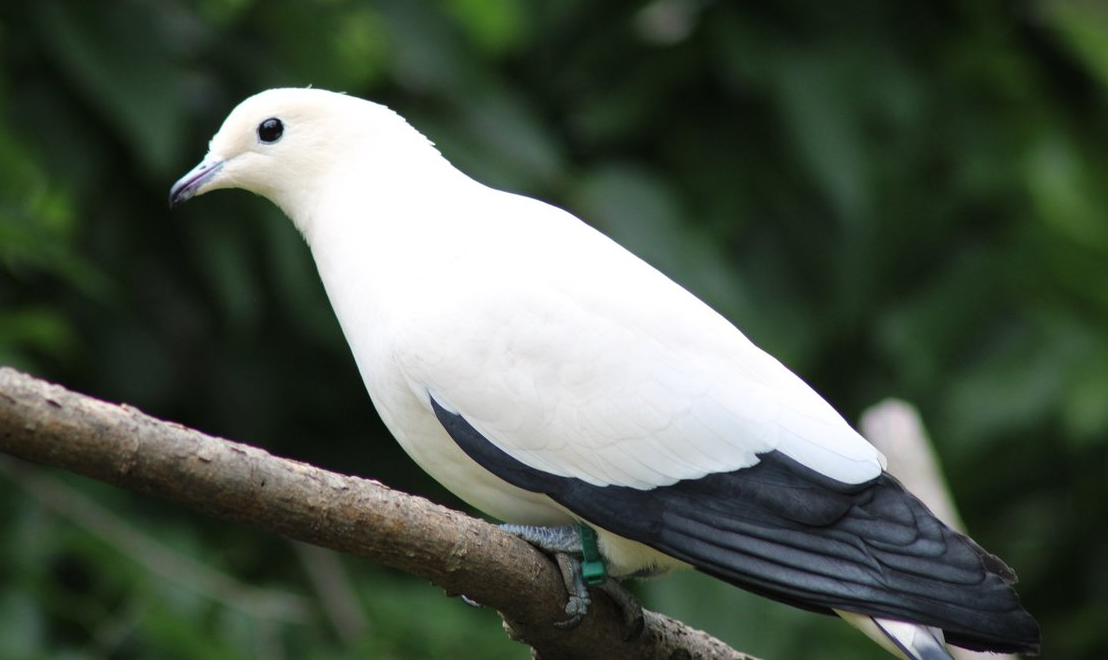
Its taxonomy is confusing and remains unsettled. It has sometimes included the Torresian, yellowish and silver-tipped imperial pigeons as subspecies. The widespread nominate subspecies of the pied imperial pigeon differs from all these by its plain white thighs and undertail coverts (though often with a dark spot at the very tip), and its narrowly dark-tipped bluish bill. For comparison, the other species' have black-spotted undertail coverts and thighs (spotting mainly near thighs in silver-tipped imperial pigeon), the bill of the Torresian imperial pigeon is greenish-yellow, and the bills of the yellowish and silver-tipped imperial pigeons are bluish at the base and yellowish at the tip. Furthermore, the yellowish imperial pigeon has a distinctive yellowish tinge to its plumage (some pied imperial pigeons may also appear yellowish, but infrequently to the same extent), and the silver-tipped imperial pigeon has silvery-grey remiges. However, the subspecies D. b. melanura of the Moluccas, which usually is considered a subspecies of the pied imperial pigeon, resembles the Torresian imperial pigeon in bill, thighs and undertail coverts, but has a significantly broader black tail-tip. Consequently, some have suggested it should be placed under the Torresian imperial pigeon, while others have suggested it should be considered an entirely separate species, D. melanura (for which the name black imperial pigeon has been used – an unfortunate choice, as only the tail has significantly more black than the other members of this group, and the name black imperial pigeon usually has been used for D. melanochroa). Yet others have considered melanura to be invalid, instead believing it only is a morph of D. b. bicolor, as both types can be found on some islands.
References
- Grimmett, Birds of India, Inskipp and Inskipp,
References
- BirdLife International. (2020). "''Ducula bicolor''".
- Kennedy, Robert. (2000-09-21). "A Guide to the Birds of the Philippines". OUP Oxford.
- Baptista, L. F., P. W. Trail, & H. M. Horblit (1997). Family Columbidae (Pigeons and Dovexs). pp. 60-243 in: del Hoya, J., A. Elliott, & J. Sargatal. eds. (1997). ''Handbook of the Birds of the World.'' Vol. 4. Sangrouse to Cuckoos. Lynx Edicions, Barcelona. {{ISBN. 84-87334-22-9
- Coates, B. J., & K. D. Bishop (1997). ''A Guide to the Birds of Wallacea.'' Dove Publications Pty. Ltd. {{ISBN. 0-9590257-3-1
- Gill, F., M. Wright, & D. Donsker (2009). ''[http://www.worldbirdnames.org/ IOC World Bird Names].'' Version 2.1. Accessed 03-07-2009
This article was imported from Wikipedia and is available under the Creative Commons Attribution-ShareAlike 4.0 License. Content has been adapted to SurfDoc format. Original contributors can be found on the article history page.
Ask Mako anything about Pied imperial pigeon — get instant answers, deeper analysis, and related topics.
Research with MakoFree with your Surf account
Create a free account to save articles, ask Mako questions, and organize your research.
Sign up freeThis content may have been generated or modified by AI. CloudSurf Software LLC is not responsible for the accuracy, completeness, or reliability of AI-generated content. Always verify important information from primary sources.
Report