From Surf Wiki (app.surf) — the open knowledge base
Picuris Pueblo, New Mexico
| Field | Value |
|---|---|
| official_name | Picuris Pueblo, New Mexico |
| settlement_type | CDP |
| image_skyline | San Lorenzo de Picurís, Picuris Pueblo.jpg |
| imagesize | 250px |
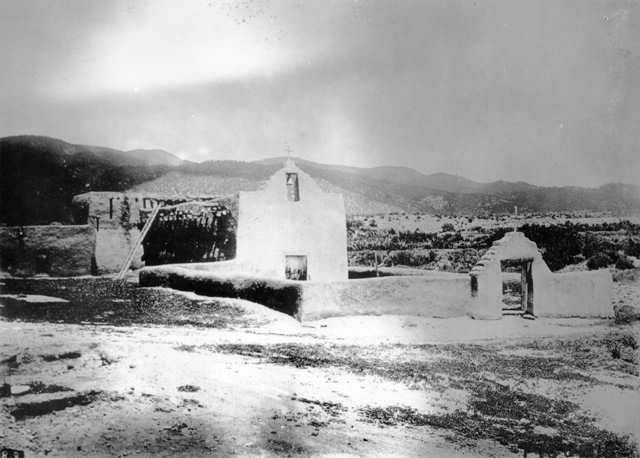
| image_caption | San Lorenzo de Picurís |
| image_map | Taos_County_New_Mexico_Incorporated_and_Unincorporated_areas_Picuris_Pueblo_Highlighted.svg |
| mapsize | 250px |
| map_caption | Location of Picuris Pueblo, New Mexico |
| pushpin_map | USA |
| pushpin_map_caption | Location in the United States |
| subdivision_type | Country |
| subdivision_name | United States |
| subdivision_type1 | State |
| subdivision_name1 | New Mexico |
| subdivision_type2 | County |
| subdivision_name2 | Taos |
| unit_pref | Imperial |
| area_footnotes | |
| area_total_km2 | 1.19 |
| area_land_km2 | 1.18 |
| area_water_km2 | 0.01 |
| area_total_sq_mi | 0.46 |
| area_land_sq_mi | 0.46 |
| area_water_sq_mi | 0.00 |
| population_as_of | 2020 |
| population_footnotes | |
| population_total | 83 |
| population_density_km2 | 70.17 |
| population_density_sq_mi | 181.62 |
| timezone | Mountain (MST) |
| utc_offset | -7 |
| timezone_DST | MDT |
| utc_offset_DST | -6 |
| elevation_footnotes | |
| elevation_ft | 7277 |
| coordinates | |
| area_code | 505 |
| blank_name | FIPS code |
| blank_info | 35-56810 |
| blank1_name | GNIS feature ID |
| blank1_info | 2409063 |
Picuris Pueblo (; Tiwa: P'įwweltha [p’ī̃wːēltʰà]) is a historic pueblo in Taos County, New Mexico, United States. The federally recognized tribe of Pueblo people inhabit the community. Picurís Pueblo is a member of the Eight Northern Pueblos. Their own name for their pueblo is P'įwweltha, meaning "mountain warrior place" or "mountain pass place." They speak the Picuris dialect of the Northern Tiwa language, part of the Kiowa-Tanoan language family. For statistical purposes, the United States Census Bureau has defined that community as a census-designated place (CDP). The 2010 census estimated that 68 people lived in the CDP, while 267 people in the U.S. reported being of the tribal group Picuris alone and 439 reported being of the tribal group Picuris alone or in combination with other groups.
Government
The administration of the Pueblo of Picuris in 2025 is:
- Governor: Wayne Yazza
- Lieutenant Governor: Craig Quanchello
Geography
Picuris Pueblo is located in northern New Mexico, on the western slopes of the Sangre de Cristo Mountains and 18 miles south of Taos Pueblo. Average elevation in the pueblo is over 7,000 feet. The Rio Santa Barbara and Rio Pueblo unite near Picurus to form Embudo Creek, a tributary of the Rio Grande.
Demographics
As of the census of 2000, there were 86 people, 38 households, and 18 families residing in the CDP. The population density was 192.7 PD/sqmi. There were 60 housing units at an average density of 134.4 /sqmi. The racial makeup of the CDP was 10.47% White, 70.93% Native American, 16.28% from other races, and 2.33% from two or more races. Hispanic or Latino of any race were 26.74% of the population.
There were 38 households, out of which 10.5% had children under the age of 18 living with them, 21.1% were married couples living together, 13.2% had a female householder with no husband present, and 52.6% were non-families. 42.1% of all households were made up of individuals, and 13.2% had someone living alone who was 65 years of age or older. The average household size was 2.26 and the average family size was 3.33.
In the CDP, the population was spread out, with 16.3% under the age of 18, 10.5% from 18 to 24, 30.2% from 25 to 44, 24.4% from 45 to 64, and 18.6% who were 65 years of age or older. The median age was 43 years. For every 100 females, there were 95.5 males. For every 100 females age 18 and over, there were 105.7 males.
The median income for a household in the CDP was $11,528, and the median income for a family was $16,875. Males had a median income of $21,000 versus $23,333 for females. The per capita income for the CDP was $12,492. There were 36.0% of families and 28.7% of the population living below the poverty line, including no under eighteens and 45.0% of those over 64.
In 1990, 147 of the 1,882 enrolled tribal members lived in the pueblo; however, the number reduced to 86 in 2000.U.S. Census Bureau. "Picuris Pueblo CDP New Mexico" . 2000. American FactFinder. Retrieved October 27, 2017. At the 2010 Census, the population was recorded as 68. By 2014, it was one of the smallest Tiwa pueblos.
History
The Picuris People once lived in Chaco Canyon, now a UNESCO World Heritage Site. The Picuris people later lived in a village of about 3,000 people now known as Pot Creek, near Taos. They migrated to the present location along the Rio Pueblo about 1250 CE. In the 15th century it was one of the largest Tiwa pueblos, influenced by Apache and other Plains Indian cultures, as was the Taos Pueblo.
In the late 17th century people from the pueblos of New Mexico revolted against the Spanish colonialists, particularly during a revolt between 1680 and 1696 when they fought for autonomy and their land. Following this period the people of the pueblo were dispersed and had abandoned their pueblo until 1706. At that time they joined with the Spanish to fight against attacks by Comanche and Apache tribes. Then, the Picuris pueblo people settled into a peaceful period.
Spanish explorer Don Juan de Oñate named the pueblo "Pikuria" - which means "those who paint." The pueblo was influenced by the Spanish, particularly adoption of Christian religious practices and letting go of traditional rituals and ceremonies. The San Lorenzo de Picurís church was built of adobe by 1776 and was restored in the 21st century. Having been influenced by the Spanish and then the Americans for centuries, the Picuris adopted telephone and electrical services, paved roads and television. They resumed their traditional customs, which are performed throughout the year, and became self-governing again in the mid-1920s. , the pueblo maintained a growing herd of buffalo. Pueblo is a member of the Intertribal Buffalo Council.
Government
The Pueblo's headquarters is in Peñasco, New Mexico. Their tribal officers, led by a tribal governor, are elected every two years. In 1991, the tribe opened the four-star Hotel Santa Fe and the Amaya Restaurant, serving Native American cuisine, in Santa Fe, New Mexico.
Education
The community is in the Peñasco Independent School District.
Tourism
Located within the Pueblo are the San Lorenzo de Picurís church and the Picuris Pueblo Museum, which displays and sells the works of local weavers, potters and beadworkers. Picuris is particularly known for its micaceous pottery. There are also picnic and campground facilities.
Events
Their major feast day is San Lorenzo's Day on August 10, There are Corn Dances and Buffalo Dances in June and August, which may be private ceremonies. There are also dances held New Year's Day and in late January and early February that are open to the public.
An Arts & Crafts fair of weaving, sculpture, beadwork, and jewelry is held the first weekend in July.
Notable people
- Anthony Durand (1956–2009), micaceous potter
- Cora Durand (1902 - 1998), micaceous potter
- Maria Ramita Martinez (1884–1969) micaceous potter
- Joseph Rael (b. 1935), New Age writer
- Rosalie Simbola Aguilar (c. 1898–1947), potter
Gallery
File:Gerald nailor jr.jpg|Gerald Nailor, Jr., Governor of Picuris File:David gaussoin picuris.jpg|David Gaussoin, Picuris jeweler File:Hippies vs Picuris 218.jpg|Picuris ballplayer File:Wayne_gaussoin_performance.jpg|Performance art by Wayne Gaussoin (Picuris Pueblo), Museum of Contemporary Native Art, Santa Fe, NM, 2009
References
References
- "ArcGIS REST Services Directory". United States Census Bureau.
- {{GNIS. 2409063
- {{NRISref
- U.S. Census Bureau. (2010). "NM - Picuris Pueblo CDP".
- Census 2010 American Indian and Alaska Native Summary File (AIANSF) - Sample Data, Pueblo of Picuris alone (H47)
- Census 2010 American Indian and Alaska Native Summary File (AIANSF) - Sample Data, Pueblo of Picuris alone or in any combination (H47) & (100-299) or (300, A01-Z99) or (400-999)
- "Our Leadership".
- Pritzker, Barry M. ''A Native American Encyclopedia: History, Culture, and Peoples.'' Oxford: Oxford University Press, 2000. p. 58. {{ISBN. 978-0-19-513877-1.
- (2010). "Embudo de Picuris Watershed".
- "Census of Population and Housing". Census.gov.
- "Census Population API". United States Census Bureau.
- "U.S. Census website". [[United States Census Bureau]].
- U.S. Census Bureau. (2010). "NM - Picuris Pueblo CDP".
- (April 30, 2025). "Picuris Pueblo oral history and genomics reveal continuity in US Southwest". Nature.
- Dunham, Will. (May 1, 2024). "DNA links modern Picuris Pueblo tribe to ancient New Mexico site".
- [http://www.indianpueblo.org/19pueblos/picuris.html Picuris Pueblo.] {{Webarchive. link. (2007-12-24 Indian Pueblo - 19 Pueblos. Retrieved July 23, 2014.)
- [http://www.newmexico.org/picuris-pueblo/ Picuris Pueblo.] {{webarchive. link. (2014-12-04 New Mexico.org Retrieved July 23, 2014.)
- [http://www.laplaza.org/penasco/picuris/picuris.html Picuris Pueblo.] {{Webarchive. link. (2008-10-10 LaPlaza.org Retrieved July 23, 2014.)
- [http://www.laplaza.org/penasco/picuris/sanlorenzo.html San Lorenzo de Picuris.] {{Webarchive. link. (2013-01-26 LaPlaza.org Penasco. Retrieved July 23, 2014.)
- Plant, Geoffrey. (2022-05-17). "Bringing the bison back to Picuris Pueblo".
- Pritzker, Barry M. ''A Native American Encyclopedia: History, Culture, and Peoples.'' Oxford: Oxford University Press, 2000. p. 61. {{ISBN. 978-0-19-513877-1.
- [http://www.hotelsantafe.com/amaya "Amaya Restaurant."] {{Webarchive. link. (2014-04-06 ''Hotel Santa Fe.'' Retrieved June 28, 2014.)
- "2020 CENSUS - SCHOOL DISTRICT REFERENCE MAP: Taos County, NM". [[U.S. Census Bureau]].
- link. (2016-03-03 . Taos.gopickle.com Retrieved July 23, 2014.)
This article was imported from Wikipedia and is available under the Creative Commons Attribution-ShareAlike 4.0 License. Content has been adapted to SurfDoc format. Original contributors can be found on the article history page.
Ask Mako anything about Picuris Pueblo, New Mexico — get instant answers, deeper analysis, and related topics.
Research with MakoFree with your Surf account
Create a free account to save articles, ask Mako questions, and organize your research.
Sign up freeThis content may have been generated or modified by AI. CloudSurf Software LLC is not responsible for the accuracy, completeness, or reliability of AI-generated content. Always verify important information from primary sources.
Report