From Surf Wiki (app.surf) — the open knowledge base
Pichavaram
Village in Cuddalore District, Tamil Nadu, India

Village in Cuddalore District, Tamil Nadu, India
| Field | Value |
|---|---|
| name | Pichavaram |
| native_name_lang | ta |
| image_skyline | Pichavaram-Pno.png |
| image_caption | Pichavaram Mangrove Forest |
| pushpin_map | India Tamil Nadu |
| map_caption | Pichavaram |
| pushpin_label_position | left |
| coordinates | |
| subdivision_type | Country |
| subdivision_name | |
| subdivision_type1 | State |
| subdivision_name1 | ..Tamil_Nadu_Flag(INDIA).png Tamil Nadu |
| subdivision_type2 | District |
| subdivision_name2 | Cuddalore |
| subdivision_type3 | Taluk |
| subdivision_name3 | Bhuvanagiri |
| subdivision_type4 | Town Panchayath |
| subdivision_name4 | Parangipettai |
| area_total_km2 | 14.79 |
| elevation_m | 6 |
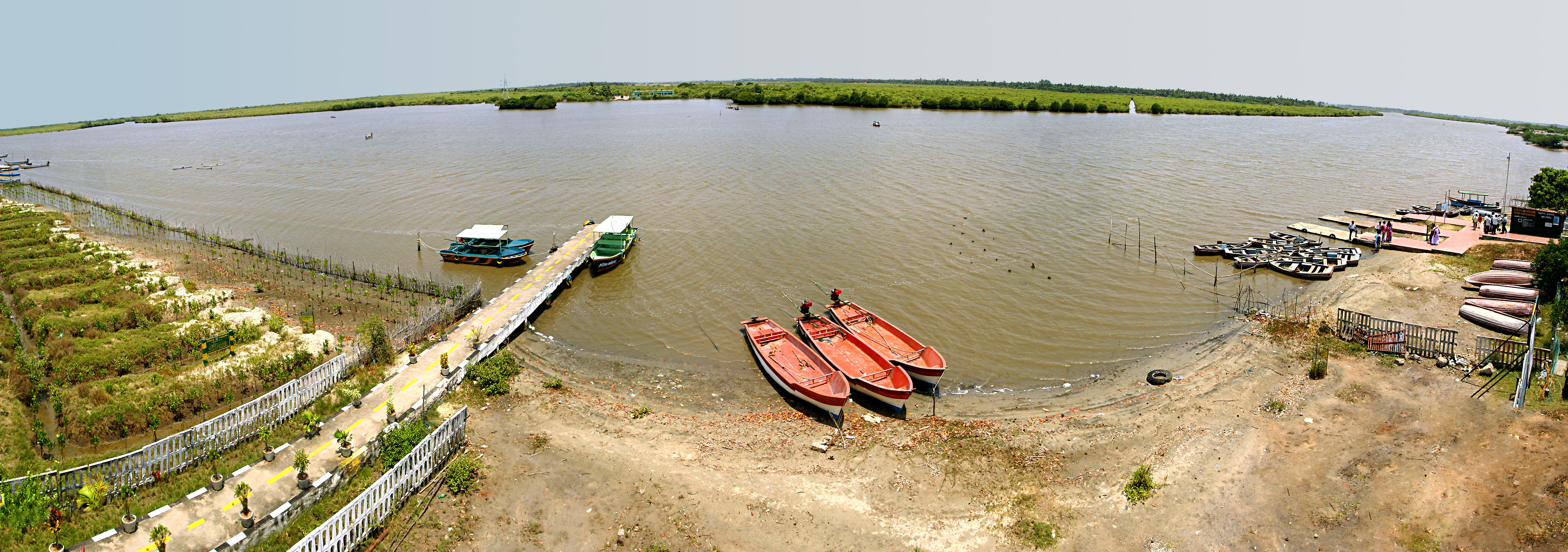
Pichavaram is one of the villages of Parangipettai near Chidambaram in Cuddalore District, Tamil Nadu, India. It is located between the Vellar estuary in the north and Coleroon estuary in the south. The Vellar-Coleroon estuarine complex forms the Killai backwater and the mangroves that are permanently rooted in a few feet of water. It is located at a distance of 243 km from Chennai and 15 km from Chidambaram.
Mangrove forests
Pichavaram consists of a number of islands interspersing a vast expanse of water covered with mangrove forest. The Pichavaram mangrove Forest is one of the largest mangrove forests in India covering about 45 km2 of area (as of 2019). It is separated from the Bay of Bengal by a sand bar. The biotope consists of species like Avicennia and Rhizophora. It also supports the existence of rare varieties of economically important shells and fishes.
Under an initiative of the Government of Tamil Nadu aimed at reducing the impact of cyclones, tidal surges, and coastal erosion, as well as supporting biodiversity and local livelihoods, mangroves have been planted in the Cuddlore district along with nine other districts. According to official statistics, more than 2,900 ha (29 km2) of mangrove forests have been planted or restored from 2021 to 2025 under this programme.
Fauna
The mangroves also attract migrant and local birds including snipes, cormorants, egrets, storks, herons, spoonbills and pelicans. About 177 species of birds belonging to 15 orders and 41 families have been recorded. The high population of birds could be seen from November to January due to the high availability of prey, the coincidence of the time of arrival of true migrants from foreign countries and local migrants from their breeding grounds across India. The availability of different habitat types such as channels, creeks, gullies, mudflats and sand flats and adjacent seashore offers ideal habitats for different species of birds and animals.
Gallery
File:Mangroves of Pichavaram.jpg|Mangroves of Pichavaram File:Mangroves canopy.jpg|Mangroves canopy File:Arial roots of Mangroves.jpg|Aerial roots of Mangroves
References
References
- "UNESCO list".
- "Mangrove forests".
- "Pichavaram Mangrove".
- "Mangroves of INDIA".
- "Top 5 Largest Mangrove and Swamp Forest in India".
- "Wayback Machine".
- "Tamil Nadu adds over 2,400 hectares of mangrove cover in four years".
- "World Mangrove Day: Tamil Nadu’s renewed efforts add nearly 3,000 hectares of mangroves in three years". The Hindu.
This article was imported from Wikipedia and is available under the Creative Commons Attribution-ShareAlike 4.0 License. Content has been adapted to SurfDoc format. Original contributors can be found on the article history page.
Ask Mako anything about Pichavaram — get instant answers, deeper analysis, and related topics.
Research with MakoFree with your Surf account
Create a free account to save articles, ask Mako questions, and organize your research.
Sign up freeThis content may have been generated or modified by AI. CloudSurf Software LLC is not responsible for the accuracy, completeness, or reliability of AI-generated content. Always verify important information from primary sources.
Report