From Surf Wiki (app.surf) — the open knowledge base
Piceol
Phenolic compound found in Norway spruces
Phenolic compound found in Norway spruces
4-Hydroxyacetophenone 4'-Hydroxyacetophenone p-Hydroxyacetophenone
Piceol is a phenolic compound found in the needles and in mycorrhizal roots of Norway spruces (Picea abies). Picein is the glucoside of piceol.
Chemical production
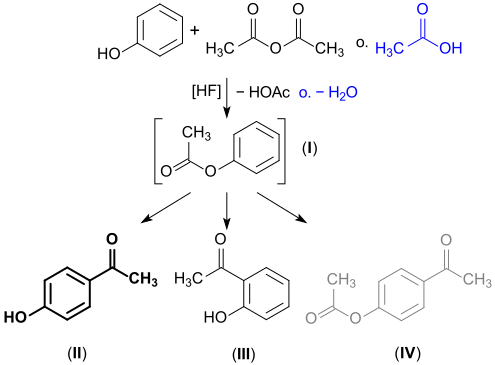
In the industrial chemical synthesis of 4-hydroxyacetophenone, phenol reacts with acetic acid or preferably with acetic anhydride in the presence of anhydrous hydrogen fluoride (HF) or hydrofluoric acid as solvent and acylation catalyst—instead of aluminum chloride (AlCl3), which must be used in stoichiometric amounts and generates problematic waste—to initially form acetic acid phenyl ester (I). This intermediate is converted to 4-hydroxyacetophenone (II) via a Fries rearrangement. As by-products (
Working with HF and hydrofluoric acid as solvents, as well as their recovery, requires complex processes and costly equipment made of special materials such as Hastelloy C-276 and surface coatings of fluoropolymers (e.g. Teflon), due to their high toxicity and corrosiveness.
Since the product 4-HAP strongly retains HF, it must be removed by distillation using, for example, n-hexane. Impurities are separated through multiple recrystallization steps from ethanol–water mixtures or similar solvents.
Properties
Pure 4-hydroxyacetophenone is a white crystalline powder that dissolves readily in lower alcohols and diethyl ether. Its odour ranges from odourless to floral. The substance is readily biodegradable and approved for use in food under FEMA/GRAS #4330 (GRAS = generally recognized as safe).
Applications
4-Hydroxyacetophenone exhibits antioxidant, fungicidal, and bacteriostatic properties and is therefore used to stabilize cosmetic formulations.
Uses
Piceol is used in the synthesis of several pharmaceutical drugs including octopamine, sotalol, bamethan, and dyclonine.
Piceol can be used to make acetaminophen by condensation with hydroxylamine and subsequent Beckmann rearrangement in acid.
4-Vinylphenol (4-hydroxystyrene) can be synthesized through a multi-step reaction sequence from 4-hydroxyacetophenone (II). First, 4-HAP is acetylated with acetic anhydride to form 4-acetoxyacetophenone (IV). Catalytic hydrogenation of (IV) yields 4-acetoxyphenylmethylcarbinol (V), which is then dehydrated upon heating to produce 4-acetoxystyrene (4-vinylphenyl acetate) (VI). Finally, the acetyl group can be hydrolyzed under basic or acidic catalysis to yield the target compound 4-hydroxystyrene (VII).

Chain polymerization of 4-vinylphenol produces poly(4-hydroxystyrene), which serves as a resin binder in photoresists. During the polymerization of 4-hydroxystyrene, chain termination reactions can occur through hydrogen abstraction from the phenolic hydroxyl group, resulting in lower molar masses and broader molar mass distributions. Therefore, the protected precursor 4-acetoxystyrene (VI) is often polymerized, after which the acetyl protecting group is removed via a polymer-analogous reaction.
A seven-step synthesis of the beta-2-sympathomimetic salbutamol (albuterol) also starts from 4-hydroxyacetophenone and yields the racemate.
The neurotransmitter Octopamine can be obtained by reacting 4-HAP with amyl nitrite or preferably tert-butyl nitrite in the presence of hydrogen chloride to form 4-hydroxyisonitrosoacetophenone, followed by catalytic hydrogenation. Under more intensive hydrogenation conditions, tyramine—the decarboxylation product of the amino acid tyrosine—is formed.

A standard route to the peripheral vasodilator Bamethane also starts from 4-hydroxyacetophenone. In this process, the compound is first protected by a benzoyl group, brominated at the methyl group, reacted with n-butylamine to form a secondary amine, and finally hydrogenated over a palladium catalyst to yield the racemic end product.

The naturally occurring homologous series compound Synephrine (oxedrine) can be synthesized analogously from 4-HAP, but its use is now considered obsolete due to questionable efficacy and safety concerns.
Alkylation of 4-HAP, e.g. with 1-bromobutane, produces 4-butoxyacetophenone, from which the local anaesthetic dyclonine can be obtained.
The analgesic Paracetamol can also be produced industrially from 4-hydroxyacetophenone by reaction with bis(hydroxylammonium) sulfate (NH3OH)2SO4 to form the corresponding oxime, followed by a Beckmann rearrangement to yield 4-acetamidophenol (acetaminophen).

However, this process proved economically uncompetitive due to high investment and environmental costs (e.g. disposal of sulfate generated from hydroxylammonium sulfate). A production plant commissioned in 1990 by Hoechst Celanese Corp. in Bishop, TX, with a capacity of 9,000 tons per year, was shut down in 2001.
Anticonvulsants are also possible by Mannich reaction:
Metabolism
Diprenylated derivatives of piceol can be isolated from Ophryosporus macrodon.
4-Hydroxyacetophenone monooxygenase is an enzyme that transforms piceol into O-acetylhydroquinone. This enzyme is found in Pseudomonas fluorescens.
References
References
- (1990). "Picein and piceol concentrations in Norway spruce". Ecotoxicology and Environmental Safety.
- (1990). "Phenolics of mycorrhizas and non-mycorrhizal roots of Norway spruce". Planta.
- (1990). "Picein and piceol concentrations in Norway spruce". Ecotoxicology and Environmental Safety.
- "Process for producing 4-hydroxyacetophenone".
- (2017-11-02). "Recommendation on Materials of Construction for Anhydrous Hydrogen Fluoride (AHF) and Hydrofluoric Acid Solutions (HF)". Eurofluor.
- "Process for purifying 4-hydroxyacetophenone".
- "Method for purification of 4-hydroxyacetophenone".
- George A. Burdock. (2010). "Fenaroli’s Handbook of Flavor Ingredients, 6th Edition". CRC Press.
- (August 2007). "GRAS Flavoring Substances 23". FEMA Expert Panel.
- "Öl in Wasser-Emulsionen mit einem Gehalt an 4-Hydroxyacetophenon und anionischen Emulgatoren".
- {{US patent. 4524217
- "Process for the preparation of 4-acetoxyphenylmethyl carbinol".
- B.B. Corson, W.J. Heintzelman, L.H. Schwartzman, H.E. Tiefenthal, R.J. Lokken, J.E. Nickels, G.R. Atwood, F.J. Pavlik. (1958). "Preparation of vinylphenols and isopropenylphenols".
- Ruben Vardanyan, Victor Hruby. (2016). "Synthesis of Best-Seller Drugs". Elsevier Inc..
- "Process for the preparation of 1-(m- and p-hydroxyphenyl)-2-aminoethanol".
- "Process for the preparation of arylalkylamines and substituted arylalkylamines".
- F. von Bruchhausen, S. Ebel, A.W. Frahm, E. Hackenthal. (1993). "Hagers Handbuch der Pharmazeutischen Praxis, Band 7, 5. Aufl.". Springer-Verlag.
- (2021-09-21). "Einstufung von Synephrin-haltigen Produkten, Stellungnahme der Gemeinsamen Expertenkommission". Bundesamt für Verbraucherschutz und Lebensmittelsicherheit.
- "Process for producing N-acyl-hydroxy aromatic amines".
- (2017). "Novel Mannich-bases as Potential Anticonvulsants: Syntheses, Characterization and Biological Evaluation". Central Nervous System Agents in Medicinal Chemistry.
- (1993). "Diprenylated derivatives of p-hydroxyacetophenone from Ophryosporus macrodon". Phytochemistry.
This article was imported from Wikipedia and is available under the Creative Commons Attribution-ShareAlike 4.0 License. Content has been adapted to SurfDoc format. Original contributors can be found on the article history page.
Ask Mako anything about Piceol — get instant answers, deeper analysis, and related topics.
Research with MakoFree with your Surf account
Create a free account to save articles, ask Mako questions, and organize your research.
Sign up freeThis content may have been generated or modified by AI. CloudSurf Software LLC is not responsible for the accuracy, completeness, or reliability of AI-generated content. Always verify important information from primary sources.
Report