From Surf Wiki (app.surf) — the open knowledge base
Photovoltaic power station
Large-scale photovoltaic system

Large-scale photovoltaic system
A photovoltaic power station, also known as a solar park, solar farm, or solar power plant, is a large-scale grid-connected photovoltaic power system (PV system) designed for the supply of merchant power. They are different from most building-mounted and other decentralized solar power because they supply power at the utility level, rather than to a local user or users. Utility-scale solar is sometimes used to describe this type of project.
This approach differs from concentrated solar power, the other major large-scale solar generation technology, which uses heat to drive a variety of conventional generator systems. Both approaches have their own advantages and disadvantages, but to date, for a variety of reasons, photovoltaic technology has seen much wider use. , about 97% of utility-scale solar power capacity was PV.
In some countries, the nameplate capacity of photovoltaic power stations is rated in megawatt-peak (MWp), which refers to the solar array's theoretical maximum DC power output. In other countries, the manufacturer states the surface and the efficiency. However, Canada, Japan, Spain, and the United States often specify using the converted lower nominal power output in MWAC, a measure more directly comparable to other forms of power generation. Most solar parks are developed at a scale of at least 1 MWp. As of 2018, the world's largest operating photovoltaic power stations surpassed 1 gigawatt. At the end of 2019, about 9,000 solar farms were larger than 4 MWAC (utility scale), with a combined capacity of over 220 GWAC.
Most of the existing large-scale photovoltaic power stations are owned and operated by independent power producers, but the involvement of community and utility-owned projects is increasing. Previously, almost all were supported at least in part by regulatory incentives such as feed-in tariffs or tax credits, but as levelized costs fell significantly in the 2010s and grid parity has been reached in most markets, external incentives are usually not needed.
History
Main article: List of photovoltaic power stations

The first 1 MWp solar park was built by Arco Solar at Lugo near Hesperia, California, at the end of 1982, followed in 1984 by a 5.2 MWp installation in Carrizo Plain. Both have since been decommissioned (although a new plant, Topaz Solar Farm, was commissioned in Carrizo Plain in 2015). The next stage followed the 2004 revisions to the feed-in tariffs in Germany, when a substantial volume of solar parks were constructed.
Several hundred installations over 1 MWp have since been installed in Germany, of which more than 50 are over 10 MWp. With its introduction of feed-in tariffs in 2008, Spain briefly became the largest market with some 60 solar parks over 10 MW, but these incentives have since been withdrawn. The USA, China, India, France, Canada, Australia, and Italy, among others, have also become major markets as shown on the list of photovoltaic power stations.
The largest sites under construction have capacities of hundreds of MWp and some more than 1 GWp.
Siting and land use

The land area required for a desired power output varies depending on the location, the slope of the site, and the type of mounting used. Fixed tilt solar arrays using typical panels of about 15% efficiency on horizontal sites, need about 1 ha/MW in the tropics and this figure rises to over 2 ha in northern Europe.
Because of the longer shadow the array casts when tilted at a steeper angle, this area is typically about 10% higher for an adjustable tilt array or a single axis tracker, and 20% higher for a 2-axis tracker, though these figures will vary depending on the latitude and topography.
The best locations for solar parks in terms of land use are held to be brown field sites, or where there is no other valuable land use. Even in cultivated areas, a significant proportion of the site of a solar farm can also be devoted to other productive uses, such as crop growing or biodiversity. The change in albedo affects local temperature. One study claims a temperature rise due to the heat island effect, and another study claims that surroundings in arid ecosystems become cooler.
Agrivoltaics
Agrivoltaics is using the same area of land for both solar photovoltaic power and agriculture. A recent study found that the value of solar generated electricity coupled to shade-tolerant crop production created an over 30% increase in economic value from farms deploying agrivoltaic systems instead of conventional agriculture. A 2023 study published in Sustainability highlighted Canada's significant potential for agrivoltaics, a dual-use land strategy that integrates solar energy production with agriculture. According to the study, installing agrivoltaic systems on just 1% of Canada's agricultural land could generate between 25% and 33% of the country's electricity needs, depending on the photovoltaic technology used (vertical bifacial vs. single-axis tracking). The authors emphasize that agrivoltaics presents a promising approach to help Canada meet its climate targets while preserving farmland and supporting rural economies. Policy incentives, technical research, and pilot projects are recommended to scale implementation across provinces.
Solar landfill
.jpg)
A Solar landfill is a repurposed used landfill that is converted to a solar array solar farm.
Co-location
In some cases, several different solar power stations with separate owners and contractors are developed on adjacent sites. This can offer the advantage of the projects sharing the cost and risks of project infrastructure such as grid connections and planning approval. Solar farms can also be co-located with wind farms.
Sometimes 'solar park' is used to describe a set of individual solar power stations, which share sites or infrastructure, and 'cluster' is used where several plants are located nearby without any shared resources. Some examples of solar parks are the Charanka Solar Park, where there are 17 different generation projects; Neuhardenberg, with eleven plants, and the Golmud solar park with total reported capacity over 500MW. An extreme example would be calling all of the solar farms in the Gujarat state of India a single solar park, the Gujarat Solar Park.
To avoid land use altogether, in 2022, a 5 MW floating solar park was installed in the Alqueva Dam reservoir, Portugal, enabling solar power and hydroelectric energy to be combined.
Solar farms in space
The first successful test in January 2024 of a solar farm in space—collecting solar power from a photovoltaic cell and beaming energy down to Earth—constituted an early feasibility demonstration completed.
Technology
Most solar parks are ground mounted PV systems, also known as free-field solar power plants. |access-date=5 March 2013 They can either be fixed tilt or use a single axis or dual axis solar tracker. |access-date=19 October 2014 While tracking improves the overall performance, it also increases the system's installation and maintenance cost. |archive-url = https://web.archive.org/web/20101122154007/http://www.wattsun.com/pdf/AC%20EnergyComparison-Madison-WI.pdf |archive-date = 22 November 2010 |access-date = 30 August 2012 |archive-url = https://web.archive.org/web/20220117055608/http://singapore.conergy.com/PortalData/1/Resources/master/pdf/Conergy_IPG_C_Transf_TD_ENG_2011-06-01_web.pdf |archive-date = 17 January 2022 |access-date = 5 March 2013
Solar array arrangements
The solar arrays are the subsystems which convert incoming light into electrical energy. They comprise a multitude of solar panels, mounted on support structures and interconnected to deliver a power output to electronic power conditioning subsystems. The majority are free-field systems using ground-mounted structures, usually of one of the following types:
Fixed arrays
Many projects use mounting structures where the solar panels are mounted at a fixed inclination calculated to provide the optimum annual output profile. In some cases, depending on local climatic, topographical or electricity pricing regimes, different tilt angles can be used, or the arrays might be offset from the normal east–west axis to favour morning or evening output.
A variant on this design is the use of arrays, whose tilt angle can be adjusted twice or four times annually to optimise seasonal output. They also require more land area to reduce internal shading at the steeper winter tilt angle. Because the increased output is typically only a few percent, it seldom justifies the increased cost and complexity of this design.
Dual axis trackers
Main article: Solar tracker
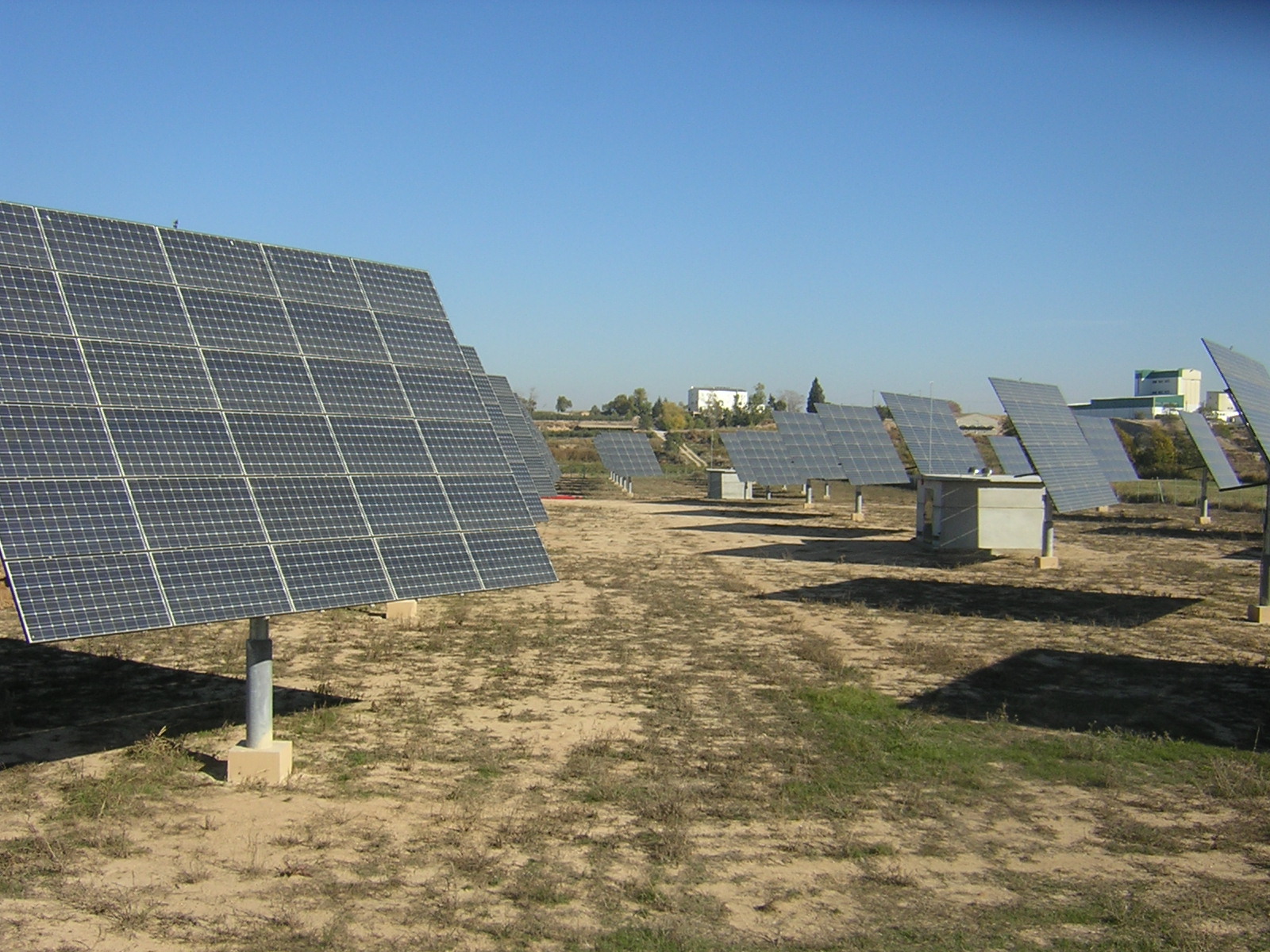
To maximise the intensity of incoming direct radiation, solar panels should be orientated normal to the sun's rays. To achieve this, arrays can be designed using two-axis trackers, capable of tracking the sun in its daily movement across the sky, and as its elevation changes throughout the year.
These arrays need to be spaced out to reduce inter-shading as the sun moves and the array orientations change, so need more land area. They also require more complex mechanisms to maintain the array surface at the required angle. The increased output can be of the order of 30% in locations with high levels of direct radiation, but the increase is lower in temperate climates or those with more significant diffuse radiation, due to overcast conditions. So dual axis trackers are most commonly used in subtropical regions, and were first deployed at utility scale at the Lugo plant.
Single axis trackers
A third approach achieves some of the output benefits of tracking, with a lesser penalty in terms of land area, capital and operating cost. This involves tracking the sun in one dimension – in its daily journey across the sky – but not adjusting for the seasons. The angle of the axis is normally horizontal, though some, such as the solar park at Nellis Air Force Base, which has a 20° tilt, incline the axis towards the equator in a north–south orientation – effectively a hybrid between tracking and fixed tilt.
Single axis tracking systems are aligned along axes roughly north–south. Some use linkages between rows so that the same actuator can adjust the angle of several rows at once.
Power conversion
Solar panels produce direct current (DC) electricity, so solar parks need conversion equipment
There are two primary alternatives for configuring this conversion equipment; centralized and string inverters, although in some cases individual, or micro-inverters are used. Single inverters allows optimizing the output of each panel, and multiple inverters increases the reliability by limiting the loss of output when an inverter fails.
Centralized inverters
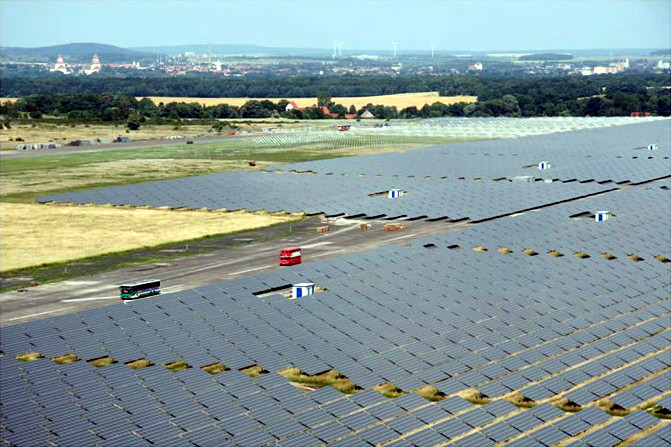
These units have relatively high capacity, typically of the order between 1 MW up to 7 MW for newer units (2020), |access-date=30 December 2012 so they condition the output of a substantial block of solar arrays, up to perhaps 2 ha in area. Solar parks using centralized inverters are often configured in discrete rectangular blocks, with the related inverter in one corner, or the centre of the block.
String inverters
String inverters are substantially lower in capacity than central inverters, of the order of 10 kW up to 250 KW for newer models (2020), and condition the output of a single array string. This is normally a whole, or part of, a row of solar arrays within the overall plant. String inverters can enhance the efficiency of solar parks, where different parts of the array are experiencing different levels of insolation, for example where arranged at different orientations, or closely packed to minimise site area.
Transformers
The system inverters typically provide power output at voltages of the order of 480 VAC up to 800 VAC. Electricity grids operate at much higher voltages of the order of tens or hundreds of thousands of volts, so transformers are incorporated to deliver the required output to the grid. Transformers typically have a life of 25 to 75 years, and normally do not require replacement during the life of a photovoltaic power station.
System performance
Main article: Photovoltaic system performance

The performance of a solar park depends on the climatic conditions, the equipment used and the system configuration. The primary energy input is the global light irradiance in the plane of the solar arrays, and this in turn is a combination of the direct and the diffuse radiation.{{cite journal cite journal |last1=Ilse |first1=Klemens |last2=Micheli |first2=Leonardo |last3=Figgis |first3=Benjamin W. |last4=Lange |first4=Katja |last5=Dassler |first5=David |last6=Hanifi |first6=Hamed |last7=Wolfertstetter |first7=Fabian |last8=Naumann |first8=Volker |last9=Hagendorf |first9=Christian |last10=Gottschalg |first10=Ralph |last11=Bagdahn |first11=Jörg |date=2019 |title=Techno-Economic Assessment of Soiling Losses and Mitigation Strategies for Solar Power Generation |journal=Joule |volume=3 |issue=10 |pages=2303–2321 |doi=10.1016/j.joule.2019.08.019 | name-list-style=vanc|doi-access=free |bibcode=2019Joule...3.2303I |hdl=11573/1625631 |hdl-access=free }}
A key determinant of the output of the system is the conversion efficiency of the solar panels, which depends in particular on the type of solar cell used.
There will be losses between the DC output of the solar panels and the AC power delivered to the grid, due to a wide range of factors such as light absorption losses, mismatch, cable voltage drop, conversion efficiencies, and other parasitic losses. A parameter called the 'performance ratio' has been developed to evaluate the total value of these losses. The performance ratio gives a measure of the output AC power delivered as a proportion of the total DC power which the solar panels should be able to deliver under the ambient climatic conditions. In modern solar parks the performance ratio should typically be in excess of 80%.
System degradation
Early photovoltaic systems output decreased as much as 10%/year, Many panel makers offer a performance guarantee, typically 90% in ten years and 80% over 25 years. The output of all panels is typically warranted at plus or minus 3% during the first year of operation.
The business of developing solar parks
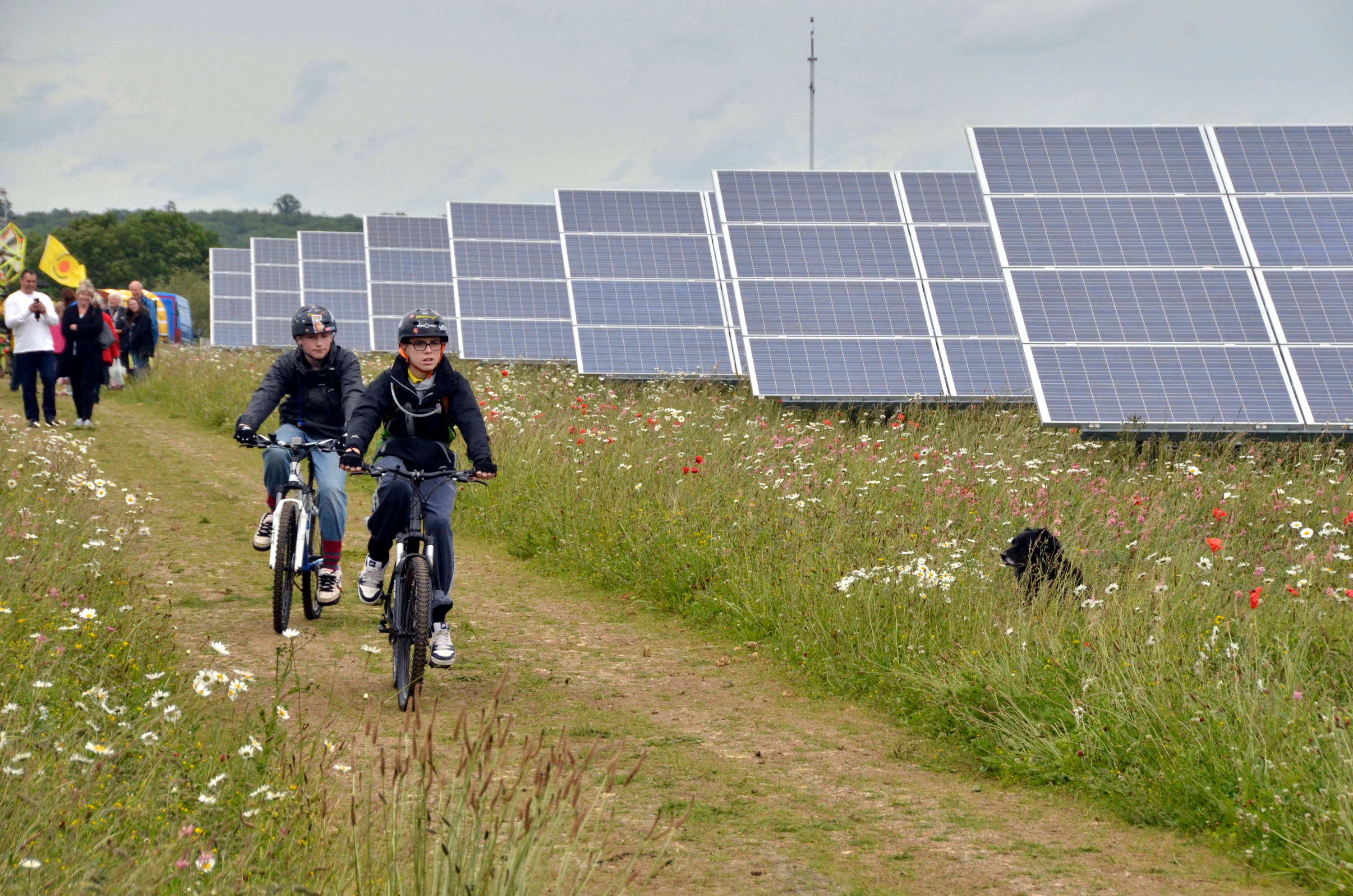
Solar power plants are developed to deliver merchant electricity into the grid as an alternative to other renewable, fossil or nuclear generating stations.
The plant owner is an electricity generator. Most solar power plants today are owned by independent power producers (IPP's), though some are held by investor- or community-owned utilities.
Some of these power producers develop their own portfolio of power plants, but most solar parks are initially designed and constructed by specialist project developers. Typically the developer will plan the project, obtain planning and connection consents, and arrange financing for the capital required. The actual construction work is normally contracted to one or more engineering, procurement, and construction (EPC) contractors.
Major milestones in the development of a new photovoltaic power plant are planning consent, grid connection approval, financial close, construction, connection and commissioning. At each stage in the process, the developer will be able to update estimates of the anticipated performance and costs of the plant and the financial returns it should be able to deliver.
Planning approval

Photovoltaic power stations occupy at least one hectare for each megawatt of rated output, so require a substantial land area; which is subject to planning approval. The chances of obtaining consent, and the related time, cost and conditions, vary by jurisdiction and location. Many planning approvals will also apply conditions on the treatment of the site after the station has been decommissioned in the future. A professional health, safety and environment assessment is usually undertaken during the design of a PV power station in order to ensure the facility is designed and planned in accordance with all HSE regulations.
Grid connection
The availability, locality and capacity of the connection to the grid is a major consideration in planning a new solar park, and can be a significant contributor to the cost.
Most stations are sited within a few kilometres of a suitable grid connection point. This network needs to be capable of absorbing the output of the solar park when operating at its maximum capacity. The project developer will normally have to absorb the cost of providing power lines to this point and making the connection; in addition often to any costs associated with upgrading the grid, so it can accommodate the output from the plant. Therefore, solar power stations are sometimes built at sites of former coal-fired power stations to reuse existing infrastructure.
Operation and maintenance
Once the solar park has been commissioned, the owner usually enters into a contract with a suitable counterparty to undertake operation and maintenance (O&M). In many cases this may be fulfilled by the original EPC contractor.
Solar plants' reliable solid-state systems require minimal maintenance, compared to rotating machinery. A major aspect of the O&M contract will be continuous monitoring of the performance of the plant and all of its primary subsystems, which is normally undertaken remotely. This enables performance to be compared with the anticipated output under the climatic conditions actually experienced. A small number of large solar farms use a separate inverter or maximizer for each solar panel, which provide individual performance data that can be monitored. For other solar farms, thermal imaging is used to identify non-performing panels for replacement.
Power delivery
A solar park's income derives from the sales of electricity to the grid, and so its output is metered in real-time with readings of its energy output provided, typically on a half-hourly basis, for balancing and settlement within the electricity market.
Income is affected by the reliability of equipment within the plant and also by the availability of the grid network to which it is exporting. Some connection contracts allow the transmission system operator to curtail the output of a solar park, for example at times of low demand or high availability of other generators. Some countries make statutory provision for priority access to the grid for renewable generators, such as that under the European Renewable Energy Directive.
Economics and finance
In recent years, PV technology has improved its electricity generating efficiency, reduced the installation cost per watt as well as its energy payback time (EPBT). It has reached grid parity in most parts of the world and become a mainstream power source. |access-date = 2014-11-22 |archive-date = 29 November 2014 |archive-url = https://web.archive.org/web/20141129041750/https://www.deutschebank.nl/nl/docs/Solar_-_2014_Outlook_Let_the_Second_Gold_Rush_Begin.pdf?dbiquery=null%3Avishal+shah |url-status = live |access-date=2014-08-18
As solar power costs reached grid parity, PV systems were able to offer power competitively in the energy market. The subsidies and incentives, which were needed to stimulate the early market as detailed below, were progressively replaced by auctions and competitive tendering leading to further price reductions.
Competitive energy costs of utility-scale solar
The improving competitiveness of utility-scale solar became more visible as countries and energy utilities introduced auctions for new generating capacity. Some auctions are reserved for solar projects, while others are open to a wider range of sources.
The prices revealed by these auctions and tenders have led to highly competitive prices in many regions. Amongst the prices quoted are:
| Date | Country | Agency | Lowest price | Equivalent | ||
|---|---|---|---|---|---|---|
| US¢/kWh | Equivalent | |||||
| €/MWh 2022 | Reference | |||||
| Oct 2017 | Saudi Arabia | Renewable Energy Project Development Office | US$17.9/MWh | 1.79 | 16 | |
| Nov 2017 | Mexico | CENACE | US$17.7/MWh | 1.77 | 16 | |
| Mar 2019 | India | Solar Energy Corporation of India | INR 2.44/kWh | 3.5 | 32 | |
| Jul 2019 | Brazil | Agencia Nacional de Energía Eléctrica | BRL 67.48/MWh | 1.752 | 16 | |
| Jul 2020 | Abu Dhabi, UAE | Abu Dhabi Power Corporation | AED fils 4.97/kWh | 1.35 | 12 | |
| Aug 2020 | Portugal | Directorate-General for Energy and Geology | €0.01114/kWh | 1.327 | 12 | |
| Dec 2020 | India | Gujarat Urja Vikas Nigam | INR 1.99/kWh | 2.69 | 24 |
Grid parity
Main article: Grid parity
Solar generating stations have become progressively cheaper in recent years, and this trend is expected to continue. Meanwhile, traditional electricity generation is becoming progressively more expensive. These trends led to a crossover point when the levelised cost of energy from solar parks, historically more expensive, matched or beat the cost of traditional electricity generation. This point depends on locations and other factors, and is commonly referred to as grid parity.
For merchant solar power stations, where the electricity is being sold into the electricity transmission network, the levelised cost of solar energy will need to match the wholesale electricity price. This point is sometimes called 'wholesale grid parity' or 'busbar parity'.
Prices for installed PV systems show regional variations, more than solar cells and panels, which tend to be global commodities. The IEA explains these discrepancies due to differences in "soft costs", which include customer acquisition, permitting, inspection and interconnection, installation labor and financing costs. |access-date=7 October 2014 |archive-url=https://web.archive.org/web/20141001012612/http://www.iea.org/publications/freepublications/publication/TechnologyRoadmapSolarPhotovoltaicEnergy_2014edition.pdf |archive-date=1 October 2014|date=2014 |url-status= live
Incentive mechanisms
Main article: Financial incentives for photovoltaics
In the years before grid parity had been reached in many parts of the world, solar generating stations needed some form of financial incentive to compete for the supply of electricity. Many countries used such incentives to support the deployment of solar power stations.
Feed-in tariffs
Main article: Feed-in tariff
Feed-in tariffs are designated prices which must be paid by utility companies for each kilowatt hour of renewable electricity produced by qualifying generators and fed into the grid. These tariffs normally represent a premium on wholesale electricity prices and offer a guaranteed revenue stream to help the power producer finance the project.
Renewable portfolio standards and supplier obligations
Main article: Renewable portfolio standard
These standards are obligations on utility companies to source a proportion of their electricity from renewable generators. In most cases, they do not prescribe which technology should be used and the utility is free to select the most appropriate renewable sources.
There are some exceptions where solar technologies are allocated a proportion of the RPS in what is sometimes referred to as a 'solar set aside'.
Loan guarantees and other capital incentives
Main article: Loan guarantee
Some countries and states adopt less targeted financial incentives, available for a wide range of infrastructure investment, such as the US Department of Energy loan guarantee scheme, which stimulated a number of investments in the solar power plant in 2010 and 2011.
Tax credits and other fiscal incentives
Another form of indirect incentive which has been used to stimulate investment in solar power plant was tax credits available to investors. In some cases the credits were linked to the energy produced by the installations, such as the Production Tax Credits. In other cases the credits were related to the capital investment such as the Investment Tax Credits
International, national and regional programmes
In addition to free market commercial incentives, some countries and regions have specific programs to support the deployment of solar energy installations.
The European Union's Renewables Directive sets targets for increasing levels of deployment of renewable energy in all member states. Each has been required to develop a National Renewable Energy Action Plan showing how these targets would be met, and many of these have specific support measures for solar energy deployment. The directive also allows states to develop projects outside their national boundaries, and this may lead to bilateral programs such as the Helios project.
The Clean Development Mechanism of the UNFCCC is an international programme under which solar generating stations in certain qualifying countries can be supported.
Additionally many other countries have specific solar energy development programmes. Some examples are India's JNNSM, the Flagship Program in Australia, and similar projects in South Africa and Israel.
Financial performance
The financial performance of the solar power plant is a function of its income and its costs.
The electrical output of a solar park will be related to the solar radiation, the capacity of the plant and its performance ratio. and any incentive payments such as those under Feed-in Tariffs or other support mechanisms.
Electricity prices may vary at different times of day, giving a higher price at times of high demand. This may influence the design of the plant to increase its output at such times.
The dominant costs of solar power plants are the capital cost, and therefore any associated financing and depreciation. Though operating costs are typically relatively low, especially as no fuel is required,
Geography
Main article: Solar power by country, Growth of photovoltaics
The first places to reach grid parity were those with high traditional electricity prices and high levels of solar radiation. The worldwide distribution of solar parks is expected to change as different regions achieve grid parity. This transition also includes a shift from rooftop towards utility-scale plants, since the focus of new PV deployment has changed from Europe towards the Sunbelt markets where ground-mounted PV systems are favored.
Because of the economic background, large-scale systems are presently distributed where the support regimes have been the most consistent, or the most advantageous. Total capacity of worldwide PV plants above 4 MWAC was assessed by Wiki-Solar as c. 220 GW in c. 9,000 installations at the end of 2019 and represents about 35 percent of estimated global PV capacity of 633 GW, up from 25 percent in 2014. |access-date = 12 June 2014 |archive-url = https://web.archive.org/web/20140625154728/http://www.epia.org/fileadmin/user_upload/Publications/EPIA_Global_Market_Outlook_for_Photovoltaics_2014-2018_-_Medium_Res.pdf |archive-date = 25 June 2014
China
Main article: Solar power in China
In 2013 China overtook Germany as the nation with the most utility-scale solar capacity. Much of this has been supported by the Clean Development Mechanism. The distribution of power plants around the country is quite broad, with the highest concentration in the Gobi desert
Germany
Main article: Solar power in Germany
The first multi-megawatt plant in Europe was the 4.2 MW community-owned project at Hemau, commissioned in 2003.
But it was the revisions to the German feed-in tariffs in 2004, which gave the strongest impetus to the establishment of utility-scale solar power plants.
The first to be completed under this programme was the Leipziger Land solar park developed by Geosol. Several dozen plants were built between 2004 and 2011, several of which were at the time the largest in the world. The EEG, the law which establishes Germany's feed-in tariffs, provides the legislative basis not just for the compensation levels, but other regulatory factors, such as priority access to the grid. since which time most solar parks have been built on so-called 'development land', such as former military sites.
India
.jpg)
Main article: Solar power in India
India has been rising up the leading nations for the installation of utility-scale solar capacity. The Charanka Solar Park in Gujarat was opened officially in April 2012 and was at the time the largest group of solar power plants in the world.
Geographically the states with the largest installed capacity are Telangana, Rajasthan and Andhra Pradesh with over 2 GW of installed solar power capacity each. Rajasthan and Gujarat share the Thar Desert, along with Pakistan. In May 2018, the Pavagada Solar Park became functional and had a production capacity of 2GW. As of February 2020, it is the largest Solar Park in the world.{{Cite web |access-date=28 April 2025
Italy
Main article: Solar power in Italy
Italy has a large number of photovoltaic power plants, the largest of which is the 84 MW Montalto di Castro project.
Jordan
By the end of 2017, it was reported that more than 732 MW of solar energy projects had been completed, which contributed to 7% of Jordan's electricity. After having initially set the percentage of renewable energy Jordan aimed to generate by 2020 at 10%, the government announced in 2018 that it sought to beat that figure and aim for 20%.
Spain
Main article: Solar power in Spain
The majority of the deployment of solar power stations in Spain to date occurred during the boom market of 2007–8. The stations are well distributed around the country, with some concentration in Extremadura, Castile-La Mancha and Murcia.
United States
Main article: Solar power in the United States

While historically, the US deployment of photovoltaic power stations had been largely concentrated in southwestern states, The Renewable Portfolio Standards in California and surrounding states provide a particular incentive. Residential solar projects have also significantly increased in popularity due to the introduction of state-implemented policies.
Notable solar parks
Main article: List of photovoltaic power stations
The following solar parks were, at the time they became operational, the largest in the world or their continent, or are notable for the reasons given:
| Name | Country | Nominal power | |||
|---|---|---|---|---|---|
| (MW) | Commissioned | Notes | |||
| Lugo, San Bernardino County, California | USA | 1 MW | Dec 1982 | First MW plant | |
| Carrisa Plain | USA | 5.6 MW | Dec 1985 | World's largest at the time | |
| Hemau | Germany | 4.0 MW | Apr 2003 | Europe's largest community-owned facility at the time | |
| Leipziger Land | Germany | 4.2 MW | Aug 2004 | Europe's largest at the time; first under FITs | |
| Pocking | Germany | 10 MW | Apr 2006 | Briefly the world's largest | |
| Nellis Air Force Base, Nevada | USA | 14 MW | Dec 2007 | America's largest at the time | |
| Olmedilla | Spain | 60 MW | Jul 2008 | World's and Europe's largest at the time | |
| Setouchi Kirei Solar Power Plant | Setouchi Kirei Mega Solar Power Plant | Japan | 235 MW | Oct 2018 | Largest solar park in Japan |
| Makran | Iran | 20 MW | Unknown | Largest solar park in Iran | |
| Sinan | Korea | 24 MW | Aug 2008 | Asia's largest at the time | |
| Waldpolenz, Saxony | Germany | 40 MW | Dec 2008 | World's largest thin film plant. Extended to 52 MW in 2011 | |
| DeSoto, Florida | USA | 25 MW | Oct 2009 | America's largest at the time | |
| La Roseraye | Reunion | 11 MW | Apr 2010 | Africa's first 10 MW+ plant | |
| Sarnia, Ontario | Canada | 97 MWP | Sep 2010 | World's largest at the time. Corresponds to 80 MWAC. | |
| Golmud, Qinghai, | China | 200 MW | Oct 2011 | World's largest at the time | |
| Finow Tower | Germany | 85 MW | Dec 2011 | Extension takes it to Europe's largest at the time | |
| Lopburi | Thailand | 73 MW | Dec 2011 | Asia's largest (outside China) at the time | |
| Perovo, Crimea | Ukraine | 100 MW | Dec 2011 | Becomes Europe's largest | |
| Charanka, Gujarat | India | 221 MW | Apr 2012 | Asia's largest solar park | |
| Agua Caliente, Arizona | USA | 290 MWAC | Jul 2012 | World's largest solar plant at the time | |
| Neuhardenberg, Brandenburg | Germany | 145 MW | Sep 2012 | Becomes Europe's largest solar cluster | |
| Greenhough River, Western Australia, | Australia | 10 MW | Oct 2012 | Australasia's first 10 MW+ plant | |
| Tze'elim, Negev | Israel | 120 MW | Jan 2020 | Largest PV plant in Israel | |
| Majes and Repartición | Peru | 22 MW | Oct 2012 | First utility-scale plants in South America | |
| Westmill Solar Park, Oxfordshire | United Kingdom | 5 MW | Oct 2012 | Acquired by Westmill Solar Co-operative to become world's largest community-owned solar power station | |
| San Miguel Power, Colorado | USA | 1.1 MW | Dec 2012 | Biggest community-owned plant in USA | |
| Sheikh Zayed, Nouakchott | Mauritania | 15 MW | Apr 2013 | Largest solar power plant in Africa | |
| Topaz, Riverside County, California | USA | 550 MWAC | Nov 2013 | World's largest solar park at the time | |
| Amanacer, Copiapó, Atacama | Chile | 93.7 MW | Jan 2014 | Largest in South America at the time | |
| Jasper, Postmasburg, Northern Cape | South Africa | 88 MW | Nov 2014 | Largest plant in Africa | |
| Longyangxia PV/Hydro power project, Gonghe Township, Ledu County, Qinghai | China | 850 MWP | Dec 2014 | Phase II of 530 MW added to 320 MW Phase I (2013) makes this the world's largest solar power station | |
| Nyngan, New South Wales | Australia | 102 MW | Jun 2015 | Becomes largest plant in Australasia and Oceania | |
| Solar Star, Los Angeles County, California | USA | 579 MWAC | Jun 2015 | Becomes the world's largest solar farm installation project (Longyanxia having been constructed in two phases) | |
| Cestas, Aquitaine | France | 300 MW | Dec 2015 | Largest PV plant in Europe | |
| Finis Terrae, María Elena, Tocopilla | Chile | 138 MWAC | May 2016 | Becomes largest plant in South America | |
| Monte Plata Solar, Monte Plata | Dominican Republic | 30 MW | March 2016 | Largest PV plant in The Caribbean. | |
| Ituverava, Ituverava, São Paulo | Brazil | 210 MW | Sep 2017 | Largest PV plant in South America | |
| Bungala, Port Augusta, SA | Australia | 220 MWAC | Nov 2018 | Becomes Australasia's largest solar power plant | |
| Noor Abu Dhabi, Sweihan, Abu Dhabi | United Arab Emirates | 1,177 MWP | Jun 2019 | The largest single solar power plant (as opposed to co-located group of projects) in Asia and the world. | |
| Cauchari Solar Plant, Cauchari | Argentina | 300 MW | Oct 2019 | Becomes South America's largest solar power plant | |
| Benban Solar Park, Benban, Aswan | Egypt | 1,500 MW | Oct 2019 | Group of 32 co-located projects becomes the largest in Africa. | |
| Bhadla Solar Park, Bhadlachuhron Ki, Rajasthan | India | 2,245 MW | Mar 2020 | Group of 31 co-located solar plants reported to be the largest solar park in the world. | |
| High Plateaus East, Adrar | Algeria | 90 MW | Unknown | Largest solar park in Algeria | |
| Villanueva Solar Park | Mexico | 828 MW | 2018 | Largest solar park in North America | |
| Kalyon Karapınar Solar Power Plant | Turkey | 1,350 MW | 2023 | Largest solar park in Turkey | |
| Núñez de Balboa solar plant, Usagre, Badajoz | Spain | 500 MWAC | Mar 2020 | Overtakes Mula Photovoltaic Power Plant (450 MWAC installed three months earlier) to become Europe's largest solar power plant. | |
| TTC Phong Dien | Vietnam | 35 MW | Sep 2018 | First solar power plant built in Vietnam. |
References
References
- (17 March 2020). "Utility-scale solar sets new record". Wiki-Solar.
- (2 February 2020). "Concentrated solar power had a global total installed capacity of 6,451 MW in 2019". HelioCSP.
- "Expanding Renewable Energy in Pakistan's Electricity Mix".
- (1984). "Design, installation and performance of the ARCO Solar one-megawatt power plant". D. Reidel Publishing.
- Wenger, H.J.. (1991). "The Conference Record of the Twenty-Second IEEE Photovoltaic Specialists Conference - 1991". IEEE.
- (2015-03-05). "Topaz Solar Farm, California".
- (21 July 2004). "The Renewable Energy Sources Act". Bundesumweltministerium(BMU).
- (4 August 2023). "Top 10 Solar PV power plants". SolarLab.
- "Solar parks map – Germany". Wiki-Solar.
- "Solar parks map – Spain". Wiki-Solar.
- (November 2023). "An Early Focus on Solar". National Geographic.
- "Solar parks map – USA". Wiki-Solar.
- "Solar parks map – China". Wiki-Solar.
- "Solar parks map – India". Wiki-Solar.
- "Solar parks map – France". Wiki-Solar.
- "Solar parks map – Canada". Wiki-Solar.
- "Solar parks map – Australia". Wiki-Solar.
- "Solar parks map – Italy". Wiki-Solar.
- "Topaz Solar Farm". First Solar.
- Olson, Syanne. (10 January 2012). "Dubai readies for 1,000MW Solar Park". PV-Tech.
- "MX Group Spa signs a 1.75 Billion Euros agreement for the construction in Serbia of the largest solar park in the world".
- Joshi, Amruta. "Estimating per unit area energy output from solar PV modules". National Centre for Photovoltaic Research and Education.
- "Screening Sites for Solar PV Potential". US Environmental Protection Agency.
- "An overview of PV panels". SolarJuice.
- "Calculating Inter-Row Spacing". Solar Pro Magazine.
- Wolfe, Philip. (2012). "Solar Photovoltaic Projects in the Mainstream Power Market". Routledge.
- "Solar Radiation on a Tilted Surface". PVEducation.org.
- "Solar parks: maximising environmental benefits". Natural England.
- "Person County Solar Park Makes Best Use of Solar Power and Sheep". solarenergy.
- "Person County Solar Park One". Carolina Solar Energy.
- "Solar Parks – Opportunities for Biodiversity". German Renewable Energies Agency.
- (December 2016). "The Photovoltaic Heat Island Effect: Larger solar power plants increase local temperatures". Scientific Reports.
- (August 2021). "Ground-mounted photovoltaic solar parks promote land surface cool islands in arid ecosystems". Renewable and Sustainable Energy Transition.
- (2016). "The potential of agrivoltaic systems". Renewable and Sustainable Energy Reviews.
- (2023-02-10). "The Agrivoltaic Potential of Canada". Sustainability.
- (2 June 2022). "U.S. Landfills Are Getting a Second Life as Solar Farms".
- "The world's largest solar power stations".
- "Addendum to conditional use permit". Kern County Planning and Community development Department.
- "The world's largest solar parks".
- "Smart Grid transmission scheme for Evacuation of Solar Power". Pandit Deendayal Petroleum University.
- "E.ON's Solar PV Portfolio". E.On.
- "Solar parks: maximising environmental benefits". Natural England.
- "First solar park set for Upington, Northern Cape". Frontier Market Intelligence.
- "Large clusters of solar power stations".
- "Solarpark Neuhardenberg – site plan". Wiki-Solar.
- (2 March 2012). "Qinghai leads in photovoltaic power". China Daily.
- "Golmud Desert Solar Park – satellite view". Wiki-Solar.
- (22 July 2022). "A pilot project in the North Sea will develop floating solar panels that glide over waves 'like a carpet'".
- (18 January 2024). "First ever space-to-Earth solar power mission succeeds". The Independent.
- "Popua Solar Farm". Meridian Energy.
- "Solar cells and photovoltaic arrays". Alternative Energy News.
- Kymakis, Emmanuel. "Performance analysis of a grid connected photovoltaic park on the island of Crete". Elsevier.
- "Mounting solar panels". 24 volt.
- "Best Practice Guide for Photovoltaics (PV)". Sustainable Energy Authority of Ireland.
- "PV Energy Conversion Efficiency". Solarlux.
- Mousazadeh, Hossain. "A review of principle and sun-tracking methods for maximizing". Elsevier.
- Appleyard, David. (June 2009). "Solar Trackers: Facing the Sun". Renewable Energy World.
- Suri, Marcel. "Solar Electricity Production from Fixed-inclined and Sun-tracking c-Si Photovoltaic Modules in". GeoModel Solar, Bratislava, Slovakia.
- Shingleton, J. "One-Axis Trackers – Improved Reliability, Durability, Performance, and Cost Reduction". National Renewable Energy Laboratory.
- "Nellis Air Force Base Solar Power System". US Air Force.
- "T20 Tracker". SunPower Corporation.
- Li, Zhimin. (June 2010). "Optical performance of inclined south-north single-axis tracked solar panels". Energy.
- "Invert your thinking: Squeezing more power out of your solar panels". scientificamerican.com.
- "Understanding Inverter Strategies". Solar Novus Today.
- "Photovoltaic micro-inverters". SolarServer.
- "Waldpolenz Solar Park". Juwi.
- "Solar Farm Fact Sheet". IEEE.
- "Sandringham Solar Farm". Invenergy.
- (March 2018). "McHenry Solar Farm". ESA.
- "Woodville Solar Farm". Dillon Consulting Limited.
- Appleyard, David. "Making waves: Inverters continue to push efficiency". Renewable Energy World.
- "Case study: German solar park chooses decentralized control". Solar Novus.
- "1 MW Brilliance Solar Inverter". General Electric Company.
- "Planning aspects of solar parks". Ownergy Plc.
- Larsson, Mats. "Coordinated Voltage Control". International Energy Agency.
- "Long Island Solar Farm Goes Live!". Blue Oak Energy.
- "Analysis of Transformer Failures". BPL Global.
- (2009). "Solar Cell Efficiency Tables". Progress in Photovoltaics: Research and Applications.
- (2010). "Forecasting photovoltaic array power production subject to mismatch losses". Solar Energy.
- Marion, B (). "Performance Parameters for Grid-Connected PV Systems". NREL.
- "The Power of PV – Case Studies on Solar Parks in Eastern". CSun.
- "Avenal in ascendance: Taking a closer look at the world's largest silicon thin-film PV power plant". PV-Tech.
- "Outdoor PV Degradation Comparison". National Renewable Energy Laboratory.
- "New Industry Leading Warrantee". REC Group.
- "Westmill Solar Park". Westmill Solar Co-operative Ltd.
- Grover, Sami. "World's Largest Community-Owned Solar Project Launches in England". Treehugger.
- "Alternative Energy". Alternative Energy.
- "independent power producer (IPP), non-utility generator (NUG)". Energy Vortex.
- "Investor-owned utility". The Free Dictionary.
- "Owners and IPPs". Wiki-Solar.
- Wang, Ucilia. (27 August 2012). "The Crowded Field of Solar Project Development". Renewable Energy World.
- "Leadership across the Entire Value Chain". First Solar.
- Englander, Daniel. (18 May 2009). "Solar's New Important Players". Seeking Alpha.
- (15 July 2011). "Solar farm on 20 acres of Kauai land gets county planning commission approval". Solar Hawaii.
- "Aylesford – Certificate for grid connection". AG Renewables.
- "SunEdison Closes R2.6 Billion (US$314 Million) in Funding for 58 MW (AC) in South Africa Solar Projects". SunEdison.
- (19 February 2013). "juwi starts build on its first solar park in South Africa". Renewable Energy Focus.
- (15 February 2013). "Saudi Arabia's Largest Solar Park Commissioned". Islamic Voice.
- "Large scale solar parks". Know Your Planet.
- (3 October 2023). "Americans don't hate living near solar and wind farms as much as you might think". The Washington Post.
- "Statistics about some selected markets for utility-scale solar parks". Wiki-Solar.
- "Τα "κομμάτια του πάζλ" μιας επένδυσης σε Φ/Β". Renelux.
- "Connecting your new home, building or development to Ausgrid's electricity network". Ausgrid.
- "The Switch to Solar at Coal Power Plants and Mines is On".
- McHale, Maureen. "Not All O&M Agreements Are Alike". InterPV.
- "Project Overview". First Solar.
- (20 January 2013). "Advantages of Solar Energy". Conserve Energy Future.
- "Addressing Solar Photovoltaic Operations and Maintenance Challenges". Electric Power Research Institute (EPRI).
- "IT for Renewable energy sources management". inAccess Networks.
- "Solar Park Maintenance". BeBa Energy.
- "Featured Array: Brewster Community Solar Garden® Facility". Enphase Energy Blog.
- "Featured Array: Strain Ranches". Enphase Energy Blog.
- (31 July 2012). "Talmage Solar Engineering, Inc. Unveils Largest Smart Array in North America".
- "PV Power Plants 2012".
- "Introduction to the Balancing and Settlement Code". Elexon.
- Mitavachan, H.. "A case study of a 3-MW scale grid-connected solar photovoltaic power plant at Kolar, Karnataka". Indian Institute of Science.
- "Electricity network delivery and access". UK Department of Energy and Climate Change.
- "Renewable electricity". European Renewable Energy Council.
- (23 April 2009). "Directive 2009/28/EC of the European Parliament and of the Council of 23 April 2009 on the promotion of the use of energy from renewable sources and amending and subsequently repealing Directives 2001/77/EC and 2003/30/EC". European Commission.
- (5 March 2024 }}{{cbignore). "The Evolution of Photovoltaic Technology: A Path to Grid Parity and Mainstream Adoption".
- (June 2019). "Renewable energy auctions and trends beyond price".
- (October 2014). "Performance of Renewable Energy Auctions".
- (31 October 2014). "Brazil Solar Power Auction May Spur $1 Billion in Investment". Renewable Energy World.
- (11 September 2020). "160 wind turbines and 1,750 hectares of solar approved in first State auction". Silicon Republic.
- (11 October 2017). "Saudi Arabia sets lowest-ever PV price; IEA hikes solar growth outlook by a third".
- (22 November 2017). "Mexico sets world's lowest solar price; Energy storage to hit 125 GW by 2030".
- (5 March 2019}}{{dead link). "Rajasthan solar auction draws electricity price of just 3.5 US cents". IndustryAbout.
- (2 July 2019). "Brazil posts new world record low price for solar power". Business Green.
- (8 July 2020). "1.35 Cents/kWh: Record Abu Dhabi Solar Bid Is A Sober Reminder To Upbeat Fossil Fuel Pundits". CleanTechnica.
- (30 August 2020). "New Record-Low Solar Price Bid – 1.3¢/kWh". CleanTechnica.
- (22 December 2020). "Indian PV auction delivers final record low price of $0.0269/kWh". Focus Technica.
- Aaron. (23 November 2012). "Solar panels to keep getting cheaper". Evo Energy.
- Jago, Simon. (6 March 2013). "Prices going one way". Energy Live News.
- Burkart, Karl. "5 breakthroughs that will make solar power cheaper than coal". Mother Nature Network.
- Spross, Jeff. "Solar Report Stunner: Unsubsidized 'Grid Parity Has Been Reached In India', Italy–With More Countries Coming in 2014". Climate Progress.
- Morgan Baziliana. (17 May 2012). "Re-considering the economics of photovoltaic power". United Nations.
- Wolfe, Philip. (19 May 2009). "Priorities for low carbon transition". The Policy Network.
- "Taxes and Incentives for renewable energy". KPMG.
- "Policymaker's Guide to Feed-in Tariff Policy Design". National Renewable Energy Laboratory.
- "What are Feed-in Tariffs". Feed-in Tariffs Limited.
- "Race to the Top: The Expanding Role of U.S. State Renewable Portfolio Standards". University of Michigan.
- "Investment in electricity generation – the role of costs, incentives and risks". UK Energy Research Centre.
- "Solar Carve-Outs in Renewables Portfolio Standards". Dsire Solar.
- "Innovative Technology Loan Guarantee Program". US DOE Loan Guarantee Program Office (LGPO).
- "Independent Review: DOE's Loan Guarantee Program Has Worked, Can Be Better". GreenTech Media.
- "Production Tax Credit for Renewable Energy". Union of Concerned Scientists.
- "Business Energy Investment Tax Credit (ITC)". US Department of Energy.
- "Directive 2009/28/EC of the European Parliament and of the Council". European Commission.
- Ragwitz, Mario. "Assessment of National Renewable Energy Action Plans". Fraunhofer Institut.
- Williams, Andrew. (3 November 2011). "Project Helios: A brighter future for Greece?". Solar Novus Today.
- "Clean Development Mechanism (CDM)". UNFCCC.
- "CDM projects grouped in types". UNEP Risø Centre.
- Ministry of New and Renewable Energy. "The Jawaharlal Nehru National Solar Mission". Government of India.
- Department for Resources, Energy and Tourism. (11 December 2009). "Solar Flagships Program Open for Business". Government of Australia.
- (29 October 2012). "South Africa: Renewable Energy Programme to Bring R47 Billion in Investment". allAfrica.com.
- "Solar Energy". Ministry of Energy and Water Resources.
- "Investment in Solar Parks". Solar Partner.
- "Community ownership". Westmill Solar Cooperative.
- "What are time-of-use rates and how do they work?". Pacific Gas and Electric.
- "Optimum Orientation of Solar Panels for Time-of-Use Rates". Macs Lab.
- "The Optimum Financing Structure". Green Rhino Energy.
- Belfiore, Francesco. "Optimizing PV Plant O&M Requires Focus on the Project Lifecycle". Renewable Energy World.
- "Statistics about selected locations for utility-scale solar parks". Wiki-Solar.
- "Solar Photovoltaics competing in the energy sector – On the road to competitiveness". European Photovoltaic Industry Association.
- "Renewable Power, Policy, and the Cost of Capital". UNEP/BASE Sustainable Energy Finance Initiative.
- "Utility-scale solar breaks all records in 2014 to reach 36 GW". Wiki-Solar.
- Hill, Joshua. (22 February 2013). "Giant Solar Farm Capacity Doubling Inside 12 Months Breaking 12 GW". Clean Technica.
- "Project search". UNFCCC.
- "Northwest China Grid Company Limited". Northwest China Grid Company Limited.
- "In Hemau liefert der weltweit größte Solarpark umweltfreundlichen Strom aus der Sonne". Stadt Hemau.
- "Best of Both Worlds: What if German installation costs were combined with the best solar resources?". National Renewable Energy Laboratory.
- "Leipziger Land project". Geosol.
- Olson, Syanne. (14 January 2011). "IBC Solar completes grid connection for 13.8MW German solar park". PV-Tech.
- "German PV Funding Up in the Air Again". SolarBuzz.
- (19 April 2012). "Gujarat Solar Park Inauguration at Charanka, Gujarat". Indian Solar Summit.
- (31 October 2017). "State wise installed solar power capacity". Ministry of New and Renewable Energy, Govt. of India.
- "Full Page Reload".
- (2018-03-01). "World's largest solar park launched in Karnataka". The Economic Times.
- "Acme Solar Commissions India's Cheapest Solar Power Plant".
- "Top 10 Solar PV Power Plants". InterPV.
- (26 April 2018). "103 MW solar plant comes online in Jordan". PV magazine.
- Brian Parkin. (23 April 2018). "Jordan Eyes Power Storage as Next Step in Green Energy Drive". Bloomberg L.P..
- Rosenthal, Elisabeth. (8 March 2010). "Solar Industry Learns Lessons in Spanish Sun". The New York Times.
- (November 2023). "U.S. Solar Photovoltaic Database". United States Geological Survey (USGS).
- "Where solar is found - U.S. Energy Information Administration (EIA)".
- "California Renewables Portfolio Standard (RPS)". California Public Utilities Commission.
- "Nevada Energy Portfolio Standard". US Department of Energy.
- "Arizona Energy Portfolio Standard". US Department of Energy.
- "Where solar is found - U.S. Energy Information Administration (EIA)".
- "Solar Parks mapping". Wiki-Solar.
- Wolfe, Philip. "Capacity rating for solar generating stations". Wiki-Solar.
- "AC-DC conundrum: Latest PV power-plant ratings follies put focus on reporting inconsistency (update)". PV-Tech.
- "The world's largest photovoltaic solar power plant is in Pocking". Solar Server.
- "Nellis Airforce Base solar power system". United States Air Force.
- "The Olmedilla Solar Park".
- "24 MW: SinAn, South Korea". Conergy.
- "DeSoto Next Generation Solar Energy Center". Florida Power and Light.
- (23 July 2008). "EDF Energies Nouvelles secures building permits for two solar power plants (15.3 MW) on Reunion Island". EDF Energies Nouvelles.
- "Sarnia Solar Project celebration". Enbridge.
- "Chint Solar successfully completed Golmud 20MW photovoltaic power station". PVsolarChina.com.
- "FinowTower I + II; Mit 84,7 MWp das größte Solarstrom-Kraftwerk Europas". SolarHybrid.
- "Lopburi Solar Farm". CLP Group.
- (29 December 2011). "Activ Solar Commissions 100-Plus MW Perovo Solar PV Station in Ukraine's Crimea". Clean Technica.
- (25 April 2012). "Gujarat's Charanka Solar Park". Energy Insight.
- "Gujarat's Charanka Solar Park".
- "Agua Caliente Solar Project". First Solar.
- "ENFO entwickelt größtes Solarprojekt Deutschlands". Enfo AG.
- Leader, Jessica. (10 October 2012). "Australia's Greenough River Solar Farm Opens Amid Renewable Target Debate". huffingtonpost.com.
- (15 October 2019). "Largest photovoltaic power plant in Israel to commence operations".
- "Photovoltaic stations". T-Solar Group.
- (27 October 2012). "President Humala inaugurates T-Solar Group photovoltaic solar-power plants in Peru".
- Ayre, James. (27 December 2012). "Biggest Community-Owned Solar Array in US Now Online".
- "Sheikh Zayed site location".
- WAM. (18 April 2013). "Shaikh Zayed Solar Power Plant in Mauritania inaugurated by Shaikh Saeed". Gulf News.
- Riverside County, California. USA. 550 MW[[watt-peak AC. AC]]. {{Hs. 2013-11-01 Nov 2013. World's largest solar park at the time[http://www.greentechmedia.com/articles/read/550-megawatts-AC-to-be-exact Topaz, the Largest Solar Plant in the World, Is Now Fully Operational], Greentechmedia, Eric Wesoff, 24 November 2014
- (9 June 2014). "SunEdison inaugurates 100MW Chile solar plant". PV-Tech.
- (14 December 2014). "World's Largest Hydro/PV Hybrid Project Synchronized". China State Power Investment Corporation.
- (24 June 2015). "Solar Star, Largest PV Power Plant in the World, Now Operational". GreenTechMedia.com.
- (1 December 2015). "New French solar farm, Europe's biggest, cheaper than new nuclear". Reuters.
- (31 May 2016). "Enel Starts Production at its Largest Solar PV Project in Chile". Renewable Energy World.
- "Inauguran en Monte Plata la planta de energía solar más grande de la región".
- Francisco, Mayelin. (30 March 2016). "Inaugurada planta de energía solar en Monte Plata".
- (18 September 2017). "ENEL starts operation of South America's two largest solar parks in Brazil". ENEL Green Power.
- (8 February 2019). "Top 35 Solar Project in Australia". SolarPlaza.
- "Noor Abu Dhabi solar plant begins commercial operation".
- "World's Largest Solar Power Plant Switched On".
- "Benban, Africa's largest solar park, completed".
- (19 March 2020). "With 2,245 MW of Commissioned Solar Projects, World's Largest Solar Park is Now at Bhadla".
- "Núñez de Balboa completed: Iberdrola finalizes the construction of the largest photovoltaic plant in Europe within one year".
- "Khánh thành nhà máy điện mặt trời 35 MW đầu tiên tại Việt Nam".
This article was imported from Wikipedia and is available under the Creative Commons Attribution-ShareAlike 4.0 License. Content has been adapted to SurfDoc format. Original contributors can be found on the article history page.
Ask Mako anything about Photovoltaic power station — get instant answers, deeper analysis, and related topics.
Research with MakoFree with your Surf account
Create a free account to save articles, ask Mako questions, and organize your research.
Sign up freeThis content may have been generated or modified by AI. CloudSurf Software LLC is not responsible for the accuracy, completeness, or reliability of AI-generated content. Always verify important information from primary sources.
Report