From Surf Wiki (app.surf) — the open knowledge base
Phosphorus (morning star)
Greek and Roman god of the Morning Star
._Engraving_by_G.H._Frezza,_1704,_Wellcome_V0035916.jpg)
Greek and Roman god of the Morning Star
Phosphorus () is the god of the planet Venus in its appearance as the Morning Star. Another Greek name for the Morning Star is "Eosphorus" (), which means "dawn-bringer". The term "eosphorus" is sometimes met in English. As an adjective, the word "phosphorus" is applied in the sense of "light-bringing" (for instance, the dawn, the god Dionysus, pine torches and the day) and "torch-bearing" as an epithet of several gods and goddesses, especially of Hecate but also of Artemis/Diana and Hephaestus. Seasonally, Venus is the "light bringer" in the northern hemisphere, appearing most brightly in December (an optical illusion due to shorter days), signalling the "rebirth" of longer days as winter wanes.
Venus

The morning star is an appearance of the planet Venus, an inferior planet, meaning that its orbit lies between the Earth and the Sun. Depending on the orbital locations of both Venus and Earth, it can be seen in the eastern morning sky for an hour or so before the Sun rises and dims it, or (as the evening star) in the western evening sky for an hour or so after the Sun sets, when Venus itself then sets. Venus is the brightest object in the sky after the Sun and the Moon, outshining the planets Jupiter and Saturn but, while these rise high in the sky, Venus never does. This may lie behind myths about deities associated with the morning star proudly striving for the highest place among the gods and being cast down.
Mythology
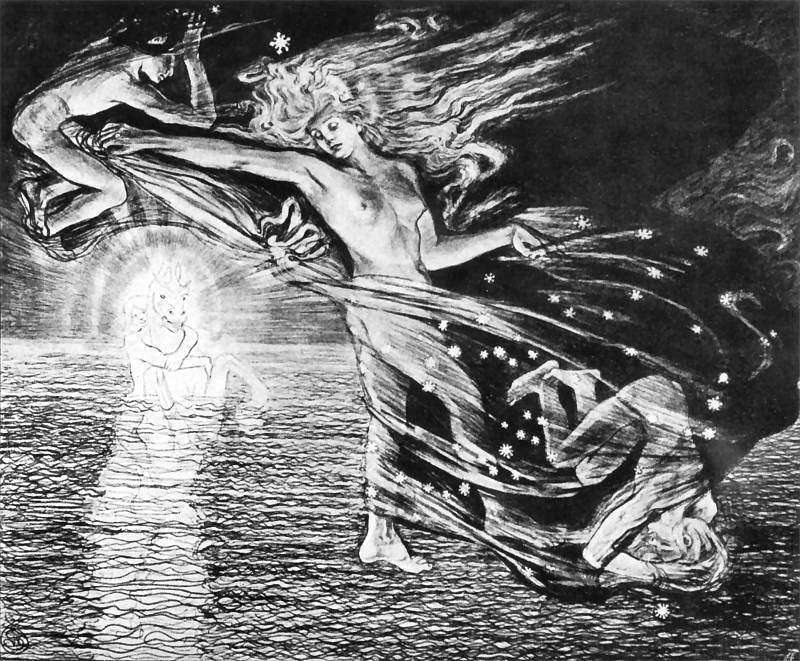
In Greek mythology, Hesiod calls Phosphorus a son of Astraeus and Eos, but other say of Cephalus and Eos, or of Atlas.
The Latin poet Ovid, speaking of Phosphorus and Hesperus (the Evening Star, the evening appearance of the planet Venus) as identical, makes him the father of Daedalion. Ovid also makes him the father of Ceyx, while the Latin grammarian Servius makes him the father of the Hesperides or of Hesperis.
While at an early stage the Morning Star (called Phosphorus and other names) and the Evening Star (referred to by names such as Hesperus) were thought of as two celestial objects, the Greeks accepted that the two were the same, but they seem to have continued to treat the two mythological entities as distinct. Halbertal and Margalit interpret this as indicating that they did not identify the star with the god or gods of mythology "embodied" in the star.
"Hesperus is Phosphorus"
Main article: Frege's puzzles
In the philosophy of language, "Hesperus is Phosphorus" is a famous sentence in relation to the semantics of proper names. Gottlob Frege used the terms "the evening star" (der Abendstern) and "the morning star" (der Morgenstern) to illustrate his distinction between sense and reference, and subsequent philosophers changed the example to "Hesperus is Phosphorus" so that it utilized proper names. Saul Kripke used the sentence to posit that the knowledge of something necessary — in this case the identity of Hesperus and Phosphorus — could be discoverable rather than known a priori.
Latin literature
The Latin word corresponding to Greek "Phosphorus" is "Lucifer". It is used in its astronomical sense both in prose and poetry.Virgil wrote:
Luciferi primo cum sidere frigida rura
carpamus, dum mane novum, dum gramina canent
(Let us hasten, when first the Morning Star appears, to the cool pastures, while the day is new, while the grass is dewy) Georgics 3:324–325. And Lucan:
Lucifer a Casia prospexit rupe diemque
misit in Aegypton primo quoque sole calentem
(The morning-star looked forth from Mount Casius and sent the daylight over Egypt, where even sunrise is hot) Lucan, Pharsalia, 10:434–435; English translation by J.D.Duff (Loeb Classical Library) Poets sometimes personify the star, placing it in a mythological context.Ovid wrote:
… vigil nitido patefecit ab ortu
purpureas Aurora fores et plena rosarum
atria: diffugiunt stellae, quarum agmina cogit
Lucifer et caeli statione novissimus exit Aurora, awake in the glowing east, opens wide her bright doors, and her rose-filled courts. The stars, whose ranks are shepherded by Lucifer the morning star, vanish, and he, last of all, leaves his station in the sky – Metamorphoses 2.114–115; A. S. Kline's Version
And Statius:
Et iam Mygdoniis elata cubilibus alto
impulerat caelo gelidas Aurora tenebras,
rorantes excussa comas multumque sequenti
sole rubens; illi roseus per nubila seras
aduertit flammas alienumque aethera tardo
Lucifer exit equo, donec pater igneus orbem
impleat atque ipsi radios uetet esse sorori
(And now Aurora rising from her Mygdonian couch had driven the cold darkness on from high in the heavens, shaking out her dewy hair, her face blushing red at the pursuing sun – from him roseate Lucifer averts his fires lingering in the clouds and with reluctant horse leaves the heavens no longer his, until the blazing father make full his orb and forbid even his sister her beams) Statius, Thebaid 2, 134–150; Translated by A. L. Ritchie and J. B. Hall in collaboration with M. J. Edwards
References
References
- "Liddell & Scott, a Greek-English Lexicon".
- [http://www.jewishencyclopedia.com/view.jsp?artid=612&letter=L Article "Lucifer"] on ''[[Jewish Encyclopedia]]''.
- ''[[Theogony]]'' 381
- "EOSPHORUS & HESPERUS (Eosphoros & Hesperos) - Greek Gods of the Morning & Evening Stars".
- ''[[Metamorphoses]]'' 11.295
- ''Metamorphoses'' 11.271
- [[Bibliotheca (Pseudo-Apollodorus)
- Halbertal, Moshe; Margalit, Avishai. ''Idolatry'' (Cambridge: Harvard University Press, 1992. {{ISBN
- Cicero wrote: ''Stella Veneris, quae Φωσφόρος Graece, Latine dicitur Lucifer, cum antegreditur solem, cum subsequitur autem Hesperos''; The star of Venus, called Φωσφόρος in [[Greek language
This article was imported from Wikipedia and is available under the Creative Commons Attribution-ShareAlike 4.0 License. Content has been adapted to SurfDoc format. Original contributors can be found on the article history page.
Ask Mako anything about Phosphorus (morning star) — get instant answers, deeper analysis, and related topics.
Research with MakoFree with your Surf account
Create a free account to save articles, ask Mako questions, and organize your research.
Sign up freeThis content may have been generated or modified by AI. CloudSurf Software LLC is not responsible for the accuracy, completeness, or reliability of AI-generated content. Always verify important information from primary sources.
Report