From Surf Wiki (app.surf) — the open knowledge base
Phoebe (moon)
Moon of Saturn

Moon of Saturn
| Field | Value |
|---|---|
| name | Phoebe |
| mpc_name | Saturn IX |
| pronounced | |
| named_after | Φοίβη Phoíbē |
| adjectives | Phoebean |
| image | Phoebe cassini full.jpg |
| caption | Cassini image of Phoebe. Jason crater occupies much of the upper image |
| discoverer | W. H. Pickering |
| discovered | 18 March 1899 (from photos taken 16 August 1898) |
| orbit_ref | |
| semimajor | 12 960 000 km |
| eccentricity | 0.1562415 |
| period | |
| inclination | 173.04° (to the ecliptic) |
| 151.78° (to Saturn's equator) | |
| satellite_of | Saturn |
| group | Norse group |
| dimensions | () × () × () km |
| mean_radius | |
| mass | |
| density | |
| surface_grav | 0.038–0.050 m/s2 |
| escape_velocity | ≈ km/s |
| sidereal_day | (9 h 16 min 25 s ± 3 s) |
| axial_tilt | 152.14° (to orbit) |
| albedo | |
| single_temperature | ≈ 73(?) K |
| abs_magnitude |
151.78° (to Saturn's equator)
Phoebe ( ) is the most massive irregular satellite of Saturn with a mean diameter of 213 km. It was discovered by William Henry Pickering on 18 March 1899 from photographic plates that had been taken by DeLisle Stewart starting on 16 August 1898 at the Boyden Station of the Carmen Alto Observatory near Arequipa, Peru. It was the first natural satellite to be discovered photographically.
Phoebe was the first target encountered upon the arrival of the Cassini spacecraft in the Saturn system in 2004, and is thus unusually well-studied for an irregular moon of its size. ''Cassini'''s trajectory to Saturn and time of arrival were chosen to permit this flyby.{{cite web | access-date = 2008-03-02 | archive-date = 2008-06-28 | archive-url = https://web.archive.org/web/20080628164421/http://www.nasa.gov/mission_pages/cassini/media/cassini-060904.html | url-status = dead
Phoebe is roughly spherical and has a differentiated interior. It was spherical and hot early in its history and was battered out of roundness by repeated impacts. There is some evidence that it may be a captured centaur that originated in the Kuiper belt. Phoebe is the second-largest retrograde satellite in the Solar System after Triton.
History
Discovery
Phoebe was discovered by William Henry Pickering on 18 March 1899 from photographic plates that had been taken starting on 16 August 1898 at the Boyden Observatory near Arequipa, Peru, by DeLisle Stewart. It was the first satellite to be discovered photographically.
Naming
Phoebe is named after Phoebe, a Titaness in Greek mythology associated with the Moon, who was the sister of Cronus (the Greek equivalent of the Roman god Saturn). It is also designated Saturn IX in some scientific literature. The IAU nomenclature standards have stated that features on Phoebe are to be named after characters in the Greek myth of Jason and the Argonauts. In 2005, the International Astronomical Union officially named 24 craters (see Named features).
Toby Owen of the University of Hawaii at Mānoa, chairman of the International Astronomical Union Outer Solar System Task Group said:
We picked the legend of the Argonauts for Phoebe as it has some resonance with the exploration of the Saturn system by Cassini–Huygens. We can't say that our participating scientists include heroes like Hercules and Atalanta, but they do represent a wide, international spectrum of outstanding people who were willing to take the risk of joining this voyage to a distant realm in hopes of bringing back a grand prize.
Orbit
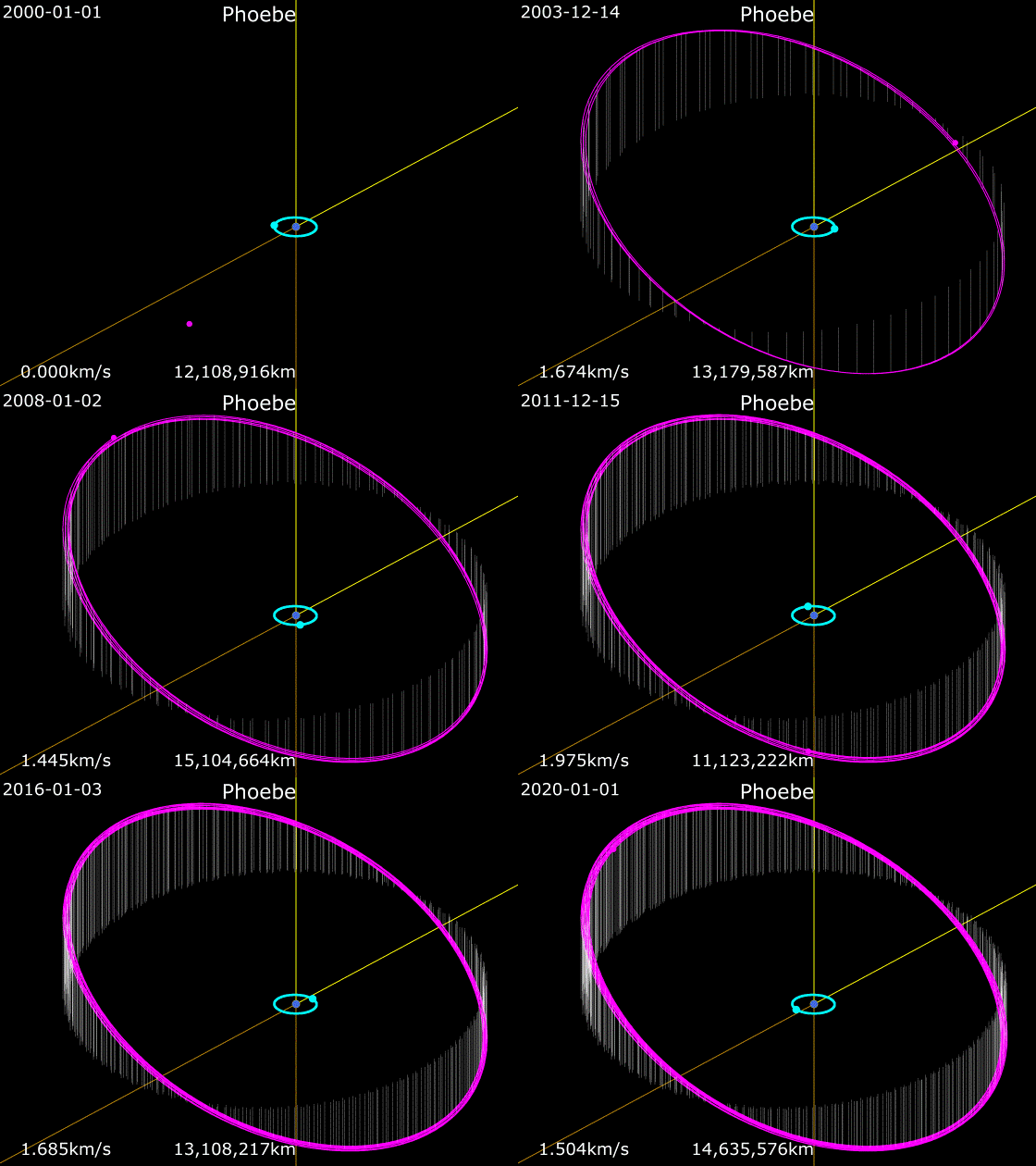
Phoebe's orbit is retrograde; that is, it orbits Saturn opposite to Saturn's rotation. For more than 100 years, Phoebe was Saturn's outermost known moon, until the discovery of several smaller moons in 2000. Phoebe is almost 4 times more distant from Saturn than its nearest major neighbor (Iapetus), and is substantially larger than any of the other moons orbiting planets at comparable distances. All of Saturn's regular moons except Iapetus orbit very nearly in the plane of Saturn's equator. The outer irregular satellites, including Phoebe, follow orbits that can be moderately to highly eccentric, and none are expected to rotate synchronously as all the inner moons of Saturn (except for Hyperion) do. Phoebe orbits within a group of irregular satellites called the Norse group.
There are a number of satellites with similar orbits that are speculated to be fragments from collision events Phoebe has experienced in the past, such as S/2006 S 20, S/2006 S 9, S/2019 S 2, and S/2007 S 2.
Phoebe ring
Main article: Rings of Saturn#Phoebe ring
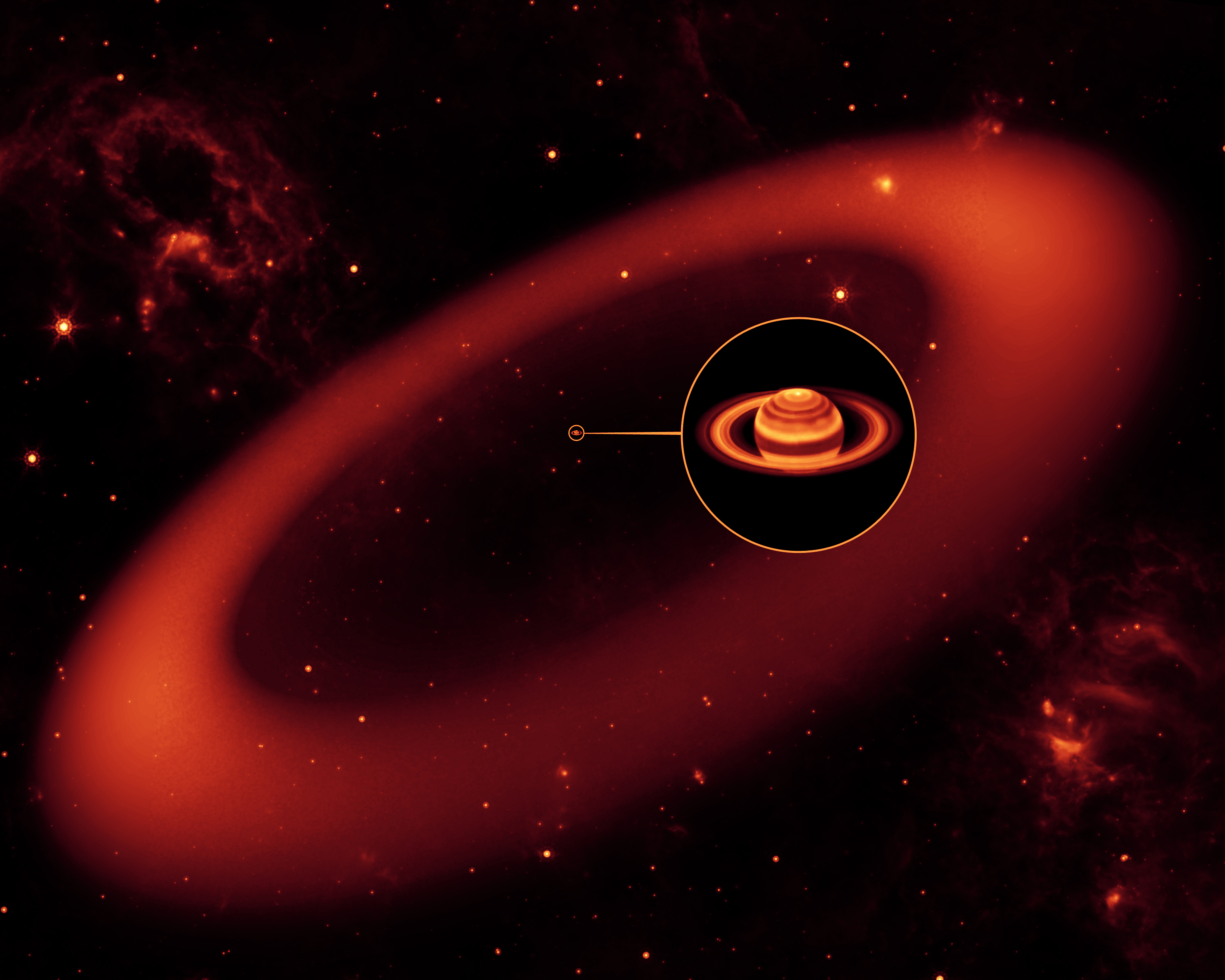
The Phoebe ring is one of the rings of Saturn. This ring is tilted 27 degrees from Saturn's equatorial plane (and the other rings). It extends from at least 128 to 207 times the radius of Saturn; Phoebe orbits the planet at an average distance of 215 Saturn radii. The ring is about 40 times as thick as the diameter of the planet. Because the ring's particles are presumed to have originated from micrometeoroid impacts on Phoebe, they should share its retrograde orbit, which is opposite to the orbital motion of the next major moon inward, Iapetus. Inwardly migrating ring material would thus strike Iapetus's leading hemisphere, contributing to its two-tone coloration.{{Cite web | access-date = 2009-12-22 | archive-date = 2012-02-03 | archive-url = https://web.archive.org/web/20120203132024/http://ciclops.org/view.php?id=6033 | url-status = dead
Material displaced from Phoebe's surface by microscopic meteor impacts may be responsible for the dark areas on the surface of Hyperion. Debris from the biggest impacts may be the origin of some of the other moons of the Norse group—almost all of which are less than 10 km in radius.
Physical characteristics

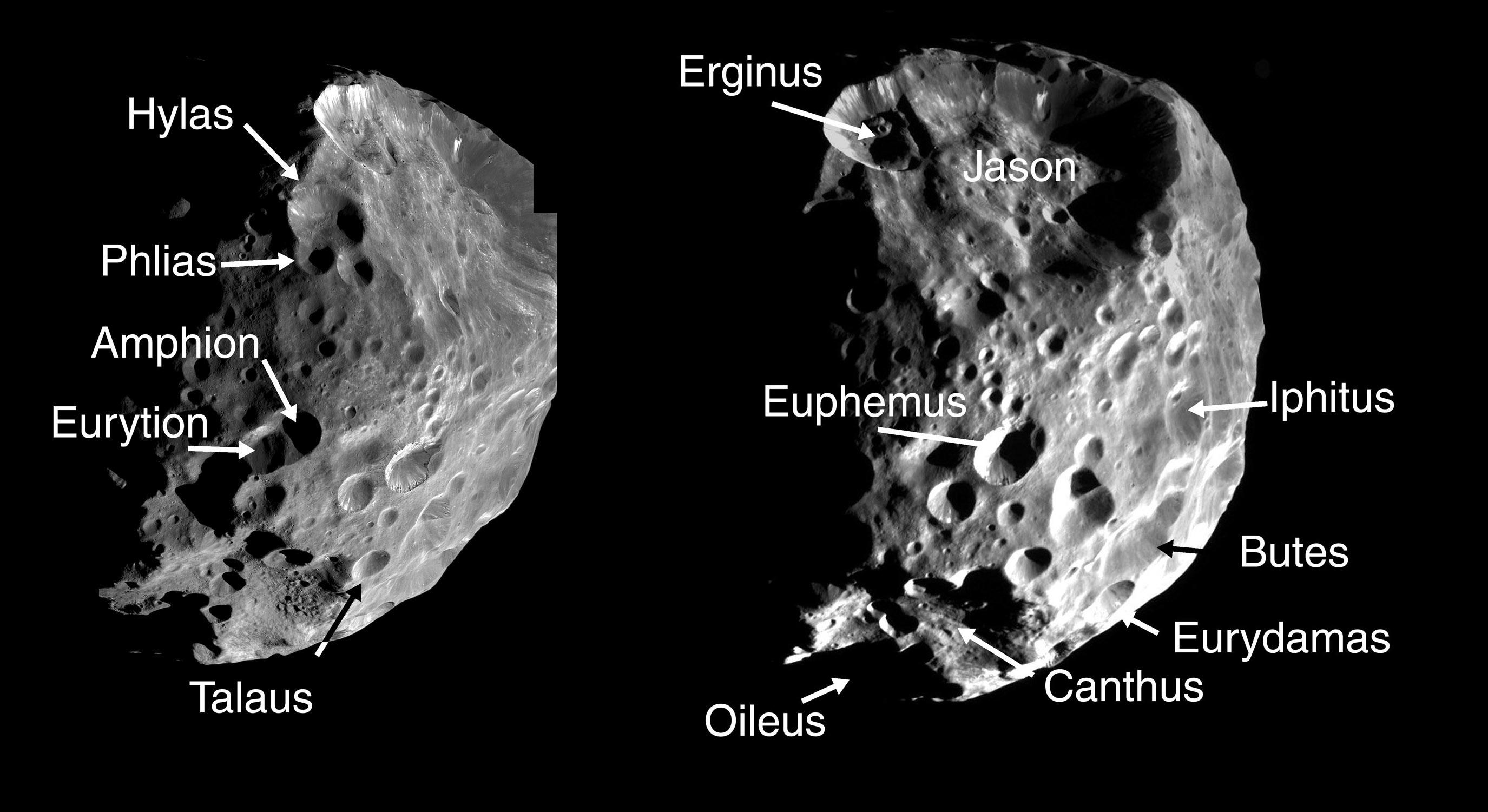
Phoebe is roughly spherical and has a diameter of (213 km), approximately one-sixteenth that of the Moon. It is Saturn's ninth-largest moon, but it is the eighth-most massive. Hyperion, another one of Saturn's moons, has a larger radius, but is less massive than Phoebe. Phoebe rotates every 9 hours and 16 minutes, and completes a full orbit around Saturn in about 18 months. Its surface temperature is on average 75 K.
Most of Saturn's inner moons have very bright surfaces, but Phoebe's albedo is much lower in comparison (), though relatively bright compared to other irregular moons with measured albedos. The Phoebean surface is heavily scarred. The largest crater, Jason, is roughly 100 km in diameter.
Phoebe's dark coloring initially led to scientists surmising that it was a captured asteroid, as it resembled the common class of dark carbonaceous asteroids. These are chemically very primitive and are thought to be composed of original solids that condensed out of the solar nebula with little modification since then.
However, images from Cassini indicate that Phoebe's craters show a considerable variation in brightness, which indicate the presence of large quantities of ice below a relatively thin blanket of dark surface deposits some 300 to thick. In addition, quantities of carbon dioxide have been detected on the surface, a finding that has never been replicated for an asteroid. It is estimated that Phoebe is about 50% rock, as opposed to the 35% or so that typifies Saturn's inner moons. For these reasons, scientists are coming to think that Phoebe is in fact a captured centaur, one of a number of icy planetoids from the Kuiper belt that orbit the Sun between Jupiter and Neptune. Phoebe is the first such object to be imaged as anything other than a dot.
Spectroscopic observations of Phoebe by the James Webb Space Telescope and the VIMS instrument on Cassini have confirmed the presence of water ice and carbon dioxide on its surface, with ambiguous evidence for organic compounds. The overall shape of the spectrum resembles that of Kuiper belt objects, providing a compositional confirmation that Phoebe is a captured body. Phoebe also appears to have distinctly more water ice than other similarly observed Saturnian irregular satellites, such as Siarnaq and Albiorix.
Despite its small size, Phoebe is thought to have been a spherical body early in its history, with a differentiated interior, before solidifying and being battered into its current, slightly non-equilibrium shape.
Named features
Apart from one regio named after Phoebe's daughter, Leto, all named features are craters named after characters from the Greek legend of Jason and the Argonauts.
| Name | Pronunciation | Greek | Coordinates | Diameter (km) | Approval Date | Named After | Ref |
|---|---|---|---|---|---|---|---|
| Leto Regio | Λητώ | 95 | 2000 | Daughter of Phoebe in Greek mythology |
| Name | Pronunciation | Greek | Coordinates | Diameter (km) | Approval Date | Named After | Ref |
|---|---|---|---|---|---|---|---|
| Acastus | Ἄκαστος | 34 | 2006 | Son of Thessalian king Pelias, took part in the Calydonian boar hunt | |||
| Admetus | Ἄδμητος | 58 | 2006 | Founder and king of Pherae in Thessaly | |||
| Amphion | Ἀμφῑ́ων | 18 | 2006 | Son of Hyperasius and Hypso | |||
| Butes | Βούτης | 29 | 2006 | Son of Teleon, bee-master | |||
| Calais | Κάλαϊς | 31 | 2006 | Son of Boreas, the north wind | |||
| Canthus | Κάνθος | 44 | 2006 | Son of Kanethos or Cerion, the only member of the expedition to die in combat | |||
| Clytius | Κλυτίος | 52 | 2006 | Son of Eurytus, skilled archer who was killed by Apollo for challenging the god to a shooting match | |||
| Erginus | Ἐργῖνος | 38 | 2006 | Son of Neptune, helmsman of the Argo after the death of Tiphys | |||
| Euphemus | Εὔφημος | 23 | 2006 | Son of Neptune and Europa | |||
| Eurydamas | Εὐρυδάμᾱς | 19 | 2006 | Son of Ctimenus | |||
| Eurytion | Εὐρυτίων | 14 | 2006 | Son of Kenethos or Cerion | |||
| Eurytus | Εὔρυτος | 89 | 2006 | Son of Mercury and Antianira | |||
| Hylas | Ὕλας | 30 | 2006 | Son of Theiodamas/Theodamas, king of the Dryopes | |||
| Idmon | Ἴδμων | 61 | 2006 | Son of Apollo and the nymph Cyrene, or of Abas, a prophet | |||
| Iphitus | Ἴφιτος | 22 | 2006 | Son of Eurytus, Jason's host during his consultation with the Oracle at Delphi | |||
| Jason | Ἰάσων | 101 | 2006 | The leading Argonaut, son of the Thessalian king Aeson, delivered the Fleece | |||
| Mopsus | Μόψος | 37 | 2006 | Prophesying son of Apollo | |||
| Nauplius | Ναύπλιος | 24 | 2006 | Son of Neptune and Amymone, or of Klytoneos | |||
| Oileus | Ὀϊλεύς | 56 | 2006 | King of the Locrians, renowned for his courage in battle | |||
| Peleus | Πηλεύς | 44 | 2006 | Son of Aeacus, father of Achilles | |||
| Phlias | Φλίας | 14 | 2006 | Son of Dionysus | |||
| Talaus | Ταλαός | 15 | 2006 | Son of Teleon, or of Bias and Pero | |||
| Telamon | Τελαμών | 28 | 2006 | Son of Aeacus, took part in the Calydonian boar hunt | |||
| Zetes | Ζήτης | 29 | 2006 | Son of Boreas, the north wind |
Maps
Phoebe 2005 Mercator PIA07795.jpg|Map of Phoebe's middle latitudes. The higher latitudes have been clipped from the main map, but can be seen in the polar projections. Phoebe 2005 south polar projection PIA07797.jpg|Map of Phoebe's south polar region Phoebe north polar region PIA 07796.png|Map of Phoebe's north polar region Phoebe contour map PIA15507.jpg|3D map showing Phoebe's once spherical shape
Formation
Phoebe formed in the Kuiper belt within three million years after the origin of the Solar System. This was early enough that sufficient radioactive material was available to melt it into a sphere and stay warm enough to have liquid water for tens of millions of years.
Observation and exploration


Unlike Saturn's other moons, Phoebe was not favorably placed for the Voyager probes. Voyager 2 observed Phoebe for a few hours in September 1981. In the images, taken from a distance of 2.2 million kilometres at low phase angle, the size of Phoebe was approximately 11 pixels and showed bright spots on the otherwise dark surface.
Cassini passed 2068 km from Phoebe on 11 June 2004, returning many high-resolution images, which revealed a scarred surface. Because Voyager 2 had not been able to produce any high-quality images of Phoebe, obtaining them was a priority for the Cassini mission and its flight path was deliberately designed to take it close by; otherwise, Cassini would likely not have returned images much better than *Voyager'''s. Because of Phoebe's short rotation period of approximately 9 hours, 17 minutes, *Cassini'' was able to map nearly the entire surface of Phoebe. The close fly-by enabled the mass of Phoebe to be determined with an uncertainty of only 1 in 500.
Notes
References
- Phoebe Profile at NASA's Solar System Exploration site
- Cassini–Huygens Multimedia: Images: Moons: Small Moons
- Cassini Pass Reveals Moon Secrets, BBC News, June 14, 2004
- The Planetary Society: Phoebe
- Asaravala, A.; Saturn's Odd Moon Out, Wired, (May 4, 2005)
- NASA: Natural Satellite Physical Parameters
- Cassini images of Phoebe
- Images of Phoebe at JPL's Planetary Photojournal
- Movie of Phoebe's rotation from the National Oceanic and Atmospheric Administration
- Phoebe basemap (December 2005) from Cassini images
- Phoebe atlas (March 2006) from Cassini images
- Phoebe nomenclature from the USGS planetary nomenclature page
- Phoebe on T. Denk's Outer Saturnian moons websites
References
- {{OED. Phoebe
- {{OED. Phoebean
- "Natural Satellites Ephemeris Service".
- (July 2010). "Sizes, shapes, and derived properties of the saturnian satellites after the Cassini nominal mission". Icarus.
- (1 November 2022). "The Orbits of the Main Saturnian Satellites, the Saturnian System Gravity Field, and the Orientation of Saturn's Pole*". The Astronomical Journal.
- (2004). "Recovering the Rotational Lightcurve of Phoebe". The Astronomical Journal.
- Porco CC. (2005-02-25). "Cassini Imaging Science: Initial Results on Phoebe and Iapetus". Science.
- (18 March 1899). "On This Day". Unknown..
- Jewitt, David. (2007). "Irregular Satellites of the Planets: Products of Capture in the Early Solar System". Annual Review of Astronomy and Astrophysics.
- "Planetary Satellite Physical Parameters".
- Pickering EC. (1899-03-17). "A New Satellite of Saturn". Harvard College Observatory Bulletin.
- (24 March 1899). "A New Satellite of Saturn". Science.
- Pickering EC. (1899-03-23). "A New Satellite of Saturn". Astronomical Journal.
- Pickering EC. (1899-04-10). "A New Satellite of Saturn". Astrophysical Journal.
- Pickering EC. (1899-04-29). "A New Satellite of Saturn". Astronomische Nachrichten.
- (April 1899). "A Ninth Satellite to Saturn". The Observatory.
- [http://www.spaceflightnow.com/cassini/050224phoebecraters.html ''Features on Saturn's moon Phoebe given names''] {{Webarchive. link. (2016-01-10 , Spaceflight Now, February 24, 2005)
- (10 March 2025). "Retrograde predominance of small saturnian moons reiterates a recent retrograde collisional disruption".
- Verbiscer, Anne. (2009-10-07). "Saturn's largest ring". [[Nature (journal).
- (2009-10-07). "The King of Rings". NASA, Spitzer Space Telescope center.
- Cowen, Rob. (October 6, 2009). "Largest known planetary ring discovered". [[Science News]].
- [https://www.newscientist.com/article/dn17928-largest-ring-in-solar-system-found-around-saturn.html Largest ring in solar system found around Saturn] {{Webarchive. link. (2015-05-18 , New Scientist)
- (2015-08-01). "NEOWISE: Observations of the Irregular Satellites of Jupiter and Saturn". The Astrophysical Journal.
- (2005). "Saturn's moon Phoebe as a captured body from the outer Solar System". [[Nature (journal).
- Martinez, C.. (May 6, 2005). "Scientists Discover Pluto Kin Is a Member of Saturn Family". Cassini–Huygens News Releases.
- (May 2005). "Compositional maps of Saturn's moon Phoebe from imaging spectroscopy". Nature.
- (2025-04-01). "Saturnian Irregular Satellites as a Probe of Kuiper Belt Surface Evolution". The Planetary Science Journal.
- Jia-Rui C. Cook and Dwayne Brown. (2012-04-26). "Cassini Finds Saturn Moon Has Planet-Like Qualities". JPL/NASA.
- link. (2020-09-25 , USGS)
- (1 November 1983). "Phoebe: Voyager 2 observations". Journal of Geophysical Research: Space Physics.
- "Encounter with Phoebe".
- Roth et al., AAS Paper 05-311
- (June 2019). "Geophysical evidence that Saturn's Moon Phoebe originated from a C-type asteroid reservoir". Monthly Notices of the Royal Astronomical Society.
- (19 September 2020). "Phoebe's differentiated interior from refined shape analysis". Astronomy & Astrophysics.
This article was imported from Wikipedia and is available under the Creative Commons Attribution-ShareAlike 4.0 License. Content has been adapted to SurfDoc format. Original contributors can be found on the article history page.
Ask Mako anything about Phoebe (moon) — get instant answers, deeper analysis, and related topics.
Research with MakoFree with your Surf account
Create a free account to save articles, ask Mako questions, and organize your research.
Sign up freeThis content may have been generated or modified by AI. CloudSurf Software LLC is not responsible for the accuracy, completeness, or reliability of AI-generated content. Always verify important information from primary sources.
Report