From Surf Wiki (app.surf) — the open knowledge base
Phineus (son of Belus)
Figure in Greek mythology
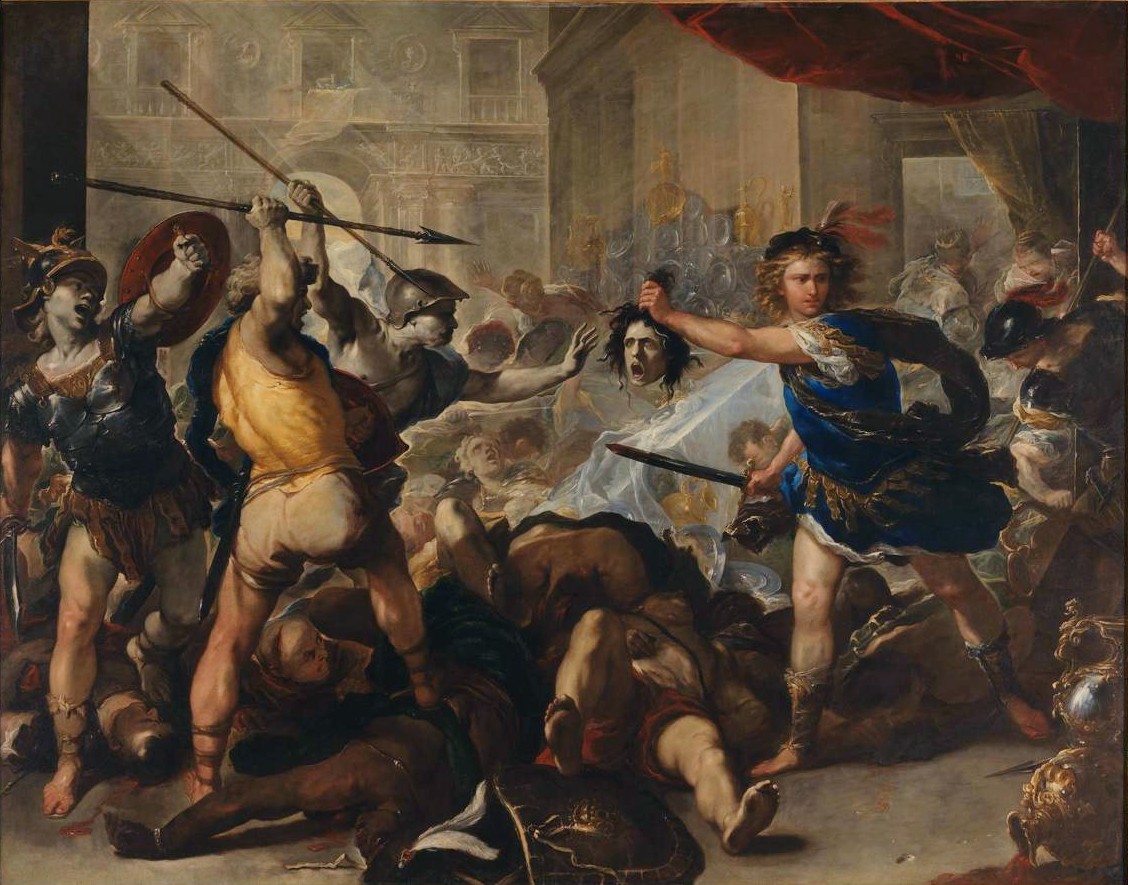
Figure in Greek mythology
In Greek mythology, Phineus (/ˈfɪniəs, ˈfɪn.juːs/; Ancient Greek: Φινεύς, ) was a son of Belus by Anchinoe and thus brother to Aegyptus, Danaus and Cepheus.
Mythology
Phineus had been engaged to Cepheus' daughter Andromeda before she wed Perseus, and Phineus plotted against him, leading Perseus to turn him and his co-conspirators into stone by showing them the head of Medusa. The affair appears to have formed part of Euripides' lost Andromeda, and receives a single line in Apollodorus' Bibliotheca, but the only extensive ancient treatment is found in Ovid's Metamorphoses.
In Ovid's account Perseus asked for Andromeda's hand in return for saving the girl from the sea-monster Cetus, to whom an oracle had ordained Andromeda be sacrificed as punishment for her mother Cassiopeia's boast that she was more beautiful than the Nereids. Perseus was successful, but as he recounted his deeds to the court, a spear-brandishing Phineus interrupted him:
Phineus' presumed motive in marrying Andromeda was to strengthen his claim to the throne, rather than any interest in the girl herself. Cepheus scolded his brother for this outburst, pointing out that he had done nothing to help Andromeda in the crisis, but Phineus still cast his spear at Perseus. Although he missed, a fierce battle ensued in which many fell, until Perseus held up the head of the Gorgon, turning all his remaining enemies - except for Phineus - to stone. Amazed by this, Phineus pleaded for his life with his gaze averted, but Perseus approached him and held the head before his eyes, turning Phineus also to stone.
References
Bibliography
- .
- .
- .
- Pseudo-Apollodorus, Apollodorus, The Library, with an English Translation by Sir James George Frazer, F.B.A., F.R.S. in 2 Volumes. Cambridge, MA, Harvard University Press; London, William Heinemann Ltd. 1921.
References
- {{harvtxt. Dräger. 2007, [[Euripides]], fr. 881 [[#{{harvid. Kannicht. 2004. Kannicht]] (cited at ''[[Bibliotheca (Pseudo-Apollodorus). Suppliants]]'' 317), [[Nonnus]], ''[[Dionysiaca]]'' 3.296–303.
- {{harvtxt. Collard. Cropp. 2008
- ''[[Metamorphoses]]'' [http://www.poetryintranslation.com/PITBR/Latin/Metamorph5.htm#_Toc64106308 5.1–235]
- [[Ovid]], ''Metamorphoses'' [http://www.poetryintranslation.com/PITBR/Latin/Metamorph4.htm#_Toc64106270 4.663–705]
- Ovid, ''Metamorphoses'' [http://www.poetryintranslation.com/PITBR/Latin/Metamorph5.htm#_Toc64106308 5.10–12], trans. A. S. Kline.
- Ovid, ''Metamorphoses'' [http://www.poetryintranslation.com/PITBR/Latin/Metamorph5.htm#_Toc64106313 5.200–49]
- [[Pseudo-Apollodorus]]. "Bibliotheca".
This article was imported from Wikipedia and is available under the Creative Commons Attribution-ShareAlike 4.0 License. Content has been adapted to SurfDoc format. Original contributors can be found on the article history page.
Ask Mako anything about Phineus (son of Belus) — get instant answers, deeper analysis, and related topics.
Research with MakoFree with your Surf account
Create a free account to save articles, ask Mako questions, and organize your research.
Sign up freeThis content may have been generated or modified by AI. CloudSurf Software LLC is not responsible for the accuracy, completeness, or reliability of AI-generated content. Always verify important information from primary sources.
Report