From Surf Wiki (app.surf) — the open knowledge base
Philistia
Geo-political region occupied by the Philistines
Geo-political region occupied by the Philistines
| Field | Value |
|---|---|
| conventional_long_name | Philistia |
| image_map | File:Kingdoms around Israel 830 map.svg |
| image_map_caption | Philistia in red, and neighbouring polities, circa 830 BC, after the Hebrew conquest of Jaffa, and before its recapture by the Philistines circa 730 BC. |
| government_type | Confederation |
| era | Iron Age |
| year_start | 1175 BC |
| year_end | 604 BC |
| p1 | Canaanites |
| s1 | Neo-Assyrian Empire |
| common_languages | Philistine |
| Canaanite | |
| Aramaic (from the 6th c. BC) | |
| religion | Canaanite religion |
| demonym | Philistine |
| event_start | Late Bronze Age collapse |
| event_end | Babylonian conquest of the Levant |
| today | Israel |
| Palestine | |
| Egypt |
Canaanite Aramaic (from the 6th c. BC) Palestine Egypt Philistia was a confederation of five main cities or pentapolis in the Southwest Levant, made up principally of Gaza, Ashkelon, Ashdod, Ekron, Gath, and for a time, Jaffa (part of present-day Tel Aviv-Yafo).
Scholars believe the Philistines were made up of people of an Aegean background that from roughly 1200 BC onwards settled in the area and mixed with the local Canaanite population, and came to be known as Peleset (i.e. "Philistines"). At its territorial maximum, the region they inhabited may have stretched along the Canaanite coast from Arish in the Sinai (today's Egypt) to the Yarkon River (today's Tel Aviv), and as far inland as Ekron and Gath. Nebuchadnezzar II invaded Philistia in 604 BC, burned Ashkelon, and incorporated the territory into the Neo-Babylonian Empire; Philistia and its population disappear from the historic record after that year, until the second century BC, when both Philistia and its cities (Joppa, Jamina, and Azotus) reappear in biblical and Greek texts in the context of the Maccabean Revolt and the Hellenistic period.
History
Ancient Egyptian hieroglyphic records from the New Kingdom period record a group of the Sea Peoples called the pwrꜣsꜣtj, generally transliterated as either Peleset or Pulasti, as invading Egypt in the mid-13th century BC. About a century later, pharaoh Ramesses III boasted of having defeated the Peleset, and allegedly relocated them to the southern abandoned coast of Canaan, recording this victory on a Medinet Habu temple inscription dated to c. 1150 BC. The pwrꜣsꜣtj are generally identified as the Philistines. The Great Harris Papyrus, a chronicle of Ramesses' reign written no later than 1149 BC, also records this Egyptian defeat of the Philistines.
Despite Ramesses III's claim, archaeology has not been able to corroborate the existence of any such (re)settlement, and the lack of sense in granting an apparently barbarous invading people an expansive and richly fertile swath of land already under Egyptian control is noted by scholars.
During Iron Age I, the Philistines seem to have had a presence far outside of what was traditionally considered Philistia, as 23 of the 26 Iron Age I sites in the Jezreel Valley, including Tel Megiddo, Tel Yokneam, Tel Qiri, Afula, Tel Qashish, Be'er Tiveon, Hurvat Hazin, Tel Risim, Tel Re'ala, Hurvat Tzror, Tel Sham, Midrakh Oz and Tel Zariq, yielded typical Philistine pottery dating from the 12th-to-10th century BC. However, given the small quantity of pottery finds, it is likely that even if the Philistines had settled in the area, they remained a minority and assimilated into the Canaanite population by the 10th century BC.
Philistia's northern boundary was the Yarkon River, with the Mediterranean Sea on the west, the Kingdom of Judah at Ziklag to the east, and the Arish to the south. Philistia consisted of the five city-states, known as the Philistine pentapolis, as described in the Book of Joshua () and the Books of Samuel (). It comprised Ashkelon, Ashdod, Ekron, Gath, and Gaza, in the south-western Levant. Tell Qasile and Aphek (see Battle of Aphek) likely marked the nation's frontiers, as evidence from Tell Qasile especially indicates that non-Philistines constituted an otherwise unusually large portion of their respective populations. The identity of the aforementioned Ziklag, a city which according to the Bible marked the border between the Philistine and Israelite territory, remains uncertain.
Philistia included Jaffa (in today's Tel Aviv). Following Sennacherib's third campaign in the Levant, the Assyrians reassigned Jaffa to the Phoenician city-state of Sidon, and Philistia never got it back.
The Five Lords of the Philistines are described in the Hebrew Bible as being in constant struggle and interaction with the neighbouring Israelites, Canaanites and Egyptians, being gradually absorbed into the Canaanite culture.
Philistia was occupied by Tiglath-Pileser III of the Neo-Assyrian Empire in the 8th century BC. Throughout the century, often at the incitement of neighboring Egypt, Philistia revolted against Assyrian rule, but each time they were defeated and forced to pay tribute. Gath disappears from history after Sargon II records its capture in 711 BC, which may indicate he destroyed the city rather than conquered it. The term "Philistia" is not used in Assyrian records describing their campaigns, only the names of individual cities, which may indicate that at this stage the Philistines had become increasingly divided, and that the confederation of the pentapolis which constituted Philistia had fractured into separate city-states. Sennacherib further reported that he had sacked (and possibly burned) a "royal city of the land Philistia that [Hezek]iah had taken away (and) fortified," but the city's name has not survived. The texts also mention that Ashkelon was sacked due to its refusal to acknowledge Assyrian authority. Despite this Philistine sedition, Sennacherib records that he divided up the lands he had plundered from Judah amongst the kings of Ashdod, Gaza, and Ekron, even going as far as freeing Padi, the king of Ekron, from Judahite captivity and returning him to the throne.
The Philistines disappear from written records following the conquest of the Levant by the Neo-Babylonian emperor Nebuchadnezzar II during the 6th century BC, when Ashkelon and many other cities from the region were destroyed.
East of Gaza
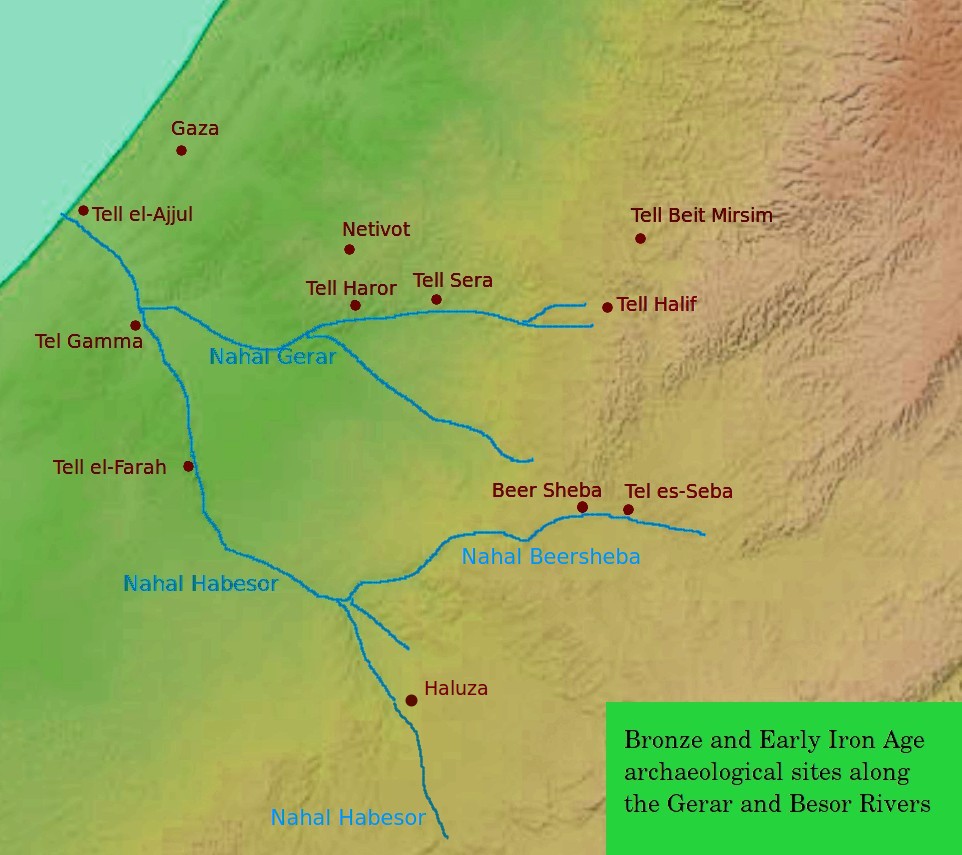
The area east of Gaza, particularly around Nahal Besor that reaches into the hills as far as Beersheva, had a very substantial Philistine presence. This area is a part of the Negev desert. It also includes Nahal Gerar to the north that joins Nahal Besor before flowing into the Mediterranean Sea.
This was a heavily populated area during the early Iron Age. It includes archaeological sites such as Tell Beit Mirsim, Tel Haror, Tel Sera (Ziklag) along Nahal Gerar, and Tell Jemmeh and Tell el-Far'ah (South) along Nahal Besor. All these sites and others in the area had Philistine settlements.
When the Neo-Assyrian Empire first invaded this area, the Philistine cities were given considerable autonomy in exchange for tribute. But having responded to various revolts, this policy hardened.
Notes
References
Bibliography
References
- (February 2001). "Herodotus' Description of the East Mediterranean Coast". The University of Chicago Press on behalf of The American Schools of Oriental Research.
- "The Philistine Age - Archaeology Magazine".
- Sullivan, Benjamin M.. (2018). "In the Shadow of Phoenicia". [[The Journal of Hellenic Studies]].
- (29 September 1992). "Philistines Were Cultured After All, Say Archeologists". [[The New York Times]].
- Kasher, Aryeh. "Jews and Hellenistic Cities in Eretz-Israel: Relations of the Jews in Eretz-Israel".
- Carl S. Ehrlich, ''The Philistines in Transition: A History of the Philistines from Ca. 1000-730 B. C. E.'', Brill 1996, p.7
- "Text of the Papyrus Harris". Specialtyinterests.net.
- Finkelstein, Israel. (January 2007). "The Synchronisation of Civilisations in the Eastern Mediterranean in the Second Millennium B. C. III. Proceedings of the SCIEM 2000 – 2nd Euro- Conference, Vienna, 28th of May–1st of June 2003, Denkschriften der Ge- samtakademie 37, Contributions to the Chronology of the Eastern Mediterranean 9, Vienna 2007".
- Avner Raban, "The Philistines in the Western Jezreel Valley", Bulletin of the American Schools of Oriental Research, No. 284 (November 1991), pp. 17–27, The University of Chicago Press on behalf of The American Schools of Oriental Research.
- (1996). "The Philistines in Transition: A History from Ca. 1000-730 B.C.E.". BRILL.
- (2010). "Philistine Iconography: A Wealth of Style and Symbolism". Saint-Paul.
- Gösta Werner Ahlström. (1993). "The History of Ancient Palestine". Fortress Press.
- (1991). "Ziklag". Holman Bible Dictionary.
- Note - the "Lords" is a translation of ''seren'' or ''ceren'' (סַרְנֵ֣י) in Hebrew, or [[satrap]] ({{lang. el. σατραπείαις) in the Greek of the [[Septuagint]]
- Library, National Public. "Philistia. National Public Library - eBooks. Read eBooks online". nationalpubliclibrary.info. Retrieved 2016-11-01.
- "Sennacherib 1015; line 11". ORACC.
- Jarus, Owen. (16 July 2016). "Who Were the Philistines?". Live Science.
- (2014). "Tell Jemmeh, Philistia and the Neo-Assyrian Empire during the Late Iron Age". Levant.
- Gunnar Lehmann. "Excavations at Qubur al-Walaydah, 2007–2009". academia.edu.
- "Tell el-Far'ah, South -- Israel Excavation Project Website". Farahsouth.cgu.edu.
This article was imported from Wikipedia and is available under the Creative Commons Attribution-ShareAlike 4.0 License. Content has been adapted to SurfDoc format. Original contributors can be found on the article history page.
Ask Mako anything about Philistia — get instant answers, deeper analysis, and related topics.
Research with MakoFree with your Surf account
Create a free account to save articles, ask Mako questions, and organize your research.
Sign up freeThis content may have been generated or modified by AI. CloudSurf Software LLC is not responsible for the accuracy, completeness, or reliability of AI-generated content. Always verify important information from primary sources.
Report