From Surf Wiki (app.surf) — the open knowledge base
Phenols
Chemical compounds in which hydroxyl group is attached directly to an aromatic ring

Chemical compounds in which hydroxyl group is attached directly to an aromatic ring
In organic chemistry, phenols, sometimes called phenolics, are a class of chemical compounds consisting of one or more hydroxyl groups (−O H) bonded directly to an aromatic hydrocarbon group. The simplest is phenol, . Phenolic compounds are classified as simple phenols or polyphenols based on the number of phenol units in the molecule.
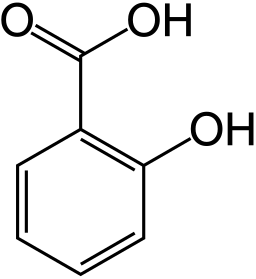
Phenols are both synthesized industrially and produced by plants and microorganisms.
Properties
Acidity
Phenols are more acidic than typical alcohols. The acidity of the hydroxyl group in phenols is commonly intermediate between that of aliphatic alcohols and carboxylic acids (their pKa is usually between 10 and 12). Deprotonation of a phenol forms a corresponding negative phenolate ion or phenoxide ion, and the corresponding salts are called phenolates or phenoxides (aryloxides, according to the IUPAC Gold Book).
Condensation with aldehydes and ketones
Phenols are susceptible to electrophilic aromatic substitutions. Condensation with formaldehyde gives resinous materials, famously Bakelite.
Another industrial-scale electrophilic aromatic substitution is the production of bisphenol A, which is produced by the condensation with acetone. :[[File:Synthesis Bisphenol A.svg|frameless|upright=2.5]]
C-Alkylation with alkenes
Phenol is readily alkylated at the ortho positions using alkenes in the presence of a Lewis acid such as aluminium phenoxide: : CH2=CR2 + C6H5OH → R2CHCH2-2-C6H4OH More than 100,000 tons of tert-butyl phenols are produced annually (year: 2000) in this way, using isobutylene (CH2=CMe2) as the alkylating agent. Especially important is 2,6-ditert-butylphenol, a versatile antioxidant.
Other reactions===
Phenols undergo esterification. Phenol esters are active esters, being prone to hydrolysis. Phenols are reactive species toward oxidation. Oxidative cleavage, for instance cleavage of 1,2-dihydroxybenzene to the monomethylester of 2,4-hexadienedioic acid with oxygen, copper chloride in pyridine. Oxidative de-aromatization to quinones also known as the Teuber reaction. Oxidizing reagents are Fremy's salt and oxone. In reaction depicted below 3,4,5-trimethylphenol reacts with singlet oxygen generated from oxone/sodium carbonate in an acetonitrile/water mixture to a para-peroxyquinole. This hydroperoxide is reduced to the quinole with sodium thiosulfate. :[[Image:OxonePhenolDearomatization.png|600px|Oxone phenol dearomatization]] Phenols are oxidized to hydroquinones in the Elbs persulfate oxidation.
Reaction of naphtols and hydrazines and sodium bisulfite in the Bucherer carbazole synthesis.
Synthesis==
Many phenols of commercial interest are prepared by elaboration of phenol or cresols. They are typically produced by the alkylation of benzene/toluene with propylene to form cumene then is added with to form phenol (Hock process). In addition to the reactions above, many other more specialized reactions produce phenols:
- rearrangement of esters in the Fries rearrangement
- rearrangement of N-phenylhydroxylamines in the Bamberger rearrangement
- dealkylation of phenolic ethers
- reduction of quinones
- replacement of an aromatic amine by an hydroxyl group with water and sodium bisulfide in the Bucherer reaction
- thermal decomposition of aryl diazonium salts, the salts are converted to phenol
- by the oxidation of aryl silanes—an aromatic variation of the Fleming-Tamao oxidation
- catalytic synthesis from aryl bromides and iodides using nitrous oxide
Classification

There are various classification schemes. A commonly used scheme is based on the number of carbons and was devised by Jeffrey Harborne and Simmonds in 1964 and published in 1980:
| Xylenol | used in antiseptics & disinfectants |
|---|
Drugs and bioactive natural products
Main article: Naturally occurring phenols
More than 371 drugs approved by the FDA between the years of 1951 and 2020 contain either a phenol or a phenolic ether (a phenol with an alkyl), with nearly every class of small molecule drugs being represented, and natural products making up a large portion of this list.
| estradiol | the major female sex hormone |
|---|
Analysis
In chemical analysis, phenols can be detected using 2,6‑dibromoquinonechlorimide. It reacts with phenols to form indophenols, resulting in a color change.
References
References
- "phenols".
- (2000). "The role of polyphenols in terrestrial ecosystem nutrient cycling". Trends in Ecology & Evolution.
- (2000). "Phenol Derivatives".
- 2,4-Hexadienedioic acid, monomethyl ester, (Z,Z)- [[Organic Syntheses]], Coll. Vol. 8, p. 490 (1993); Vol. 66, p. 180 (1988) [http://www.orgsynth.org/orgsyn/prep.asp?prep=cv8p0490 Article].
- (1972). "2,5-Cyclohexadiene-1,4-dione, 2,3,5-trimethyl". Organic Syntheses.
- (2006). "Oxidative De-aromatization of para-Alkyl Phenols into para-Peroxyquinols and para-Quinols Mediated by Oxone as a Source of Singlet Oxygen". [[Angewandte Chemie International Edition]].
- (1908). "Über Homologe des Cumaranons und ihre Abkömmlinge". [[Chemische Berichte]].
- (1910). "Über ein Kondensationsprodukt des Cumaranons und seine Umwandlung in Oxindirubin". [[Chemische Berichte]].
- Bamberger, E.. (1894). "Ueber die Reduction der Nitroverbindungen". [[Chemische Berichte]].
- Bamberger, E.. (1894). "Über das Phenylhydroxylamin". Chemische Berichte.
- H. Bucherer. (1904). "Über die Einwirkung schwefligsaurer Salze auf aromatische Amido- und Hydroxylverbindungen". [[J. Prakt. Chem.]].
- H. E. Ungnade, E. F. Orwoll. (1943). "3-Bromo-4-hydroxytoluene". Organic Syntheses.
- (2010). "Arylsilane oxidation—new routes to hydroxylated aromatics". Chem. Comm..
- (2022). "Catalytic synthesis of phenols with nitrous oxide". Nature.
- Wilfred Vermerris and Ralph Nicholson. [https://books.google.com/books?id=uLzdv8fsRxYC&dq Phenolic Compound Biochemistry] Springer, 2008.
- (1980). "Encyclopedia of Plant Physiology, volume 8 Secondary Plant Products". Springer-Verlag.
- (2022-05-26). "Phenols in Pharmaceuticals: Analysis of a Recurring Motif". Journal of Medicinal Chemistry.
- (1948-12-01). "Determination of Phenol and Structurally Related Compounds by Gibbs Method". Analytical Chemistry.
- Gibbs, H.D.. (1 April 1927). "PHENOL TESTS". Journal of Biological Chemistry.
This article was imported from Wikipedia and is available under the Creative Commons Attribution-ShareAlike 4.0 License. Content has been adapted to SurfDoc format. Original contributors can be found on the article history page.
Ask Mako anything about Phenols — get instant answers, deeper analysis, and related topics.
Research with MakoFree with your Surf account
Create a free account to save articles, ask Mako questions, and organize your research.
Sign up freeThis content may have been generated or modified by AI. CloudSurf Software LLC is not responsible for the accuracy, completeness, or reliability of AI-generated content. Always verify important information from primary sources.
Report