From Surf Wiki (app.surf) — the open knowledge base
Phased array ultrasonics
Non-destructive testing method
Non-destructive testing method

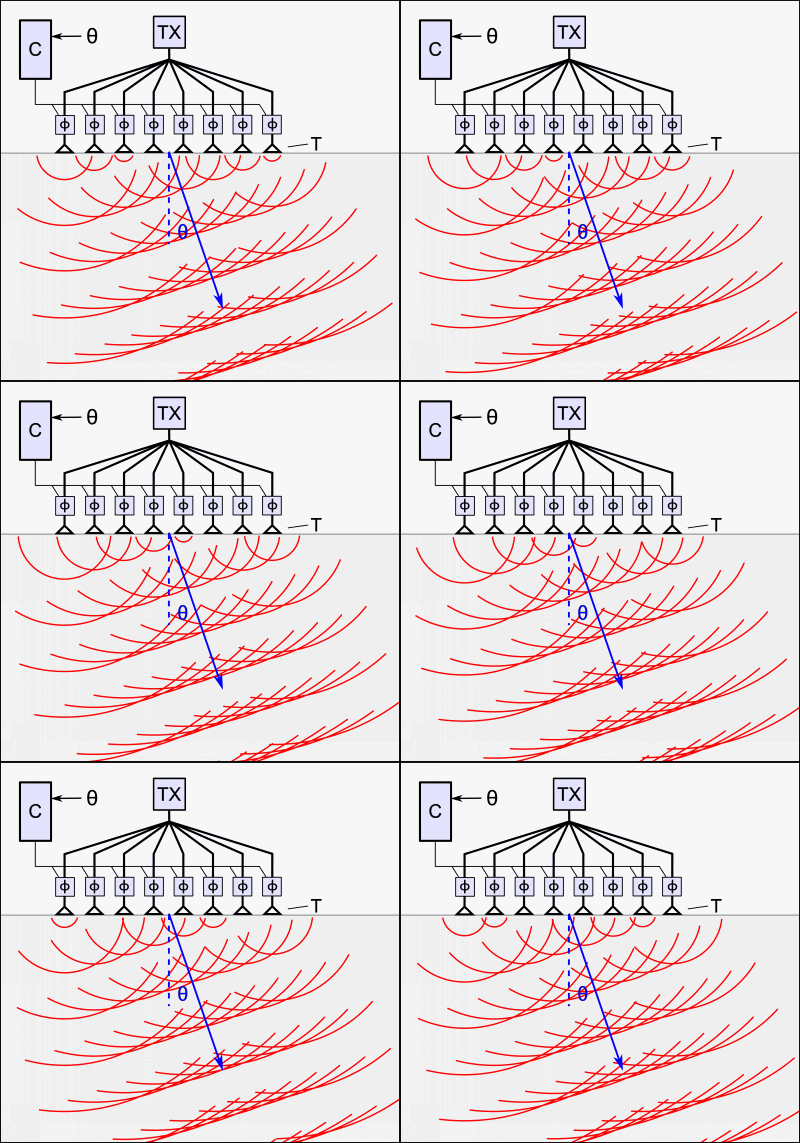
Phased array ultrasonics (PA) is an advanced method of ultrasonic testing that has applications in medical imaging and industrial nondestructive testing. Common applications are to noninvasively examine the heart or to find flaws in manufactured materials such as welds. Single-element (non-phased array) probes, known technically as monolithic probes, emit a beam in a fixed direction. To test or interrogate a large volume of material, a conventional probe must be physically scanned (moved or turned) to sweep the beam through the area of interest. In contrast, the beam from a phased array probe can be focused and swept electronically without moving the probe. The beam is controllable because a phased array probe is made up of multiple small elements, each of which can be pulsed individually at a computer-calculated timing. The term phased refers to the timing, and the term array refers to the multiple elements. Phased array ultrasonic testing is based on principles of wave physics, which also have applications in fields such as optics and electromagnetic antennae.
Principle of operation
The PA probe consists of many small ultrasonic transducers, each of which can be pulsed independently. By varying the timing, for instance by making the pulse from each transducer progressively delayed going up the line, a pattern of constructive interference is set up that results in radiating a quasi-plane ultrasonic beam at a set angle depending on the progressive time delay. In other words, by changing the progressive time delay the beam can be steered electronically. It can be swept like a search-light through the tissue or object being examined, and the data from multiple beams are put together to make a visual image showing a slice through the object.
Use in industry
Phased array is widely used for nondestructive testing (NDT) in several industrial sectors, such as construction, pipelines, and power generation. This method is an advanced NDT method that is used to detect discontinuities i.e. cracks or flaws and thereby determine component quality. Due to the possibility to control parameters such as beam angle and focal distance, this method is very efficient regarding the defect detection and speed of testing. Apart from detecting flaws in components, phased array can also be used for wall thickness measurements in conjunction with corrosion testing. Phased array can be used for the following industrial purposes:
- Inspection of welds
- Thickness measurements
- Corrosion inspection
- PAUT Validation/Demonstration Blocks
- Rolling stock inspection (wheels and axles)
- PAUT & TOFD Standard Calibration Blocks
Features

-
The method most commonly used for medical ultrasonography.
-
Multiple probe elements produce a steerable and focused beam.
-
Focal spot size depends on probe active aperture (A), wavelength (λ) and focal length (F). Focusing is limited to the near field of the phased array probe.
-
\text{Focal spot size} = F\lambda/A
-
\text{Near Field} = A^2/4\lambda
-
-
Produces an image that shows a slice through the object.
-
Compared to conventional, single-element ultrasonic testing systems, PA instruments and probes are more complex and expensive.
-
In industry, PA technicians require more experience and training than conventional UT technicians.
Standards
European Committee for Standardization (CEN)
- prEN 16018, Non destructive testing - Terminology - Terms used in ultrasonic testing with phased arrays
- ISO/WD 13588, * Non-destructive testing of welds – Ultrasonic testing – Use of (semi-) automated phased array technology*
References
Books
- ASME Boiler and Pressure Vessel Code. American Society Of Mechanical Engineers, 2013. Section V — Nondestructive Examination. [See Article 4 — Ultrasonic Examination Methods for Welds. Para E-474 UT-Phased Array Technique]
References
- [http://www.oilfieldtesting.co.uk/corrosion-under-pipe-support-inspection.php Corrosion under pipe support inspection. Retrieved on July 13, 2012.]
- [http://www.tuv.com/en/corporate/business_customers/materials_testing_and_inspection/advanced_ndt/phased_array/phased_array.jsp Phased Array (PA). Retrieved on July 13, 2012]
- [https://massless.info/images/MCarte_Corrosion_Mapping_2.pdf Corrosion Mapping with Phased Array Ultrasonics. 2011 API Inspection Summit and Expo. Retrieved on July 13, 2012.]
- ASTM, E2700. (2012). "Nondestructive Testing, vol 3.03, Contact Ultrasonic Testing of Welds using Phased Arrays". American Society for Testing of Materials.
- "Nde Flaw Tech".
- ASTM, E2491. (2012). "Nondestructive Testing vol 3.03, Evaluating Phased Array Characteristics of Phased Array Ultrasonic Testing Instruments and Systems". American Society for Testing of Materials.
- Birring, Anmol. (September 2008). "Selection of Phased Array Parameters for Weld Testing". Materials Evaluation.
This article was imported from Wikipedia and is available under the Creative Commons Attribution-ShareAlike 4.0 License. Content has been adapted to SurfDoc format. Original contributors can be found on the article history page.
Ask Mako anything about Phased array ultrasonics — get instant answers, deeper analysis, and related topics.
Research with MakoFree with your Surf account
Create a free account to save articles, ask Mako questions, and organize your research.
Sign up freeThis content may have been generated or modified by AI. CloudSurf Software LLC is not responsible for the accuracy, completeness, or reliability of AI-generated content. Always verify important information from primary sources.
Report