From Surf Wiki (app.surf) — the open knowledge base
Phaeton body
Style of open automobile, popular in the early 20th-century
Style of open automobile, popular in the early 20th-century
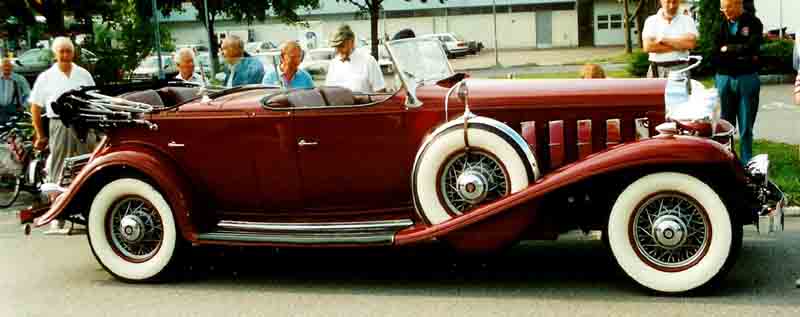
A phaeton is a style of open automobile without any fixed weather protection, which was popular from the 1900s until the 1930s. It is an automotive equivalent of the horse-drawn fast, lightweight phaeton carriage.
A popular style in the US from the mid–1920s and continuing into the first half of the 1930s was the dual cowl phaeton, with a cowl separating the rear passengers from the driver and front passenger.
Phaetons fell from favour when closed cars and convertible body styles became widely available during the 1930s. Eventually, the term "phaeton" became so widely and loosely applied that almost any vehicle with two axles and a row or rows of seats across the body could be called a phaeton. Convertibles and pillarless hardtops were sometimes marketed as "phaetons" after actual phaetons were phased out.
History
The term phaeton had historically described a light, open four-wheeled carriage. When automobiles arrived it was applied to a light two-seater with minimal coachwork. The term was interchangeable with spyder, derived from a light form of phaeton carriage known as a spider. Originally meant to denote a faster and lighter vehicle than a touring car, the two terms eventually became interchangeable.
A detachable folding or rigid roof could be added before a drive in preparation for inclement weather, and side curtains or screens could be installed once the roof was in place. This was mainly temporary and partial relief rather than the more permanent, watertight protection offered by a convertible. As a result, a phaeton was much lighter than the sturdier, weather-ready convertible. Since the body was entirely open, it was easy to add or remove an extra row of seating where space had been left in the original construction.
A phaeton differs from a convertible in having no winding or sliding windows in the doors or the body. File:1917.hudson.phaeton.arp.jpg|1917 Hudson phaeton File:Isotta Fraschini Tipo 8 Sala Phaeton.jpg|Isotta Fraschini Tipo 8 Sala File:Studebaker Phaeton.jpg|1930 Studebaker File:Ford A Typ180A DeLuxePhaeton1930 2.JPG|1930 Ford Model A File:1934 ford model 40 750 De Luxe Phaeton.jpg|1934 Ford Model B File:1936 Toyota Model AB Phaeton 01.jpg|Toyota AB phaeton
Doubles and triples
There were also double phaetons, with two rows of seats, triple phaetons, and closed phaetons.
After 1912, American use of the term began to be most closely associated with the "triple phaeton" body configurations that had room for three rows of seats, whether all three were installed or not. This also led to the term "phaeton" becoming similar to, and eventually interchangeable with, the term "touring car".
File:1924RollsRoyce.jpg|1924 Rolls-Royce 40/50 File:Duesenberg Convertible SJ LA Grand Dual-Cowl Phaeton 1935.jpg|1935 Duesenberg File:Mercedes Double Phaeton.jpg|1905 Mercedes 28/50 PS double phaeton File:President Johnson (USA) had besprekingen met Kiesinger te Bonn, lijfwacht Presid, Bestanddeelnr 920-2596.jpg|Cadillac phaeton carrying President Johnson, 1967, nicknamed the "Queen Mary" by his Secret Service detail File:Chrysler Phaeton 1.jpg|1997 Chrysler Phaeton concept car
Dual cowl phaeton
Specific use of the term phaeton is with the dual cowl phaeton, a body style in which the rear passengers were separated from the driver and the front passengers by a cowl or bulkhead, often with its own folding windshield.
File:DUESENBERG MODEL SJ LAGRANDE.jpg|1935 Duesenberg Model SJ LaGrande Dual Cowl Phaeton File:1956 Imperial Parade Phaeton - Dwight Eisenhower car - fvl.jpg|1956 Chrysler Imperial Parade Phaeton
Decline in popularity
The phaeton and the touring car were popular up to the 1930s, after which they were largely replaced by the convertible, which also had a retractable roof, but also included side windows so that the car could be completely enclosed.
The Willys-Overland Jeepster was the last true phaeton produced by a major US automaker, and was introduced ten years after the previous phaeton to be offered by an American manufacturer. The post-World War II demand for automobiles - of any description - was an opportunity for Willys-Overland to build on the Jeep's military recognition and they evolved the 1946 Jeepster two-door station wagon to the 1948 phaeton. It provided a "Spartan but adequate appointments" that included hinged front door vent windows and plastic side curtains rather than roll-up glass windows. Marketed from 1948 to 1951, the Jeepster phaeton was a rather expensive niche vehicle and "though admired by many, it was purchased by relatively few."
In 1952, a year after Willys last offered the Jeepster, Chrysler Corporation built three Imperial Parade phaetons for ceremonial use, one by New York City, one by Los Angeles, and one intended for the White House, but ultimately used for events throughout the United States. These were dual-cowl phaetons custom-built on stretched versions of the company’s Imperial Crown Limousine chassis.
As a model name
In the late 1930s, Buick included a "convertible phaeton" body style, which was actually a four-door convertible, as the doors had roll up windows in them and the car could be fully closed.
During the 1956 model year, Mercury marketed the four-door hardtop versions of its Montclair and Monterey models as "phaetons."
In 2004, Volkswagen introduced a vehicle with the name Phaeton, based on the Audi A8, which had a typical four-door sedan body style.
File:1934 Buick Series 60 Convertible Phaeton.JPG|1934 Buick "convertible phaeton" File:1956MercuryMontclair.jpg|1956 Mercury Montclair Phaeton 4-door hardtop sedan File:2013 Volkswagen Phaeton V6 4MOTION TDi SWB Automatic 3.0.jpg|2013 Volkswagen Phaeton – a four-door hardtop sedan
References
References
- "Definition of Phaeton".
- Haajanen, Lennart W.. (2017). "Illustrated Dictionary of Automobile Body Styles". McFarland.
- Roberts, Peter. (1974). "Veteran and Vintage Cars". Octopus Books.
- "Definition of Phaeton".
- "Phaeton vs. Convertible?". Jalopy Journal - The H.A.M.B..
- (1914). "Motor Body-building in All Its Branches". E. & F. N. Spon.
- (1966). "Webster's Third New International Dictionary of the English Language, Unabridged". G & C Merriam.
- (2013). "The complete catalogue of British Cars 1895 - 1975". Veloce Publishing.
- (11 August 2015). "Nothing Arrives in Style Like a Dual Cowl Phaeton". The Truth About Cars.
- (16 May 2018). "Sure, phaetons are fabulous; just don't try riding in the back seat". Hagerty.
- Matar, George. (December 2005). "1948-1951 Jeepster". Hemmings Classic Car.
- (1994). "Jeep: The Unstoppable Legend". Publications International.
- (15 August 1998). "1949 Willys Jeepster Phaeton". Christies.
- ((The Auto Editors of Consumer Guide)). (30 October 2007). "Introduction to the 1967-1973 Jeepster Commando".
- (19 February 2019). "Chrysler Imperial: The Most Beautiful Presidential Limo in History". Car and Driver.
- "Imperial Parade Phaeton".
- "Buick brochure".
- Gunnel, John. (2004). "Standard Catalog of Buick 1903-2004". Krause Publications.
- (March 2020). "The 1938 Buick Century Convertible Phaeton offers great bang for the buck". Hemmings Motor News.
- (January 1956). "Four-door hardtop is the newest member of 1956 Mercury line". Popular Science.
- "1956 Mercury Hardtops brochure (Meet Mercury's new fleet of low-siluette hardtops ... featuring glamorous, new 4-DOOR ''Phaetons'')".
- (22 July 2012). "Biggest Automotive Missteps: Volkswagen Phaeton - The "Peoples' Car" brand simply couldn't get away with a full-blown luxury sedan". CarBuzz.

This article was imported from Wikipedia and is available under the Creative Commons Attribution-ShareAlike 4.0 License. Content has been adapted to SurfDoc format. Original contributors can be found on the article history page.
Ask Mako anything about Phaeton body — get instant answers, deeper analysis, and related topics.
Research with MakoFree with your Surf account
Create a free account to save articles, ask Mako questions, and organize your research.
Sign up freeThis content may have been generated or modified by AI. CloudSurf Software LLC is not responsible for the accuracy, completeness, or reliability of AI-generated content. Always verify important information from primary sources.
Report