From Surf Wiki (app.surf) — the open knowledge base
Peugeot 208
Supermini car produced by Peugeot
_(cropped).jpg)
Supermini car produced by Peugeot
| Field | Value |
|---|---|
| name | Peugeot 208 |
| image | Peugeot 208 PureTech 130 EAT8 Allure GT-Line (II) – f 17102021.jpg |
| caption | Peugeot 208 GT Line (second generation) |
| manufacturer | Peugeot |
| production | March 2012 – present |
| class | Supermini (B) |
| layout | Front-engine, front-wheel-drive |
| related | Peugeot 2008 |
| predecessor | Peugeot 207 |
The Peugeot 208 is a subcompact car (B-segment in Europe) produced by the French automaker Peugeot. Unveiled at the Geneva Motor Show in March 2012 and positioned below the larger 308, the 208 replaced the 207 in 2012, and the second generation model was introduced in 2019.
TOC
{{Anchor|A9}}First generation (A9; 2012)
January 2013 – March 2020 (Brazil) Brazil: Porto Real (PSA Brazil) Malaysia: Gurun (NAM) Slovakia: Trnava (Trnava Plant) Iran: Tehran (IKAP) Citroën C3 (SX) Citroën C4 Cactus DS 3 Opel Crossland | Petrol: | 1.0 L I3 VTi | 1.2 L I3 VTi | 1.2 L I3 Puretech N/A and Turbo | 1.4 L I4 VTi | 1.6 L I4 VTi | 1.6 L I4 Prince engine THP | Diesel: | 1.4 L I4 DV4 HDi | 1.4 L I4 DV4 e-HDi | 1.5 L I4 DV5 BlueHDi | 1.6 L I4 DV6 HDi | 1.6 L I4 DV6 e-HDi | 1.6 L I4 DV6 BlueHDi The 208 was designed by a team under the direction of Pierre Authier who also designed the Peugeot 2008 Mk1. In November 2011, the initial 208 models were three-door hatchbacks produced at Peugeot's new plant in Trnava, Slovakia. As five-door hatchbacks became available in June 2012, production also started at Peugeot's French plants located in Mulhouse and Poissy.
Design
The first-generation 208, developed under the code name "A9", is constructed on the PSA PF1 platform. The car was unveiled in March 2012 at Geneva Motor Show 2012. It is 173 kg (or 110 kg on average) lighter than the 207, while still providing more room. The boot capacity is rated at 285 L (VDA), which is 15 L more than the 207, while the legroom in the rear seat has increased by 5 cm.
The design work of the first-generation 208 was led by Pierre Authier, with Sylvain Henry as the exterior designer. Adam Bazydlo was responsible for the interior design, and Marie Sanou oversaw colour and trim. The vehicle is equipped with a tablet computer-like display, a panoramic glass roof surrounded by LED lights, and has a relatively low drag coefficient of 0.29.
The three-door 208 was discontinued in mid-2018, and Peugeot ceased production of the first-generation 208 in Europe in 2019. From January 2013 to March 2020, the first-generation 208 was produced in Brazil. It was replaced with the second-generation model, which is imported from Argentina.
File:Peugeot 208 95 VTi Active – Heckansicht, 5. Mai 2012, Düsseldorf.jpg|2012 Peugeot 208 VTi Active 3-door hatchback (pre-facelift; Germany) File:Peugeot 208 e-HDi FAP 115 Stop & Start Allure – Heckansicht, 23. September 2012, Hilden.jpg|2012 208 e-HDi FAP 115 Allure 5-door hatchback (pre-facelift, Germany) File:2015 Peugeot 208 Cielo interior.jpg|Interior
Presentation
Five petrol and three diesel were available from its launch in 2012. To keep maximum weight reduction, the brand favours fuel consumption, safety and the overall performance of the vehicle. All components of the vehicle have been considered with this in mind. The vehicle features an aluminium front beam-absorber, size of the front subframe, laser welding of the roof, and an extensive use of VHSS and UHSS panels, soundproofing of the engine. The vehicle weighs about 110 kg less than the 207.
After launch, the Peugeot 208 Mk1 had received new variants that moved towards the hot hatch segment. The GTi had started production in February 2013, with a 1.6-litre petrol engine, and the XY trim level had started slightly after the GTi, positioned between the 208 and the GTi model. The diesel engines return the most efficient fuel economy.
In June 2015, the Mk1 208 was given a facelift, which had revised its styling, and added extra safety equipment. The facelift also introduced the top-level GT-Line trim level, which added a touchscreen display, Apple CarPlay and Android Auto compatibility on most models. In November 2014 Peugeot launched the limited edition "30th Anniversary" version of the 208 GTi, and the diesel range would decrease to a 1.5-litre line-up by 2018.
File:2017 Peugeot 208 Active 1.2 facelift Front.jpg|2017 208 1.2 Active 5-door hatchback (facelift; UK) File:2017 Peugeot 208 Active 1.2 facelift Rear.jpg|2017 208 1.2 Active 5-door hatchback (facelift; UK) File:2016_Peugeot_208_Allure_PureTech_-1200cc_1.2(100PS)Petrol-Silver-_07-2024,_Front.jpg|2016 208 1.2 Allure 5-door hatchback (facelift; UK)
208 GTi
The 208 GTi was introduced in September 2012 as the performance model of the first-generation 208. Previously, it was showcased as a concept model in March 2012. Based on the three-door 208, the variant weighs 1160 kg, which is 90 kg lighter than the 207 GTi.
Compared to the standard 208, the front and rear tracks have been widened 10 mm and 20 mm. Fitted with 17-inch alloy wheels with 205/45 tyre size, the 208 GTi is also equipped with a larger 302 mm disc brakes at the front, cooled by functional vents. Its suspension has also been upgraded and the steering recalibrated appropriately.
The 208 GTi is fitted with a 1.6 litre turbo (1,598 cc) four cylinder in line turbo petrol Prince engine producing 200 PS at 5,800 rpm and 275 Nm of torque at 1,700 rpm, and is fitted with a six-speed manual transmission. The GTi's Prince engine is shared with the Peugeot RCZ, several Mini and various Citroëns.
This first GTi model has since been replaced by the 208 GTi by PeugeotSport which is directly derived from the limited edition '30ème Anniversaire Edition' which put out 208 hp with revised suspension and an optional two tone paint along with a facelift of the original bumpers and other small changes.
Although a high-performance 208 R was planned for the lineup, it was never released. It would have been positioned above the 208 GTi.
File:Peugeot 208 GTi (front quarter).JPG|208 GTi (pre-facelift) File:2017 Peugeot 208 GTi 1.6 Front.jpg|208 GTi (facelift)
208 GTi 30th by Peugeot Sport
A limited edition "30th by Peugeot Sport" was launched to mark the 30th anniversary of the 205 GTi, launched in 1984. Equipped with a 208 PS engine, the model was tuned by Peugeot Sport, the brand's competition department. Improvements over the regular 208 GTi include a Torsen limited-slip differential from the RCZ R and performance-oriented suspension and steering settings. Braking is handled by front 323 mm discs pinched by 4-piston fixed Brembo calipers.
The car was shown at the 2014 Goodwood Festival of Speed. It went on sale the following November in France
Powertrain
All the petrol engines comply with the Euro 5 norm and the diesel engines have emissions of 99 g/km or lower. In addition to the four cylinder petrol engines carried over from the previous model, from September 2012, the 208 has been offered with two new three cylinder units with variable valve timing – the 1.0 VTi producing 68 PS and 1.2 VTi 82 PS.
The 1.0 comes with an advertised fuel consumption of 4.3 L/100 km, and a emissions value of 99 g/km. A 1.2 L three cylinder is available with a turbocharger designated as the PureTech 110 S&S (available on the GT Line models and the allures) or without designated PureTech 82 S&S (available on the active, VTi, or XS). This engine is coupled to a five speed manual or a six speed automatic.
The range of diesel units starts with the four-cylinder 1.4-litre e HDi unit, originally introduced in 2010 for the 207, which provides 50 kW of power coupled, in the 208, with published fuel economy and emission figures of 3.4 L/100 km and 87 g/km.
2012-2015
| Petrol engines | Model | Type | Power, Torque@rpm | 0–100 km/h (0-62 mph) (s) | Top speed | Transmission | Kerb weight | Years | Diesel engines |
|---|---|---|---|---|---|---|---|---|---|
| 1.0 VTi | 999 cc I3 | 68 PS @ 6000 RPM, 95 Nm @ 3000 RPM | 14 | 163 km/h | 5-speed manual | 975 kg | 2012–2015 | ||
| 1.2 VTi | 1199 cc I3 | 82 PS @ 6000 RPM, 118 Nm @ 2750 RPM | 12.2 | 175 km/h | 5-speed manual | 975 kg | 2012–2015 | ||
| 1.4 VTi | 1397 cc I4 | 95 PS @ 6000 RPM, 136 Nm @ 4000 RPM | 10.5 | 188 km/h | 5-speed manual | 1070 kg | 2012–2015 | ||
| 1.6 VTi | 1598 cc I4 | 120 PS @ 6000 RPM, 160 Nm @ 4250 RPM | 8.9 | 190 km/h | 5-speed manual | 1090 kg | 2012–2015 | ||
| 1.6 THP | 1598 cc turbo I4 | 155 PS N/A, N/A | 7.3 | 215 km/h | 6-speed manual | 1165 kg | 2012–2015 | ||
| GTI (1.6 THP) | 1598 cc turbo I4 | 200-208 PS @ 6800/5800 RPM, 275 Nm @ 1700/1700-3000 RPM | 6.8/6.5 | 230 km/h | 6-speed manual | 1160 kg | 2013–2015 | ||
| 1.4 HDi/e-HDi | 1397 cc I4 | 68 PS @ 4000, 160 Nm @ 1750 RPM | 13.5 | 163 km/h | 5-speed manual | 1050 kg | 2012–2015 | ||
| 1.6 e-HDi | 1560 cc turbo I4 | 92 PS @ 4000 RPM, 230 Nm @ 1750 RPM | 10.9 | 185 km/h | 5-speed manual | 1080 kg | 2012–2015 |
2015-2018
| Petrol engines | Model | Type | Power, Torque@rpm | 0–100 km/h (0-62 mph) (s) | Top speed | Transmission | Kerb weight | Years | Diesel engines | |||
|---|---|---|---|---|---|---|---|---|---|---|---|---|
| 1.0 Puretech | {{convert | 999 | cc | cuin | I3]] | 68 PS @ 6000, 95 Nm @ 3000 | 14 | 165 kph | 5-speed manual | 960 kg | 2015-2016 | |
| 1.2 Puretech | {{convert | 1199 | cc | cuin | I3]] | 68 PS @ 5750, 106 Nm @ 2750 | 13.8 | 166 kph | 5-speed manual | 960 kg | 2016-2019 | |
| {{convert | 1199 | cc | cuin | I3]] | 82 PS @ 5750, 118 Nm @ 2750 | 12.2 | 175 kph | 5-speed manual | ||||
| 5-speed automatic | 960 kg | |||||||||||
| 960 kg (AT) | 2015-2018 | |||||||||||
| {{convert | 1199 | cc | cuin | I3]] | 83 PS @ 5750, 118 Nm @ 2750 | 13.6 | 175 kph | 5-speed manual | 1080 kg | 2018-2019 | ||
| {{convert | 1199 | cc | cuin | turbo]] I3 | 110 PS @ 5500, 205 Nm @ 1500 | 9.6 | 190 kph | 5-speed manual | 1060 kg | |||
| 1090 kg (AT) | 2015-2018 | |||||||||||
| {{convert | 1199 | cc | cuin | abbr=on}} turbo I3 | 110 PS @ 5500, 205 Nm @ 1750 | 9.3 | 188 kph | 5-speed manual | 1075 kg | |||
| 1090 kg (AT) | 2018-2019 | |||||||||||
| 1.6 THP | {{convert | 1598 | cc | cuin | abbr=on}} turbo I4 | 208 PS @ 6000, 300 Nm @ 3000 | 6.5 | 230 kph | 6-speed manual | 1160 kg | 2015-2016 | |
| 1.5 BlueHDI | {{convert | 1499 | cc | cuin | abbr=on}} turbo I4 | 102 PS @ 3500, 250 Nm @ 1750 | 10.5 | 188 kph | 6-speed manual | 1080 kg | 2018-2019 | |
| 1.6 BlueHDI | 1560 cc turbo I4 | 75 PS @ 3500, 230 Nm @ 1750 | 13.3 | 171 kph | 5-speed manual | 1065 kg | 2015-2018 | |||||
| 1560 cc turbo I4 | 100 PS @ 3750, 254 Nm @ 1750 | 10.7 | 187 kph | 5-speed manual | 1090 kg | 2015-2018 | ||||||
| 1560 cc turbo I4 | 120 PS @ 3500, 285 Nm @ 1750 | 9.4 | 190 kph | 6-speed manual | 1115 kg | 2015-2018 |
Trims
The 208 comes with a range of trims and specs. Starting from the entry model
- Active – Available with either a 1.2L PureTech 82 S&S petrol engine or a 1.5L BlueHDi diesel engine, both come with a 5-speed manual.
- Signature (also known as the Allure) – Comes with the same engine and transmission as the Active but has different styling and wheels.
- Tech Edition – As well as coming with the same engine as the Active and Signature it also comes with a 1.2L PureTech 110 turbocharged engine with 5-speed manual or 6-speed automatic transmissions.
- GT-Line – This is the top of line model that is available from Peugeot. Coupled with the 1.2L 110 bhp engines with 6-speed automatic and 5-speed manual transmission as well as the 1.5 litre diesel. This trim offers all the styling of a hot hatch, it has 16-inch alloy wheels which are diamond cut.
Additional trims consist of the Access, Access Plus, Style, Lime, XY, GTI, GTI Prestige, GTI Limited Edition, GTI 30th Anniversary, Roland Garros, Intuitive, and the Feline. A number of models mentioned are limited.
Safety
ANCAP
Euro NCAP
Latin NCAP
The 208 in its most basic Latin American market configuration with 2 airbags received 4 stars for adult occupants and 3 stars for toddlers from Latin NCAP 1.0 in 2014.
The 208 in its most basic Latin American market configuration with 2 airbags and no ESC received 2 stars for adult occupants and 3 stars for toddlers from Latin NCAP 2.0 in 2016.
| Child protection stars |
|---|
ASEAN NCAP
{{Anchor|UB|UJ|UP|UW}} Second generation (P21; 2019)
Spain: Zaragoza (Opel España de Automóviles) Morocco: Kenitra (Kenitra Plant) Argentina: El Palomar, Buenos Aires Yann Beurel (exterior) Eric Dejou (interior) | Peugeot 2008 (P24) | Opel Corsa F | Opel Mokka B | DS 3 Crossback | Citroën C4 (2020) | Lancia Ypsilon IV | Petrol: | 1.0 L FireFly I3 flex fuel (South America) | 1.2 L EB2FA I3 | 1.2 L EB2ADTD/EB2DTS turbo I3 | 1.6 L EC5 I4 flex fuel (South America) | Diesel: | 1.5 L DV5 BlueHDi I4 | 1.6 L DV6 D HDI I4 (Morocco)
Since this generation, the 208 switches from the older PF1 platform to the Common Modular Platform (CMP). The newer platform, which is shared with the 2008, the DS 3 Crossback and Opel Corsa, allowed Peugeot's engineers to reduce around 30 kg from the vehicle's weight. The newly developed platform also enhanced the vehicle's aerodynamics and comfort, as noise, vibration, and harshness (NVH) levels are claimed to be reduced compared to its predecessor.
The 208's interior has also been updated with Peugeot's i-Cockpit, featuring a digital instrument cluster, smaller steering wheel design and a touchscreen display available in various sizes. Physical buttons and switches have been minimized, as most of the controls have been integrated into the infotainment system. It is also available with optional advanced driver-assistance systems, featuring adaptive cruise control, lane centering, automatic parking, and blind spot monitoring. Models equipped with a manual transmission feature cruise control down to a minimum speed of 18 mph; the automatic and e-208 models can control the car down to a stop. File:Peugeot 208 PureTech 130 EAT8 Allure GT-Line (II) – h 17102021.jpg|Rear view (GT Line) File:2019 Peugeot 208 GT Line PureTech Automatic 1.2 Interior.jpg|Interior (GT Line)
Technical
The 208 offers a choice of powertrains, using conventional petrol or diesel engines, or an electric motor. The conventional petrol engines branded "PureTech" are all 1.2-litre, three-cylinder naturally aspirated EB2FA with 74 hp, or turbo EB2DT with 100 hp, or turbo EB2DTS with 129 hp, except the versions made in Argentina which use the 1.6-litre naturally-aspirated EC5 either petrol-only or ethanol-capable flex fuel for export to Brazil.
The diesel model will come in just one engine variant, a 1.5-litre four cylinder engine producing 75 kW. Moroccan buyers have the option of the older 1.6 HDi engine producing 92 PS. Peugeot have yet to announce the Sport models and what engine they will be using, such as the GTi which has been part of the family of the 208.
However, Guillaume Clerc, the project manager for the second generation 208, stated that development of a petrol 208 GTi ended in 2017, because it was impossible to meet the corporate average emission targets with the larger 1.6-litre engine used in the previous generation 208 GTi. Clerc hinted the next GTi could be based on the e-208.
{{anchor|e-208}}e-208
Main article: Peugeot e-208
Since the introduction of the second-generation 208, Peugeot also offers a battery electric version called the e-208. Unlike competing contemporary vehicles such as the Renault Zoe and Volkswagen ID.3, the e-208 shares a common chassis with the conventional petrol/diesel powered 208. Peugeot chose this deliberately to enable potential buyers to select the drivetrain that best suits their requirements. It also allows Peugeot to assemble the e-208 on the same line as the 208, at the Slovakian Trnava plant.
Compared to the conventionally powered versions of the 208, the e-208 is approximately 350 kg heavier, and has a slightly wider rear axle, to accommodate the battery pack.
The e-208 has a heat-pump controlled 50 kWh battery, a 100 kW motor, and a 6.6 kW charger. WLTP range is 211 mi. It is equipped with a CCS Combo Type 2 connector, or CHAdeMO in Japan, and can charge at a rate of up to 100 kW from a suitable DC fast charging station. Charge rate can be 70 kW up to 40% state of charge, then decreasing to 50 kW. The onboard charger is limited to 7.4 kW, but may be equipped with a three phase 11 kW charger as an option. In the e-208, the gear selector is used to choose the level of regenerative braking.
Shortly after it went on sale in October 2019, demand for the e-208 was reported as strong. Peugeot had anticipated making approximately 30,000 e-208 cars per year, 10 percent of the planned annual production of 300,000 for the entire 208 product line, but of all pre-orders received were for the e-208. Maximum annual production for the e-208 is 60,000 units.
The electric e-208 was voted "Most Desired Electric Car" in North Macedonia at the Golden Steering Wheel awards at the beginning of 2021. File:2020 Peugeot e-208 GT Rear.jpg|Rear view (e-208 GT)
Facelift
In July 2023, Peugeot announced a facelift for the second generation 208.
The updated model has a new front end with new headlights, front apron and grille, while it receives new tail lights in the back. LED headlights and partial LED tail lights became standard, with full LED options available. The grille maintains its overall proportions but has new designs with body coloured elements (except for the base trim) and the apron incorporated three vertical lines as the new light signature and DRLs. New colours are also available.
In the interior, the infotaintment system became equipped with a 10-inch display as standard (as opposed to 7-inch in the pre-facelift model), but the cockpit remains analogue for the base trim. New fabrics are also available.
The PureTech 75 and 100 engines with manual gearboxes remain in the lineup, while the automatic PureTech 100 and 130 get a new 48V hybrid system which can run in electric mode at times. The e-208 has a new powertrain which outputs 115 kW and has an increased range of 400 km. File:Peugeot e-208 facelift 1X7A2502.jpg|e-208 GT (facelift) File:Peugeot e-208 facelift Auto Zuerich 2023 1X7A1209.jpg|Rear view File:Peugeot 208 B facelift DSC 7227.jpg|208 GT (facelift) File:Peugeot 208 B facelift Hybrid 1X7A2503.jpg|Rear view
e-208 GTI
Peugeot unveiled the E-208 GTI at the 2025 24 Hours of Le Mans in France, bringing the GTI badge back to its lineup after a six-year absence and using it on an electric car, with the e-208 GTI sharing much with the Abarth 600e Scorpionissima and Alfa Romeo Junior Veloce. File:Peugeot E-208 GTi Auto Zuerich 2025 DSC 3025.jpg|e-208 GTI File:Peugeot E-208 GTi Auto Zuerich 2025 DSC 3030.jpg|Rear view
South American assembly
In July 2020, Peugeot started the assembly of the second-generation 208 in Argentina in its Buenos Aires plant. The vehicles produced at the plant are intended for South American market, with 60 percent exported outside Argentina. Only internal combustion models are produced there, as the e-208s sold in South America are imported.
In 2020, the Argentinian-made 208 was claimed to be 95 percent equal to the European version (with a different engine and other parts), while 40% of its parts are made in Argentina. The South American model are engineered with a higher ground clearance (+10 to 12 mm) and a higher approach angle (16 degrees instead of 14 degrees) to adapt to the more rugged local roads compared to European ones. It also uses less expensive materials, such as using steel instead of aluminum. Other differences include different rear seats and a larger fuel tank.
The Argentinian-made 208 is equipped with the 1.6-litre EC5F engine producing 114 PS. In May 2022, following the merger of PSA and FCA to form Stellantis, Peugeot released a naturally-aspirated 1.0-litre 208 as an entry-level option for the Brazilian market. This model uses the Firefly engine from the Fiat Argo, rated at 71 or depending on whether it uses petrol or ethanol. Naturally-aspirated 1.0 engines represent most of the B-hatch segment sales in Brazil.
Since the second half of 2022, a portion of the 208s sold in Chile are from Argentina (in addition to European imports).
In September 2023, a third engine was added to the Brazilian range, which is a 1.0-litre Turbo 200 130 PS from Fiat.
File:2023 Peugeot 208 1.6 Feline Triptronic.jpg|2023 Peugeot 208 1.6 Feline (Argentina) File:2023 Peugeot 208 Style (produced in Argentina) interior.png|Interior
Powertrain (Europe)
| Petrol engines | Model | Type | Power, Torque@rpm | 0–100 km/h (0-62 mph) (s) | Top speed | Transmission | emission (g/km) | Years | Diesel engine | Electric motor (e-208) | Battery | Power, Torque | 0–100 km/h (s) | Top speed | Transmission | Range (WLTP) | Years | |||
|---|---|---|---|---|---|---|---|---|---|---|---|---|---|---|---|---|---|---|---|---|
| 1.2 PureTech 75 S&S | {{convert | 1199 | cc | cuin | I3]] | 75 PS @ 5750, 118 Nm @ 2750 | 13.2 | 102 mph | 5 speed manual | 93–98 | 2019– | |||||||||
| 1.2 PureTech 100 S&S | {{convert | 1199 | cc | cuin | I3]] | 100 PS @ 5500, 205 Nm @ 1750 | 9.9 | 117 mph | 6 speed manual | 96–102 | 2019– | |||||||||
| 1.2 PureTech 100 EAT8 S&S | {{convert | 1199 | cc | cuin | I3]] | 100 PS @ 5500, 205 Nm @ 1750 | 10.8 | 117 mph | 8 speed automatic | 97–104 | 2019– | |||||||||
| 1.2 PureTech 130 EAT8 S&S | {{convert | 1199 | cc | cuin | I3]] | 130 PS @ 5500, 230 Nm @ 1750 | 8.7 | 129 mph | 8 speed automatic | 101–108 | 2019– | |||||||||
| 1.5 BlueHDi 100 | {{convert | 1499 | cc | cuin | I4]] | 102 PS @ 3500, 250 Nm @ 1750 | 10.2 | 117 mph | 6 speed manual | 84–92 | 2019– | |||||||||
| 50 kWh lithium-ion | 136 PS, | |||||||||||||||||||
| 260 – | 8.1 | 93 mph | 1 speed automatic | 340 km | 2019–2021 | |||||||||||||||
| 50 kWh lithium-ion | 136 PS, | |||||||||||||||||||
| 260 – | N/A | 93 mph | 1 speed automatic | 362 km | 2021–2023 | |||||||||||||||
| 51 kWh lithium-ion | 156 PS, | |||||||||||||||||||
| 260 – | N/A | N/A | 1 speed automatic | 400 km | 2023–present |
Safety
ANCAP
Euro NCAP
Latin NCAP
The 208 in its most basic Latin American market configuration with 4 airbags and ISA received 2 stars from Latin NCAP 3.0 in 2021 (similar to Euro NCAP 2014).
Sales
Peugeot announced the 300,000th 208 was produced in February 2013.
| Year | Europe | Brazil | Worldwide production | Worldwide sales | Notes |
|---|---|---|---|---|---|
| 2011 | 198 | 631 | |||
| 2012 | 160,047 | 242,900 | 220,800 | Total production reaches 243,600 units. | |
| 2013 | 237,266 | 20,715 | 333,800 | 334,439 | Total production reaches 577,400 units. |
| 2014 | 214,547 | 23,523 | |||
| 2015 | 228,088 | 13,334 | |||
| 2016 | 247,379 | 10,769 | |||
| 2017 | 242,589 | 12,157 | |||
| 2018 | 230,107 | 7,093 | |||
| 2019 | 224,848 | 5,608 | |||
| 2020 | 199,316 | 4,403 | |||
| 2021 | 195,728 | 16,345 | |||
| 2022 | 206,816 | 29,879 | |||
| 2023 | 28,634 | ||||
| 2024 | 17,717 | ||||
| 2025 | 9,812 |
Motorsport
208 T16 Pikes Peak

In April 2013, a 208 T16 was tested by Sébastien Loeb at Mont Ventoux. Loosely based on the shape and design of the production 208, the T16 is a lightweight 875 kg vehicle that uses the rear wing from the Peugeot 908, and has a 3.2 litre, twin turbo V6 engine, developing 875 bhp, allowing it to accelerate from 0–100 km/h in 1.8 seconds,{{cite web |access-date =27 February 2020
At Pikes Peak on 30 June 2013, Sébastien Loeb used the 208 T16 to break Rhys Millen's record time, set in 2012 on the first fully paved roads in the history of the competition. The previous record of 9:46.164 was shattered, and a new record time of 8:13.878 was set.
The car also won the hillclimbing race, at the 2014 Goodwood Festival of Speed in June 2014.
Racing
In 2018, a Peugeot 208 GTi 30th Edition model won the overall award in the inaugural Classic Sports Car Club Turbo Tin Tops Series, for forced induction front wheel drive cars.
Rallycross
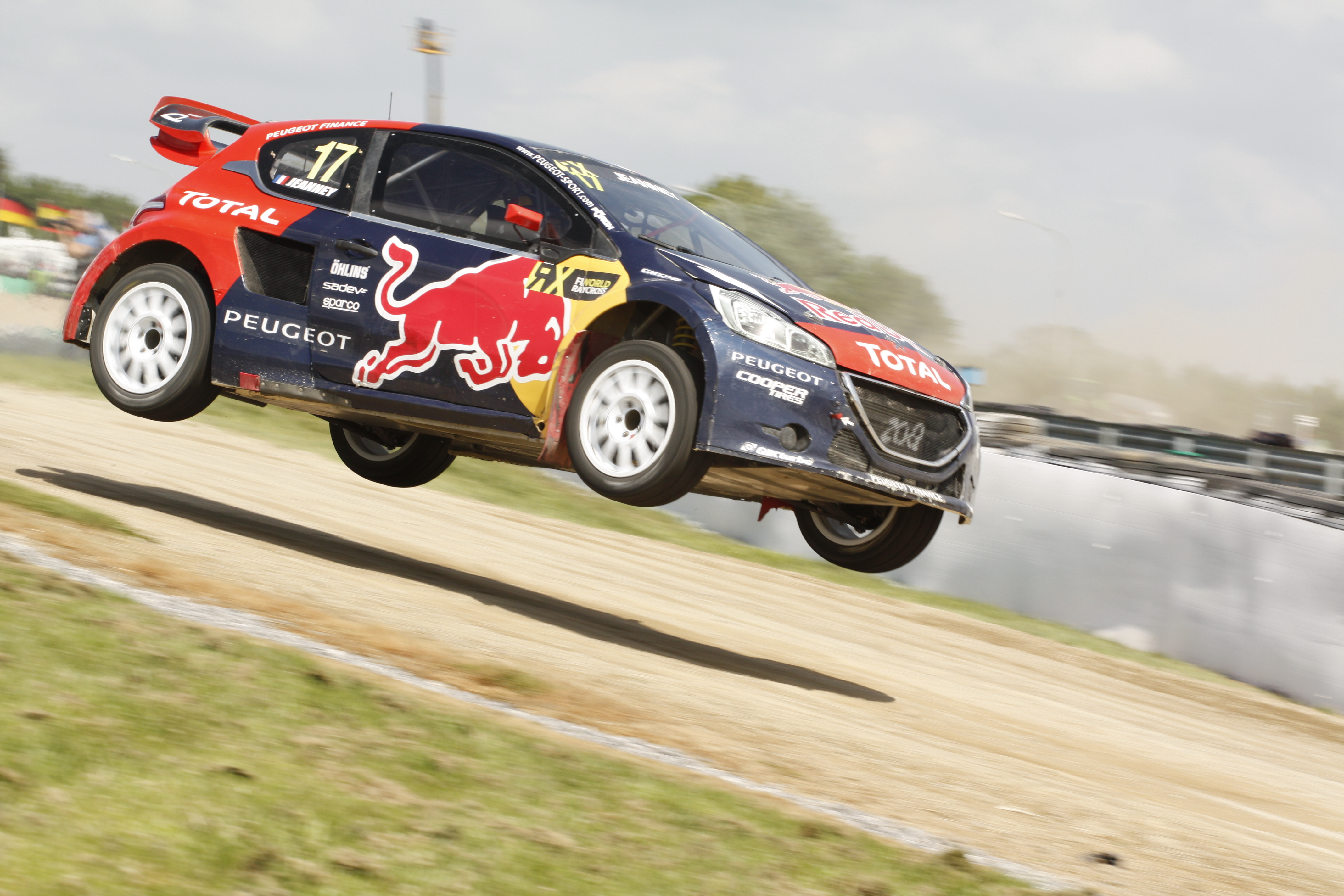
Team Peugeot-Hansen won the manufacturers title at the FIA World Rallycross Championship in November 2015. Jérôme Grosset-Janin was runner up in the FIA European Rallycross Championship in the same year.
Timmy Hansen won the 2019 FIA World Rallycross Championship using a Peugeot 208, and Hansen MJP won the teams championship.
Rally

Juha Salo won the Finnish Rally Championship in 2015 and 2016.
Notes
Awards
208 receives the 'Best Cars' award for the best city car by a jury of readers from the magazine l'Automobile.
On January 26, 2016, thirteen journalists from the magazine Kilomètres Entreprise awarded its Blue HDi 100 version the "Business Cars of the Year" trophy in the "Versatile Business 2016" category.
References
References
- "Peugeot 208 GTi". NewsComAu.
- "Professional MBA Automotive Industry: Factory visit and workshop at PSA Peugeot Citroën in Trnava". tuwien.ac.at.
- (11 May 2012). "Avec la 208 PSA Mulhouse voit la vie en rose". La Tribune.
- (4 November 2011). "Peugeot 208 Arrives in Europe Next Spring". Inside Line.
- [http://www.dinside.no/881849/peugeot-208-tilbake-til-rottene Dinside.no] {{Webarchive. link. (2016-03-04 Norwegian)
- [http://www.motoring.co.uk/car-news/new-peugeot-208-on-sale-next-summer_36467 "New Peugeot 208 on sale next summer"] by motoring.co.uk. Visited 2011-11-22
- [http://newcarspec.com/2011/11/16/2012-peugeot-208-design-details/ 2012 Peugeot 208 Design Details] {{webarchive. link. (2012-01-25 by newcarspec.com 2011-11-16 visited 2011-11-22.)
- (2018-04-17). "Peugeot : fin de parcours pour la 208 trois portes".
- (2013-01-30). "Lancement de la production de la Peugeot 208 au Brésil - News Féline".
- Vidal, Marlos Ney. (2020-04-09). "[Obituário] Antigo Peugeot 208 já deixou de ser produzido no Brasil".
- "Peugeot 208 (2013)".
- (7 December 2021). "Used Peugeot 208 (Mk1, 2012-2019) review".
- "Peugeot 208 GTI (2012) first official pictures".
- "Peugeot 208 GTi revealed".
- English, Andrew. (4 April 2013). "Peugeot 208 GTi review". The Daily Telegraph.
- (2015-10-30). "Review: 2015 Peugeot 208 GTI by Peugeot Sport".
- Ciferri, Luca. (2013-11-05). "Peugeot CEO outlines plan to boost profit".
- (June 26, 2014). "Peugeot 208 GTI 30th : le rouge est mis".
- (February 20, 2015). "Peugeot 208 GTi 30th Anniversary review".
- Mihalascu, Dan. (September 18, 2014). "Peugeot Releases More Photos of the 208 GTi 30th".
- (September 16, 2014). "Peugeot dévoile les prix et les équipements de la 208 GTi 30th".
- [http://www.tv2.no/underholdning/broom/peugeot-208-denne-bilen-gaar-mot-stroemmen-3627258.html tv2.no] Norwegian
- "Peugeot 208 (2012 - 2015) used car review".
- "Official results of the Peugeot 208 + 2 Airbags 2014".
- "Official results of the Peugeot 208 + 2 Airbags 2016".
- (11 October 2019). "Peugeot 208 (2019) : découvrez les 208 auxquelles vous avez échappé ! - L'Argus".
- (25 February 2019). "Lignes/auto à bord de la nouvelle Peugeot 208 – French and English Version - Lignes/auto".
- (8 August 2019). "New 2020 Peugeot 208 prices confirmed, electric e-208 tops £25,050".
- Mahoney, John. (September 14, 2018). "DS 3 Crossback makes global debut". Motoring.
- "2019 Peugeot 208 revealed with more style and sophistication".
- "Peugeot 208 1.6 HDi 92 Allure neuve au Maroc - Fiche Technique". wandaloo.com.
- Kew, Ollie. (2 October 2019). "So what's going on with the new Peugeot 208 GTI?". BBC.
- Lane, Richard. (2 October 2019). "Peugeot e-208 GT 2019". Autocar.
- Prior, Matt. (12 July 2019). "Peugeot 208 1.2 Puretech GT Line 2020 review". Autocar.
- (2019-04-04). "The first electric cars have rolled off the production line in Trnava".
- (4 July 2019). "Nye Peugeot e-208: 50 kWh batteri for under 250.000 kroner". [[Teknisk Ukeblad]].
- (25 February 2019). "Peugeot e-208 official specs".
- (30 April 2020). "Det er lett å like Peugeots nye elbil". [[Teknisk Ukeblad]].
- "Charging your electric Peugeot".
- Ciferri, Luca. (October 4, 2019). "Peugeot sees stronger-than-expect demand for electric 208, CEO says". Automotive News Europe.
- "Златно Тркало 2021 – Ова се победниците!".
- "New Peugeot E-208: Irresistible and Fun to Drive".
- Anderson, Brad. (July 6, 2023). "2024 Peugeot 208 Looks Even More Stylish And Has More Impressive Tech".
- (July 6, 2023). "2024 Peugeot 208 And E-208 Debut With Stylish Facelift, Improved Tech".
- "The First Electric GTI Isn't From VW | Carscoops".
- (2020-07-31). "Un León argentino: arrancó la producción en serie del nuevo Peugeot 208 en El Palomar".
- (5 October 2022). "El mapa exportador de autos: todos los modelos que vende la Argentina a la región".
- "Novo Peugeot e-208 GT: versão 100% elétrica é lançada no Brasil".
- Panzera, Daniel. (August 3, 2020). "Peugeot Argentina: "El 95% del nuevo 208 es igual al europeo"".
- (2022-05-16). "Stellantis traerá al Peugeot 208 argentino a Chile".
- Rodrigues, Ruth. (2024-09-14). "Are you going to buy? Peugeot 208 2025 arrives in Brazil with a discount of 15 thousand reais, renewed design and new versions, including turbo engine and high technology".
- Tavares, Nicolas. "Peugeot 208 2023 agora tem motor 1.0 da Fiat e parte de R$ 72.990".
- Ney Vidal, Marlos. (2022-04-13). "Nem turbo, nem 1.3: Peugeot 208 2023 receberá primeiro o motor 1.0 Firefly".
- Vidal, Marlos Ney. (2022-05-27). "Primeira volta: Peugeot 208 1.0 Style 2023 agrada em movimento e equipamentos".
- guiadocarro. "Peugeot 208 Turbo estreia abaixo de R$ 100 mil e é empolgante".
- (August 2019). "All-New Peugeot 208 UK Brochure".
- "New 100% Electric Peugeot e-208: More Powerful, More Efficient, And Up to 400 km in Range".
- "Resultados oficiales de la valoración de seguridad del Peugeot 208 + 4 Airbags 2021".
- (26 February 2013). "Peugeot produces its 300 000th 208". Peugeot.
- (January 2016). "TOTAL DE EMPLACAMENTOS DE VEÍCULOS LEVES NO BRASIL POR MÊS E ANO".
- (March 2018). "PSA Annual Report 2012". PSA.
- (21 February 2013). "Memento Mars 2013". PSA Peugeot Citroën.
- (March 2014). "Memento Mars 2014". PSA Peugeot Citroën.
- (23 April 2013). "Peugeot reveals full spec of Loeb's 875bhp, 875kg Pikes Peak T16". Autosport.
- "Sébastien Loeb breaks Rhys Millen's time at Pikes Peak". PPIHC.
- "Sébastien Loeb breaks record".
- Jonathon Ramsey. (30 June 2013). "Sebastien Loeb demolishes Pikes Peak record with an 8:13.878 [Update: w/video]". Autoblog.
- "875bhp twin-turbo Peugeot 208 T16". Autocar.
- "Turbo Tin Tops".
- (19 February 2016). "Le prix "Best Cars" décernés aux Peugeot 208 et Peugeot 308".
- (26 January 2016). "Peugeot 208 et 308 élues « Voitures Business de l'Année 2016 » !".
This article was imported from Wikipedia and is available under the Creative Commons Attribution-ShareAlike 4.0 License. Content has been adapted to SurfDoc format. Original contributors can be found on the article history page.
Ask Mako anything about Peugeot 208 — get instant answers, deeper analysis, and related topics.
Research with MakoFree with your Surf account
Create a free account to save articles, ask Mako questions, and organize your research.
Sign up freeThis content may have been generated or modified by AI. CloudSurf Software LLC is not responsible for the accuracy, completeness, or reliability of AI-generated content. Always verify important information from primary sources.
Report