From Surf Wiki (app.surf) — the open knowledge base
Peruvian corn
Large-kernel variety of field corn from the Andes

Large-kernel variety of field corn from the Andes


Choclo, also referred to as Peruvian corn or Cuzco corn (after Cuzco, the capital city of the Inca empire), is a large-kernel variety of field corn from the Andes. It is consumed in parts of Central America and South America, especially in Ecuador, Peru, Bolivia and Colombia. Choclo may also refer to common corn in Argentina, Chile and Uruguay.
Choclo can be eaten raw when the ears are young, or cooked when the ears are more mature. It has a milder flavor compared to other varieties of field corn, and is better suited for human consumption. When compared to sweet corn, the kernels are larger and chewier and have a starchy, hefty texture, rather than a sweet taste. The taste and appearance are somewhat similar to hominy.
Choclo is used in the making of humitas in Bolivia, choclo arepas in Colombia and for pastel de choclo. Peruvian corn is often white in color.
The word choclo derives from the Quechua word choccllo and has since taken on a broader context within the Spanish language, often being used to refer to cobs of corn in general.
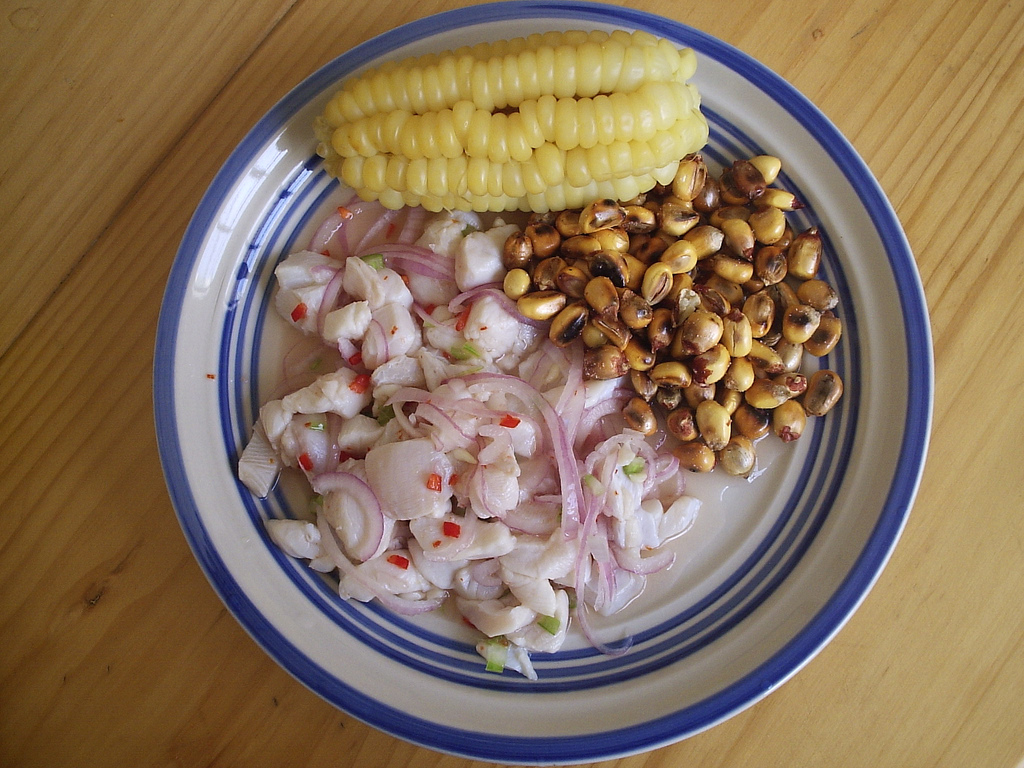
In Peru, choclo is commonly served as an accompaniment to dishes such as ceviche, and its toasted, salted form, similar to corn nuts, are customarily given free to restaurant patrons upon being seated. Full ears of choclo are also a popular street food in Peru and other Andean countries, typically served with a slice of cheese as choclo con queso.
While flavors vary greatly, finger foods like choclo con queso mirror the popularity of corn on the cob as a convenient street snack in Latin America.
References
References
- Grobman, A.. (1961). "Races of Maize in Peru: Their Origins, Evolution and Classification". National Academy of Sciences-National Research Council.
- "Peruvian Corn Information, Recipes, and Facts". Specialty Produce.
- Marian Blazes. "Cheers for Choclo!". southamericanfood.about.com.
- (2008). "Cuisine À Latina: Fresh Tastes and a World of Flavors from Michy's Miami Kitchen". Houghton Mifflin.
- "myEtymology.com: Spanish etymology of choclo". myetymology.com.
This article was imported from Wikipedia and is available under the Creative Commons Attribution-ShareAlike 4.0 License. Content has been adapted to SurfDoc format. Original contributors can be found on the article history page.
Ask Mako anything about Peruvian corn — get instant answers, deeper analysis, and related topics.
Research with MakoFree with your Surf account
Create a free account to save articles, ask Mako questions, and organize your research.
Sign up freeThis content may have been generated or modified by AI. CloudSurf Software LLC is not responsible for the accuracy, completeness, or reliability of AI-generated content. Always verify important information from primary sources.
Report