From Surf Wiki (app.surf) — the open knowledge base
Pertinax
Roman emperor in 193
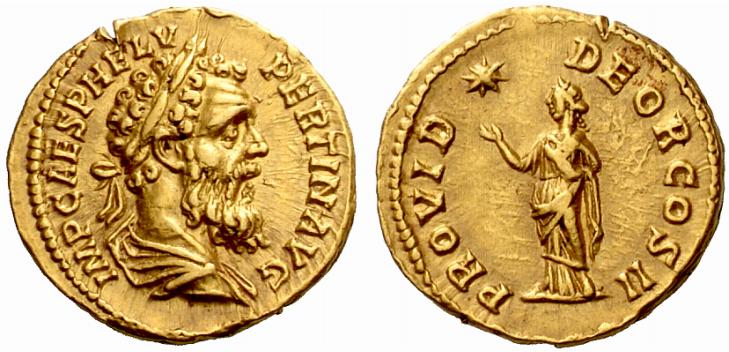
Roman emperor in 193
| Field | Value |
|---|---|
| image | Galleria degli Uffizi, Florence (19676748662).jpg |
| alt | White bust |
| caption | Bust, Galleria degli Uffizi, Florence |
| succession | Roman emperor |
| reign | 1 January – 28 March 193 |
| predecessor | Commodus |
| successor | Didius Julianus |
| birth_date | 1 August 126 |
| birth_place | Alba Pompeia, Italy |
| death_date | 28 March 193 (aged 66) |
| death_place | Rome, Italy |
| burial_place | Rome |
| spouse | Flavia Titiana |
| issue | |
| full name | Publius Helvius Pertinax |
| regnal name | Imperator Caesar Publius Helvius Pertinax Augustus |
| father | Helvius Successus |
| issue-link = | issue-pipe =
Publius Helvius Pertinax ( ; 1 August 126 – 28 March 193) was Roman emperor for the first three months of 193, succeeding Commodus and becoming the first ruler of the turbulent Year of the Five Emperors.
The son of a freedman, Pertinax rose from modest origins through a military career. He distinguished himself in the Roman–Parthian War of 161–166 and went on to hold a succession of governorships and senior commands. He also sat in the Roman Senate, where he was a contemporary of the historian Cassius Dio.
After the assassination of Commodus, Pertinax was chosen emperor. He aimed at restoring army discipline and imperial financial stability, but his reforms angered the Praetorian Guard, who killed him after just 87 days. He was later deified by Septimius Severus, who promoted his memory as part of his own rise to power. Ancient and modern assessments generally view Pertinax as a capable and conscientious ruler undone by circumstances.
Early life and Career
Pertinax’s background is recorded in the Historia Augusta and in Cassius Dio’s Roman History, with many details supported by inscriptions. The son of Helvius Successus, a freedman, he was born in Alba Pompeia in northern Italy. According to Dio, Successus was born in modest circumstances but gave his son an education enough for advancement in Roman life. With the support of a patron—either Lucius Avitus or Tiberius Claudius Pompeianus—Pertinax obtained a commission as a cohort officer.
He won distinction in the Parthian War, where he earned rapid promotion. He later served in Roman Britain as tribune of the Legio VI Victrix and along the Danube frontier, and then as procurator in Dacia. Though briefly sidelined by court politics under Marcus Aurelius, he was recalled for the Marcomannic Wars and made suffect consul in 175.
Between 175 and 185, he governed a series of provinces including Upper and Lower Moesia, Dacia, Syria, and finally Britain. In Britain his strict discipline provoked hostility; mutinous soldiers once left him for dead, and he was forced to resign in 187. He later served as proconsul of Africa (188–189), then as urban prefect of Rome, and finally consul again in 192 with Commodus as colleague.
Emperor
Rise to power
After Commodus was assassinated by a palace conspiracy involving the praetorian prefect Quintus Aemilius Laetus, his mistress Marcia, and his chamberlain Eclectus, on 31 December 192, Pertinax, then urban prefect, was taken to the Praetorian camp and acclaimed emperor.
Reign and downfall
Reigning only 87 days, he attempted to emulate Marcus Aurelius in restraint and reform. He tightened discipline in the Praetorian Guard, tried to regulate the alimenta (a state welfare scheme), and improved the coinage by raising the silver content of the denarius from 74% to 87%. His efforts, however, met resistance. The Guard resented the modest donativum on his accession and demanded more, forcing him to sell off Commodus’ property and concubines. In March, a failed coup sought to replace him with the consul Quintus Pompeius Sosius Falco.
On 28 March 193, around 200–300 praetorians stormed the palace. Abandoned by his guards and betrayed by Laetus, Pertinax attempted to reason with them, but was cut down. Cassius Dio praised his courage but noted the futility of confronting enraged soldiers.
Aftermath

After Pertinax’s death, the Guard notoriously auctioned the throne, which was purchased by Didius Julianus. Julianus lasted only weeks before being replaced by Septimius Severus, who honoured Pertinax by executing his killers, securing his deification, and adopting “Pertinax” into his own name.
Historical reputation
Cassius Dio, who knew him personally, called him “an excellent and upright man” who governed with integrity and frugality. He criticised only the haste of his reforms, which provoked resentment and led to his downfall.
Later writers echoed this assessment. Niccolò Machiavelli cited him in The Prince as a good ruler fatally undermined by trying to reform corrupt soldiers too quickly. David Hume praised him as an “excellent prince”. In 1788, at the Virginia Ratifying Convention, John Dawson referred to Pertinax’s murder as a warning against standing armies.{{cite book |last=Richard |first=Carl J. |date=1994 |title=The Founders and the Classics: Greece, Rome, and the American Enlightenment |url=https://books.google.com/books?id=uSEIrw6QryoC&q=%22John+Dawson%22+Pertinax&pg=PA103
In popular culture
The French journalist André Géraud (1882–1974) wrote under the pseudonym “Pertinax”.
In the alternate history novel Romanitas by Sophia McDougall, Pertinax survives the coup and enacts reforms that preserve the Roman Empire into the modern age.{{Cite web |url=http://www.romanitas.com/text/history.htm |archive-url=https://web.archive.org/web/20060630171948/http://www.romanitas.com/text/history.htm |url-status=dead |archive-date=30 June 2006 |title=A Short History of the Roman Empire |last=McDougall |first=Sophia |website=Romanitas |access-date=26 March 2018 }}
References
Sources
Primary sources
- Historia Augusta, Life of Pertinax, English translation at Lacus Curtius
- Herodian, History of the Roman Empire, English translation at Lacus Curtius
- Cassius Dio, Roman History, Book 74, English translation at The Tertullian Project
- Aurelius Victor,* "Epitome de Caesaribus"*, English translation at De Imperatoribus Romanis
- Zosimus, "Historia Nova", English translation at The Tertullian Project
Secondary sources
References
- [http://www.digitalsculpture.org/florence/main/model/f23e722f0e7d4b61af40ddf30e38c78f Pertinax Inv. 1914 n. 202]. ''Uffizi Digitization Project''.
- ''[[Inscriptiones Latinae Selectae]]'' [https://archive.org/details/inscriptioneslat21dessuoft/page/438 5842, 5845.]
- Elliott, Simon. (2020). "Pertinax: The Son of a Slave Who Became Roman Emperor". Greenhill Books.
- Cooley, Alison E.. (2012). "The Cambridge Manual of Latin Epigraphy". Cambridge University Press.
- Dio, 74:3
- Historia Augusta, ''Pertinax'', 1:6
- Historia Augusta, ''Pertinax'', 2:1
- Historia Augusta, ''Pertinax'', 2:4
- Historia Augusta, ''Pertinax'', 3:10
- Historia Augusta, ''Pertinax'', 4:1
- Victor, 18:2
- Historia Augusta, ''Pertinax'', 4:5
- Dio 74:6
- Kenneth W. Harl. (1999). "Roman Currency of the Principate". Tulane University.
- Dio, 74:5
- Historia Augusta, ''Pertinax'', 7:8
- Dio, 74:8
- Dio, 74:9
- Dio, 74:10
- (2001). "A History of Rome". Blackwell Publishing.
- Historia Augusta, ''Pertinax'', 15:2
- Dio, 74:1
- Dio, 74:10
- (15 October 1945). "The Press: Pertinax Goes Home".
This article was imported from Wikipedia and is available under the Creative Commons Attribution-ShareAlike 4.0 License. Content has been adapted to SurfDoc format. Original contributors can be found on the article history page.
Ask Mako anything about Pertinax — get instant answers, deeper analysis, and related topics.
Research with MakoFree with your Surf account
Create a free account to save articles, ask Mako questions, and organize your research.
Sign up freeThis content may have been generated or modified by AI. CloudSurf Software LLC is not responsible for the accuracy, completeness, or reliability of AI-generated content. Always verify important information from primary sources.
Report