From Surf Wiki (app.surf) — the open knowledge base
Perpignan
.jpg)
| Field | Value | |
|---|---|---|
| name | Perpignan | |
| native name | ca | |
| commune status | Prefecture and commune | |
| image coat of arms | Arms of Perpignan.svg | |
| image | {{Photomontage | position=center |
| photo1a | Perpignan banner.jpg | |
| photo2a | Perpignan - panoramio.jpg | |
| photo2b | Quai Sébastien Vauban - panoramio.jpg | |
| photo3a | Castillet in Perpignan.jpg | |
| size | 270 | |
| spacing | 2 | |
| color | #FFFFFF | |
| border | 0 | |
| arrondissement | Perpignan | |
| canton | Perpignan-1, 2, 3, 4, 5 and 6 | |
| mayor | Louis Aliot | |
| party | RN | |
| term | 2020–2026 | |
| intercommunality | Perpignan Méditerranée Métropole | |
| coordinates | ||
| elevation m | 30 | |
| elevation min m | 8 | |
| elevation max m | 95 | |
| area km2 | 68.07 | |
| population | ||
| population date | ||
| population footnotes | ||
| INSEE | 66136 | |
| postal code | 66000 | |
| demonym | Perpignanais (masc.), Perpignanaise (fem.) (French) | |
| perpinyanès (masc.), perpinyanesa (fem.) (Catalan) | ||
| website | Mairie-Perpignan.fr |
|image coat of arms = Arms of Perpignan.svg perpinyanès (masc.), perpinyanesa (fem.) (Catalan)
Perpignan (, , ; ; ) is the prefecture of the Pyrénées-Orientales department in Southern France, in the heart of the plain of Roussillon, at the foot of the Pyrenees a few kilometres from the Mediterranean Sea and the scrublands of the Corbières massif. It is the centre of the Perpignan Méditerranée Métropole metropolitan area.
In 2021, Perpignan had a population of 119,656 in the commune proper, and the agglomeration had a total population of 205,183, making it the last major French city before the Spanish border. Perpignan is sometimes seen as the "entrance" to the Iberian Peninsula.
Perpignan was the capital of the former province and County of Roussillon (Rosselló in Catalan) and continental capital of the Kingdom of Majorca in the 13th and 14th centuries, as well as one of the most important cities of the Principality of Catalonia. It has preserved an extensive old centre with its bodegas in the historic centre, coloured houses in a series of picturesque streets and alleys stretching between the banks of the Têt and its tributary, the Basse.
The city is also known for its International Festival of Photojournalism, the medieval Trobades festival and its centuries-old garnet industry.
Geography
Location
Perpignan is located in the center of the Roussillon plain, 13 km west of the Mediterranean coast. It is the southernmost city of metropolitan France.
File:Map commune FR insee code 66136.png|Map of Perpignan and its surrounding communes File:Perpignan Pyrenees-Orientales.png|Location within the Pyrénées-Orientales département.
Hydrography
Perpignan is crossed by the largest river in Roussillon, the Têt, and by one of its tributaries, the Basse. Floods have occurred, as in 1892 when the rising of the Têt in Perpignan destroyed 39 houses, leaving more than 60 families homeless.
Climate
Perpignan has a typical hot-summer Mediterranean climate (Köppen Csa), similar to much of the Mediterranean coastline of France. One might expect rain to be rare in the city, but the annual precipitation levels are similar to the national average. However, the city is known for its patchy rains, with weeks or even months of rain falling in a matter of hours, followed by several weeks without a drop of water. Perpignan experiences very hot summers and fairly mild winters. Temperatures can reach 40 °C, while there has been little snow for decades. Most precipitation occurs in the cold season, with summers being extremely dry. A fresh north-westerly wind often blows, the Tramontana (French: Tramontane, pronounced [tʁamɔ̃tan]), keeping the sky clear much of the time and resulting in high annual sunshine. But the presence of this wind makes winters colder than would be expected from the geographical position of the city.
|Jan record high C = 25.0 |Feb record high C = 26.5 |Mar record high C = 28.0 |Apr record high C = 32.4 |May record high C = 34.4 |Jun record high C = 42.4 |Jul record high C = 40.5 |Aug record high C = 39.9 |Sep record high C = 36.8 |Oct record high C = 34.2 |Nov record high C = 28.1 |Dec record high C = 26.7 |year record high C = 42.4 |Jan record low C = -8.2 |Feb record low C = -11.0 |Mar record low C = -5.9 |Apr record low C = 0.2 |May record low C = 2.4 |Jun record low C = 7.4 |Jul record low C = 11.2 |Aug record low C = 10.4 |Sep record low C = 5.0 |Oct record low C = 1.2 |Nov record low C = -5.7 |Dec record low C = -6.3 |year record low C = -11.0 | access-date = 27 September 2023 | access-date = 7 January 2016}}
Transport
;Roads The A9 motorway connects Perpignan with Barcelona and Montpellier.
;Trains Perpignan is served by the Gare de Perpignan railway station, which offers connections to Paris, Barcelona, Toulouse, and several regional destinations. Salvador Dalí proclaimed the station to be the "Cosmic Centre of the Universe" after experiencing a vision there in 1963.
;Airport The nearest airport is Perpignan–Rivesaltes Airport. However, the airport only provides flights to limited European destinations. The nearest major international airports are Montpellier - Méditerranée Airport, located 160 km north east, Josep Tarradellas Barcelona–El Prat Airport, located 204 km south and Toulouse–Blagnac Airport, located 217 km north west of Perpignan.
Toponymy
The name of Perpignan appears in 927 as Perpinianum, followed in 959 by Villa Perpiniano, Pirpinianum in the 11th century, and Perpiniani in 1176. Perpenyà, which appears in the 13th century, was the most common form until the 15th century, and was still used in the 17th century. It probably derives from the Roman name Perpennius.
The city is sometimes nicknamed Perpi for short.
History
- Sinyal d'Aragón.svg Principality of Catalonia (Sinyal d'Aragón.svg Crown of Aragon) 1172–1276
- Flag of the Kingdom of Majorca (1269).png[[File:Pfeil rechts.svg|7px]]Bandera del Reino de Mallorca.svg Kingdom of Majorca 1276–1344
- Sinyal d'Aragón.svg Principality of Catalonia (Sinyal d'Aragón.svg Crown of Aragon) 1344–1463
- Pavillon royal de la France.svg Kingdom of France 1463–1493
- Sinyal d'Aragón.svg Principality of Catalonia (Sinyal d'Aragón.svg Crown of Aragon, Spanish Empire) 1493–1659
- Pavillon royal de France.svg[[File:Pfeil rechts.svg|7px]]Flag of France (1790–1794).svg Kingdom of France 1659–1792
- Flag of France (1790–1794).svg[[File:Pfeil rechts.svg|7px]]Flag of France (1794-1815).svg French Republic 1792–1804
- Flag of France (1794-1815).svg French Empire 1804–1815
- Royal flag of France during the Bourbon Restoration.svg[[File:Pfeil rechts.svg|7px]]Flag of France (1794–1815, 1830–1958).svg Kingdom of France 1815–1848
- Flag of France (1794–1815, 1830–1958).svg French Republic 1848–1852
- Flag of France (1794–1815, 1830–1958).svg French Empire 1852–1870
- Flag of France (1794–1815, 1830–1958).svg French Republic 1870–1940
- Flag of France (1794–1815, 1830–1958).svg French State 1940–1944
- French Republic 1944–present
Though settlement in the area goes back to Roman times, the medieval town of Perpignan seems to have been founded around the beginning of the 10th century. Shortly afterwards, Perpignan became the capital of the counts of Roussillon. Historically, it was part of the region known as Septimania. In 1172 Count Girard II bequeathed his lands to the Counts of Barcelona. Perpignan acquired the institutions of a partly self-governing commune in 1197. French feudal rights over Roussillon were given up by Louis IX in the Treaty of Corbeil.
When James I the Conqueror, king of Aragon and count of Barcelona, founded the Kingdom of Majorca in 1276, Perpignan became the capital of the mainland territories of the new state. The subsequent decades are considered the city's historical golden age. It prospered as a centre of cloth manufacture, leatherwork, goldsmithery, and other luxury crafts. King Philippe III of France died there in 1285, as he was returning from his unsuccessful crusade against the Aragonese Crown.
.jpg)
In 1344 Peter IV of Aragon annexed the Kingdom of Majorca and Perpignan once more became part of the Principality of Catalonia. A few years later it lost approximately half of its population to the Black Death. It was attacked and occupied by Louis XI in 1463; a violent uprising against French rule in 1473 was harshly put down after a long siege, but in 1493 Charles VIII, wishing to conciliate Castile in order to free himself to invade Italy, restored it to Ferdinand II of Aragon.
Again besieged and captured by the French during the Thirty Years' War in September 1642, Perpignan was formally ceded by Spain 17 years later in the Treaty of the Pyrenees, and thereafter remained a French possession.
In June 2020, Louis Aliot of the National Rally was elected mayor of Perpignan. This was the first time since 1995 that the far-right party had won a city of more than 100,000 people.
Government and politics

The Hôtel de Ville (City Hall) dates back to 1318.
Mayors
| Mayor | Term start | Term end |
|---|---|---|
| Edmond Benoit | July 1910 | May 1911 |
| Léon Nérel | May 1911 | May 1912 |
| Joseph Denis | May 1912 | May 1929 |
| Victor Dalbiez | May 1929 | May 1935 |
| Jean Payra | May 1935 | 29 May 1937 (death) |
| Laurent Baudru | June 1937 | December 1940 |
| Antoine Castillon | December 1940 | March 1941 |
| Ferdinand Coudray | March 1941 | August 1944 |
| Félix Mercader | August 1944 | 11 March 1949 (death) |
| Félix Depardon | April 1949 | March 1959 |
| Paul Alduy | March 1959 | May 1993 |
| Jean-Paul Alduy | June 1993 | 27 April 2009 (election of 2008 cancelled) |
| Bernard Bacou (retired magistrate acting as mayor) | 27 April 2009 | 5 July 2009 |
| Jean-Paul Alduy | 5 July 2009 | 15 October 2009 (resignation) |
| Jean-Marc Pujol | 22 October 2009 | 3 July 2020 |
| Louis Aliot | 3 July 2020 |
International relations
;Twin towns – sister cities Perpignan is twinned with:
;Partner towns
Education
More than 10,000 students between the ages of 2 and 12 attend 61 preschools and primary schools in the city. Perpignan also has 26 high schools.
Population
| graph-pos = bottom |1793 | 9134 |1800 | 10415 |1806 | 12499 |1821 | 14864 |1831 | 17114 |1836 | 17618 |1841 | 20792 |1846 | 22706 |1851 | 21783 |1856 | 23301 |1861 | 23462 |1866 | 25264 |1872 | 27378 |1876 | 28353 |1881 | 31735 |1886 | 34183 |1891 | 33878 |1896 | 35088 |1901 | 36157 |1906 | 38898 |1911 | 39510 |1921 | 53742 |1926 | 68835 |1931 | 73962 |1936 | 72207 |1946 | 74984 |1954 | 70051 |1962 | 83025 |1968 | 102191 |1975 | 106426 |1982 | 111669 |1990 | 105983 |1999 | 105115 |2007 | 116041 |2012 | 120489 |2017 | 120158
Culture
.jpg)
Since 2004, the free three-day Guitares au Palais has been held each year in the last weekend of August in the Palace of the Kings of Majorca. The festival has a broad mainstream focus with pop-related music as well as traditional acoustic guitar music and alternative music. The festival has attracted international guests like Caetano Veloso (2007), Rumberos Catalans, Pedro Soler, Bernardo Sandoval, Peter Finger, and Aaron and Bryce Dessner (2008).
Each September, Perpignan hosts the internationally renowned Visa pour l'Image festival of photojournalism. Free exhibitions are mounted in the Couvent des Minimes, Chapelle des Dominicaines and other buildings in the old town.
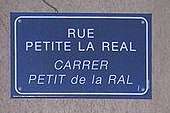
In 2008, Perpignan became Capital of Catalan Culture. Many street name signs in the city are in both French and Catalan.
Sport

Like the rest of the south of France, Perpignan is a rugby stronghold. Their rugby union side, USA Perpignan, are regular competitors in the European Rugby Champions Cup and have been champions of the French Top 14 seven times (most recently in 2009). They play at the Stade Aimé Giral.
Their rugby league team Catalans Dragons plays in the British Super League. The Dragons' games in Perpignan against the Northern English-based sides are usually very popular with British rugby fans, with thousands descending on the city on the day of the game, including many holidaying fans travelling up from the Spanish Costa Brava to join those who came directly from the UK. The club was founded in 2000 as a merger of XIII Catalan with the nearby team AS Saint Estève to form Union Treiziste Catalane in 2000 who changed their name to Catalans Dragons upon transfer from the French to British rugby league system. The Dragons became the first non-English team to win the Challenge Cup when they defeated Warrington Wolves in the 2018 final. They are based at Stade Gilbert Brutus. AS Saint Estève's youth teams still operates as Saint-Estève XIII Mavericks in the National Division 2, while a new Elite One Championship club was formed in 2000 under the name Saint-Estève XIII Catalan which is in effect Catalans Dragons reserves; both play at the Stade Municipal in the suburb of Saint-Estève.
The local association football team is Canet Roussillon FC.
There is also an Australian rules football club, Perpignan Tigers, and American football club Grizzlys Catalans.
The Roussillon Grand Prix was a Grand Prix motor racing event that was held between 1946 and 1949 in the streets of Perpignan.
Economy
Traditional commerce was in wine, olive oil, corks (the cork oak Quercus suber grows in Perpignan's mild climate), wool, leather, and iron. In May 1907 it was a seat of agitation by southern producers for government enforcement of wine quality following a collapse in prices. JOB rolling papers are currently manufactured in Perpignan.
Sites of interest
Construction work on Perpignan Cathedral began in 1324 and finished in 1509.
The 13th century Palace of the Kings of Majorca sits on the high citadel, surrounded by ramparts, reinforced for Louis XI and Charles V, which were updated in the 17th century by Louis XIV's military engineer Vauban.
The walls surrounding the town, which had likewise been designed by Vauban, were razed in 1904 to accommodate urban development. The main city gate, the Castillet is a small fortress built in the 14th century, which has been preserved. It was also used as a prison until the end of the 19th century.
The Hôtel Pams is a lavishly decorated mansion designed for Jules Pams that illustrates the artistic tastes of the wealthy bourgeois at the turn of the 20th century.
Les Halles de Vauban are a new addition to the banks of the city's canal. Opened in November 2017, the indoor markets are privately owned and cost €1.5 million. Split into two locations, vendors offer fresh fruit and vegetables, bread, flowers, cheese, and other items. There is a bar and central eating court with a range of tapas, burgers, omelettes and food from around the world.


Notable people linked to Perpignan
- Paul Alday (c.1763–1835), violinist, composer, and music publisher
- Christian Andreu (born 1976), guitarist
- Anna Maria Antigó (1602–1676), abbess
- François Arago (1786–1853), physicist, astronomer, and liberal politician
- Alexandre Artus (1821–1911), composer and conductor
- Amédée Artus (1815–1892), composer and conductor
- Frédérick Bousquet (born 1981), freestyle and butterfly swimmer
- Robert Brasillach (1909–1945), fascist author and journalist
- Eugène Collache (1847–1883), French Navy officer who fought in Japan
- Mary Elmes (1908–2002), Irish aid worker
- Jean-Luc Escayol (born 1972), footballer
- François de Fossa (1775–1849), classical guitarist and composer
- Jacques-François Gallay (1795–1864), French horn player and composer
- Philippe Georget (born 1962), novelist
- Louise Labé (1524–1566), Lyons poet of the Renaissance
- Aristide Maillol (1861–1944), sculptor and painter
- André Marty (1886–1956), communist leader
- Menachem Meiri (1249–c.1310), Catalan rabbi, Talmudist, and Maimonidean
- Isabelle Pasco (born 1966), actress
- Hyacinthe Rigaud (1659–1743), painter
Following a visit in 1963, the Catalan surrealist artist Salvador Dalí declared the city's railway station the centre of the Universe, claiming that he always had his best ideas sitting in its waiting room. Dalí's painting La Gare de Perpignan commemorates his vision of "cosmogonic ecstasy" there on 19 September 1963. He followed that up some years later by declaring that the Iberian Peninsula rotated precisely at Perpignan station 132 million years ago – an event the artist invoked in his 1983 painting Topological Abduction of Europe – Homage to René Thom. Above the station is a monument in Dali's honour, and across the surface of one of the main platforms is painted, in large letters, «perpignan centre du monde» (French for "perpignan centre of the world").

Gallery
Perpignan Castillet 1.jpg|Le Castillet Perpignanrivierebasse.jpg|Bridge over the Basse Font sirenes Perpinya.jpg|Mermaids fountain 086 Perpignan Rue.JPG|City centre Le cinéma art nouveau "le Castillet" (Perpignan) (8846519405).jpg|Cinéma Le Castillet ChateauRoussillon Tour.jpg|Château Roussillon: tower of the old castle (13th and 14th centuries) ChateauRoussillon ChapelleStPierre 01.jpg|Château Roussillon: Sainte-Marie and Saint-Pierre chapel (11th and 12th centuries) 087 Perpignan La Loge de Mer -1397, agrandi au XVIème-.JPG Perpignan Cathedral 2020 - Nave.jpg|Cathédrale Saint-Jean Lycée françois arago.jpeg|François Arago Lyceum Palaisdesrois.jpg|Palace of the Kings of Mallorca Perpignan bridge.JPG|The bridge
References
Bibliography
- Alícia Marcet, Histoire de Perpignan, la fidelíssima (1995), Perpinyà [Perpignan] : Llibres del Trabucaire,
References
- (6 June 2023). "Répertoire national des élus: les maires". data.gouv.fr, Plateforme ouverte des données publiques françaises.
- {{cite LPD. 3
- {{cite EPD. 18
- "Commune de Perpignan (66136)". INSEE.
- Fabricio Cardenas. (2 March 2014). "Vieux papiers des Pyrénées-Orientales: Inondations en novembre 1892".
- Coppens, Philip. "Salvador Dalí: painting the fourth dimension".
- "Press Pack: Travel Experiences".
- "Perpignan City Guide".
- (28 June 2020). "Far-right to win southern French town of Perpignan: Exit poll". Reuters.
- (28 June 2020). "France's Greens make gains, Macron loses ground in low-turnout local elections".
- "L'Hôtel de Ville". Mairie Perpignan.
- "Hanover – Twin Towns".
- "British towns twinned with French towns". Archant Community Media Ltd.
- "Sarasota Sister Cities Association, Sarasota Florida". Sarasotasistercities.org.
- "Écoles".
- "ECOLES À PERPIGNAN (66000)".
- {{Cassini-Ehess. 26522. Perpignan
- [https://www.insee.fr/fr/statistiques/4515315?geo=COM-66136#ancre-POP_T1 Population en historique depuis 1968], INSEE
- (22 August 2017). "Visa Pour l'Image".
- (2016-04-20). "VilaWeb - Diari escola: Perpinyà, Capital de la Cultura Catalana 2008".
- "Cathédrale St Jean-Baptiste". Histoire du Roussillon.
- Fabricio Cardenas. (20 March 2014). "Vieux papiers des Pyrénées-Orientales: La prison du Castillet, 1892".
- "Fiche Pédagogique - Hôtel Pams de Perpignan". Association Pédagogique de la Plaine, du Vallespir et de la Côte Vermeille.
- (2017-12-19). "Indoor markets bring new life to Perpignan {{!}} P-O Life". anglophone-direct.
- "Salvador Dali: painting the fourth dimension".
- Elliott King in [[Dawn Adès]] (ed.), ''Dalí'', Bompiani Arte, Milan, 2004, p. 448.
This article was imported from Wikipedia and is available under the Creative Commons Attribution-ShareAlike 4.0 License. Content has been adapted to SurfDoc format. Original contributors can be found on the article history page.
Ask Mako anything about Perpignan — get instant answers, deeper analysis, and related topics.
Research with MakoFree with your Surf account
Create a free account to save articles, ask Mako questions, and organize your research.
Sign up freeThis content may have been generated or modified by AI. CloudSurf Software LLC is not responsible for the accuracy, completeness, or reliability of AI-generated content. Always verify important information from primary sources.
Report