From Surf Wiki (app.surf) — the open knowledge base
Periodic points of complex quadratic mappings

This article describes periodic points of some complex quadratic maps. A map is a formula for computing a value of a variable based on its own previous value or values; a quadratic map is one that involves the previous value raised to the powers one and two; and a complex map is one in which the variable and the parameters are complex numbers. A periodic point of a map is a value of the variable that occurs repeatedly after intervals of a fixed length.
These periodic points play a role in the theories of Fatou and Julia sets.
Definitions
Let
:f_c(z) = z^2+c,
be the complex quadratic mapping, where z and c are complex numbers.
Notationally, f^{(k)} _c (z) is the k-fold composition of f_c with itself (not to be confused with the kth derivative of f_c)—that is, the value after the k-th iteration of the function f _c. Thus
:f^{(k)} _c (z) = f_c(f^{(k-1)} _c (z)).
Periodic points of a complex quadratic mapping of period p are points z of the dynamical plane such that
:f^{(p)} _c (z) = z,
where p is the smallest positive integer for which the equation holds at that z.
We can introduce a new function:
:F_p(z,f) = f^{(p)} _c (z) - z,
so periodic points are zeros of function F_p(z,f): points z satisfying
:F_p(z,f) = 0,
which is a polynomial of degree 2^p.
Number of periodic points
The degree of the polynomial F_p(z,f) describing periodic points is d = 2^p so it has exactly d = 2^p complex roots (= periodic points), counted with multiplicity.
Stability of periodic points (orbit) - multiplier
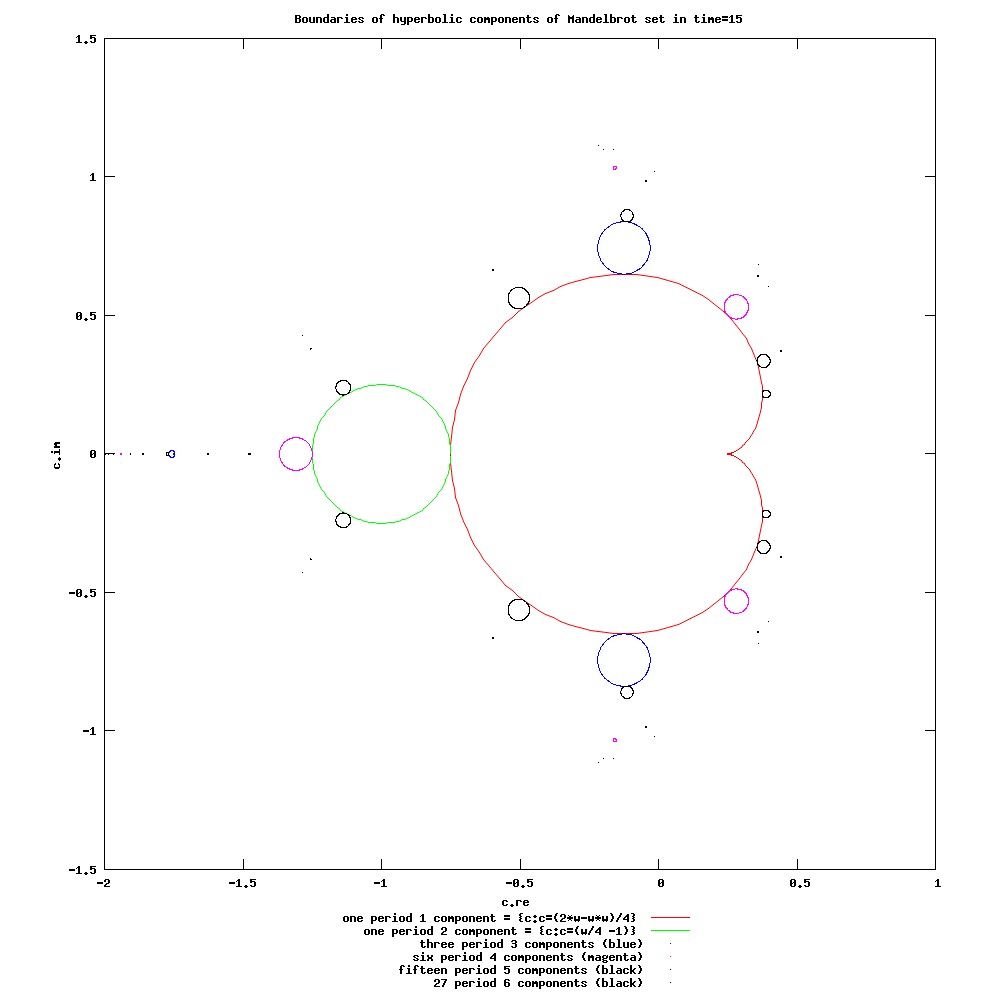

The multiplier (or eigenvalue, derivative) m(f^p,z_0)=\lambda of a rational map f iterated p times at cyclic point z_0 is defined as:
:m(f^p,z_0) = \lambda = \begin{cases} f^{p \prime}(z_0), &\mbox{if }z_0 \ne \infty \ \frac{1}{f^{p \prime} (z_0)}, & \mbox{if }z_0 = \infty \end{cases}
where f^{p\prime} (z_0) is the first derivative of f^p with respect to z at z_0.
Because the multiplier is the same at all periodic points on a given orbit, it is called a multiplier of the periodic orbit.
The multiplier is:
- a complex number;
- invariant under conjugation of any rational map at its fixed point;
- used to check stability of periodic (also fixed) points with stability index abs(\lambda). ,
A periodic point is
- attracting when abs(\lambda)
- super-attracting when abs(\lambda) = 0;
- attracting but not super-attracting when 0
- indifferent when abs(\lambda) = 1;
- rationally indifferent or parabolic if \lambda is a root of unity;
- irrationally indifferent if abs(\lambda)=1 but multiplier is not a root of unity;
- repelling when abs(\lambda) 1.
Periodic points
- that are attracting are always in the Fatou set;
- that are repelling are in the Julia set;
- that are indifferent fixed points may be in one or the other. A parabolic periodic point is in the Julia set.
Period-1 points (fixed points)
Finite fixed points
Let us begin by finding all finite points left unchanged by one application of f. These are the points that satisfy f_c(z)=z. That is, we wish to solve
: z^2+c=z,,
which can be rewritten as
: \ z^2-z+c=0.
Since this is an ordinary quadratic equation in one unknown, we can apply the standard quadratic solution formula:
: \alpha_1 = \frac{1-\sqrt{1-4c}}{2} and \alpha_2 = \frac{1+\sqrt{1-4c}}{2}. So for c \in \mathbb{C} \setminus {1/4} we have two finite fixed points \alpha_1 and \alpha_2.
Since : \alpha_1 = \frac{1}{2}-m and \alpha_2 = \frac{1}{2}+m where m = \frac{\sqrt{1-4c}}{2},
we have \alpha_1 + \alpha_2 = 1.
Thus fixed points are symmetrical about z = 1/2.
Complex dynamics


Here different notation is commonly used:
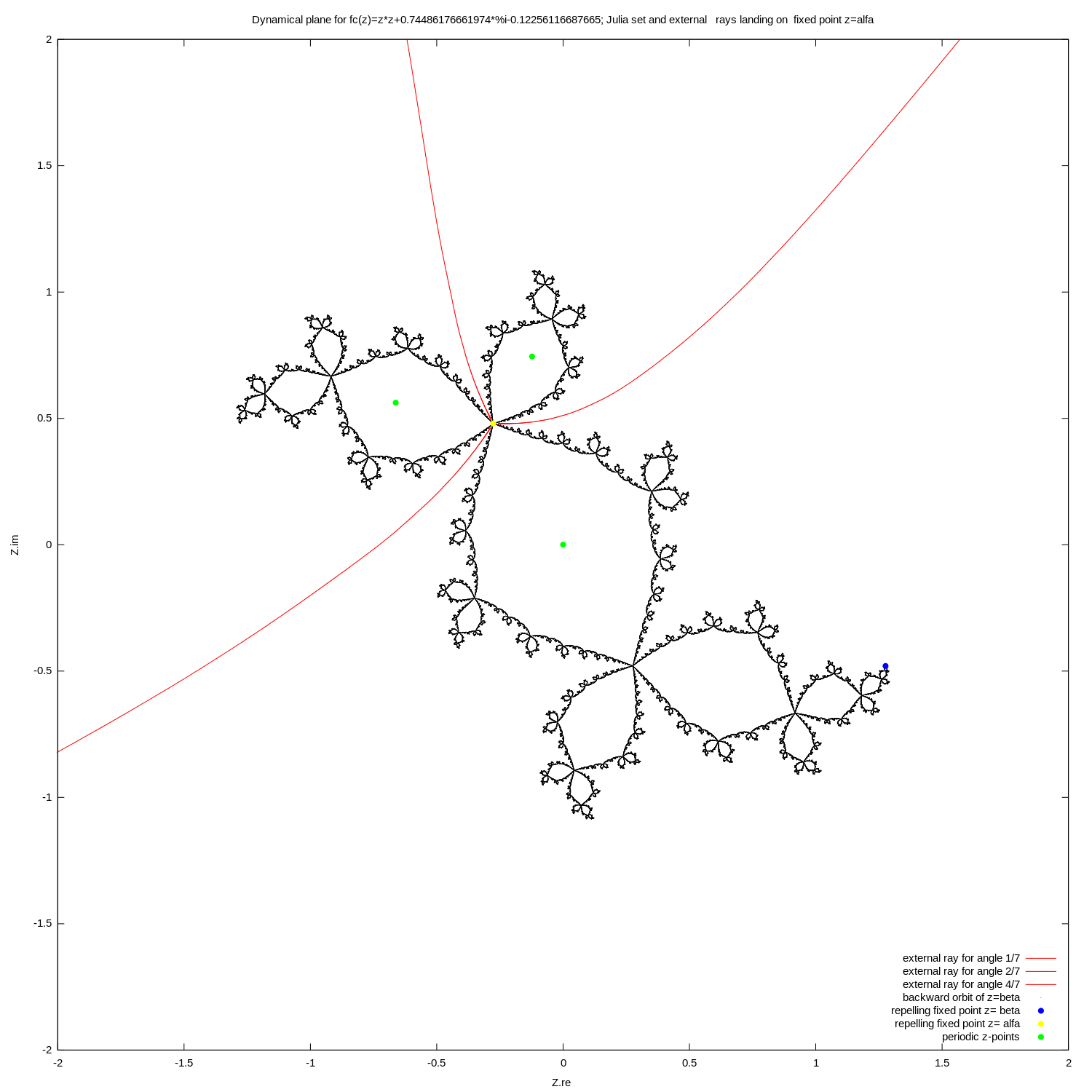
:\alpha_c = \frac{1-\sqrt{1-4c}}{2} with multiplier \lambda_{\alpha_c} = 1-\sqrt{1-4c}
and
:\beta_c = \frac{1+\sqrt{1-4c}}{2} with multiplier \lambda_{\beta_c} = 1+\sqrt{1-4c}.
Again we have
:\alpha_c + \beta_c = 1 .
Since the derivative with respect to z is
:P_c'(z) = \frac{d}{dz}P_c(z) = 2z ,
we have
:P_c'(\alpha_c) + P_c'(\beta_c)= 2 \alpha_c + 2 \beta_c = 2 (\alpha_c + \beta_c) = 2 .
This implies that P_c can have at most one attractive fixed point.
These points are distinguished by the facts that:
- \beta_c is:
- the landing point of the external ray for angle=0 for c \in M \setminus \left{ 1/4 \right}
- the most repelling fixed point of the Julia set
- the one on the right (whenever fixed point are not symmetrical around the real axis), it is the extreme right point for connected Julia sets (except for cauliflower).
- \alpha_c is:
- the landing point of several rays
- attracting when c is in the main cardioid of the Mandelbrot set, in which case it is in the interior of a filled-in Julia set, and therefore belongs to the Fatou set (strictly to the basin of attraction of finite fixed point)
- parabolic at the root point of the limb of the Mandelbrot set
- repelling for other values of c
Special cases
An important case of the quadratic mapping is c=0. In this case, we get \alpha_1 = 0 and \alpha_2=1. In this case, 0 is a superattractive fixed point, and 1 belongs to the Julia set.
Only one fixed point
We have \alpha_1=\alpha_2 exactly when 1-4c=0. This equation has one solution, c=1/4, in which case \alpha_1=\alpha_2=1/2. In fact c=1/4 is the largest positive, purely real value for which a finite attractor exists.
Infinite fixed point
We can extend the complex plane \mathbb{C} to the Riemann sphere (extended complex plane) \mathbb{\hat{C}} by adding infinity:
:\mathbb{\hat{C}} = \mathbb{C} \cup { \infty }
and extend f_c such that f_c(\infty)=\infty.
Then infinity is:
- superattracting
- a fixed point of f_c:f_c(\infty)=\infty=f^{-1}_c(\infty).
Period-2 cycles
=z*z_+c.gif)
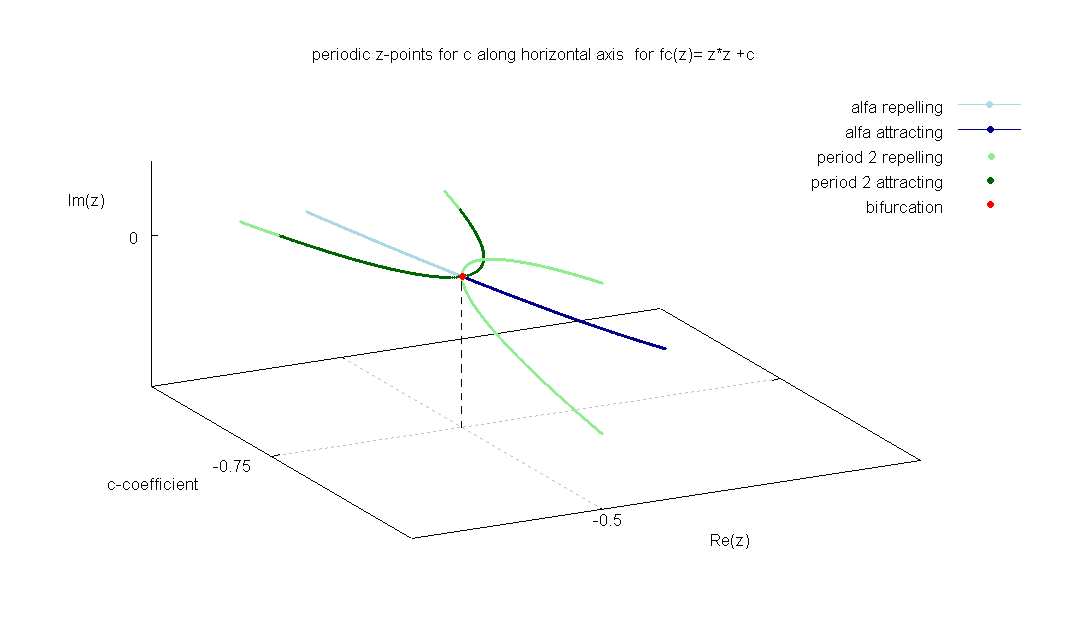
Period-2 cycles are two distinct points \beta_1 and \beta_2 such that f_c(\beta_1) = \beta_2 and f_c(\beta_2) = \beta_1, and hence
:f_c(f_c(\beta_n)) = \beta_n
for n \in {1, 2}:
:f_c(f_c(z)) = (z^2+c)^2+c = z^4 + 2cz^2 + c^2 + c.
Equating this to z, we obtain
:z^4 + 2cz^2 - z + c^2 + c = 0.
This equation is a polynomial of degree 4, and so has four (possibly non-distinct) solutions. However, we already know two of the solutions. They are \alpha_1 and \alpha_2, computed above, since if these points are left unchanged by one application of f, then clearly they will be unchanged by more than one application of f.
Our 4th-order polynomial can therefore be factored in 2 ways:
First method of factorization
: (z-\alpha_1)(z-\alpha_2)(z-\beta_1)(z-\beta_2) = 0.,
This expands directly as x^4 - Ax^3 + Bx^2 - Cx + D = 0 (note the alternating signs), where
: D = \alpha_1 \alpha_2 \beta_1 \beta_2, ,
: C = \alpha_1 \alpha_2 \beta_1 + \alpha_1 \alpha_2 \beta_2 + \alpha_1 \beta_1 \beta_2 + \alpha_2 \beta_1 \beta_2, ,
: B = \alpha_1 \alpha_2 + \alpha_1 \beta_1 + \alpha_1 \beta_2 + \alpha_2 \beta_1 + \alpha_2 \beta_2 + \beta_1 \beta_2, ,
: A = \alpha_1 + \alpha_2 + \beta_1 + \beta_2.,
We already have two solutions, and only need the other two. Hence the problem is equivalent to solving a quadratic polynomial. In particular, note that
: \alpha_1 + \alpha_2 = \frac{1-\sqrt{1-4c}}{2} + \frac{1+\sqrt{1-4c}}{2} = \frac{1+1}{2} = 1
and
: \alpha_1 \alpha_2 = \frac{(1-\sqrt{1-4c})(1+\sqrt{1-4c})}{4} = \frac{1^2 - (\sqrt{1-4c})^2}{4}= \frac{1 - 1 + 4c}{4} = \frac{4c}{4} = c.
Adding these to the above, we get D = c \beta_1 \beta_2 and A = 1 + \beta_1 + \beta_2. Matching these against the coefficients from expanding f, we get
: D = c \beta_1 \beta_2 = c^2 + c and A = 1 + \beta_1 + \beta_2 = 0.
From this, we easily get
:\beta_1 \beta_2 = c + 1 and \beta_1 + \beta_2 = -1.
From here, we construct a quadratic equation with A' = 1, B = 1, C = c+1 and apply the standard solution formula to get
: \beta_1 = \frac{-1 - \sqrt{-3 -4c}}{2} and \beta_2 = \frac{-1 + \sqrt{-3 -4c}}{2}.
Closer examination shows that:
:f_c(\beta_1) = \beta_2 and f_c(\beta_2) = \beta_1,
meaning these two points are the two points on a single period-2 cycle.
Second method of factorization
We can factor the quartic by using polynomial long division to divide out the factors (z-\alpha_1) and (z-\alpha_2), which account for the two fixed points \alpha_1 and \alpha_2 (whose values were given earlier and which still remain at the fixed point after two iterations):
:(z^2+c)^2 + c -z = (z^2 + c - z)(z^2 + z + c +1 ). ,
The roots of the first factor are the two fixed points. They are repelling outside the main cardioid.
The second factor has the two roots
:\frac{-1 \pm \sqrt{-3 -4c}}{2}. ,
These two roots, which are the same as those found by the first method, form the period-2 orbit.
Special cases
Again, let us look at c=0. Then
: \beta_1 = \frac{-1 - i\sqrt{3}}{2} and \beta_2 = \frac{-1 + i\sqrt{3}}{2},
both of which are complex numbers. We have | \beta_1 | = | \beta_2 | = 1. Thus, both these points are "hiding" in the Julia set. Another special case is c=-1, which gives \beta_1 = 0 and \beta_2 = -1. This gives the well-known superattractive cycle found in the largest period-2 lobe of the quadratic Mandelbrot set.
Cycles for period greater than 2
_=_z*z-0.75_for_period_=6_as_intersections_of_2_implicit_curves.svg)
The degree of the equation f^{(n)}(z)=z is 2n; thus for example, to find the points on a 3-cycle we would need to solve an equation of degree 8. After factoring out the factors giving the two fixed points, we would have a sixth degree equation.
There is no general solution in radicals to polynomial equations of degree five or higher, so the points on a cycle of period greater than 2 must in general be computed using numerical methods. However, in the specific case of period 4 the cyclical points have lengthy expressions in radicals.
In the case c = –2, trigonometric solutions exist for the periodic points of all periods. The case z_{n+1}=z_n^2-2 is equivalent to the logistic map case r = 4: x_{n+1}=4x_n(1-x_n). Here the equivalence is given by z=2-4x. One of the k-cycles of the logistic variable x (all of which cycles are repelling) is
:\sin^2\left(\frac{2\pi}{2^k-1}\right), , \sin^2\left(2\cdot\frac{2\pi}{2^k-1}\right), , \sin^2\left(2^2\cdot\frac{2\pi}{2^k-1}\right), , \sin^2\left(2^3\cdot\frac{2\pi}{2^k-1}\right), \dots , \sin^2\left(2^{k-1}\frac{2\pi}{2^k-1}\right).
References
References
- Alan F. Beardon, Iteration of Rational Functions, Springer 1991, {{ISBN. 0-387-95151-2, p. 41
- Alan F. Beardon, ''Iteration of Rational Functions'', Springer 1991, {{ISBN. 0-387-95151-2, page 99
- "Some Julia sets by Michael Becker".
- [http://www.math.nagoya-u.ac.jp/~kawahira/works/cauliflower.pdf On the regular leaf space of the cauliflower by Tomoki Kawahira Source: Kodai Math. J. Volume 26, Number 2 (2003), 167-178. ] {{webarchive. link. (2011-07-17)
- [http://www.ibiblio.org/e-notes/MSet/Attractor.htm Periodic attractor by Evgeny Demidov] {{webarchive. link. (2008-05-11)
- [[Robert L. Devaney. R L Devaney]], [[Linda Keen. L Keen]] (Editor): Chaos and Fractals: The Mathematics Behind the Computer Graphics. Publisher: Amer Mathematical Society July 1989, {{ISBN. 0-8218-0137-6 , {{ISBN. 978-0-8218-0137-6
- [http://www.ibiblio.org/e-notes/MSet/Attractor.htm Period 2 orbit by Evgeny Demidov] {{webarchive. link. (2008-05-11)
- [https://arxiv.org/abs/0802.2565 Gvozden Rukavina : Quadratic recurrence equations - exact explicit solution of period four fixed points functions in bifurcation diagram]
This article was imported from Wikipedia and is available under the Creative Commons Attribution-ShareAlike 4.0 License. Content has been adapted to SurfDoc format. Original contributors can be found on the article history page.
Ask Mako anything about Periodic points of complex quadratic mappings — get instant answers, deeper analysis, and related topics.
Research with MakoFree with your Surf account
Create a free account to save articles, ask Mako questions, and organize your research.
Sign up freeThis content may have been generated or modified by AI. CloudSurf Software LLC is not responsible for the accuracy, completeness, or reliability of AI-generated content. Always verify important information from primary sources.
Report