From Surf Wiki (app.surf) — the open knowledge base
Period-doubling bifurcation
Event in dynamical systems theory
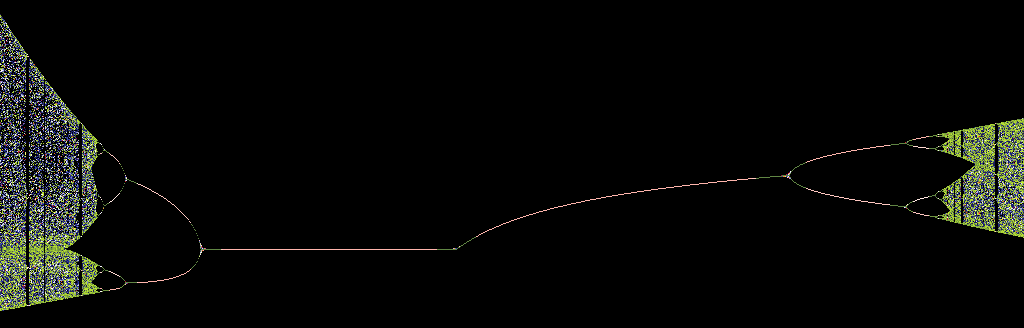
Event in dynamical systems theory
In dynamical systems theory, a period-doubling bifurcation occurs when a slight change in a system's parameters causes a new periodic trajectory to emerge from an existing periodic trajectory—the new one having double the period of the original. With the doubled period, it takes twice as long (or, in a discrete dynamical system, twice as many iterations) for the numerical values visited by the system to repeat themselves.
A period-halving bifurcation occurs when a system switches to a new behavior with half the period of the original system.
A period-doubling cascade is an infinite sequence of period-doubling bifurcations. Such cascades are one route by which dynamical systems can develop chaos. In hydrodynamics, they are one of the possible routes to turbulence.
Examples

It shows the attractor values, like x_* and x'_*, as a function of the parameter r.]]
Logistic map
The logistic map is :x_{n+1} = r x_n (1 - x_n) where x_n is a function of the (discrete) time n = 0, 1, 2, \ldots. The parameter r is assumed to lie in the interval [0,4], in which case x_n is bounded on [0,1].
For r between 1 and 3, x_n converges to the stable fixed point x_* = (r-1)/r. Then, for r between 3 and 3.44949, x_n converges to a permanent oscillation between two values x_* and x'_* that depend on r. As r grows larger, oscillations between 4 values, then 8, 16, 32, etc. appear. These period doublings culminate at r \approx 3.56995, beyond which more complex regimes appear. As r increases, there are some intervals where most starting values will converge to one or a small number of stable oscillations, such as near r=3.83, where there is a stable period-three solution.
In the interval where the period is 2^n for some positive integer n, not all the points actually have period 2^n. These are single points, rather than intervals. These points are said to be in unstable orbits, since nearby points do not approach the same orbit as them.
Kuramoto–Sivashinsky equation

The Kuramoto–Sivashinsky equation is an example of a spatiotemporally continuous dynamical system that exhibits period doubling. It is one of the most well-studied nonlinear partial differential equations, originally introduced as a model of flame front propagation.
The one-dimensional Kuramoto–Sivashinsky equation is : u_t + u u_x + u_{xx} + \nu , u_{xxxx} = 0 A common choice for boundary conditions is spatial periodicity: u(x + 2 \pi, t) = u(x,t).
For large values of \nu, u(x,t) evolves toward steady (time-independent) solutions or simple periodic orbits. As \nu is decreased, the dynamics eventually develops chaos. The transition from order to chaos occurs via a cascade of period-doubling bifurcations, one of which is illustrated in the figure.
Logistic map for a modified Phillips curve
Consider the following logistical map for a modified Phillips curve:
\pi_{t} = f(u_{t}) + b \pi_{t}^e
\pi_{t+1} = \pi_{t}^e + c (\pi_{t} - \pi_{t}^e)
f(u) = \beta_{1} + \beta_{2} e^{-u} ,
b 0, 0 \leq c \leq 1, \frac {df} {du}
where :
- \pi is the actual inflation
- \pi^e is the expected inflation,
- u is the level of unemployment,
- m - \pi is the money supply growth rate.
Keeping \beta_{1} = -2.5, \ \beta_{2} = 20, \ c = 0.75 and varying b, the system undergoes period-doubling bifurcations and ultimately becomes chaotic.
Experimental observation
Period doubling has been observed in a number of experimental systems. There is also experimental evidence of period-doubling cascades. For example, sequences of 4 period doublings have been observed in the dynamics of convection rolls in water and mercury. Similarly, 4-5 doublings have been observed in certain nonlinear electronic circuits. However, the experimental precision required to detect the ith doubling event in a cascade increases exponentially with i, making it difficult to observe more than 5 doubling events in a cascade.
Notes
References
References
- Alligood (1996) et al., p. 532
- (2017). "Modern Classical Physics: Optics, Fluids, Plasmas, Elasticity, Relativity, and Statistical Physics". Princeton University Press.
- Strogatz (2015), pp. 360–373
- (2015). "An in-depth numerical study of the two-dimensional Kuramoto–Sivashinsky equation". Proceedings of the Royal Society A: Mathematical, Physical and Engineering Sciences.
- (1991). "Predicting chaos for infinite dimensional dynamical systems: the Kuramoto-Sivashinsky equation, a case study.". Proceedings of the National Academy of Sciences.
- (1991). "The route to chaos for the Kuramoto-Sivashinsky equation". Theoretical and Computational Fluid Dynamics.
- see Strogatz (2015) for a review
- (1981). "Transition to Chaotic Behavior via a Reproducible Sequence of Period-Doubling Bifurcations". Physical Review Letters.
- (1982). "Period doubling cascade in mercury, a quantitative measurement". Journal de Physique Lettres.
- (1981). "Period Doubling and Chaotic Behavior in a Driven Anharmonic Oscillator". Physical Review Letters.
- (1982). "Evidence for Universal Chaotic Behavior of a Driven Nonlinear Oscillator". Physical Review Letters.
- (1982). "Hopping Mechanism Generating1fNoise in Nonlinear Systems". Physical Review Letters.
- Strogatz (2015), pp. 360–373
This article was imported from Wikipedia and is available under the Creative Commons Attribution-ShareAlike 4.0 License. Content has been adapted to SurfDoc format. Original contributors can be found on the article history page.
Ask Mako anything about Period-doubling bifurcation — get instant answers, deeper analysis, and related topics.
Research with MakoFree with your Surf account
Create a free account to save articles, ask Mako questions, and organize your research.
Sign up freeThis content may have been generated or modified by AI. CloudSurf Software LLC is not responsible for the accuracy, completeness, or reliability of AI-generated content. Always verify important information from primary sources.
Report