From Surf Wiki (app.surf) — the open knowledge base
Perforator vein
| Field | Value |
|---|---|
| Name | Perforator vein |
| Latin | venae perforantes |
| Image | Perfurante insuficiente.jpg |
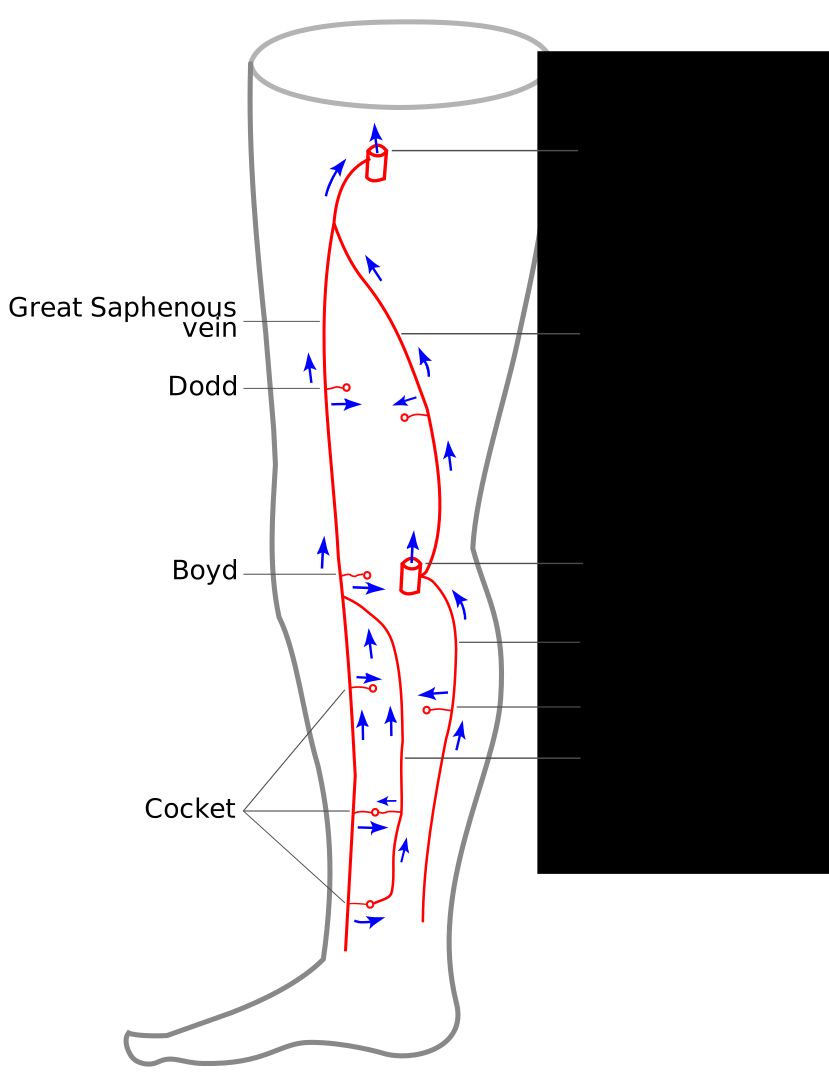
| Caption | Insufficiency caused by incompetent perforator valve |
Perforator veins are so called because they perforate the deep fascia of muscles, to connect the superficial veins to the deep veins where they drain.
Perforator veins play an essential role in maintaining normal blood draining. They have valves which prevent blood flowing back (regurgitation) from deep to superficial veins in muscular systole or contraction.
Location
Perforator veins exist along the length of the lower limb, in greater number in the leg (anatomical ref to below knee) than in the thigh.
Some veins are named after the physician who first described them:
- Dodd's perforator at the inferior 1/3 of the thigh
- Boyd's perforator at the knee level
- Cockett's perforators at the inferior 2/3 of the leg (usually there are three: superior medium and inferior Cockett perforators)
Others have the name of the deep vein where they drain:
- Medial gastrocnemius perforator, draining into the gastrocnemius vein
- Fibular perforators, usually two, one superior near the lateral aspect of the knee and one inferior at the lateral aspect of the ankle
When the valves of perforator veins become incompetent they can cause venous reflux when the muscles contract. This has been explained by Mark Whiteley as "active venous reflux". The resulting reflux can cause a rapid deterioration in an existing varicose disease and be responsible for the development of venous ulcers.
In the past, when varicose vein surgery is undertaken, the surgeon carefully ligated all perforators, but some believe that you can use conservative techniques to treat varicose disease use perforators to drain the superficial venous system. In this case, lower limbs venous ultrasonography plays an important role in evaluating which continent perforators can be used.
However, increasing evidence (see below) is starting to favor the treatment of incompetent perforator veins by minimally invasive techniques such as transluminal occlusion of perforators (TRLOP).
Clinical significance
Whether incompetent perforator veins (IPVs) require treatment or not is controversial, particularly when associated with the treatment of varicose veins. However research has shown that there is a clear association between the presence of IPVs and recurrent varicose veins.
Before 1985, the ligation of IPVs needed open surgery. In 1985, G. Hauer described the Sub-fascial endoscopic perforator vein surgery (SEPS) technique allowing IPVs to be clipped through a small incision.
SEPS was superseded in 2001 by minimally invasive laparoscopy, a technique using very small incisions, called transluminal occlusion of perforators (TRLOP) which by 2009 had shown to be as effective as SEPS in a 5-year study. As TRLOP can be performed under local anaesthetic and under ultrasound guidance, the advantages over the more invasive and painful SEPS were clear.
In 2007 there was an attempt to rename TRLOP as percutaneous ablation of perforators (PAP) but PAPs was seen to be merely a copy of the already described TRLOP procedure.
References
References
- (July 1997). "Validation of duplex ultrasonography in detecting competent and incompetent perforating veins in patients with venous ulceration of the lower leg". Journal of Vascular Surgery.
- http://www.veinsveinsveins.com/perforators{{full citation needed. (August 2014)
- (March 2006). "Duplex ultrasound investigation of the veins in chronic venous disease of the lower limbs--UIP consensus document. Part II. Anatomy". European Journal of Vascular and Endovascular Surgery.
- (2011). "Understanding Venous Reflux - the cause of varicose veins and venous leg ulcers".
- Linton RR. (April 1938). "The communicating veins of the lower leg and the operative technic for their ligation". Annals of Surgery.
- Franceschi, Claude. (August 2014). "Théorie et Pratique de la Cure Conservatrice et Hémodynamique de l'Insuffisance Veineuse en Ambulatoire". Armançon.
- Whiteley MS. (September 2014). "Part One: For the Motion. Venous Perforator Surgery is Proven and Does Reduce Recurrences". European Journal of Vascular and Endovascular Surgery.
- (May 2001). "Incompetent perforating veins are associated with recurrent varicose veins". European Journal of Vascular and Endovascular Surgery.
- Hauer G. (1985). "[Endoscopic subfascial discussion of perforating veins--preliminary report]". VASA.
- (April 2002). "Surgical technique and preliminary results of perforator vein closure - TRLOPS (Transluminal Occlusion of perforators)}} in {{cite journal". British Journal of Surgery.
- (April 2009). "Five-year results of incompetent perforator vein closure using TRans-Luminal Occlusion of Perforator". Phlebology.
- The College of Phlebology. (December 14, 2012). "TRLOP closure of incompetent perforating vein (IPV)". The College of Phlebology.
- (2007). "Ultrasound-guided percutaneous ablation for the treatment of perforating vein incompetence". Vascular.
- Whiteley MS. (December 2010). "Letter regarding: 'The role of perforators in chronic venous insufficiency' by TF O'Donnell. Phlebology 2010;25:3-10". Phlebology.
This article was imported from Wikipedia and is available under the Creative Commons Attribution-ShareAlike 4.0 License. Content has been adapted to SurfDoc format. Original contributors can be found on the article history page.
Ask Mako anything about Perforator vein — get instant answers, deeper analysis, and related topics.
Research with MakoFree with your Surf account
Create a free account to save articles, ask Mako questions, and organize your research.
Sign up freeThis content may have been generated or modified by AI. CloudSurf Software LLC is not responsible for the accuracy, completeness, or reliability of AI-generated content. Always verify important information from primary sources.
Report