From Surf Wiki (app.surf) — the open knowledge base
Peptide
Short chains of 2–50 amino acids

Short chains of 2–50 amino acids
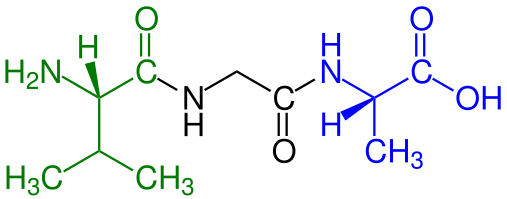
Peptides are short chains of amino acids linked by peptide bonds. A polypeptide is a longer, continuous, unbranched peptide chain. Polypeptides that have a molecular mass of 10,000 Da or more are called proteins. Chains of fewer than twenty amino acids are called oligopeptides, and include dipeptides, tripeptides, and tetrapeptides. Proteins are polypeptides, i.e. large peptides.
Amino acids comprise peptides as residues. Peptides are usually "linear" with an N-terminal (amine group) and C-terminal (carboxyl group) residue at the ends. Cyclic peptides are a distinct class.
Classification
Peptides have been classified according to their sources and functions. Some groups of peptides include plant peptides, bacterial/antibiotic peptides, fungal peptides, invertebrate peptides, amphibian/skin peptides, venom peptides, cancer/anticancer peptides, vaccine peptides, immune/inflammatory peptides, brain peptides, endocrine peptides, ingestive peptides, gastrointestinal peptides, cardiovascular peptides, renal peptides, respiratory peptides, opioid peptides, neurotrophic peptides, and blood–brain peptides.
Some ribosomal peptides are subject to proteolysis. These function, typically in higher organisms, as hormones and signaling molecules. Some microbes produce peptides as antibiotics, such as microcins and bacteriocins.
Peptides frequently have post-translational modifications such as phosphorylation, hydroxylation, sulfonation, palmitoylation, glycosylation, and disulfide formation. In general, peptides are linear, although lariat structures have been observed. More exotic manipulations do occur, such as racemization of L-amino acids to D-amino acids in platypus venom.
Nonribosomal peptides are assembled by enzymes, not the ribosome. A common non-ribosomal peptide is glutathione, a component of the antioxidant defenses of most aerobic organisms. Other nonribosomal peptides are most common in unicellular organisms, plants, and fungi and are synthesized by modular enzyme complexes called nonribosomal peptide synthetases.
Peptone These complexes are often laid out in a similar fashion, and they can contain many different modules to perform a diverse set of chemical manipulations on the developing product. These peptides are often cyclic and can have highly complex cyclic structures, although linear nonribosomal peptides are also common. Since the system is closely related to the machinery for building fatty acids and polyketides, hybrid compounds are often found. The presence of oxazoles or thiazoles often indicates that the compound was synthesized in this fashion.
Peptones are derived from animal milk or meat digested by proteolysis. In addition to containing small peptides, the resulting material includes fats, metals, salts, vitamins, and many other biological compounds. Peptones are used in nutrient media for growing bacteria and fungi.
Peptide fragments refer to fragments of proteins that are used to identify or quantify the source protein. Often these are the products of enzymatic degradation performed in the laboratory on a controlled sample, but can also be forensic or paleontological samples that have been degraded by natural effects.
Chemical synthesis
Main article: Peptide synthesis

Protein-peptide interactions

Peptides can perform interactions with proteins and other macromolecules. They are responsible for numerous important functions in human cells, such as cell signaling, and act as immune modulators. Indeed, studies have reported that 15-40% of all protein-protein interactions in human cells are mediated by peptides. Additionally, it is estimated that at least 10% of the pharmaceutical market is based on peptide products.
Example families
The peptide families in this section are ribosomal peptides, usually with hormonal activity. All of these peptides are synthesized by cells as longer "propeptides" or "proproteins" and truncated prior to exiting the cell. They are released into the bloodstream where they perform their signaling functions.
Antimicrobial peptides
- Magainin family
- Cecropin family
- Cathelicidin family
- Defensin family
Tachykinin peptides
Main article: Tachykinin peptides
- Substance P
- Kassinin
- Neurokinin A
- Eledoisin
- Neurokinin B
Vasoactive intestinal peptides
Main article: Secretin family
- VIP (Vasoactive Intestinal Peptide; PHM27)
- PACAP Pituitary Adenylate Cyclase Activating Peptide
- Peptide PHI 27 (Peptide Histidine Isoleucine 27)
- GHRH 1-24 (Growth Hormone Releasing Hormone 1-24)
- Glucagon
- Secretin
Pancreatic polypeptide-related peptides
- NPY (NeuroPeptide Y)
- PYY (Peptide YY)
- APP (Avian Pancreatic Polypeptide)
- PPY (Pancreatic PolYpeptide)
Opioid peptides
Main article: Opioid peptide
- Proopiomelanocortin (POMC) peptides
- Enkephalin pentapeptides
- Prodynorphin peptides
Calcitonin peptides
- Calcitonin
- Amylin
- AGG01
Self-assembling peptides
- Aromatic short peptides
- Biomimetic peptides
- Peptide amphiphiles
- Peptide dendrimers
Other peptides
- B-type Natriuretic Peptide (BNP) – produced in the myocardium and useful in medical diagnosis
- Lactotripeptides – Lactotripeptides might reduce blood pressure, although the evidence is mixed.
- Peptidic components from traditional Chinese medicine Colla Corii Asini in hematopoiesis.
- Jelleine – produced from royal jelly of honey bees.
Terminology
Length
Several terms related to peptides have no strict length definitions, and there is often overlap in their usage:
- A polypeptide is a single linear chain of many amino acids (any length), held together by amide bonds.
- A protein consists of one or more polypeptides (more than about 50 amino acids long).
- An oligopeptide consists of only a few amino acids (between two and twenty).
Number of amino acids
Peptides and proteins are often described by the number of amino acids in their chain, e.g. a protein with 158 amino acids may be described as a "158 amino-acid-long protein". Notes on terminology"Peptides of specific shorter lengths are named using IUPAC numerical multiplier prefixes:
- A monopeptide has one amino acid (not alone but combined with (an)other type(s) of molecule(s)).
- A dipeptide has two amino acids.
- A tripeptide has three amino acids.
- A tetrapeptide has four amino acids.
- A pentapeptide has five amino acids. (e.g., enkephalin).
- A hexapeptide has six amino acids. (e.g., angiotensin IV).
- A heptapeptide has seven amino acids. (e.g., spinorphin).
- An octapeptide has eight amino acids (e.g., angiotensin II).
- A nonapeptide has nine amino acids (e.g., oxytocin).
- A decapeptide has ten amino acids (e.g., gonadotropin-releasing hormone and angiotensin I).
- A undecapeptide has eleven amino acids (e.g., substance P).
The same words are also used to describe a group of residues in a larger polypeptide (e.g., RGD motif).
Function
- A neuropeptide is a peptide that is active in association with neural tissue.
- A lipopeptide is a peptide that has a lipid connected to it, and pepducins are lipopeptides that interact with GPCRs.
- A peptide hormone is a peptide that acts as a hormone.
- A proteose is a mixture of peptides produced by the hydrolysis of proteins. The term is somewhat archaic.
- A peptidergic agent (or drug) is a chemical which functions to directly modulate the peptide systems in the body or brain. An example is opioidergics, which are neuropeptidergics.
- A cell-penetrating peptide is a peptide able to penetrate the cell membrane.
References
References
- Hamley, I. W.. (September 2020). "introduction to Peptide Science". Wiley.
- {{Lehninger4th
- Saladin, K.. (13 January 2011). "Anatomy & physiology: the unity of form and function". McGraw-Hill.
- "proteins".
- (2013-05-03). "Obey the Peptide Assembly Rules". Science.
- "amino-acid residue in a polypeptide".
- Hamley, I. W.. (September 2020). "introduction to Peptide Science". Wiley.
- (2013). "Handbook of Biologically Active Peptides". Elsevier Science.
- (August 2007). "Microcins, gene-encoded antibacterial peptides from enterobacteria". Natural Product Reports.
- (May 1991). "Conformational analysis of bacitracin A, a naturally occurring lariat". Biopolymers.
- (July 2002). "D-Amino acid residue in the C-type natriuretic peptide from the venom of the mammal, Ornithorhynchus anatinus, the Australian platypus". FEBS Letters.
- (1983). "Glutathione". Annual Review of Biochemistry.
- (November 2004). "Selective interaction between nonribosomal peptide synthetases is facilitated by short communication-mediating domains". Proceedings of the National Academy of Sciences of the United States of America.
- (2004). "Biosynthesis of nonribosomal peptides1". Annual Review of Microbiology.
- (March 2001). "Biosynthesis of hybrid peptide-polyketide natural products". Current Opinion in Drug Discovery & Development.
- "UsvPeptides- USVPeptides is a leading pharmaceutical company in India".
- (27 September 1974). "Advances in Microbial Physiology, Volume 13". Elsevier Science.
- (2007). "ProMEX: a mass spectral reference database for proteins and protein phosphorylation sites". BMC Bioinformatics.
- (2005). "Chemical Genomics".
- (October 1999). "Liquid chromatography-mass spectrometry: potential in forensic and clinical toxicology". Journal of Chromatography B.
- "Propedia v2.3 - Peptide-Protein Interactions Database".
- (December 2021). "Propedia: a database for protein–peptide identification based on a hybrid clustering algorithm". BMC Bioinformatics.
- (2005-11-15). "Systematic Discovery of New Recognition Peptides Mediating Protein Interaction Networks". PLOS Biology.
- (2025-01-11). "Protein Synthesis: From Ribosomes to Post-Translational Modifications".
- (17 Nov 2017). "Self-assembling peptide semiconductors". Science.
- (26 Apr 2016). "Fmoc-modified amino acids and short peptides: simple bio-inspired building blocks for the fabrication of functional materials". Chem. Soc. Rev..
- (February 10, 2011). "Self-Assembly of Short Aβ(16−22) Peptides: Effect of Terminal Capping and the Role of Electrostatic Interaction". Langmuir.
- Ian Hamley. (2011). "Self-Assembly of Amphiphilic Peptides". Soft Matter.
- (July 26, 2016). "Design of Controllable Bio-Inspired Chiroptic Self-Assemblies". Biomacromolecules.
- (23 August 2016). "Entropic Phase Transitions with Stable Twisted Intermediates of Bio-Inspired Self-Assembly". Chem. Eur. J..
- (June 16, 2011). "Dynamic Adsorption and Structure of Interfacial Bilayers Adsorbed from Lipopeptide Surfactants at the Hydrophilic Silicon/Water Interface: Effect of the Headgroup Length". Langmuir.
- (2019-08-21). "Stereoselective pH Responsive Peptide Dendrimers for siRNA Transfection". Bioconjugate Chemistry.
- (March 2009). "Lactotripeptides and antihypertensive effects: a critical review". The British Journal of Nutrition.
- (October 2008). "Effect of milk tripeptides on blood pressure: a meta-analysis of randomized controlled trials". Nutrition.
- Pripp AH. (2008). "Effect of peptides derived from food proteins on blood pressure: a meta-analysis of randomized controlled trials". Food & Nutrition Research.
- (February 2008). "Lactotripeptides show no effect on human blood pressure: results from a double-blind randomized controlled trial". Hypertension.
- (April 2016). "Extraction and identification of collagen-derived peptides with hematopoietic activity from Colla Corii Asini". Journal of Ethnopharmacology.
This article was imported from Wikipedia and is available under the Creative Commons Attribution-ShareAlike 4.0 License. Content has been adapted to SurfDoc format. Original contributors can be found on the article history page.
Ask Mako anything about Peptide — get instant answers, deeper analysis, and related topics.
Research with MakoFree with your Surf account
Create a free account to save articles, ask Mako questions, and organize your research.
Sign up freeThis content may have been generated or modified by AI. CloudSurf Software LLC is not responsible for the accuracy, completeness, or reliability of AI-generated content. Always verify important information from primary sources.
Report