From Surf Wiki (app.surf) — the open knowledge base
People's Mojahedin Organization of Iran
| Field | Value | |
|---|---|---|
| name | People's Mojahedin Organization | |
| logo | File:Logo of the People's Mujahedin of Iran.svg | |
| logo_size | 120 | |
| colorcode | ||
| leader | Maryam Rajavi | |
| Massoud Rajavi | ||
| secretary_general | Zahra Merrikhi | |
| foundation | ||
| banned | 1981 (in Iran) | |
| headquarters | {{plainlist | |
| * <ref name | durres-locals/}} | |
| website | ||
| country | Iran | |
| abbreviation | PMOI, MEK, MKO | |
| native_name | سازمان مجاهدین خلق | |
| native_name_lang | fa | |
| split | Freedom Movement of Iran | |
| founders | Mohammad Hanifnejad | |
| Saeid Mohsen | ||
| Ali-Asghar Badi'zadegan | ||
| Ahmad Rezaei | ||
| wing1_title | Political wing | |
| wing1 | National Council of Resistance of Iran | |
| (1981–present) | ||
| wing2_title | Military wing | |
| wing2 | National Liberation Army (1987–2003) | |
| membership | 5,000 to 10,000 | |
| ideology | See below | |
| position | Syncretic | |
| colours | Red | |
| religion | Shia Islam | |
| flag | {{Multiple image | |
| align | center | |
| direction | horizontal | |
| width | 100 | |
| image1 | Flag of the People's Mujahedin of Iran.svg | |
| alt1 | Flag of the People's Mujahedin of Iran | |
| image2 | Flag of the People's Mujahedin of Iran (Yellow).svg | |
| alt2 | Yellow version of the flag of the People's Mujahedin of Iran | |
| border | infobox | |
| newspaper | Mojahed |
Massoud Rajavi
- Camp Ashraf 3, Albania (2018–)
- Paris, France (1981–1986; 2003–2018)
- Camp Liberty, Iraq (2012–2016)
- Camp Ashraf, Iraq (1986–2013)
- Tehran, Iran (1965–1981) Saeid Mohsen Ali-Asghar Badi'zadegan Ahmad Rezaei (1981–present) The People's Mojahedin Organization of Iran (PMOI), also known as Mojahedin-e-Khalq (MEK) or Mojahedin-e-Khalq Organization (MKO; ), is an Iranian dissident organization. It was an armed group until 2003, afterwards transitioning into a political group. Its headquarters is currently in Albania. The group's ideology was influenced by Islam and revolutionary Marxism; and while it denied Marxist influences, its revolutionary reinterpretation of Shia Islam was shaped by the writings of Ali Shariati. After the Iranian Revolution, the MEK opposed the new theocratic Government of the Islamic Republic of Iran, seeking to replace it with its own government. At one point the MEK was Iran's "largest and most active armed dissident group", and it is still sometimes presented by Western political backers as a major Iranian opposition group. The MEK is known to be deeply unpopular today within Iran, largely due to its siding with Iraq in the Iran–Iraq War and continued ties with the government of Saddam Hussein afterwards.
The MEK was founded on 5 September 1965 by leftist Iranian students affiliated with the Freedom Movement of Iran to oppose the Shah Mohammad Reza Pahlavi. The organization contributed to overthrowing the Shah during the 1979 Iranian Revolution. It subsequently pursued the establishment of a democracy in Iran, particularly gaining support from Iran's middle class intelligentsia. The MEK boycotted the 1979 constitutional referendum, which led to Khomeini barring MEK leader Massoud Rajavi from the 1980 presidential election. On 20 June 1981, the MEK organized a demonstration against Khomeini and against the ousting of President Abolhassan Banisadr and the protest was violently suppressed by the Islamic Revolutionary Guard Corps, which shot into the crowds, killing fifty and injuring hundreds, before later executing 23 further protesters who had been arrested, including teenage girls. On 28 June, the MEK was implicated in the blowing up of the headquarters of the Islamic Republican Party (IRP) in the Hafte Tir bombing, killing 74 officials and party members.{{bulleted list | | | | |
Facing the subsequent repression of the MEK by the IRP, Rajavi fled to Paris. During the exile, the underground network that remained in Iran continued to plan and carry out attacks and it allegedly conducted the August 1981 bombing that killed Iran's president and prime minister. In 1983, the MEK began meeting with Iraqi officials. In 1986, France expelled the MEK at the request of Iran, forcing it to relocate to Camp Ashraf in Iraq. In 1987, it founded the "National Liberation Army of Iran" (NLA), with the sole objective of "toppling the Islamic Republic through military force from outside the country". During the Iran–Iraq War, the MEK then sided with Iraq, taking part in Operation Forty Stars, and Operation Mersad. Following Operation Mersad, Iranian officials ordered the mass execution of prisoners said to support the MEK. The group gained significant publicity in 2002 by announcing the existence of Iranian nuclear facilities. In 2003, the MEK's military wing signed a ceasefire agreement with the U.S. and was disarmed at Camp Ashraf.
Between 1997 and 2013, the MEK was on the lists of terrorist organizations of the US, Canada, EU, UK and Japan for various periods. The MEK is designated as a terrorist organization by Iran. Critics have described the group as exhibiting traits of a "personality cult", while its backers describe the group as proponents of "a free and democratic Iran" that could become the next government there.
History
Early years (1965–1970)
The Mojahedin-e-Khalq (MEK) was founded in 1965 by a group of Tehran University students who had opposed the Shah Mohammad Reza Pahlavi in the 1950s. They considered the mainstream Liberation Movement too moderate and ineffective, and aimed to establish a socialist state in Iran based on a modern and revolutionary interpretation of Islam that originated from Islamic texts like Nahj al-Balagha and some of Ali Shariati's works. MEK founders included Mohammad Hanifnejad, Saeed Mohsen, and Ali Asghar Badiazadegan, and it attracted primarily young, well-educated Iranians. While MEK publications were banned in Iran, in its first five years, the group primarily engaged in ideological work.
Schism (1970–1978)
| 1971 | 1972 | 1973 | 1974 | 1975 |
|---|---|---|---|---|
| Bahram Aram | ||||
| Reza Rezaeia | Taghi Shahram | |||
| Kazem Zolanvarb | Majid Sharif Vaghefic | |||
| a Killed in action by SAVAK in 1973 | ||||
| b Arrested in 1972, executed in 1975 | ||||
| c Killed by Marxist offshoot in 1975 purge |
By August 1971, the MEK's Central Committee included Reza Rezai, Kazem Zolanvar, and Brahram Aram. Arrests and executions carried out by the Shah Mohammad Reza Pahlavi's security services between 1971 and 1972, compounded by internal factional infighting, shattered the organisation.
During the 1970s, the MEK opposed the Shah and SAVAK, whom they described as "anti-patriotic, anti-Islamic, and collaborative with Imperialist and anti-popular oppressors".
Between August and September 1971, SAVAK arrested and executed many MEK members including its co-founders. Some surviving members restructured the group by replacing the central cadre with a three-man central committee. Each of the three central committee members led a separate branch of the organization. Two of the original central committee members were replaced in 1972 and 1973, and the replacing members were in charge of leading the organization until the internal purge of 1975.
By 1973, MEK members that declared themselves Marxist–Leninist launched an "internal ideological struggle", and by 1975 two opposing MEK factions had formed, one being Muslim and the other Marxist. The Marxist offshoot asserted that "they had reached the conclusion that Marxism, not Islam, was the true revolutionary philosophy". Members who did not convert to Marxism were expelled or reported to SAVAK. This led to two rival Mojahedin, each with its own publication, its own organization, and its own activities. The Marxist offshoot was initially known as the Mojahedin M.L. (Marxist–Leninist). A few months before the Iranian Revolution, the majority of the Marxist Mojahedin renamed themselves Peykar (Organization of Struggle for the Emancipation of the Working Class) in 1978. From 1973 to 1979, the Muslim MEK including Massoud Rajavi were mainly in prison. "Rajavi, upon release from prison during the revolution, had to rebuild the organization". In May 1972, there was an assassination attempt on Brig. Gen. Harold Price in Tehran, and in 1973 Lt. Col. Louis Lee Hawkins was shot dead in Tehran, though it remains unclear whether the MEK itself or its Marxist offshoot were responsible.
Between 1973 and 1975, the Marxist–Leninist offshoot escalated their militant activities in Iran. In 1973, they engaged in two street battles with Tehran police and bombed ten buildings including Plan Organization, Pan-American Airlines, Shell Oil Company, Hotel International, Radio City Cinema, and an export company owned by a Baháʼí businessman. In February 1974, they attacked a police station in Isfahan and in April, they bombed a reception hall, Oman Bank, gates of the British embassy, and offices of Pan-American Oil company in protest of the Sultan of Oman's state visit. A communiqué by the organization declared that their actions had been to show solidarity with the people of Dhofar. On 19 April 1974, they attempted to bomb the SAVAK centre at Tehran University. On 25 May, they set off bombs at three multinational corporations. In August 1976, a car carrying three American employees of Rockwell International - William Cottrell, Donald Smith, and Robert Krongard - was attacked, resulting in their deaths. While some sources suggest the MEK was responsible, the Marxist offshoot, which at the time had retained the organization's name, claimed responsibility for the killings in their "Military Communique No.24", concluding that the murders were in retaliation for recent death sentences.
1979 Iranian Revolution and subsequent power struggles
Main article: Iranian Revolution
The MEK supported the revolution in its initial phases, and became "a major force in Iranian politics" according to Ervand Abrahamian. However, it soon entered into conflict with Khomeini, and became a leading opposition to the new theocratic regime. By early 1979, the MEK had organized themselves and recreated armed cells, especially in Tehran and helped overthrow the Pahlavi regime. In January 1979, Massoud Rajavi was released from prison and rebuilt the MEK together with other members that had been imprisoned. Also in January 1979 the MEK released a program advocating for increased rights for ethnic minorities in Iran, the introduction of welfare-state policies, and gender equality; while the Khomeini regime perceived these demands as a threat.
Its candidate for the head of the newly founded Council of Experts was Massoud Rajavi in the referendum of August 1979. He was not elected. The MEK was one of the supporters of the occupation of the American embassy in Tehran after the Iranian revolution, although MEK has denied this.
The MEK refused to participate in the December 1979 Iranian constitutional referendum organized by the Islamic Republican Party to ratify the Constitution drafted by the Assembly of Experts, arguing that the new constitution had failed in many aspects "most important of all, accept the concept of the 'classless tawhidi society'". Despite the opposition, the 3 December 1979 referendum vote approved the new constitution. Once the constitution had been ratified, the MEK proposed Rajavi as their presidential candidate. In his campaign, Rajavi promised to rectify the constitution's shortcomings. The conflict surrounding the Constitution intensified when the Assembly of Experts added numerous clauses that transferred sovereignty from the Iranian population to the ulama, shifting the power to senior clerics and away from the president and elected representatives. In the years that followed, the clerics strengthened their grip on the republic, eventually gaining control over all branches of government and fully establishing a theocratic state. As a result of the boycott, Khomeini subsequently refused to allow Massoud Rajavi and MEK members to run in the 1980 Iranian presidential election. Khomeini declared that "those who had failed to endorse the Constitution could not be trusted to abide by that Constitution". In the March and April 1980 parliamentary elections, the MEK secured the second-highest number of votes. Massoud Rajavi garnered 500,000 votes, while his wife Maryam received over 250,000. However, Khomeini restricted both of them from entering the parliament (Majles). Rajavi then allied with Iran's new president, Abolhassan Banisadr, elected in January 1980.
Cultural revolution, Iranian protests, and subsequent oppression (1980–1981)
Main article: Cultural Revolution in Iran, 1981–1982 Iran Massacres, 20 June 1981 Iranian protests, Aftermath of the Iranian Revolution
On June 14, 1980, Ayatollah Khomeini initiated an order aimed to "purify" higher education by removing Western, liberal, and leftist elements, leading to the closure of universities, the banning of student unions, and violent occupations of campuses. Following the 1979 revolution, the MEK started to gain popularity among university students. During the Cultural Revolution in Iran, clerics imposed policies to Islamize Iranian society, including the expulsion of critical academics, the suppression of secular political groups, and the persecution of intellectuals and artists. These measures sparked large-scale protests across the country.
On the final day of the elections, Rajavi met with President Abolhassan Banisadr, complaining that the IRP and its Hezbollah supporters were systematically intimidating voters, disrupting rallies, assaulting campaign workers, and setting ballot boxes on fire. The MEK then arrived at two key conclusions: first, that they had enough popular backing to serve as an opposition to the IRP; and second, that the IRP would not allow them to operate as an opposition. The group began clashing with the ruling Islamic Republican Party while avoiding direct and open criticism of Khomeini. The MEK was in turn suppressed by Khomeini's revolutionary organizations.
In response to the widely disputed impeachment of President Banisadr, the MEK organized a large-scale protest against Khomeini on June 20, 1981, intending to topple the regime. Big crowds gathered in various cities, with the Tehran protest alone attracting up to 500,000 people. Leading clerics proclaimed that demonstrators would be considered "enemies of God" and face immediate execution regardless of age. This marked the beginning of the 1981–1982 Iran Massacres led by the Islamic government. In the area around Tehran University, 50 people were killed, 200 wounded, and 1,000 taken into custody, surpassing the intensity of most street battles during the Islamic Revolution. 23 demonstrators were also executed by firing squads, with teenage girls among those executed. From June 24 to 27, the regime executed an additional 50 people. The reported number of executions increased to "600 by September, 1700 by October, and 2500 by December." Initially, the regime publicly displayed the bodies and took pride in declaring the execution of entire families, "including teenage daughters and 60-year-old grandmothers." The MEK responded by declaring war against the Government of Islamic Republic of Iran, and initiating a series of bombings and assassinations targeting the clerical leadership.
In September 1980 during Iraq's invasion of Iran, the MEK stepped up to fight for their country despite its strained relationship with Khomeini's government. Thousands of MEK members joined the front lines.
Hafte Tir bombing
Main article: Hafte Tir bombing
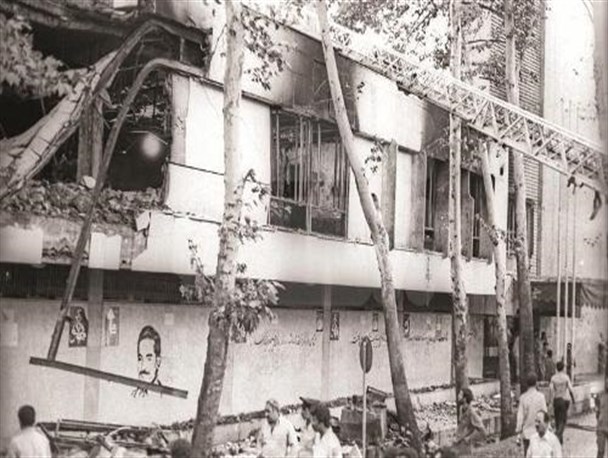
On 28 June 1981, the Islamic Republican Party headquarters was bombed in the Hafte Tir bombing, which killed 74 party officials and other party members, including Mohammad Beheshti, the party's secretary-general and Chief Justice of Iran, 4 cabinet ministers, 10 vice ministers and 27 members of the Parliament of Iran. Iranian officials initially blamed various groups including the Iraqi government, SAVAK, and the United States. Two days after the incident Ruhollah Khomeini accused the MEK. In the years that followed, others were also held accountable, including a man named Mehdi Tafari executed by a Tehran tribunal for his alleged involvement. Kenneth Katzman notes there is much speculation among academics and observers that the bombings could have been orchestrated by top IRP officials as a strategy to eliminate political opponents within the government. According to the United States Department of State, in addition to other sources, the bombing was carried out by the MEK. Ervand Abrahamian argues that whatever the truth may be, the Islamic Republic used this incident to fight the MEK. The MEK declared that the bombing was a "natural and necessary reaction to the regime's atrocities", and it never claimed responsibility for the attack.
Open conflict with the Islamic Republican Party
While Khomeini and the MEK had allied against the Shah, Khomeini "disliked the MEK's philosophy, which combined Marxist theories of social evolution and class struggle with a view of Shiite Islam that suggested Shiite clerics had misinterpreted Islam and had been collaborators with the ruling class", and by mid-1980, clerics close to Khomeini were openly referring to the MEK as "monafeghin", "kafer", and "elteqatigari". The MEK in turn accused Khomeini and the clerics of "monopolizing power", "hijacking the revolution", "trampling over democratic rights", and "plotting to set up a fascistic one-party dictatorship".
In July 1981, the MEK then formed the National Council of Resistance of Iran (NCRI) with the stated goal of uniting the opposition to the Iranian government under one umbrella organization. Rajavi assumed the position of chairman of the organization. On 30 August 1981, they bombed the Prime Minister's office, killing the elected President Rajai and Premier Mohammad Javad Bahonar. Iranian authorities announced that Massoud Keshmiri, an MEK member was probably responsible. The reaction to the Hafte Tir bombing and the bombing of the Prime Minister's office was intense, with many arrests and executions of Mojahedin. The MEK responded by targeting key Iranian official figures for assassination, as well as attacking low-ranking civil servants and members of the Revolutionary Guards, along with ordinary citizens who supported the new government.
Between June 1981 and April 1982, around 3,500 MEK members were either executed or killed by the Islamic Revolutionary Guard Corps. Another 5000 MEK prisoners were detained in camps, and another 8,000 were imprisoned for charges such as possessing copies of Mujahid newspaper. During the same period the MEK was responsible for about 65 percent of nearly 1,000 Khomeini officials killed. From 26 August 1981 to December 1982, the MEK orchestrated 336 attacks against Khomeini officials. In July 1982, 13 IRGC members and Mohammad Sadoughi were killed by MEK members.
Exile and underground opposition activity (1982–1988)
In 1982, the Islamic Republic cracked down MEK operations within Iran. On 8 February Mousa Khiabani, Rajavi's deputy and the MEK's field commander in Iran was killed following a three-hour gunfight at a North Tehran safehouse. Alongside him died his wife Azar Rezaei, Ashraf Rabiei, Rajavi's first wife and six others. Rajavi's son Mostafa survived and was later sent to Paris. The MEK stressed the significance of ideology, which was shaped by its interpretation of what was missing in Iran at the time such as lack of freedom and human rights limitations by the Islamic Republic. The majority of the MEK leadership and members fled to France, where it operated until 1985. In 1983, the MEK started an alliance with Iraq following a meeting between Massoud Rajavi and Tariq Aziz. Iran's deposed president Abolhassan Banisadr ended his alliance with the group in 1984, denouncing its stance during the Iran–Iraq War.
In 1986, after French Prime Minister Jacques Chirac struck a deal with Tehran for the release of French hostages held prisoners by the Hezbollah in Lebanon. Also in June 1986, the Islamic Republic "won another major victory in its campaign to isolate the Mojahedin" by persuading the French government to close down the MEK headquarters in Paris. This improved relations between France and Iran. During this period other European nations declined to offer political asylum to the group. With no alternative available and a desire to maintain the group's cohesion, they ultimately decided to relocate to Iraq. James Piazza contends that the MEK's expulsion from France and relocation to Iraq is a "crucial episode" in the group's exile, as it appears Khomeini aimed to send the MEK to a remote place. However, the group ended up in a location that enabled it to continue its cross-border attacks. MEK representatives contend that their organization had little alternative to moving to Iraq considering its aim of toppling the Iranian clerical government. By 1987, most MEK leaders were based in Iraq, where the group remained until the 2003 US invasion. According to the US State Department, the MEK was mainly supported by Iraq during that period and was fighting on the Iraqi side in the 1980–1988 Iran–Iraq War.
From 1982 to 1988, despite the mounting casualties on both sides, the lingering underground presence of the MEK in Iran remained operational and went on to perform an average of sixty operations per week, resulting in assassinations of important Khomeini deputies. The MEK came to be considered Iran's "largest and most active Iranian exile organization", and its publications were commonly circulated within the Iranian diaspora.
Operations Shining sun, Forty Stars, and Mersad


The MEK's official argument for moving to Iraq was that it would place them geographically close to their enemy, the Islamic Republic government in Iran. In 1987 Masoud Rajavi declared the establishment of the National Liberation Army of Iran (, NLA). It served as an infantry force that included different militant groups and members of the NCRI. its sole objective was to "overthrow the Islamic Republic using a military force outside the country." Through a broadcast on Baghdad radio, the MEK extended an invitation to all progressive-nationalist Iranian individuals to join the NLA in overthrowing the government of the Islamic Republic.
On 27 March 1988, the NLA launched its first military offensive against the Islamic Republic's armed forces. The NLA captured 600 square-kilometres of Islamic Republic territory and 508 soldiers from the Iranian 77th infantry division in Khuzestan Province. The operation was named "Shining Sun" (or "Operation Bright Sun") in which according to Massoud Rajavi, 2000 soldiers of the Islamic Republic were killed and $100 million worth of equipment was captured and exhibited for journalists.
Operation Forty Stars was launched on June 18, 1988. With 530 aircraft sorties and heavy use of nerve gas, they attacked to the Iranian forces in the area around Mehran, killing or wounding 3,500 and nearly destroying a Revolutionary Guard division. The forces captured the city and took positions in the heights near Mehran, coming close to wiping out the whole Iranian Pasdaran division and taking most of its equipment. While some sources claim that Iraq participated in the operation, the MEK and Baghdad said Iraqi soldiers did not take part.
Near the end of the Iran–Iraq War, a military force of 7,000 members of the MEK, armed and equipped by Saddam's Iraq and calling itself the National Liberation Army of Iran (NLA) was founded. On 26 July 1988, six days after Ayatollah Khomeini had announced his acceptance of the UN-brokered ceasefire resolution, the NLA advanced under heavy Iraqi air cover, crossing the Iranian border from Iraq. It seized the Iranian town of Islamabad-e Gharb. As it advanced further into Iran, Iraq ceased its air support, with Iranian forces cutting off NLA supply lines and counterattacking under cover of fighter planes and helicopter gunships. The MEK claims it lost 1,400 dead or missing and the Islamic Republic sustained 55,000 casualties. It claims to have killed 4,500 NLA during the operation. The operation was called Foroughe Javidan (Eternal Light) by the MEK and the counterattack Operation Mersad by the Iranian forces. Rajavi later stated that "the failure of Eternal Light was not a military blunder, but was instead rooted in the members' thoughts for their spouses".
1988 execution of MEK prisoners
Main article: 1988 executions of Iranian political prisoners
Following the MEK's Operation Mersad against Iranian forces, thousands of imprisoned members of the MEK, along with members of other leftist opposition groups, were executed. The Iranian government used the MEK's failed invasion as a pretext for the mass execution of those "who remained steadfast in their support for the MEK" and other jailed opposition group members.
On 19 July 1988, the authorities isolated major prisons, having its courts of law go on an unscheduled holiday to prevent relatives from inquiring about those imprisoned, and as Ervand Abrahamian notes, "thus began an act of violence unprecedented in Iranian history". Prisoners were asked if they were willing to denounce the MEK before cameras, help the IRI hunt down MEK members and name secret sympathizers. Those who gave unsatisfactory answers were promptly taken away and hanged. Children and Women were among those executed. Human rights groups say that the number of those executed remains uncertain, but "thousands of political dissidents were systematically subjected to enforced disappearance in Iranian detention facilities across the country", with those executed charged with "moharebeh" or "waging war on God", and of "disclosing state secrets" and threatening national security". Since the executions, Amnesty International has stated that "there has also been an ongoing campaign by the Islamic Republic to demonize victims, distort facts, and repress family survivors and human rights defenders." Under international law, these mass extrajudicial killings without fair proceedings were also considered systematic crimes against humanity.
The executions were ordered directly by Ayatollah Khomeini through a written fatwa. The killings were implemented a "death committees," composed of an Islamic judge, a representative of the Ministry of Intelligence, and a state prosecutor. High-ranking officials, such as Mohammad Khatami and Ayatollah Ali Khamenei, were identified by opposition groups as responsible.{{Cite web |access-date=2025-12-04 |archive-url=https://archive.today/20130103141612/http://www.telegraph.co.uk/news/worldnews/middleeast/iran/1321090/Khomeini-fatwa-led-to-killing-of-30000-in-Iran.html |archive-date=3 January 2013 |url-status=live
According to Professor Cheryl Bernard, the mass execution of political prisoners carried out by the Islamic Republic in 1981 caused the MEK to split into four groups: those that were arrested, imprisoned or executed, a group that went underground in Iran, another that left to Kurdistan and a final group that left to other countries abroad. By the end of 1981, the principal refuge for many exiled members of the MEK had become France.
Post-war Saddam era (1988–2003)
The Iranian government isbelieved to be concerned about MEK activities in Iran. As such, MEK supporters are a major target of Iran's internal security apparatus abroad and it is said to be responsible for killing MEK members, Kazem Rajavi on 24 April 1990 and Mohammad-Hossein Naghdi, a NCRI representative on 6 March 1993. In 1991 the MEK was accused of helping the Iraqi Republican Guard suppress Shiite and Kurdish nationwide uprisings, a claim the MEK has consistently denied. Ervand Abrahamian suggests that one motivation for the MEK's opposition to the clerical regime was its infringement on the rights of national minorities, especially the Kurds.
In April 1992, the MEK attacked 10 Iranian embassies, including the Iranian Mission to the United Nations in New York using different weapons, taking hostages, and injuring Iranian ambassadors and embassy employees. There were dozens of arrests. According to MEK representatives, the attacks were a way to protest the bombing of a MEK military base where several people had been killed and wounded.
In June 1998 FIFA president Sepp Blatter said that he received "anonymous threats of disruption from Iranian exiles" for the 1998 FIFA World Cup match between Iran and the U.S. football teams at Stade de Gerland. The MEK bought some 7,000 out of 42,000 tickets for the match between, in order to promote themselves with the political banners they smuggled. The plan was ultimately foiled with TV cameras avoiding filming them, and intelligence sources having been tipped off about a potential pitch invasion. To prevent an interruption in the match, extra security entered Stade Gerland.
In 1999, after a 2 1⁄2-year investigation, Federal authorities arrested 29 individuals in Operation Eastern Approach, of whom 15 were held on charges of helping MEK members illegally enter the United States. The ringleader pled guilty to providing fake documents to MEK members and to violations of the Antiterrorism and Effective Death Penalty Act of 1996. In 2002 the NCRI publicly called or the formation of a National Solidarity Front to help overthrow the Iranian Government.
2003 French arrests
In June 2003, French police raided the MEK's properties, including its base in Auvers-sur-Oise, under the orders of anti-terrorist magistrate Jean-Louis Bruguière, after suspicions that it was trying to shift its base of operations there. 160 suspected MEK members were then arrested, including Maryam Rajavi and her brother Saleh Rajavi. After questioning, most of those detained were released, but 24 members, including Maryam Rajavi, were kept in detention.
In response, 40 supporters began hunger strikes to protest the arrests, and 10 members including Neda Hassani, immolated themselves in various European capitals. French Interior Minister Nicolas Sarkozy declared that the MEK "recently wanted to make France its support base, notably after the intervention in Iraq", while Pierre de Bousquet de Florian, head of France's domestic intelligence service, claimed that the group was "transforming its Val d'Oise centre [near Paris] [...] into an international terrorist base". Police found $1.3 million in $100 bills in cash in their offices.
U.S. Senator Sam Brownback, a Republican from Kansas and chairman of the Foreign Relations subcommittee on South Asia, then accused the French of doing "the Iranian government's dirty work". Along with other members of Congress, he wrote a letter of protest to President Jacques Chirac, while longtime MEK supporters such as Sheila Jackson Lee, a Democrat from Texas, criticized Maryam Radjavi's arrest. A court later found that there were no grounds for terrorism or terrorism-related finance charges. In 2014, prosecuting judges also dropped all charges of money laundering and fraud.
Post-U.S. invasion of Iraq (2003–2016)

In May 2003, during the Iraq War, the Coalition forces bombed MEK bases and forced them to surrender. This resulted in at least 50 deaths. The US forces then disarmed Camp Ashraf residents. In the operation, the U.S. reportedly captured 6,000 MEK soldiers and over 2,000 pieces of military equipment, including 19 British-made Chieftain tanks. Following the occupation the U.S. did not hand over MEK fighters to Iran. The group's core members were for many years effectively confined to Camp Ashraf, before later being relocated to a former U.S. military base, Camp Liberty, in Iraq. Then-Secretary of Defense Donald Rumsfeld and Vice President Dick Cheney argued that the MEK should be used against Iran. They were then placed under the guard of the U.S. Military. Defectors from the MEK requested assistance from the Coalition forces, who created a "temporary internment and protection facility" for them. In the first year these numbered "several hundred", mainly Iranian soldiers captured in the Iran–Iraq War and other Iranians lured to the MEK. In all, during the period of US control, nearly 600 members of the MEK defected.
In June 2004, Donald Rumsfeld designated the MeK as protected persons under the Fourth Geneva Convention. and signed a formal ceasefire agreement. Since 2009, when the Iraqi government became openly hostile to MEK, the U.S. led efforts to get the group's members out of Iraq. After it was no longer designated as a terrorist group, the US was able to convince Albania to accept the remaining 2,700 members who were brought to Tirana between 2014 and 2016.
Separate to events in Iraq, the organization launched a free-to-air satellite television network named Vision of Freedom (Sima-ye-Azadi) in England in 2003. It previously operated Vision of Resistance analogue television in Iraq in the 1990s, accessible in western provinces of Iran. They also had a radio station, Radio Iran Zamin, that was closed down in June 1998. In 2006, an EU freeze on the group's funds was overturned by the European Court of First Instance. In 2010 and 2011 Ali Saremi, Mohammad Ali Haj Aghaei and Jafar Kazemi were executed by the Iranian government for co-operating with the MEK.
Iraqi government crackdown (2009–2013)
In 2009 American troops gave the Iraqi government responsibility of the MEK. Iraqi authorities, which were sympathetic to Iran, allowed Iran-linked militias to attack the MEK. Prime Minister Nuri al-Maliki announced that the militant group would not be allowed to base its operations from Iraqi soil. On 23 January 2009, while on a visit to Tehran, Iraqi National Security Advisor Mowaffak al-Rubaie reiterated the Iraqi Prime Minister's earlier announcement that the MEK organization would no longer be able to base itself on Iraqi soil and stated that the members of the organization would have to make a choice, either to go back to Iran or to go to a third country, adding that these measures would be implemented over the next two months.
On 28 July 2009, Iraqi security forces raided MEK headquarters at Camp Ashraf. MEK claimed 11 dead and 400 injured in clashes while the Iraqi government claimed 30 policemen injured. U.S. officials had long opposed a violent takeover of the camp northeast of Baghdad, and the raid is thought to symbolize the declining American influence in Iraq. After the raid, the U.S. Secretary of State, Hillary Rodham Clinton, stated the issue was "completely within [the Iraqi government's] purview". In the course of attack, 36 Iranian dissidents were arrested and removed from the camp to a prison in a town named Khalis, where the arrestees went on hunger strike for 72 days. Finally, the dissidents were released when they were in an extremely critical condition and on the verge of death.
In January 2010, Iranian authorities charged five MEK protesters of "rioting and arson" under the crime of moharebeh, an offence reserved for those who "take up arms against the state" and carries the death penalty. In July 2010, the Supreme Iraqi Criminal Tribunal issued an arrest warrant for 39 MEK members, including Massoud and Maryam Rajavi, accusing them of crimes against humanity during the 1991 uprisings in Iraq. The MEK denied the charges.
In 2012, the MEK moved from Camp Ashraf to Camp Hurriya in Baghdad (a onetime U.S. base formerly known as Camp Liberty). A rocket and mortar attack killed 5 and injured 50 others at Camp Hurriya on 9 February 2013. MEK residents of the facility and their representatives appealed to the UN Secretary-General and U.S. officials to let them return to Ashraf, which they said has concrete buildings and shelters that offer more protection. The United States has been working with the UN High Commissioner for Refugees on the resettlement project.
In 2013, 52 unarmed MEK members were killed during an attack on Camp Ashraf. 7 other members were also reported missing. Iraqi security forces are thought to be responsible for the assault, with guidance and support from the Iranian government.
Iran's nuclear programme
The MEK and the NCRI revealed the existence of Iran's nuclear program in a press conference held on 14 August 2002 in Washington, D.C. MEK representative Alireza Jafarzadeh stated that Iran is running two top-secret projects, one in the city of Natanz and another in a facility located in Arak, which was later confirmed by the International Atomic Energy Agency.
Journalists Seymour Hersh and Connie Bruck have written that the information was given to the MEK by Israel. Among others, it was described by a senior IAEA official and a monarchist advisor to Reza Pahlavi, who said before MEK they were offered to reveal the information, but they refused because it would be seen negatively by the people of Iran. Similar accounts could be found elsewhere by others, including comments made by US officials.
On 18 November 2004, MEK representative Mohammad Mohaddessin used satellite images to state that a new facility existed in northeast Tehran named "Center for the Development of Advanced Defence Technology". This allegation by MEK and all their subsequent allegations were false.
In 2010 the NCRI claimed to have uncovered a secret nuclear facility in Iran. These claims were dismissed by U.S. officials, who did not believe the facilities to be nuclear. In 2013, the NCRI again claimed to have discovered a secret underground nuclear site.
In 2012, NBC News' Richard Engel and Robert Windrem published a report quoting U.S. officials, who spoke to NBC News on condition of anonymity, that the MEK was being "financed, trained, and armed by Israel's secret service" to assassinate Iranian nuclear scientists. A senior U.S. State Department official said the Department never claimed that the MEK was involved in the assassinations of Iranian nuclear scientists. Former CIA case officer in the Middle East, Robert Baer said that the perpetrators "could only be Israel", and that "it is quite likely Israel is acting in tandem with" the MEK.
On 27 November 2020, Iran's top nuclear scientist Mohsen Fakhrizadeh was assassinated. Iranian Rear Admiral Ali Shamkhani, who heads the Supreme National Security Council, blamed Mujahideen-e-Khalq and Israel.
Settlement in Albania (2016–present)
In 2016, the United States brokered a deal to relocate the MEK to Albania. About 3,000 members moved to Albania, and the U.S. donated $20 million to the U.N. refugee agency to help them resettle. On 9 September 2016, more than 280 remaining MEK members were relocated to Albania. Camp Ashraf 3 is located in Manëz, Durrës County, where they have been protested by the locals.
Relationship during Trump presidency
In 2017, the year before John Bolton became President Trump's National Security Adviser, Bolton addressed members of the MEK and said that they would celebrate in Tehran before 2019. By 2018, operatives of the MEK were believed to be still conducting covert operations inside Iran to overthrow Iran's government. It also maintained some operations in France, and in January 2018, Iranian President Hassan Rouhani phoned French president Emmanuel Macron, asking him to order kicking the MEK out of its base in Auvers-sur-Oise, alleging that the MEK stirred up the 2017–18 Iranian protests. By 2018, over 4,000 MEK members had entered Albania, according to the INSTAT data.
On 30 June 2018, Rudy Giuliani, Donald Trump's personal lawyer, lectured an MEK gathering in Paris, calling for regime change in Tehran. John McCain and John Bolton have met the MEK's leader Maryam Rajavi or spoken at its rallies.

During the Free Iran 2019 conference in Albania, former New York City mayor Rudy Giuliani attended an MEK podium, where he described the group as a "government-in-exile", saying it is a ready-to-go alternative to lead the country if the Iranian government falls.
Islamic Republic of Iran operations against MEK inside Europe
On 30 June 2018 Belgian police arrested married couple of Iranian heritage Amir Saadouni and Nasimeh Naami on charges of "attempted terrorist murder and preparing a terrorist act" against an MEK rally in France. The couple had in their possession half of a kilogram of TATP explosives and a detonator. Police also detained Asadollah Asadi, an Iranian diplomat in Vienna. German prosecutors charged Asadi with "activity as foreign agent and conspiracy to commit murder by contacting the couple and giving them a device containing 500 grams of TATP". Prosecutors said Asadi was a member of the Iranian Ministry of Intelligence and Security service, an organization that focuses on "combating of opposition groups inside and outside of Iran". Iran responded that the arrests were a "false flag ploy", with the Iranian Foreign Ministry spokesman saying the "two suspects in Belgium were in fact members of the People's Mujahideen". In October 2018, the French government officially and publicly blamed Iran's Intelligence Service for the failed attack against the MEK. U.S. officials also condemned Iran over the foiled bomb plot that France blames on Tehran. In December 2018, Albania expelled two Iranian diplomats due to alleged involvement in the bomb plot against the MEK (where Mayor Giuliani and other US government officials were also gathered) accusing the two of "violating their diplomatic status". Iranian President Hassan Rouhani said that the MEK incited violence during the 2017–2018 Iranian protests.
In October 2019, Albanian police discovered an Iranian paramilitary network that allegedly planned attacks against MEK members in Albania. Albania's police chief, Ardi Veliu, said that the Iran Revolutionary Guard's foreign wing operated an "active terrorist cell" that targeted members of the MEK. A police statement said that two Iranian security officials led the network from Tehran, and that it was allegedly linked to organised crime groups in Turkey. It also said that the network used a former MEK member to collect information in Albania. Valiu also said that a planned attack on the MEK by Iranian government agents was foiled in March.
In 2020, newspaper De Standaard said evidence that Iranian intelligence and security was involved in the failed 2018 bomb plot against an MEK rally was mounting. In a note to the federal prosecutor's office, the State Security writes that "the attack was devised in the name and under the impetus of Iran", with the note also describing one of the case's suspects, Asadollah Asadi, as a MOIS agent. Amir Saadouni and Nasimeh Naami, who in 2018 were found with half a kilo of explosives and are also being charged in the case, admitted that they had been in contact with Asadollah Asadi. In October 2020, the Iranian diplomat Asadollah Asadi charged in Belgium with planning to bomb a rally by the MEK "warned authorities of possible retaliation by unidentified groups if he is found guilty". Asadi would become the first Iranian diplomat to go on trial on charges of terrorism within the European Union. In February 2021, Asadi and his accomplices were found guilty of attempted terrorism and Asadi was sentenced to 20 years in prison.
In September 2022, Albania suffered a second cyber-attack, resulting in it cutting diplomatic ties with the Islamic Republic and ordering Iranian embassy staff to leave. According to the FBI and CISA, the cyberattacks were motivated by Albania's hosting of the MEK.
In 2023, Deputy Minister of International Affairs of the Judiciary Kazem Gharibabadi opened a case against 107 members of the MEK for treason, calling the organization "a terrorist group whose hands are stained with the blood of thousands of Iranians".
Ideology
Before the revolution
In the 1960s the MEK created a series of pamphlets designed to outline their worldviews. Their work "The Portrait of a Muslim" is thought to be the "first book in Persian" to systematically interpret "early Shiism as a protest movement against class exploitation and state oppression." The group's early ideology asserted that science, reason, and modernity were compatible with Islam. They adopted the concept of class struggle from Karl Marx but rejected being labeled as Marxists or socialists as they believed in the spiritual dimension of human beings, a concept incompatible with Marxist philosophy. During this period, the MEK's ideology embraced class struggle and historical determinism but rejected the denial of God.
According to Katzman, the MEK's early ideology is a matter of dispute. While scholars generally describe the MEK's ideology as an attempt to combine "Islam with revolutionary Marxism", today the organization claims that it has always emphasized Islam, and that Marxism and Islam are incompatible. Despite their Marxist influence, the group never used the terms "socialist" or "communist" to describe themselves. Katzman writes that their ideology "espoused the creation of a classless society that would combat world imperialism, international Zionism, colonialism, exploitation, racism, and multinational corporations". The MEK's ideological foundation was developed during the period of the Iran revolution. According to its official history, the MEK first defined itself as a group that wanted to establish a nationalist, democratic, revolutionary Muslim organization in favour of change in Iran.
Historian Ervand Abrahamian observed that the MEK were "consciously influenced by Marxism, both modern and classical", but they always denied being Marxists because they were aware that the term was colloquial to 'atheistic materialism' among Iran's general public. The Iranian regime for the same reason was "eager to pin on the Mojahedin the labels of Islamic-Marxists and Marxist-Muslims".
According to Abrahamian, it was the first Iranian organization to develop systematically a modern revolutionary interpretation of Islam that "differed sharply from both the old conservative Islam of the traditional clergy and the new populist version formulated in the 1970s by Ayatollah Khomeini and his disciples". Abrahamian said that the MEK's early ideology constituted a "combination of Muslim themes; Shii notions of martyrdom; classical Marxist theories of class struggle and historical determinism; and neo-Marxist concepts of armed struggle, guerilla warfare and revolutionary heroism". According to James Piazza, the MEK worked towards the creation by armed popular struggle of a society in which ethnic, gender, or class discrimination would be obliterated.
Nasser Sadegh told military tribunals that although the MEK respected Marxism as a "progressive method of social analysis, they could not accept materialism, which was contrary to their Islamic ideology". The MEK eventually had a falling out with Marxist groups. According to Sepehr Zabir, "they soon became Enemy No. 1 of both pro-Soviet Marxist groups, the Tudeh and the Majority Fedayeen."
The MEK's ideology of revolutionary Shi'ism is based on an interpretation of Islam so similar to that of Ali Shariati that "many concluded" they were inspired by him. According to Ervand Abrahamian, it is clear that "in later years" that Shariati and "his prolific works" had "indirectly helped the Mujahedin".
In the group's "first major ideological work", Nahzat-i Husseini or Hussein's Movement, authored by one of the group's founders, Ahmad Reza'i, it was argued that Nezam-i Towhid (monotheistic order) sought by the prophet Muhammad, was a commonwealth fully united not only in its worship of one God but in a classless society that strives for the common good. "Shiism, particularly Hussein's historic act of martyrdom and resistance, has both a revolutionary message and a special place in our popular culture."
As described by Abrahamian, one Mojahedin ideologist argued:
Reza'i further argued that the banner of revolt raised by the Shi'i Imams, especially Ali, Hassan, and Hussein, was aimed against feudal landlords and exploiting merchant capitalists as well as against usurping Caliphs who betrayed the Nezam-i-Towhid. For Reza'i and the Mujahidin it was the duty of all Muslims to continue this struggle to create a 'classless society' and destroy all forms of capitalism, despotism, and imperialism. The Mojahedin summed up their attitude towards religion in these words: 'After years of extensive study into Islamic history and Shi'i ideology, our organization has reached the firm conclusion that Islam, especially Shi'ism, will play a major role in inspiring the masses to join the revolution. It will do so because Shi'ism, particularly Hussein's historic act of resistance, has both a revolutionary message and a special place in our popular culture.
After the revolution

Massoud Rajavi supported the idea that Shi'ism is compatible with pluralistic democracy. In 1981, after signing the "covenant of freedom and independence" with Banisadr, and establishing NCRI Massoud Rajavi made an announcement to the foreign press about the MEK's ideology saying that "First we want freedom for all political parties. We reject both political prisoners and political executions. In the true spirit of Islam, we advocate freedom, fraternity, and an end to all repression, censorship, and injustices." They appealed to all opposition groups to join NCRI. Some secular groups had reservations that an "Islamic Democratic People's Republic" was unattainable, while Massoud Rajavi maintained that Shiite religion and pluralistic democracy are compatible. Along with former Iranian president Abolhassan Banisadr, Rajavi published a Covenant promoting freedom of speech, press, and religion in Iran, as well as protection of Iranian minorities, "especially the Kurdish minority".
In 2001, Kenneth Katzman wrote that the MEK had "tried to show itself as worthy of U.S. support on the basis of its commitment to values compatible with those of the United States – democracy, free market economics, protection of the rights of women and minorities, and peaceful relations with Iran's neighbors", but some analysts dispute that they are genuinely committed to what they state. According to Department of State's October 1994 report, the MEK used violence in its campaign to overthrow the Iranian regime. A 2009 U.S. Department of State report stated that their ideology was a blend of Marxism, Islamism and feminism.
The MEK says it is seeking regime change in Iran through peaceful means with an aim to replace the clerical rule in Iran with a secular government. It also claims to have disassociated itself from its former revolutionary ideology in favor of liberal democratic values, but they fail to "present any track record to substantiate a capability or intention to be democratic".
The MEK says it supports a "secular democratic system", where their leader, Maryam Rajavi, calls for a "pluralist system", a non-nuclear Iran, human rights and freedom of expression, a separation of government and religion, and an end to Sharia law.
Ideological revolution and women's rights
During the transitional period, the MEK projected an image of a "forward looking, radical and progressive Islamic force". Throughout the revolution, the MEK played a major role in developing the "revolutionary Muslim woman", which was portrayed as "the living example of the new ideal of womanhood". The MEK is "known for its female-led military units". According to Ervand Abrahamian, the MEK "declared that God had created men and women to be equal in all things: in political and intellectual matters, as well as in legal, economic, and social issues." According to Tohidi, in 1982, as the government in Tehran led an expansive effort to limit women's rights, the MEK adopted a female leadership. In 1987, the National Liberation Army (NLA), "saw female resistors commanding military operations from their former base at Camp Ashraf (in Diyala, Iraq) to Iran's westernmost provinces, where they engaged alongside the men in armed combat with Iran's regular and paramilitary forces".
Shortly after the revolution, Rajavi married Ashraf Rabii, an MEK member regarded as "the symbol of revolutionary womanhood". Rabii was killed by Iranian forces in 1982. On 27 January 1985, Massoud Rajavi appointed Maryam Azodanlu as his co-equal leader. The announcement, stated that this would give women equal say within the organization and thereby "would launch a great ideological revolution within Mojahedin, the Iranian public and the whole Muslim World".
In 1985, Rajavi launched an "ideological revolution" banning marriage and enforced divorce on all members who were required to separate from their spouses. Five weeks later, the MEK announced that its Politburo and Central Committee had asked Rajavi and Azondalu, who was already married, to marry one another to deepen and pave the way for the "ideological revolution". At the time Maryam Azodanlu was known only as the younger sister of a veteran member, and the wife of Mehdi Abrishamchi. According to the announcement, Maryam Azodanlu and Mehdi Abrishamchi had recently divorced in order to facilitate this 'great revolution.' According to Ervand Abrahamian "in the eyes of traditionalists, particularly among the bazaar middle class, the whole incident was indecent. It smacked of wife-swapping, especially when Abrishamchi announced his own marriage to Khiabani's younger sister. It involved women with young children and wives of close friends – a taboo in traditional Iranian culture;" something that further isolated the Mojahedin and also upset some members of the organization. Also according to Abrahamian, "the incident was equally outrageous in the eyes of the secularists, especially among the modern intelligentsia. It projected onto the public arena a matter that should have been treated as a private issue between two individuals." Many criticized Maryam Azodanlu's giving up her own maiden name (something most Iranian women did not do and she herself had not done in her previous marriage). They would question whether this was in line with her claims of being a staunch feminist.
Maryam Rajavi became increasingly important over feminism-colored politics. The emancipation of women is now depicted in Maryam Rajavi's writings "as both a policy end and a strategy toward revolutionizing Iran. Secularism, democracy, and women's rights are thus today's leading themes in the group's strategic communications. As for Maryam Rajavi's leadership, in 2017 it appears to be political and cultural; any remnants of a military force and interest in terrorist strategies have faded away."
Cult of personality
The MEK has been described as a cult of personality by a variety of sources.
- The Thousand and One Borders of Iran Travel and Identity. Author: Fariba Adelkhah. Publisher: Routledge, 2015. Page 270.
- Iran Agenda The Real Story of U.S. Policy and the Middle East Crisis. Authors: Reese Erlich, Robert Scheer. Publisher: Routledge, 2016. Page 99.
- Women in Iran: Gender Politics in the Islamic Republic. Author: Hammed Shahidian. Publisher: Praeger, 2002. Page 123.
- Reformers and Revolutionaries in Modern Iran: New Perspectives on the Iranian Left. Author: Stephanie Cronin. Publisher: Routledge, 2013. Page 274.
- The Iranians Persia, Islam and the soul of a nation. Author: Sandra Mackey. Publisher: Plume, New York, 1998. Page 372.
- The Fate of Third Worldism in the Middle East: Iran, Palestine and Beyond (Radical Histories of the Middle East). Author: Rasmus C. Elling. Publisher: Oneworld Academic, 2004.
- Deadly Connections States that Sponsor Terrorism. Author: Daniel Byman. Publisher: Cambridge University Press, 2005. Page 37.
- Ghost Wars: The Secret History of the CIA, Afghanistan, and bin Laden, from the Soviet Invasion to September 10, 2001. Author: Steve Coll. Publisher: Penguin Putnam Inc, 2004. The MEK has been described as a "cult" by the Iranian government and Iraqi politician Samir Sumaidaie. On May 25, 1981, Khomeini appeared on national television accusing those who criticized the Islamic Consultative Assembly's decisions of having a cult of personality.
It has also been described as a cult by the United States government, and another retired United States general described it as "Cult? How about admirably focused group?". Romain Nadal said the MEK had a "cult nature", and Bernard Kouchner said he was ashamed by Nadal's criticism. Also numerous academics and former MEK members who defected have described it as a cult.
Some sources argue that the Iranian government exploits such allegations to demonize the MEK. The Iranian government is reportedly running a disinformation campaign to discredit the MEK, with the head of the Mackenzie Institute commenting that "Iran is trying to get other countries to label it as a terrorist cult". According to a RAND Corporation report for the US government, during Masoud Rajavi's "ideological revolution", members were required to give "near-religious devotion" to its leaders. Also according to RAND, the MEK had "many of the typical characteristics of a cult, such as authoritarian control, confiscation of assets, sexual control (including mandatory divorce and celibacy), emotional isolation, forced labour, sleep deprivation, physical abuse and limited exit options," while this is vehemently denied by its supporters and leaders. United Press International (UPI) said that "The truth is that the group's ideology has evolved over the years in order to adapt with the region's geopolitical changes."
In 1990 MEK leadership ordered all couples to divorce, forbid them from remarrying, and children were sent away. Critics often describe the MEK as the "cult of Rajavi", arguing that it revolves around the husband-and-wife duo, Maryam and Massoud Rajavi. Members reportedly had to participate in regular "ideological cleansings". According to RAND, members were lured in through "false promises of employment, land, aid in applying for asylum in Western countries" and then prevented from leaving. Masoud Banisadr, a vocal former member, suggested that the MEK had become a cult in order to survive.
Structure and organization
Organizations
Alongside its central organization, the PMOI has a political wing, the National Council of Resistance of Iran (NCRI), established in 1981 with the stated goal of uniting the opposition to the Iranian government under one umbrella organization. The organization has the appearance of a broad-based coalition, but analysts consider NCRI and MEK to be synonymous and recognize the NCRI as an only "nominally independent" political wing of the PMOI. In 2002 the FBI reported that the NCRI has always been "an integral part" of the MEK and its "political branch".
The PMOI also historically maintained a dedicated armed wing known as the National Liberation Army of Iran (NLA) that was established in 1987 to serve as an infantry force and coordinate the different militant groups members of the NCRI. It was formally disbanded in 2003 during the Iraq war.
Through its history, the MEK has maintained several front organizations including the Association of Iranian Scholars and Professionals, the Association of Iranian Women, Iran Aid, the California Society for Democracy, the Iranian-American Community of Northern Virginia and the Union Against Fundamentalism.
Membership
Before the Iran–Iraq War, the MEK was estimated to have about 2,000 members, peaking at 10,000 to 15,000 during the 1980s.{{efn|Available estimates of historical MEK membership are:
-
Jeffrey S. Dixon and Meredith Reid Sarkees estimating prewar strength at 2,000, later peaking to 10,000.
-
Pierre Razoux estimating maximum strength between 1981 and 1988 to about 15,000 fighters.
-
According to a 2003 article by The New York Times, 5,000 fighters based in Iraq.
-
In 2011, United States Department of Defense estimated global membership of the organization between 5,000 and 10,000 members, with 3,400 of them being at Camp Ashraf.
-
A 2013 article in Foreign Policy claimed that there were some 2,900 members in Iraq.}} In February 2020, the MEK claimed to have 2,500 members in its Albania camp (); a New York Times reporter visiting the camp estimated 200 people were present over two days.
Fundraising
During its life in exile, MEK was initially financed by backers including Saddam Hussein, and later a network of fake charities based in European countries.
In 2004, a report by the US weapons inspector Charles Duelfer claimed that Saddam Hussein provided millions of dollars from the United Nations' Oil-for-Food program to the MEK.
In Germany, the MEK used a NGO to "support asylum seekers and refugees". Another alleged organization collected funds for "children whose parents had been killed in Iran" in sealed and stamped boxes placed in city centers. According to the Nejat Society, in 1988, the Nuremberg MEK front organization was uncovered by police. Initially, The Greens supported these organizations while it was unaware of their purpose.
In 1999, United States authorities arrested 29 individuals in Operation Eastern Approach, of whom 15 were held on charges of helping MEK members illegally enter the US. The ringleader pleaded guilty to providing phony documents to MEK members and violation of Antiterrorism and Effective Death Penalty Act of 1996.
The MEK also operated a UK-based charity, Iran Aid, which claimed to raise money for Iranian refugees. In 2001, the Charity Commission for England and Wales closed it down after finding no "verifiable links between the money donated by the British public [approximately £5 million annually] and charitable work in Iran".
In December 2001, a joint FBI-Cologne police operation discovered what a 2004 report calls "a complex fraud scheme involving children and social benefits", involving the sister of Maryam Rajavi. The High Court ruled to close several MEK compounds after investigations revealed that the organization fraudulently collected between $5 million and $10 million in social welfare benefits for children of its members sent to Europe.
In 2003, General Intelligence and Security Service (AIVD) claimed that Netherlands charity that raises money for "children who suffer under the Iranian regime" (SIM ()) was fundraising for the MEK. A spokesperson for the charity said that SIM was unrelated to the MEK and that these allegations were "lies from the Iranian regime".
As RAND Corporation policy reported, MEK supporters seek donations at public places, often showing "gruesome pictures" of human rights victims in Iran and claiming to raise money for them but funneling it to MEK. A 2004 report by Federal Bureau of Investigation (FBI) states that the organization is engaged "through a complex international money laundering operation that uses accounts in Turkey, Germany, France, Belgium, Norway, Sweden, Jordan, and the United Arab Emirates".
On 19 November 2004, two front organizations called the Iranian–American Community of Northern Virginia and the Union Against Fundamentalism organized demonstrations in front of the Capitol building in Washington, D.C., and transferred funds for the demonstration, some $9,000 to the account of a Texas MEK member. Congress and the bank in question were not aware that the demonstrators were actually providing material support to the MEK. According to Spiegel Online security experts say that U.S., Saudi Arabia and Israel provide the group with financial support, though there is no proof for this supposition and MEK denies this. The Hamburg state court ordered Der Spiegel in 2019 to remove unsupported claims from an article that accused the MEK of "torture" and "psychoterror."
Intelligence capabilities
During the years MEK was based in Iraq, it was closely associated with the intelligence service Mukhabarat (IIS), and even had a dedicated department in the agency. Directorate 14 of the IIS worked with the MEK in joint operations while Directorate 18 was exclusively responsible for the MEK and issued the orders and tasks for their operations. The MEK offered IIS with intelligence it gathered from Iran, interrogation and translation services.
A 2008 report by the United States Army Intelligence Center, states that the MEK operates a HUMINT network within Iran, which is "clearly a MEK core strength". It has started a debate among intelligence experts that "whether western powers should leverage this capability to better inform their own intelligence picture of the Iranian regime's goals and intentions". Rick Francona told Foreign Policy in 2005 that the MEK teams could work in conjunction with collection of intelligence and identifying agents. U.S. security officials maintain that the organization has a record of exaggerating or fabricating information, according to Newsweek. David Kay believes that "they're often wrong, but occasionally they give you something".
American government sources told Newsweek in 2005 that the Pentagon is hoping to utilize MEK members as informants or give them training as spies for use against Tehran.
The MEK is able to conduct "telephone intelligence" operations effectively, i.e. gathering intelligence through making phone calls to officials and government organizations in Iran. According to Ariane Tabatabai, the MEK's "capabilities to conduct terrorist attacks may have decreased in recent years."
Propaganda and social media
The MEK's first act of counter-propaganda was to release about 2014 Iranian prisoners of war within a period of 9 months. It started on 11 March 1986 when the NLA released 370 prisoners of war. They then released 170 prisoners of war in November 1987 that had been captured by the NLA. A third wave of 1300 prisoners of war were released in August 1988, with some joining the NLA ranks. During the last release, Massoud Rajavi promoted it this as an act of compassion by the NCRI, which was in contrast to the Islamic Republic's "cruel manner of treating" prisoners of war. In the 1980s and the 1990s, their propaganda was mainly targeted against the officials in the establishment. According to Anthony H. Cordesman, since the mid-1980s the MEK has confronted Iranian representatives overseas through "propaganda and street demonstrations". Other analysts have also alleged that there is a propaganda campaign by the MEK in the West, including Christopher C. Harmon and Wilfried Buchta, and others.
According to Kenneth Katzman, the MEK is able to mobilize its exile supporters in demonstration and fundraising campaigns. The organization attempts to publicize regime abuses and curb foreign governments' relations with Tehran. To do so, it frequently conducts anti-regime marches and demonstrations in those countries.
A 1986 U.S. State Department letter to KSCI-TV described "MEK propaganda" as being in line with the following: "[T]he Iranian government is bad, the PMOI is against the Iranian government, the Iranian government represses the PMOI, therefore, the PMOI and its leader Rajavi are good and worth of support." According to Masoud Kazemzadeh, the MEK has also used propaganda against defectors of the organization.
Al Jazeera reported on an alleged Twitter-based MEK campaign. According to Exeter University lecturer Marc Owen Jones, accounts tweeting #FreeIran and #Iran_Regime_Change "were created within about a four-month window", suggesting bot activity.
In an article published by The Intercept on 9 June 2019, two former MEK members claimed that "Heshmat Alavi" is not a real person, and that the articles published under that name were actually written by a team of people at the political wing of MEK. Alavi contributed to several media outlets including Forbes, The Diplomat, The Hill, The Daily Caller, The Federalist and the English edition of Al Arabiya's website. According to The Intercept, one of Alavi's articles published by Forbes was used by the White House to justify Donald Trump Administration's sanctions against Iran. Since the article's publication, Twitter has suspended the "Heshmat Alavi" account, and the writings in the name of "Heshmat Alavi" were removed from The Diplomat and Forbes website. A website purported to be a personal blog of "Heshmat Alavi" published a post with counterclaims saying that their Twitter account had been suspended.
Terrorist designation
Assignment of designation
The countries and organizations below have officially listed MEK as a terrorist organization:
| United Nations | The group was described as "involved in terrorist activities" by the United Nations Committee against Torture in 2008 |
|---|
In 1997, the United States put the MEK on the U.S. State Department list of Foreign Terrorist Organizations. The Los Angeles Times reported a senior official of the Clinton administration as saying that the designation of the MEK as a terrorist group "was intended as a goodwill gesture to Tehran and its newly elected president, Mohammad Khatami".
In 2004, the United States also considered the group as "noncombatants" and "protected persons" under the Geneva Conventions. In 2002, the European Union, pressured by Washington, added MEK to its terrorist list. In 2009, the U.S. Secretary of State Condoleezza Rice denied the MEK its request to be delisted. In 2008, the United Nations Committee against Torture said the MEK was involved in terrorist activities.
After the US invasion of Iraq, the MEK had a strong support base in the United States to be removed from its list of Foreign Terrorists Organizations, consequently turning it into a legitimate actor.
Removal of designation
The United Kingdom lifted the MEK's designation as a terrorist group in June 2008, followed by the Council of the European Union on 26 January 2009. It was also lifted in the United States following a decision by U.S. Secretary of State Hillary Clinton on 21 September 2012 and lastly in Canada on 20 December 2012.
The Council of the European Union removed the group's terrorist designation following the Court of Justice of the European Union's 2008 ruling, which criticized France for failing to reveal new supposed evidence that the MEK posed a terrorist threat. Delisting allowed MEK to pursue tens of millions of dollars in frozen assets

On 28 September 2012, the U.S. State Department formally removed MEK from its official list of terrorist organizations, beating a 1 October deadline in an MEK lawsuit. Secretary of State Clinton said in a statement that the decision was made because the MEK had renounced violence and had cooperated in closing their Iraqi paramilitary base. It was reported that MEK was removed from the U.S. list of terrorist organizations after intensive lobbying by a bipartisan group of lawmakers. An official denied that lobbying by well-known figures influenced the decision. Some former U.S. officials vehemently reject the new status and believe the MEK has not changed its ways. MEK leaders began a lobbying campaign to be removed from the list by promoting the group as a viable opposition to the clerical regime in Iran.
The MEK advocated to remove itself from the list of Foreign Terrorist Organizations, having paid high-profile officials upwards of $50,000 give speeches calling for delisting. Ervand Abrahamian, Shaul Bakhash, Juan Cole and Gary Sick among others, published "Joint Experts' Statement on the Mujahedin-e Khalq" on Financial Times voicing their concerns regarding MEK delisting. The National Iranian American Council denounced the decision, stating it "opens the door to Congressional funding of the M.E.K. to conduct terrorist attacks in Iran" and "makes war with Iran far more likely." Iran state television also condemned the delisting of the group, saying that the U.S. considers MEK to be "good terrorists because the U.S. is using them against Iran".
The campaign to delist the MEK in the European Union counted with Spanish MEP Alejo Vidal-Quadras as one of its lobbyists. Vox, the far-right party he founded, later received funding by the National Council of Resistance of Iran. The party received almost €1 million between December 2013 and April 2014.
Foreign relations

While dealing with anti-regime clergy in 1974, the MEK became close with secular Left groups in and outside Iran. These included the confederation of Iranian Students, The People's Democratic Republic of Yemen (South Yemen), and the Popular Front for the Liberation of Oman, among others. The MEK sent five trained members into South Yemen to fight in the Dhofar Rebellion against Omani and Iranian forces.
On 7 January 1986, the MEK leaders sent a twelve-page letter to the "comrades" of Central Committee of the Communist Party of the Soviet Union, asking for temporary asylum and a loan of $300 million to continue their "revolutionary anti-imperialist" actions. It is not clear how the Soviets responded, according to Abbas Milani.
Israel's foreign intelligence agency Mossad maintains connections with the MEK, dating back to the 1990s. Until 2001, the MEK received support from the Taliban. The MEK was also among the opposition groups receiving support from Gulf nations such as Saudi Arabia.
In April 2012, journalist Seymour Hersh reported that the U.S. Joint Special Operations Command had trained MEK operatives at a secret site in Nevada from 2005 to 2009. According to Hersh, MEK members were trained in intercepting communications, cryptography, weaponry and small unit tactics at the Nevada site up until President Barack Obama took office in 2009.
Position on the Israel–Palestinian conflict
Initially, the MEK used to criticize the Pahlavi dynasty for allying with Israel and Apartheid South Africa, calling them racist states and demanding cancellation of all political and economic agreements with them. The MEK opposed Israeli–Palestinian peace process and was anti-Zionist.
The MEK's Central Cadre established contact with the Palestine Liberation Organization (PLO), by sending emissaries to Paris, Dubai, and Qatar to meet PLO officials. On 3 August 1972, they bombed the Jordanian embassy as a means to avenge King Hussein's unleashing his troops on the PLO in 1970.
Relations with the United States
In the late 1970s, the intelligentsia as a class in Iran was distinctly nationalistic and anti-imperialistic. The MEK had impeccable nationalistic credentials, calling for the nationalization of foreign companies and economic independence from the capitalist world, and praising writers such as Al-e Ahmad, Saedi and Shariati for being "anti-imperialist". Rajavi in his presidential campaign after revolution used to warn against what he called the "imperialist danger." The matter was so fundamental to MEK that it criticized the Iranian government on that basis, accusing the Islamic Republic of "capitulation to imperialism" and being disloyal to democracy that according to Rajavi was the only means to "safeguard from American imperialism."
After exile, the MEK sought the support of prominent politicians, academics and human rights lawyers. Rajavi tried to reach as broad a Western public as possible by giving frequent interviews to Western newspapers. In these interviews, Rajavi toned down the issues of imperialism, foreign policy, and social revolution. Instead, he stressed the themes of democracy, political liberties, political pluralism, human rights, respect for 'personal property,' the plight of political prisoners, and the need to end the senseless war.
Hyeran Jo, associate professor of Texas A&M University wrote in 2015 that the MEK is supported by the United States. In January 1993, President-elect Clinton wrote a private letter to Massoud Rajavi, in which he set out his support for the organization. The organization has also received support United States officials including Tom Ridge, Howard Dean, Michael Mukasey, Louis Freeh, Hugh Shelton, Rudy Giuliani, John Bolton, Bill Richardson, James L. Jones, and Edward G. Rendell.
As Mukasey mentioned in The New York Times, in 2011 he had received $15,000 to $20,000 to present a lecture about "MEK-related events", as well as what he listed as "a foreign agent lobbying pro bono for MEK's political arm". Rendell said he had been paid to speak in support of the MEK and Hamilton said he was paid to "appear on a panel Feb. 19 at the Mayflower Hotel in Washington." In February 2015, The Intercept published that Bob Menendez, John McCain, Judy Chu, Dana Rohrabacher and Robert Torricelli received campaign contributions from MEK supporters.
Some politicians have declared receiving payment for supporting the MEK, but others support the group without payment. In May 2018, Daniel Benjamin who held office as the Coordinator for Counterterrorism between 2009 and 2012, told The New York Times that the MEK offered him money in exchange for his support.
Human rights record
In 2006, Iraqi Prime Minister Al-Maliki told the MEK it had to leave Iraq, but the MEK responded that the "request violated their status under the Geneva Convention". Al-Maliki and the Iraqi Ministry of Justice maintained that the MEK had committed human rights abuses in the early 1990s when it aided Saddam Hussain's campaign against the Shia uprising. According to Time magazine, the MEK has denied aiding Saddam in quashing Kurdish and Shia rebellions.
In May 2005, Human Rights Watch (HRW) issued a report describing prison camps run by the MEK and severe human rights violations committed by the group against its members, ranging from prolonged incommunicado and solitary confinement to beatings, verbal and psychological abuse, coerced confessions, threats of execution, and torture that in two cases led to death. This report was disputed by the UK's Lord Corbett. Human Rights Watch released a statement in February 2006 stating the criticisms they received concerning the substance and methodology of the report were unwarranted.
Former American military officers who had aided in guarding the MEK camp in Iraq gave differing accounts. Those suggested by MEK said its members had been free to leave the camp and that they had not found any prison or torture facilities. Captain Woodside who was not one of those who MEK suggested, said that US officers did not have regular access to camp buildings, or to group members and that it was difficult for members to leave. Jo Hyeran, in her work examining humanitarian violations of rebel groups to international law, states that the MEK has not accepted International Committee of the Red Cross (ICRC) visits to its detention centers. According to criticism of Human Right groups, marriage had been banned in the camp. Upon entry into the group, new members are indoctrinated in ideology and a revisionist history of Iran. All members are required to participate in weekly "ideologic cleansings". Members who defected from the MEK and some experts say that these Mao-style self-criticism sessions are intended to enforce control over sex and marriage in the organization as a total institution. MEK denied the brainwashing describing it as part of Iranian 'misinformation campaign.' Also Abbas Milani calls those describing MEK as a cult as lobbyists paid by Iranian regime. In July 2020 a German court ordered the Frankfurter Allgemeine Zeitung to remove false information about the MEK.
Intelligence campaigns against the MEK
The Shah's regime waged a propaganda campaign against the MEK, accusing them "of carrying out subversive acts at the behest of their foreign patrons" and claiming that "the shoot-outs and bombings caused heavy casualties among bystanders and innocent civilians, especially women and children". It also obtained "public confessions" that accused former colleagues of crimes including sexual promiscuity. The regime claimed that the MEK were "unbelievers masquerading as Muslims", and used the Quranic term "monafeqin" (hypocrites) to describe them.
The Islamic Republican Party later used many of the same tactics, labelling the MEK "Marxist hypocrites and Western-contaminated 'electics', and as 'counter-revolutionary terrorists' collaborating with the Iraqi Ba'thists and the imperialists". After the 1994 Imam Reza shrine bomb explosion in Mashhad which killed 25 and wounded at least 70 people, the Iranian regime immediately blamed the MEK. A month after the attack, a Sunni group calling itself "al-haraka al-islamiya al-iraniya" claimed responsibility for the attack. Despite this, the Iranian government continued to hold the MEK responsible for both attacks. According to an anonymous U.S. official, Ramzi Yousef built the bomb and MEK agents placed it in the shrine.
Even into the 2000s, the MEK has remained a major target of Iran's internal security apparatus. Since 2001, several reports by Dutch, German and US intelligence services have noted the ongoing efforts by the Iran's Ministry of Intelligence to "track down and identify those who are in contact with opposition groups abroad", including the MEK. German and US intelligence have noted that Iranian intelligence was directly financing a misinformation campaign and trying to recruit active or former members of opposition groups, sometimes through "threats to use force against them or their families living in Iran".
In 2018, U.S. District Court charged two alleged Iran agents of "conducting covert surveillance of Israeli and Jewish facilities in the United States and collecting intelligence on Americans linked to a political organization that wants to see the current Iranian government overthrown". During the court process, it was revealed that the two alleged agents of Iran had mostly gathered information concerning activities involving the MEK. The two men pleaded guilty in November 2019 to several charges including conspiracy and "acting as an undeclared agent of the Iranian government". The Justice Department said that one of the men arrived in the US to gather "intelligence information" about the MEK (as well as Israeli and Jewish entities). The other admitted to taking photographs at a 2017 MEK rally in order to profile attendees.
In January 2020, Ahmadreza Mohammadi-Doostdar, an Iranian-American, was sentenced by a U.S. court to 38 months in prison for conducting surveillance on American MEK members. In September 2020 The New York Times published a report where researchers alleged that opponents of the Iranian regime had been targets of a cyber attack by Iranian hackers through a variety of infiltration techniques. MEK was reportedly among the most prominent targets of the attacks.
Targeting of MEK members outside Iran
From 1989 to 1993, the Islamic Republic of Iran carried out numerous assassinations of MEK members. Between March and June 1990, three MEK members were assassinated in Turkey. On 24 February 1990, Dr Kazem Rajavi (a National Council member) was assassinated in Geneva. In January 1993, an MEK member was murdered in Baghdad.
On 23 September 1991, an attempt was carried out to assassinate Massoud Rajavi in Baghdad. In August 1992, a MEK member was kidnapped and brought to Iran. In September 1992, MEK offices in Baghdad were broken into. In January 1993, a MEK bus was bombed without casualties. Towards the end of 1993, anonymous gunmen attacked Air France offices and the French embassy in Iran after France allowed Maryam Rajavi and 200 MEK members to enter France.
In March 1993, the NCRI's spokesman was murdered in Italy. In May 1990, a MEK member was murdered in Cologne. In February 1993, a MEK member was murdered in Manila. In April 1992, a MEK member was murdered in the Netherlands. In August 1992, a MEK member was murdered in Karachi. In March 1993, two assassins on motorcycles murdered NCRI representative Mohammad Hossein Naqdi in Italy. This led to the European Parliament issuing a condemnation of the Islamic Republic of Iran for political murder.
The Iranian regime is also believed to be responsible for killing NCR representative in 1993, and Massoud Rajavi's brother in 1990. The MEK claims that in 1996 a shipment of Iranian mortars was intended for use by Iranian agents against Maryam Rajavi. In May 1994, Islamic Republic agents assassinated two MEK members in Iraq. In May 1995, five MEK members were assassinated in Iraq. In 1996, two MEK members were murdered in Turkey (including NCRI member Zahra Rajabi); in the same year two MEK members were killed in Pakistan and another one in Iraq.
Support
Inside Iran
After the 1979 Iranian revolution, the MEK gained significant support from the Iranian public, becoming the most popular dissident group. It also received support from national figures including intellectuals, military officers, and athletes. Following the Iran–Iraq ceasefire, the Iranian regime executed Iranian citizens in western Iran accused of assisting the MEK. The regime continues to target MEK supporters in the present day. Inside Iran, the strength of the MEK is uncertain since many of its supporters have been executed, tortured, or jailed. Its supporters within Iran have remained persistent, resisting the regime's attempts to eradicate the organization from the country. Kenneth Katzman wrote in 2001 that the MEK is "Iran's most active opposition group".
After becoming more violent and siding with Saddam Hussein's Iraq during the Iran–Iraq War the MEK's standing inside Iran diminished.For the diminishing popularity of the Mojahedin in Iran, see: | | | | | |
Outside Iran
During the 1970s the group received assistance from the Liberation Movement. In the 1980s, the MEK and the Kurdish Democratic Party, the National Democratic Front, the Hoviyat Group, and other groups joined the National Council of Resistance of Iran. Other groups opposing Khomeini's government, such as the National Resistance Movement of Iran (NAMIR), led by Shapour Bakhtiar, criticized and rejected cooperation with the MEK. The MEK has received political backing from American politicians advocating regime change in Iran. Kenneth Katzman suggests that it's hard to determine the level of MEK support among Iran's exiles. While certain groups have distanced themselves from the organization, others have lent their support.
In the media
Main article: List of works about the People's Mujahedin of Iran#Documentary films
The MEK has been featured in several documentaries, including A Cult That Would Be an Army: Cult of the Chameleon (2007), The Strange World of the People's Mujahedin (2012) and Midday Adventures (2017).
Notes
References
For the Fourth Geneva Convention protected status granted by the US see:
For the MEK support of the occupation of the American embassy in Tehran see:
For the role of the MEK in funding Spanish political party Vox see:
Bibliography
References
- (2009). "Historical Dictionary of Terrorism". [[Scarecrow Press]].
- Chehabi, Houchang E.. (1990). "Iranian Politics and Religious Modernism: The Liberation Movement of Iran Under the Shah and Khomeini". I.B. Tauris.
- "Mujahedin-E Khalq Organization (MEK or MKO)".
- Saikal, Amin. "The Rise and Fall of the Shah". [[Princeton University Press]].
- Emery, Christian. (2013). "US Foreign Policy and the Iranian Revolution". [[Palgrave Macmillan]].
- "Civilian Jihad". [[Palgrave Macmillan]].
- Hambly, Gavin R.G.. "The Cambridge History of Iran, Volume 7". [[Cambridge University Press]].
- "Conflict in the Modern Middle East: An Encyclopedia of Civil War, Revolutions, and Regime Change". [[ABC-CLIO]].
- Abedin, Mahan. (2019). "Iran Resurgent: The Rise and Rise of the Shia State". [[C. Hurst & Co.]].
- (4 December 2013). "From businessman to 'spy': a Canadian-Iranian man's ordeal in Tehran's Evin Prison".
- Milani, Mohsen. (1 April 2013). "The Making of Iran's Islamic Revolution: From Monarchy to Islamic Republic". Westview Press.
- Rozenberg, Joshua. (23 October 2008). "Ban on Iran opposition should be lifted, says EU court". [[The Daily Telegraph]].
- Campbell, Matthew. (22 August 2021). "The People's Mujahidin: the Iranian dissidents seeking regime change in Tehran". [[The Times]].
- Newton, Michael. (2014). "Famous Assassinations in World History: An Encyclopedia". [[ABC-CLIO]].
- "The People's Mojahedin: exiled Iranian opposition". [[France24]].
- Svensson, Isak. (1 April 2013). "Ending Holy Wars: Religion and Conflict Resolution in Civil Wars". Univ. of Queensland Press.
- {{harvnb. Katzman. 2001
- (9 November 2018). "Terrorists, cultists – or champions of Iranian democracy? The wild wild story of the MEK". [[The Guardian]].
- Colgan, Jeff. (31 January 2013). "Petro-Aggression: When Oil Causes War". [[Cambridge University Press]].
- (5 October 2015). "Government and Politics of the Contemporary Middle East: Continuity and change". [[Routledge]].
- Newton, Michael. (17 April 2014). "Famous Assassinations in World History: An Encyclopedia". [[ABC-CLIO]].
- "Dream of Iranian revolution turns into a nightmare". Christian Science Monitor.
- (2024). "Investigating the 1981 Massacre in Iran: On the Law-Constituting Force of Violence". Journal of Genocide Research.
- Nasiri, Shahin. "Clerical Sovereignty and its Absolute Others: Religious Genocide in Iran". Journal of Genocide Research.
- (2004). "Encyclopedia of Modern Worldwide Extremists and Extremist Groups". Greenwood.
- (2014). "Famous Assassinations in World History: An Encyclopedia [2 volumes]". ABC-CLIO.
- Shay, Shaul. (October 1994). "The Axis of Evil: Iran, Hizballah, and the Palestinian Terror". Routledge.
- {{harvnb. Piazza. 1994: "At the beginning of January 1983, Rajavi held a highly publicized meeting with then Deputy Prime Minister of Iraq Tarqi Aziz, which culminated in the signing of a peace communique on January 9 of that year. Rajavi, acting as the chairman of the NCR, co-outlined a peace plan with Aziz based on an agreement of mutual recognition of borders as defined by the 1975 Algiers Treaty."
- (10 January 1983). "Iraqi Visits Iranian Leftist in Paris". [[The New York Times]].
- Shay, Shaul. (October 1994). "The Axis of Evil: Iran, Hizballah, and the Palestinian Terror". [[Routledge]].
- (14 November 2001). "La République atomique". [[Arte TV]].
- "Outlook for Iraq and U.S. policy : hearing before the Committee on Foreign Affairs, House of Representatives, One Hundred Eleventh Congress, first session, September 10, 2009.". United States. Congress. House. Committee on Foreign Affairs.
- (1989). "Journal of South Asian and Middle Eastern studies". Pakistan American Foundation.
- Buchan, James. (15 October 2013). "Days of God: The Revolution in Iran and Its Consequences". [[Simon and Schuster]].
- Al-Hassan, Omar. (1989). "Strategic Survey of the Middle East". Brassey's.
- Alaolmolki, Nozar. (1991). "Struggle for Dominance in the Persian Gulf: Past, Present, and Future Prospects". University of Michigan.
- Dehghan, Saeed Kamali. (2 July 2018). "Who is the Iranian group targeted by bombers and beloved of Trump allies?". The Guardian.
- Farrokh, Kaveh. (20 December 2011). "Iran at War: 1500–1988". [[Osprey Publishing]].
- "Khomeini fatwa 'led to killing of 30,000 in Iran'". [[The Independent]].
- Hurst, Stephen. (2018). "The United States and the Iranian Nuclear Programme: A Critical History". Edinburgh University Press.
- Khanlari, Sam. (2018). "Western signs of support for Iranian dissident group will only deepen the divide with Tehran".
- Graff, James. (14 December 2006). "Iran's Armed Opposition Wins a Battle — In Court".
- Byman, Daniel. (2005). "Deadly connections states that sponsor terrorism.". Cambridge University Press.
- (15 July 2019). "Trump allies' visit throws light on secretive Iranian opposition group". [[The Guardian]].
- Newton, Michael. (2014). "Famous Assassinations in World History: An Encyclopedia". ABC-CLIO.
- Maziar Behrooz, ''Rebels With A Cause: The Failure of the Left in Iran'', page vi
- (8 August 2009). "Memo to Obama: They Are Not Terrorists". The Daily Beast.
- "Mojahedin-e-Khalq: Saddam's Iranian Allies - Jamestown". Jamestown.
- (27 October 2011). "COMMUNISM iii. In Persia after 1953". Bibliotheca Persica Press.
- Abrahamian, Ervand, ''Tortured Confessions'', University of California Press (1999), p. 151
- (7 November 2005). "Mujahedin-e Khalq".
- Shirali, Mahnaz. (2014). "The Mystery of Contemporary Iran". Transaction Publishers.
- Gambrel, Jon. "Trump Cabinet pick paid by controversial Iranian exile group". AP News.
- Gibson, Bryan R.. (2016). "Sold Out? US Foreign Policy, Iraq, the Kurds, and the Cold War". Springer.
- (28 July 2017). "The Mystery of Contemporary Iran". Routledge.
- (2011). "Camp Ashraf: Iraqi Obligations and State Department Accountability: Joint Hearing Before the Subcommittee on Oversight and Investigations and the Subcommittee on the Middle East and South Asia of the Committee on Foreign Affairs, House of Representatives, One Hundred Twelfth Congress, First Session, December 7, 2011". U.S. Government Printing Office.
- (1976). "Iran Almanac and Book of Facts, Volumen 15".
- "Chapter 8 -- Foreign Terrorist Organizations".
- "Chapter 6 -- Terrorist Organizations".
- (2009). "Encyclopedia of Terrorism, Revised Edition". Infobase Publishing.
- (2007). "Chapter 6 – Terrorist Organizations". U.S. Department of State.
- (January 1987). "Post-Revolutionary Iranian Exiles: A Study in Impotence". Third World Quarterly.
- Kingsley, Patrick. (16 February 2020). "Highly Secretive Iranian Rebels Are Holed Up in Albania. They Gave Us a Tour.". The New York Times.
- (2008). "Iran Today: An Encyclopedia of Life in the Islamic Republic". Greenwood.
- (2011). "The Iranian military in revolution and war". Routledge.
- (2012). "Presidential Elections in Iran: Islamic Idealism since the Revolution". Cambridge University Press.
- (28 July 2022). "Investigating the 1981 Massacre in Iran: On the Law-Constituting Force of Violence". Journal of Genocide Research.
- (2009). "Sexual Politics in Modern Iran". Cambridge University Press.
- (2016). "Revolutionary Iran: A History of the Islamic Republic". Oxford University Press.
- (1990). "The reign of the ayatollahs". Basic Books.
- "Dream of Iranian revolution turns into a nightmare". csmonitor.
- (2024). "Investigating the 1981 Massacre in Iran: On the Law-Constituting Force of Violence". Journal of Genocide Research.
- (2013). "Iran Under the Ayatollahs (Routledge Revivals)". Routledge.
- Qasemi, Hamid Reza. (2016). "Eradicating Terrorism from the Middle East". Springer International Publishing Switzerland.
- (2015). "Chronologies of Modern Terrorism". Routledge.
- (29 June 1981). "33 HIGH IRANIAN OFFICIALS DIE IN BOMBIMG AT PARTY MEETING; CHIEF JUDGE IS AMONG VICTIMS".
- (1981). "Chronologies of major developments in selected areas of foreign affairs". Library of Congress. Foreign Affairs and National Defense Division.
- "Background Information on Designated Foreign Terrorist Organizations".
- (2013). "Petro-Aggression: When Oil Causes War". Cambridge University Press.
- (2015). "Government and Politics of the Contemporary Middle East: Continuity and change". Routledge.
- (2014). "Famous Assassinations in World History: An Encyclopedia [2 volumes]". ABC-CLIO.
- (2016). "Revolutionary Iran: A History of the Islamic Republic". Oxford University Press.
- Dorsey, James. (15 September 1981). "Iran's rebels getting bolder day by day". The Christian Science Monitor.
- (14 September 1981). "Iran: Secret agent was bomber". The Spokesman-Review.
- (2013). "Iran Under the Ayatollahs (Routledge Revivals)". Routledge.
- (2016). "Terrornomics". Routledge.
- (2016). "Eradicating Terrorism from the Middle East". Springer International Publishing Switzerland.
- Singleton, Anne. (2003). "Iran Chamber Society: History of Iran: Saddam's Private Army: How Rajavi changed Iran's Mojahedin from armed revolutionaries to armed cult".
- Pearson, Erica. (2011). "The SAGE Encyclopedia of Terrorism, Second Edition". [[Sage Publications]].
- Shay, Shaul. (October 1994). "The Axis of Evil: Iran, Hizballah, and the Palestinian Terror". Routledge.
- (14 November 2001). "La République atomique". [[Arte TV]].
- {{bulleted list. {{harvnb. Katzman. 2001. {{harvnb. Piazza. 1994. {{Harvnb. Cohen. 2009. {{harvnb. Keddie. 2006. {{harvnb. Abrahamian. 1989
- (15 June 2011). "The SAGE Encyclopedia of Terrorism, Second Edition". SAGE Publication.
- Cody, Edward. (23 December 2010). "GOP leaders criticize Obama's Iran policy in rally for opposition group". The Washington Post.
- Con Coughlin Khomeini's Ghost: The Iranian Revolution and the Rise of Militant Islam, Ecco Books 2010 p. 377 n. 21
- "Outlook for Iraq and U.S. policy : hearing before the Committee on Foreign Affairs, House of Representatives, One Hundred Eleventh Congress, first session, September 10, 2009.". United States. Congress. House. Committee on Foreign Affairs.
- (1989). "Journal of South Asian and Middle Eastern studies". Pakistan American Foundation.
- "The Lessons of Modern War". Center for Strategic and International Studies.
- Razoux, Pierre. "The Iran-Iraq War". [[Harvard University Press]].
- {{harvnb. Piazza. 1994: "On June 19, 1988, the NLA launched its offensive entitled Chehel Setareh or "40 Stars" in which twenty-two organized brigades of Mojahedin recaptured the city of Mehran, which the regime had wrested from Iraqi control after the Mojahedin had set up its "provisional government" there. The Mojahedin and claimed that absolutely no Iraqi soldiers participated in this operation, and Iraqi Culture and Information Minister, Latif Nusayyif Jasim, later denied that Iraq had deployed air units to help the NLA or had used chemical weapons to drive the Islamic Republic's troops from Mehran."
- (4 July 1988). "The Gulf: Fraternal Drubbing".
- Hiro, Dilip. "The Longest War: The Iran-Iraq Military Conflict". [[Routledge]].
- Hiro, Dilip, ''The Longest War'' (1999), pp. 246–247.
- "The Bloody Red Summer of 1988". [[PBS]].
- Siavoshi, Sussan. (2017). "Montazeri: The Life and Thought of Iran's Revolutionary Ayatollah". [[Cambridge University Press]].
- (4 December 2018). "Blood-soaked secrets with Iran's 1998 Prison Massacres are ongoing crimes against humanity".
- (4 December 2018). "Blood-soaked secrets: Why Iran's 1998 Prison Massacres are ongoing crimes against humanity". Amnesty International.
- Abrahamian, Ervand. (1999). "Tortured Confessions". [[University of California Press]].
- (29 August 2013). "Iran still seeks to erase the '1988 prison massacre' from memories, 25 years on".
- "I was lucky to escape with my life. The massacre of Iranian political prisoners in 1988 must now be investigated". [[The Independent]].
- (12 December 2018). "Iran: Top government officials distorted the truth about 1988 prison massacres".
- (4 December 2018). "Blood-soaked secrets: Why Iran's 1998 Prison Massacres are ongoing crimes against humanity". [[Amnesty International]].
- (8 June 2022). "Iran's 1988 Mass Executions". [[HRW]].
- (17 April 2017). "Nasrin Sotoudeh: Investigate Iranian Presidential Hopeful Ebrahim Raisi for 1988 Mass Executions".
- (2015). "Breaking the Stalemate: The Case for Engaging the Iranian Opposition". Basic Books.
- "Proscribed Organisations Appeal Commission". Judicial Office UK.
- "Iran's Ministry of Intelligence and Security: A Profile." A Report Prepared by the Federal Research Division, Library of Congress, Washington, December 2012. pp. 26–28 [https://fas.org/irp/world/iran/mois-loc.pdf] {{webarchive. link. (7 November 2015)
- "Behind the Mujahideen-e-Khalq (MeK)".
- (2004). "Encyclopedia of Modern Worldwide Extremists and Extremist Groups". Greenwood.
- Mcfadden, Robert D.. (6 April 1992). "Iran Rebels Hit Missions in 10 Nations". The New York Times.
- (21 June 1998). "France: USA v Iran World Cup Match Becomes a Political Hotcake". The Associated Press.
- Billingham, Neil. (6 June 2014). "USA vs Iran at France '98: the most politically charged game in World Cup history". FourFourTwo.
- (16 March 1999). "29 arrested in immigration fraud ring". CNN.
- Rosenzweig, David. (17 March 1999). "15 Held on Charges of Helping Alleged Terrorists Enter U.S.". Los Angeles Times.
- Rosenzweig, David. (27 October 1999). "Man Convicted of Assisting Terrorist Group". Los Angeles Times.
- (27 October 1999). "Californian pleads guilty to aiding Irani terrorist group". CNN.
- Berman, Ilan. (5 July 2019). "Making Sense of The MeK". National Interest.
- (17 June 2003). "Paris police target Iranian groups".
- "France drops charges against Iran opposition group". Fox News.
- (22 June 2003). "France investigates Iran exiles". [[BBC News]].
- Sciolino, Elaine. (18 June 2003). "French Arrest 150 From Iranian Opposition Group". [[The New York Times]].
- (12 May 2011). "France Will Drop Charges Against Iranian Dissidents". [[the New York Times]].
- (17 September 2014). "France drops case against Iranian dissidents after 11-year probe". [[Reuters]].
- (2009). "The A to Z of Middle Eastern Intelligence". [[Scarecrow Press]].
- (2016). "The Complete Infidel's Guide to Iran". Simon and Schuster.
- Sullivan, John. (11 May 2003). "Armed Iranian exiles surrender; 6,000-member unit accepts U.S. terms". Knight Ridder.
- (19 June 2003). "M2 Presswire". US DoD.
- (December 14, 2006). "Iran's Armed Opposition Wins a Battle — In Court".
- (September 2005). "People's Mojahedin Of Iran- Mission Report". [[L'Harmattan]].
- Shane, Scott. (21 September 2012). "Iranian Dissidents Convince U.S. to Drop Terror Label". [[The New York Times]].
- (9 November 2018). "Terrorists, cultists – or champions of Iranian democracy? The wild wild story of the MEK". The Guardian.
- (2014). "From internment to resettlement of refugees: on US obligations towards MEK defectors in Iraq". Melbourne Journal of International Law.
- (17 July 2019). "How Iranian MEK went from US terror list to halls of Congress".
- "Terrorism and Corruption: Albania's Issues with EU Accession".
- (2 Jul 2018). "Who is the Iranian group targeted by bombers and beloved of Trump allies?".
- (9 September 2016). "Iranian opposition group in Iraq resettled to Albania". Reuters.
- Semati, Mehdi. (2007). "Media, Culture and Society in Iran: Living with Globalization and the Islamic State". Routledge.
- (1993). "Summary of World Broadcasts (SWB): Part 4: The Middle East, Africa, and Latin America". British Broadcasting Corporation. Monitoring Service.
- Kroeger, Alex. (12 December 2006). "EU unfreezes Iran group's funds". BBC.
- (29 December 2010). "Iran hangs man accused of passing military secrets to Israel".
- "Iran hangs man accused of passing military secrets to Israel". Los Angeles Times.
- "Grand Ayatollah Challenges Regime; Report: 7 al-Qaeda Arrested".
- (2011-01-24). "Two Political Prisoners Arrested After Elections Executed".
- "Iran hangs two activists".
- Hauslohner, Abigail. (5 January 2008). "Iranian Resistance Group a Source of Contention in Iraq". Time Magazine.
- Al-Jazeera. link. (24 January 2009)
- (29 July 2009). "Iraq denies Iran exile killings, exiles show images". Reuters.
- Williams, Timothy. (29 July 2009). "Clashes at Iranian Exile Camp in Iraq". The New York Times.
- (29 July 2009). "Iraq Raids Camp of Exiles From Iran". The Washington Post.
- Abouzeid, Rania. (29 July 2009). "Iraq Cracks Down on Iranian Exiles at Camp Ashraf".
- (25 August 2009). "PMOI on hunger strike". UPI.
- (8 January 2010). "Ashoura Protesters Risk Execution in Iran".
- Mohammed, Muhanad. (11 July 2010). "Iraqi court seeks arrest of Iranian exiles". [[Reuters]].
- (9 February 2013). "Attack kills 5 at Iranian exile camp in Iraq". CNN.
- Dreazen, Yochi. (17 December 2013). "Exclusive: U.S. Fingers Iranian Commandos for Kidnapping Raid Inside Iraq". Foreign Policy.
- "The Iran Nuclear "Alleged Studies" Documents: The Evidence of Fraud".
- (2015). "Guess who credits the Mossad with producing the 'laptop documents?'".
- Hersh, Seymour. (2004). "Chain of Command: The Road from 9/11 to Abu Ghraib". HarperCollins.
- Bruck, Connie. (6 March 2006). "Exiles: How Iran's Expatriates are Gaming the Nuclear Threat".
- (11 July 2013). "Exiled dissidents claim Iran building new nuclear site | Reuters". reuters.com.
- "Israel teams with terror group to kill Iran's nuclear scientists, U.S. officials tell NBC News".
- (9 February 2012). "Israel's Mossad Trained Assassins of Iran Nuclear Scientists, Report Says". [[Haaretz]].
- "Background Briefing on an Announcement Regarding the Mujahedin-e Khalq".
- Borger, Julian. (2012-01-12). "Who is responsible for the Iran nuclear scientists attacks?". The Guardian.
- (30 November 2020). "Mohsen Fakhrizadeh: Iran scientist 'killed by remote-controlled weapon'". BBC.
- Dockins, Pamela. (14 February 2016). "US Praises Albania for MEK Resettlement". VOA.
- (9 May 2018). "Durrës locals protest MEK members' burial in local cemetery". Tirana Times.
- Mackey, Robert. (23 March 2018). "Here's John Bolton Promising Regime Change in Iran by the End of 2018". [[The Intercept]].
- Engel, Richard. (25 May 2018). "The MEK's man inside the White House". MSNBC.
- (2 January 2018). "Rouhani calls on Macron to act over anti-Iran 'terrorists' in France".
- (24 August 2018). "Deri më tani në Shqipëri kanë ardhur 4000 muxhahedinë". Gazeta Telegraf.
- Saeed Kamali Dehghan. (22 April 2014). "Iranian prisoners allegedly forced to run gauntlet of armed guards". [[The Guardian]].
- (30 June 2018). "Rudy Giuliani calls for Iran regime change at rally linked to extreme group". The Guardian.
- Broder, Jonathan. (27 August 2019). "As Iran's opposition groups prepare for the regime's collapse, who else is ready?".
- O'Hern, Steven. (2019). "Terrorism Worldwide, 2018". McFarland.
- (10 October 2020). "L'attentat manqué de Villepinte en 2018 a été " conçu par l'Iran ", conclut une enquête belge". LeMonde.
- (9 October 2020). "Iranian diplomat warned of retaliation over Belgian bomb plot trial, document shows". Reuters.
- (3 July 2018). "Iran says Belgium arrests are a plot to sabotage Rouhani Europe visit". Reuters.
- (4 October 2018). "Alleged Iranian bomb plot in France is a 'wake-up call' for Europe, U.S. says". NBC News.
- (8 September 2022). "Iranian Diplomats Set to Leave Albania After Expulsion Order".
- (15 January 2020). "Albania, host of Iranian dissident camp, expels two Iranian diplomats". Reuters.
- (20 April 2021). "Iran protests: Supreme leader blames 'enemies' for meddling".
- (23 October 2019). "Albanian police say Iranian 'terror cell' planned to attack exiles". The Guardian.
- (25 May 2023). "Belgian terror file linked to Iranian regime". Standaard.
- (9 October 2020). "Iranian diplomat warned of retaliation over Belgian bomb plot trial, document shows". [[Reuters]].
- (10 October 2020). "Report: Iranian diplomat held in Belgium on terror charges warned of retaliation". [[Times of Israel]].
- (4 February 2021). "In first for Europe, Iran envoy sentenced to 20-year prison term over bomb plot". [[Reuters]].
- "Albania severs diplomatic ties with Iran over cyber-attack". [[BBC News]].
- "Albania Suffers 2nd Cyberattack, Blames Iran". [[Voice of America]].
- (23 September 2022). "Iranian State Actors Conduct Cyber Operations Against the Government of Albania".
- "تشکیل پروندهای سنگین برای ۱۰۷ نفر از اعضای ارشد منافقین". Etemad.
- (2016). "La articulación de intereses de los Moyāhedīn-e Jalq-e Iran: De la Revolución islámica al Movimiento Verde". Estudios de Asia y África.
- "Iran condemns US for 'double standards' over MEK terror de-listing". The Guardian.
- (9 November 2021). "Iran Lashes Mike Pence After Hawkish MEK Speech: 'Trumpian Criminals'".
- Paidar, Parvin. (2008). "Women & Political Process 20C Iran (Cambridge Middle East Studies)". Cambridge University Press.
- (13 January 2019). "Is Tehran spying on Southern California? Feds say O.C. waiter and 'Chubby' from Long Beach were agents of Iran". [[Los Angeles Times]].
- Mohanty, A. Russo. (1991). "Gender and Islamic Fundamentalism: Feminist Politics in Iran". Indiana University Press.
- (2016). ""Maniacal slaves:" normative misogyny and female resistors of the Mojahedin-e Khalq Iran". Department of Politics, the New School for Social Research, New York, USA.
- Kamrava, Mehran. (2008). "Iran today: an encyclopedia of life in the Islamic Republic". Greenwood Press.
- Byman, Daniel. (2005). "Deadly connections states that sponsor terrorism". Cambridge University Press.
- Zartman, Jonathan. (2020). "Conflict in the modern Middle East: an encyclopedia of civil war, revolutions, and regime change". ABC-CLIO.
- Rogin, Josh. (25 August 2011). "MEK rally planned for Friday at State Department". [[Foreign Policy]].
- (15 April 2012). "An Iranian mystery: Just who are the MEK?". BBC.
- (27 June 2014). "France lashes out at Iranian opposition group".
- Cronin, Stephanie. (2013). "Reformers and Revolutionaries in Modern Iran: New Perspectives on the Iranian Left". [[Routledge]].
- Axworthy, Michael. (2008). "Empire of the Mind: A History of Iran". Hachette Books.
- Khodabandeh, Massoud. (January 2015). "The Iranian Mojahedin-e Khalq (MEK) and Its Media Strategy: Methods of Information Manufacture". [[Asian Politics & Policy]].
- Banisadr, Masoud. (2009). "Terrorist Organizations Are Cults". [[Cultic Studies Review]].
- Rubin, Elizabeth. (13 July 2003). "The Cult of Rajavi". [[The New York Times]].
- (2006). "Appeasing the Ayatollahs and Suppressing Democracy: U.S. Policy and the Iranian Opposition". Iran Policy Committee.
- Sheehan, Ivan Sascha. (12 December 2018). "Iran's Heightened Fears of MEK Dissidents Are a Sign of Changing Times". International Policy Digest.
- Rafizadeh, Majid. (18 November 2018). "West should beware Iranian regime's opposition smear campaign". Arab News.
- Salhani, Claude Sascha. (5 May 2008). "Analysis: Is MeK still a terrorist group?". UPI.
- (11 November 2019). "The Iranian opposition fighters who mustn't think about sex". [[BBC]].
- "An Iranian mystery: Just who are the MEK?". [[BBC]].
- Fadel, Leila. "Cult-like Iranian militant group worries about its future in Iraq". [[McClatchy]].
- (2009). "Iranian Weapons of Mass Destruction: The Birth of a Regional Nuclear Arms Race?". [[ABC-CLIO]].
- Banisadr, Masoud. (2016). "Revisionism and Diversification in New Religious Movements". Routledge.
- Forrest, Adam. (2 September 2014). "A Former MEK Member Talks About the Extremist Iranian 'Cult'". Vice.
- Ansari, Ali M.. (2006). "Confronting Iran: The Failure of American Foreign Policy and the Roots of Mistrust". Hurst Publishers.
- Hantschel, Allison. (2005). "Special Plans: The Blogs on Douglas Feith & the Faulty Intelligence That Led to War". Franklin, Beedle & Associates, Inc..
- (2005). "Middle East Report". Middle East Research & Information Project, JSTOR.
- {{cite court. link. (9 July 2004)
- "Iran (1905-present)". [[University of Central Arkansas]].
- (2015). "A Guide to Intra-state Wars: An Examination of Civil, Regional, and Intercommunal Wars, 1816–2014". SAGE Publications.
- (2015). "The Iran-Iraq War". Harvard University Press.
- Rubin, Elizabeth. (13 July 2003). "The Cult of Rajavi". The New York Times.
- (31 July 2012). "Country Reports on Terrorism 2011".
- Dreazen, Yochi. "Meet The Weird, Super-Connected Group That's Mucking Up U.S. Talks With Iraq". Foreign Policy.
- (15 June 2011). "The SAGE Encyclopedia of Terrorism, Second Edition". SAGE Publication.
- (18 December 2019). "Debating the Iran-Iraq War in Contemporary Iran". [[Taylor & Francis]].
- (20 June 2003). "Stichting: Wij steunen geen terrorisme".
- MICHAEL ISIKOFF. (2004-10-12). "Terror Watch: Shades of Gray". [[Newsweek]].
- Jalil Roshandel, Alethia H. Cook. "The United States and Iran: Policy Challenges and Opportunities". [[Palgrave Macmillan]].
- (18 December 2019). "Debating the Iran-Iraq War in Contemporary Iran". [[Taylor & Francis]].
- (29 November 2004). "2004 MUJAHEDIN—E KHALQ (MEK) CRIMINAL INVESTIGATION". Federal Bureau of Investigation.
- "Iran still seeks to erase the '1988 prison massacre' from memories, 25 years on". Amnesty International.
- (18 February 2019). "Prisoners of Their Own Rebellion: The Cult-Like Group Fighting Iran". Spiegel Online.
- (26 March 2019). "German magazine ordered to pull claims about Iranian group". The Star.
- (22 July 2003). "After the War: Intelligence; U.S. Said to Seek Help of Ex-Iraqi Spies on Iran". The New York Times.
- (2008). "International Security and the United States: An Encyclopedia". Greenwood Publishing Group.
- Todd, Paul. (2003). "Global Intelligence: The World's Secret Services Today". Zed Books.
- (26 November 1997). "Iraqi Intelligence Service - IIS [Mukhabarat]". Federation of American Scientists.
- Connor Norris. (27 July 2008). "Mujahideen-e-Khalq (MEK) Part I: Genesis and Early Years". United States Army Intelligence Center, University of Military Intelligence.
- Sass, Erik. (2 November 2005). "With Friends Like These". Foreign Policy.
- Hosenball, Mark. (13 February 2005). "LOOKING FOR A FEW GOOD SPIES". Newsweek.
- Tabatabai, Ariane M.. (2017). "Other side of the Iranian coin: Iran's counterterrorism apparatus". [[Journal of Strategic Studies]].
- (1999). "Iraq and the War of Sanctions: Conventional Threats and Weapons of Mass Destruction". [[Greenwood Publishing Group]].
- (2000). "Who rules Iran?: the structure of power in the Islamic Republic". The Washington Institute for Near East Policy, The Konrad Adenauer Stiftung.
- (27 June 2014). "France lashes out at Iranian opposition group". [[Associated Press]].
- (2003). "Planet TV: A Global Television Reader". [[New York University Press]].
- Kazemzadeh, Masoud. (2002). "Islamic Fundamentalism, Feminism, and Gender Inequality in Iran Under Khomeini". [[University Press of America]].
- "The Listening Post | Videos | Al Jazeera". [[Al Jazeera Arabic.
- (9 June 2019). "An Iranian Activist Wrote Dozens of Articles for Right-Wing Outlets. But Is He a Real Person?". [[The Intercept]].
- "مجله فوربز مقالات 'کارشناس ایرانی جعلی' را حذف کرد". BBC News فارسی.
- Theodoulou, Michael. (26 July 2011). "US move to delist MEK as terror group worries Iran's opposition". [[Abu Dhabi Media]].
- (29 August 1976). "Three US Civilians Slain By Guerrillas in Teheran". [[The New York Times]].
- Hauslohner, Abigail. (5 January 2009). "Iranian Group a Source of Contention in Iraq".
- Smith, Ben. (7 March 2016). "BRIEFING PAPER Number CBP 5020: The People's Mujahiddeen of Iran (PMOI)". The House of Commons Library research service.
- "テロリスト等に対する資産凍結等措置について".
- "削除されるタリバーン関係者等".
- (26 May 2005). "Canada Lists Iranian Opposition Organization As Terrorist Entity". Radio Free Europe/Radio Liberty.
- (20 December 2012). "Ottawa drops Saddam Hussein-linked Iranian group from terror list in bid to ramp up pressure against Tehran". National Post.
- Brew, Nigel. (5 December 2012). "Delisting the Mujahideen-e-Khalq (MeK)". FlagPost.
- Hersh, Seymour M. (5 April 2012). "Our Men in Iran?".
- Kempster, Norman. (9 October 1997). "U.S. Designates 30 Groups as Terrorists". Los Angeles Times.
- (28 September 2012). "Iranian exile group removed from U.S. terror list". CNN.
- Taheri, Amir. (25 June 2003). "France paints an abstract picture to please Iran". [[Gulf News]].
- Elliott, Justin. (31 August 2012). "Watergate Journalist Carl Bernstein Spoke at Event Supporting Iranian 'Terrorist' Group". ProPublica.
- United Nations Committee against Torture. (2008). "Selected Decisions of the Committee Against Torture: Convention Against Torture and Other Cruel, Inhuman Or Degrading Treatment Or Punishment". United Nations Publications.
- Merat, Arron. (2018-11-09). "Terrorists, cultists – or champions of Iranian democracy? The wild wild story of the MEK". The Guardian.
- (15 July 2016). "Proscribed terrorist groups or organisations". [[Home Office]].
- Runner, Philippa. (26 January 2009). "EU ministers drop Iran group from terror list". Euobserver.
- John, Mark. (26 January 2009). "EU takes Iran opposition group off terror list". Reuters.
- The EU courts declared that the listing was unlawful because of "serious procedural failures" and lack of evidence connecting the MEK with terrorist activities.Spaventa, E. (2009). [https://dro.dur.ac.uk/9345/ Case T-256/07, People's Mojahedin Organization of Iran v. Council, judgment of the Court of First Instance of 23 October 2008, Case T-284/08, People's Mojahedin Organization of Iran v. Council, judgment of the Court of First Instance of 4 December 2008]. Common Market Law Review.
- (26 January 2009). "EU removes PMOI from terrorist list". UPI.
- (4 October 2012). "Federal Register /Vol. 77, No. 193 /Thursday, October 4, 2012 /Notices 60741 10 17 CFR 200.30–3(a)(12)".
- Quinn, Andrew. (28 September 2012). "US drops Iranian MEK dissident group from terrorism list". [[Reuters]].
- "Delisting of the Mujahedin-e Khalq". U.S. Department of State.
- White, Jonathan R.. (2016). "Terrorism and Homeland Security". Cengage Learning.
- Shane, Scott. (27 November 2011). "For Obscure Iranian Exile Group, Broad Support in U.S.". The New York Times.
- (2018). "John Bolton support for Iranian opposition spooks Tehran".
- Dawson, Andrew. (2016). "The Politics and Practice of Religious Diversity: National Contexts, Global Issues". Routledge.
- (26 November 2011). "For Obscure Iranian Exile Group, Broad Support in U.S.". The New York Times.
- (10 August 2011). "Joint Experts' Statement on the Mujahedin-e Khalq". [[Financial Times]].
- (29 September 2012). "Iran condemns US for 'double standards' over MEK terror de-listing". [[The Guardian]].
- "Register of the Archives of the Soviet communist party and Soviet state microfilm collection: Russian State Archive of Contemporary History (Rossiiskii gosudarstvennyi arkhiv noveishei istorii - RGANI)".
- Zabir, Sepehr. (2012). "The Left in Contemporary Iran (RLE Iran D)". [[CRC Press]].
- Milani, Abbas. (18 August 2011). "The Inside Story of America's Favorite Terrorist Group". The National Interest.
- (2014). "Iran's Nuclear Program and the Israeli-Iranian Rivalry in the Post Revolutionary Era". British Journal of Middle Eastern Studies.
- Sheikhneshin, Arsalan Ghorbani. (2009). "Iran and the US: Current Situation and Future Prospects". Journal of International and Area Studies.
- Hunter, Shireen. (2010). "Iran's Foreign Policy in the Post-Soviet Era: Resisting the New International Order, p. 193". [[ABC-CLIO]].
- Piszkiewicz, Dennis. (2003). "Terrorism's War with America: A History". Greenwood Publishing Group.
- Banisdar, Masoud. (2013). "Revisionism and Diversification in New Religious Movements". Ashgate Publishing.
- Jo, Hyeran. (2015). "Compliant Rebels: Rebel Groups and International Law in World Politics". Cambridge University Press.
- Tarock, Adam. (1998). "The Superpowers' Involvement in the Iran-Iraq War". Nova Science Publishers Inc.
- Tromblay, Darren E.. (2018). "Political Influence Operations: How Foreign Actors Seek to Shape U.S. Policy Making". Rowman & Littlefield Publishers.
- (5 January 2018). "Who are the Iranian opposition and who will rule if the regime falls?".
- Shane, Scott. (13 March 2012). "U.S. Supporters of Iranian Group Face Scrutiny". The New York Times.
- Slavin, Barbara. (1 March 2011). "US: Iranian "Terrorist" Group Courts Friends in High Places". Inter Press Service.
- Ali Gharib, Eli Clifton. (26 February 2015). "Long March of the Yellow Jackets: How a One-Time Terrorist Group Prevailed on Capitol Hill". The Intercept.
- (15 April 2012). "An Iranian mystery: Just who are the MEK?". BBC News.
- (5 February 2017). "Trump Cabinet pick was paid by 'cult-like' Iranian exile group that killed Americans".
- Tabrizy, Nilo. (7 May 2018). "M.E.K.: The Group John Bolton Wants to Rule Iran". The New York Times.
- (2008). "Iraq's Insurgency and the Road to Civil Conflict". [[Greenwood Publishing Group]].
- Abouzeid, Rania. (29 July 2009). "At Tehran's Bidding? Iraq Cracks Down on a Controversial Camp".
- (May 2005). "No Exit: Human Rights Abuses Inside the MKO Camps". [[Human Rights Watch]].
- Leigh, David. (30 May 2005). "'Tank girl' army accused of torture". [[The Guardian]].
- (14 February 2006). "Statement on Responses to Human Rights Watch Report on Abuses by the Mojahedin-e Khalq Organization (MKO)". [[Human Rights Watch]].
- Jo, Hyeran. (2015). "Compliant Rebels: Rebel Groups and International Law in World Politics". [[Cambridge University Press]].
- Foreign and Commonwealth Office. (March 2011). "Human Rights and Democracy: The 2010 Foreign & Commonwealth Office Report". The Stationery Office.
- (2009). "Iranian Weapons of Mass Destruction: The Birth of a Regional Nuclear Arms Race?". [[ABC-CLIO]].
- "Who are the People's Mujahedeen of Iran?". [[Fox News]].
- Charbonneau, Louis. (16 July 2013). "U.N. envoy accuses Iran group's leaders in Iraq of rights abuses". [[Reuters]].
- (2000). "Who rules Iran?: the structure of power in the Islamic Republic". The Washington Institute for Near East Policy, The Konrad Adenauer Stiftung.
- Williams, Brian. (9 February 2012). "Israel teams with terror group to kill Iran's nuclear scientists, U.S. officials tell NBC News". [[NBC News]].
- Brie, André. (2005). "People's Mojahedin of Iran: mission report". [[L'Harmattan]].
- (2007). "The New Iranian Leadership: Ahmadinejad, Terrorism, Nuclear Ambition, and the Middle East (Praeger Security International)". Praeger.
- "Iran's Ministry of Intelligence and Security: A Profile", A Report Prepared by the Federal Research Division, Library of Congress under an Interagency Agreement with the Combating Terrorism Technical Support Office's Irregular Warfare Support Program, December 2012, p. 26
- Harris, Shane. (15 June 2015). "Iran's Spies Tried to Recruit Me". [[The Daily Beast]].
- Riechmann, Deb. (23 August 2016). "2 alleged agents of Iran arrested for spying in US". [[Associated Press]].
- (6 November 2019). "Iranian Agents Plead Guilty To Collecting Info On Opposition Group In The US".
- (5 November 2019). "Two Individuals Plead Guilty to Acting as Illegal Agents of the Government of Iran".
- (28 April 2020). "Iran Silent on 12 Iranians Detained by US Despite Pledge to Swap Prisoners Again".
- (18 September 2020). "Iranian Hackers Found Way Into Encrypted Apps, Researchers Say". [[The New York Times]].
- (12 May 2005). "Italy puts Iranian on trial for opposition murder". New Zealand Herald.
- European Union, Resolution on Iranian human rights violations, O.J. C150 (31 May 1993), p.264.
- Chicago Tribune wires, 'Iraq Denies Link with Death of Opposition Leader in Rome', Chicago Tribune (17 March 1993), p.4.
- Safa Haeri, 'A bad month', Middle East International, No. 463 (19 November 1993), p.11.
- "Which are Iran's main opposition groups?". Aljazeera.
- "Giuliani's work for Iranian group with bloody past could lead to more legal woes". NBC News.
- (2009). "Which Path to Persia?: Options for a New American Strategy toward Iran". Brookings Institution.
- "Government fights to keep ban on main Iranian opposition group". The Guardian.
- Khonsari, Mehrdad. (1995). "The National Movement of the Iranian Resistance 1979–1991: The role of a banned opposition movement in international politics". [[London School of Economics and Political Science]].
- "Iran blacklists US officials for supporting 'terrorist' group MEK". Al Jazeera.
- (8 April 2012). "The Strange World of the People's Mujahedin". [[BBC World Service]].
- (7 July 2013). "Ian Burrell: It's time for the BBC to give independent radio a break". [[The Independent]].
- (11 February 2017). "Political drama 'Midday Event' named best at Fajr Film Festival". Mehr News Agency.
This article was imported from Wikipedia and is available under the Creative Commons Attribution-ShareAlike 4.0 License. Content has been adapted to SurfDoc format. Original contributors can be found on the article history page.
Ask Mako anything about People's Mojahedin Organization of Iran — get instant answers, deeper analysis, and related topics.
Research with MakoFree with your Surf account
Create a free account to save articles, ask Mako questions, and organize your research.
Sign up freeThis content may have been generated or modified by AI. CloudSurf Software LLC is not responsible for the accuracy, completeness, or reliability of AI-generated content. Always verify important information from primary sources.
Report